NATE Certification for Technicians: 20.6% More Work, Fewer Callbacks
NATE certification is the industry’s standard credential proving an HVAC technician can install, service, and troubleshoot real systems correctly, not just pass a classroom quiz. It’s earned through one of two paths, the Traditional route or the newer CHP-5 pathway, administered by NATE (North American Technician Excellence) and its NATE Training Academy. Credentials expire every two years unless renewed.
TL;DR:
- Certified technicians complete over 20% more work during peak seasons, reducing callbacks and increasing productivity for contractors.
- NATE offers two routes to certification: a traditional two-exam path or the shorter, stage-focused CHP-5 exams, suitable for different experience levels.
- Certification renewal every two years can be done via retesting or continuing education, with most technicians favoring ongoing learning.
- Homeowners gain trust and reduced diagnostic errors when hiring NATE-certified technicians, translating to fewer service visits and better system performance.
- Preparation should involve official study guides and hands-on work, as exam questions emphasize applied field knowledge over rote memorization.
Table of Contents
- What Is NATE Certification, Exactly?
- Who Actually Benefits From NATE Certification?
- Traditional Pathway vs. CHP-5: Which One Fits You?
- Exam Day: Format, Timing, Cost, and Where to Test
- How to Prepare Without Wasting Study Time
- Keeping Your Certification Active
- How Certified Technicians Change What Homeowners Experience
- NATE Certification: What HVAC Technicians Need to Know
- Sources
What Is NATE Certification, Exactly?
NATE is the industry owned nonprofit that sets the certification standard for heating, ventilation, air conditioning, and refrigeration (HVACR) technicians. It launched in 1997 and runs out of Arlington, Virginia, built by contractors, manufacturers, and utilities who got tired of hiring “experienced” technicians who couldn’t actually diagnose a bad capacitor.
The scale is what gives the credential weight. NATE has certified more than 35,000 technicians and works with many contractors and testing organizations nationwide. That’s not a marketing badge handed out after a webinar. Every exam question comes from a nationwide committee of working contractors, trade educators, and equipment manufacturers, which is why the Department of Energy points to NATE as a credential that reflects genuine field competence rather than textbook memorization.
A few things separate NATE from other trade credentials technicians run into:
- It’s exam based, not attendance based. You have to demonstrate knowledge, not just sit through hours of training.
- It’s specialty specific, so a technician certifies in the exact equipment category they actually work on.
- It’s maintained on a two-year cycle, so a NATE credential reflects current knowledge, not a one-time test from a decade ago.
Who Actually Benefits From NATE Certification?
Technicians, employers, and homeowners each get something different out of it, and the case is stronger than most people expect.
Pro Tip: If you’re weighing whether certification is worth the study time, look at productivity data before you look at the exam fee. The return shows up in fewer callbacks, not just a higher hourly rate.
Peak season data backs this up directly: certified technicians completed 20.6% more work than non-certified peers during a 2024 study, a gap large enough to change staffing decisions for any contractor running multiple crews.
- Technicians gain leverage for higher pay, faster promotion, and a credential that travels between employers.
- Contractors get a screening and retention tool. NATE credentials help identify skilled hires and reduce turnover.
- Homeowners get a trust signal. Asking “is your technician NATE certified?” is one of the simplest ways to vet who’s about to touch a $6,000 system.
Traditional Pathway vs. CHP-5: Which One Fits You?
Both routes lead to the same certification, but they suit different career stages.
- Traditional pathway. This is the classic route: a 50-question Core exam covering universal HVACR knowledge, followed by a 100-question Specialty exam in a category like Air Conditioning Service or Heat Pump Installation. Passing both earns Installation, Service, or Senior Level specialty certification, depending on experience and exam combination.
- CHP-5 pathway. Instead of two exams, candidates take five separate 30-question exams, each covering a distinct domain (like electrical, airflow, or refrigerant systems). It’s built for technicians who want to certify in stages rather than cram for one large test.
Experienced technicians who already have deep field knowledge in one specialty usually move faster through the Traditional pathway. Newer technicians, or those studying while working full shifts, often prefer CHP-5 because each exam is shorter and easier to schedule around a busy calendar. NATE recommends starting CHP-5 with the electrical and safety domains first, since that knowledge carries into every later exam.
Exam Day: Format, Timing, Cost, and Where to Test
Here’s what to actually expect once you schedule a test.
A passing score generally lands around 70%, though the exact cut score is set per exam. Once you pass, NATE issues your credential digitally, along with a wallet card and patch mailed separately.
Testing happens two ways:
- Through a NATE-approved testing organization, usually a trade school, union hall, or contractor training center.
- Through live remote proctoring, useful for technicians without a nearby test site.
Fees vary by testing organization and exam combination, and most candidates also budget for study guides and the possibility of a retest fee if they don’t pass on the first attempt. Technicians who also handle refrigerant should note that EPA Section 608 certification is a separate legal requirement, not something NATE covers.
How to Prepare Without Wasting Study Time
Preparation matters more here than for most trade tests, because the questions are written to catch technicians who memorized theory but never applied it in the field.
The NATE Training Academy offers official study guides and practice questions built around the same domains the real exam covers, which is a smarter starting point than generic trade forums or outdated PDFs floating around online.
Pro Tip: Don’t study in isolation. Pair the official practice questions with real diagnostic work on the job. Technicians who apply concepts on live equipment during the study window tend to retain more than those who just memorize flashcards.
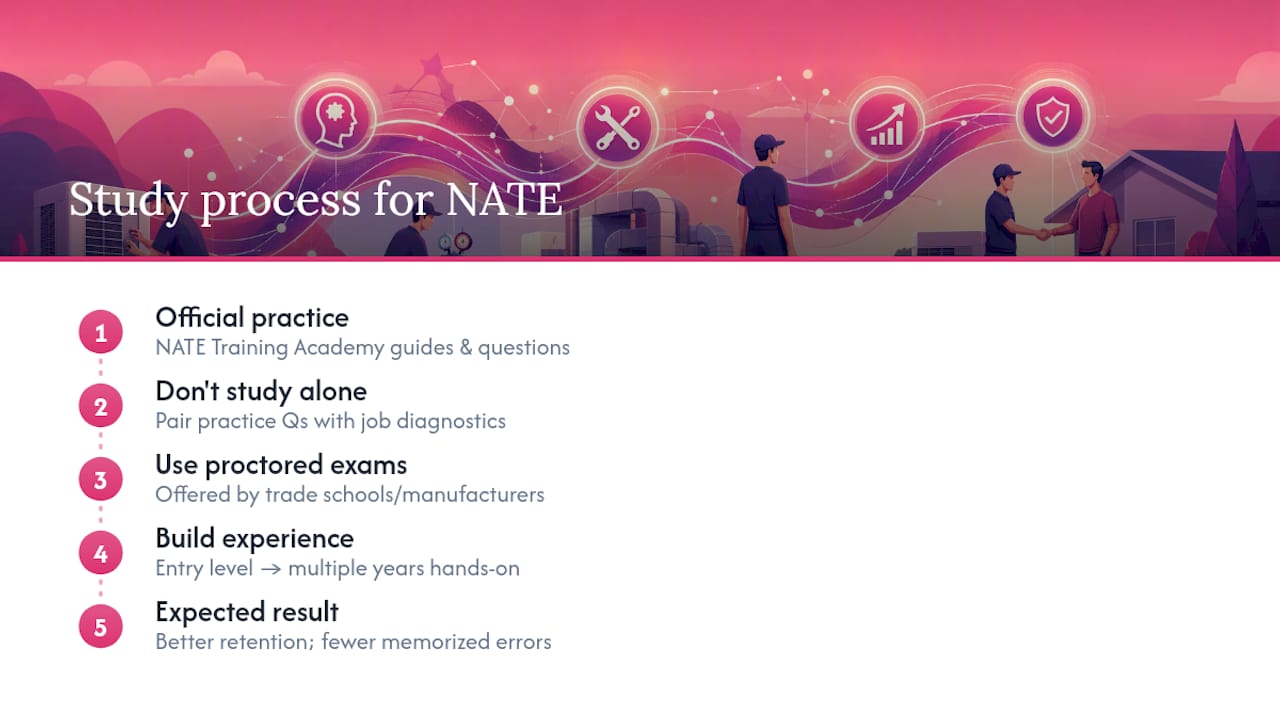
Recommended experience varies by certificate level, typically ranging from entry level up to multiple years of hands-on experience depending on the certification.
Trade schools, manufacturers, and employers often supply proctored practice exams as part of onboarding, so ask before paying out of pocket for extra materials.
Keeping Your Certification Active
NATE certification isn’t permanent. Technicians have two options to stay current: retest every two years, or complete NATE-recognized continuing education, commonly totaling 16 hours.
- Continuing education can come from manufacturer training, employer-run courses, or approved trade seminars, as long as they carry NATE recognition.
- Retesting works better for technicians who want to add or upgrade a specialty anyway.
- On certification, technicians receive a digital badge, a wallet card, and a patch, and employers can verify status through a technician’s NATE ID.
Retesting tends to cost more in time and fees than the CE route, which is why many active technicians lean toward continuing education unless they’re chasing a new specialty.
How Certified Technicians Change What Homeowners Experience
Trucomfortaz built its technician roster around NATE certification for a practical reason: certified technicians make fewer diagnostic mistakes, and mistakes are what turn a $200 repair into a $2,000 one.
- The technician roster is built around NATE certification for a practical reason: certified technicians make fewer diagnostic mistakes.
- Technicians work on a non-commissioned basis, which removes the incentive to recommend unnecessary repairs or replacements.
- Maintenance plans and emergency service availability offer homeowners ongoing access to certified diagnostics rather than a one-time fix.
The productivity data cited earlier isn’t abstract for a homeowner. Fewer callbacks mean a furnace or AC unit gets fixed correctly the first visit, not the third. For a deeper look at how this plays out on real installations, see why NATE certified experts matter for HVAC installation in Anthem and New River.
NATE Certification: What HVAC Technicians Need to Know
Most explainers on this topic treat NATE certification like a resume line item, something to check off and forget. That framing undersells it. The real value shows up in how a technician diagnoses a problem under pressure, on a 115 degree afternoon, with a homeowner standing over their shoulder asking why the air isn’t cold yet. That’s the scenario the exam is actually built around, not a quiet classroom.
The conventional advice, “get certified because employers want it,” is true but incomplete. Employers want it because certification correlates with measurable output, and contractors who track callback rates already know the difference between a certified crew and an uncertified one. For a homeowner, the credential isn’t a formality. It’s the fastest way to gauge whether the person in your attic knows what they’re doing before they touch your ductwork.
If you’re a technician deciding where to spend limited study hours, prioritize the specialty you actually work in daily over chasing every available credential. Depth in one area beats a shallow spread across five.
Contractors who want that same reliability in their own home should look for certified installation and maintenance experience rather than the lowest quoted price. For readers weighing a bigger project, like central air installation with existing ductwork, the technician’s credentials matter as much as the equipment brand.
Sources
- NATE (North American Technician Excellence)
- Certs for success: accreditation that can help you stand out — Contracting Business
- Department of Energy — North American Technician Excellence
Recommended
- Why NATE Certified Experts In HVAC Installation Are Important in Anthem and New River, AZ
- Why Summers Are A Great Time For Furnace Maintenance In Phoenix, New River and Anthem
- How Often Should Home AC Systems Be Maintained In New River and Anthem, AZ?
- Why Spring Is A Great TIme To Schedule Furnace Maintenance Service In New River and Anthem, AZ