Homeowners’ Furnace Maintenance Checklist: 4 Monthly Checks in 5–10 Min
Change the filter, test your carbon monoxide and smoke alarms, and run a short test cycle before the weather turns. Beyond that, book a licensed technician for an annual tune-up in early fall, before heating season backlogs fill their calendar. If you smell gas, see a yellow flame, hear loud banging, or your CO alarm sounds, shut the system off and call for help immediately.
TL;DR:
- Homeowners should replace their air filters, test alarms, and run a full heating cycle before the season begins to catch potential issues early.
- Professional maintenance includes inspecting the heat exchanger, cleaning burners, and testing safety controls, which are not safe for DIY.
- A typical annual tune-up costs between $80 and $200 and covers multiple checks like combustion analysis, flame inspection, and safety switch tests.
- Signs such as a yellow flame, gas odor, or loud banging require shutting off the system and calling for emergency help immediately.
- Scheduling a fall maintenance appointment or a recurring service plan ensures safety, efficiency, and warranty compliance, especially for older systems.
Table of Contents
- The Complete Furnace Maintenance Checklist by Cadence
- What Can Homeowners Do Themselves vs What Needs a Pro?
- What Does a Professional Furnace Tune-Up Actually Include?
- When Should You Schedule Furnace Maintenance Each Year?
- How Much Does a Furnace Tune-Up Cost, and Is It Worth It?
- What Warning Signs Mean You Should Stop and Call for Help?
- What Tools and Filters Do You Actually Need?
- How Do You Check Vents, Registers, and Outdoor Intakes?
- Should You Check and Calibrate Your Thermostat?
- Why Do Moving Parts Need Lubrication?
- How Do You Check the Blower Motor and Belts?
- How Do You Inspect the Flue Pipe for Damage?
- How Do You Check the Pilot Light or Ignition System?
- How Are Safety Controls and Limit Switches Tested?
- Why Tru Comfort Built This Checklist the Way We Did
- Skip the Annual Scramble With a Maintenance Plan
- Sources
The Complete Furnace Maintenance Checklist by Cadence
A working furnace maintenance checklist isn’t one long list. It breaks down into three rhythms: things you check monthly, things you do right before the season starts, and things only a technician should touch once a year. Treating all three as separate categories is what keeps a home heating system running safely without turning you into an amateur HVAC tech.
Monthly checks (DIY, 5 to 10 minutes):
- Inspect the air filter and replace it if it looks gray or clogged.
- Walk the house and confirm supply vents and return registers are open and unblocked by furniture or rugs.
- Test carbon monoxide and smoke alarms using the built-in test button.
- Glance at the flame through the furnace’s viewing window. It should burn blue with maybe a small yellow tip, not solid yellow or orange.
A quick monthly visual check like this takes under five minutes but catches a surprising number of developing problems before they turn into a no-heat call on the coldest night of the year.
Pre-season tasks (DIY, September or October):
- Clear boxes, paint cans, and clutter from around the furnace cabinet to maintain proper airflow and safety.
- Vacuum dust from the immediate area and check that nothing blocks the return air path.
- Test your thermostat by bumping the setpoint up 5 degrees and confirming the furnace kicks on within a few minutes.
- Run a full heating cycle for 15 to 20 minutes before the season starts, listening for grinding, squealing, or banging.
Annual professional tasks (licensed technician, 1 to 2 hours):
- Heat exchanger inspection using a borescope camera
- Combustion analysis and carbon monoxide testing at the flue
- Burner and igniter cleaning
- Tightening of electrical connections and testing of safety switches
For more homeowner-level detail on the DIY side, our guide to furnace maintenance ideas walks through each task step by step.
What Can Homeowners Do Themselves vs What Needs a Pro?
The line between safe DIY and “call a technician” isn’t about difficulty. It’s about tools, certification, and what happens if something goes wrong. ENERGY STAR guidance draws a fairly clean boundary: anything that requires opening the cabinet, handling gas connections, or measuring combustion gases belongs to a licensed technician.
Safe for homeowners:
- Replacing or cleaning the air filter
- Vacuuming dust around the unit and clearing vents
- Testing the thermostat and replacing its batteries
- Checking that outdoor intakes and exhaust vents aren’t blocked by debris or snow
Needs a professional:
- Heat exchanger inspection with a borescope
- Combustion analysis and CO testing
- Cleaning burners and adjusting gas pressure
- Inspecting and lubricating the blower motor
- Testing limit switches and safety controls
- Any work involving the gas valve or electrical panel
Pro Tip: Keep a folder (paper or digital) of every professional service receipt. Many manufacturer warranties require proof of annual maintenance, and skipping it can void coverage if a major component fails.
What Does a Professional Furnace Tune-Up Actually Include?
A real tune-up is not a five-minute filter swap with a invoice attached. A proper visit typically covers around 15 distinct inspection and service points, which is worth knowing before you compare quotes from different companies.
- Heat exchanger inspection (borescope camera, checking for cracks or corrosion)
- Combustion analysis and carbon monoxide testing at the flue
- Burner cleaning and flame sensor inspection
- Igniter or pilot assembly testing
- Inducer motor and draft check
- Blower motor inspection, lubrication, and belt check
- Electrical connection tightening throughout the unit
- Thermostat calibration check
- Limit switch and safety control testing
Because a cracked heat exchanger can leak carbon monoxide into the air your family breathes without any visible sign from outside the cabinet, this single inspection point is arguably the most important item on the entire list. Most full tune-ups run 60 to 90 minutes, and a reputable technician should leave you with a written report documenting what was checked. That paperwork matters later. If you ever file a warranty claim, documented inspection records are often the difference between a covered repair and an out-of-pocket bill. For a breakdown of what a visit like this should cost in your area, see our page on HVAC tune-up pricing.
When Should You Schedule Furnace Maintenance Each Year?
Timing isn’t arbitrary. Scheduling in September or October gets you ahead of the rush and gives a technician time to order parts if something needs replacing before the first cold snap. ENERGY STAR recommends this pre-season window specifically because it catches combustion and safety issues before the system runs continuously for months.
- Standard filters (1 inch): replace every 30 to 60 days during heating season.
- Pleated or high-capacity filters: every 90 days, unless you have pets or allergy sufferers in the house.
- Homes with pets, wood stoves, or heavy dust: check monthly regardless of filter type.
- Systems older than 12 to 15 years: consider a mid-season check in January in addition to the fall tune-up, since aging components fail faster once stressed by daily cycling.
How Much Does a Furnace Tune-Up Cost, and Is It Worth It?
Furnace tune-ups typically fall in the $80 to $200 range nationally, with the final number depending on your fuel type, region, and how much cleaning the burner assembly needs. Older units with heavier soot buildup or corrosion take longer to service and cost more.
| Factor | Effect on Price |
|---|---|
| Gas vs. oil furnace | Oil systems often cost more due to extra burner cleaning |
| System age (10+ years) | Higher, due to added inspection and cleaning time |
| Regional labor rates | Varies by market |
| Add-on services (duct check, humidifier tune) | Adds to base price |
A clean furnace typically runs closer to its rated efficiency, while a neglected one loses output to dirty burners and restricted airflow. The bigger financial risk isn’t the tune-up fee. It’s the mid-winter breakdown that costs far more in emergency service fees and, in the worst cases, a full furnace repair instead of a routine adjustment. Local pricing can vary from national averages, so check our furnace tune-up cost guide for a more specific figure.
What Warning Signs Mean You Should Stop and Call for Help?
Some signs are inconveniences. Others are emergencies. Knowing the difference matters more than any other item on this list.
- CO alarm sounding: evacuate immediately, call 911 or your gas utility’s emergency line, then call an HVAC technician once it’s safe.
- Yellow or flickering flame instead of steady blue: shut off the furnace and call a professional. This often signals incomplete combustion and possible CO production.
- Strong gas odor: leave the house, don’t flip any switches, and call your gas company from outside.
- Loud banging, screeching, or grinding: turn off the unit and schedule service before running it again.
- Short-cycling (turning on and off rapidly): this can point to a failing limit switch or airflow restriction and shouldn’t be ignored.
A cracked heat exchanger is invisible from outside the cabinet, which is exactly why borescope and combustion analyzer inspections exist. No amount of homeowner vigilance replaces that specific test.
What Tools and Filters Do You Actually Need?
You don’t need a toolbox full of specialty gear for the homeowner side of this checklist. A flashlight, a vacuum with a hose attachment, and a screwdriver cover most tasks. The one non-negotiable purchase is a plug-in carbon monoxide detector with digital readout, placed near sleeping areas, separate from your smoke alarms.
- Standard fiberglass filters (MERV 1 to 4) offer minimal filtration but barely restrict airflow.
- Mid-range pleated filters (MERV 8 to 11) balance filtration and airflow for most homes.
- High-MERV filters (13+) trap finer particles but can restrict airflow in furnaces not designed for them, forcing the blower to work harder and sometimes triggering short-cycling.
If you’re unsure which MERV rating your system tolerates, check the manufacturer’s manual before upgrading, or ask your technician at the next tune-up. Keep one spare filter on hand so a dirty one never gets ignored because a replacement isn’t in the house. Our furnace cleaning guide covers more on filter selection and safe cleaning practices around the unit.
How Do You Check Vents, Registers, and Outdoor Intakes?
Airflow problems rarely announce themselves. They just make your furnace work harder, run longer, and wear out faster. Checking vents and intakes takes a few minutes and belongs on the monthly list, not just the annual one.
Walk through every room and confirm supply vents are open at least partially, even in rooms you rarely use. Closing vents to “save energy” is a common mistake that actually raises pressure inside the ductwork and can stress the blower motor. Check return air grilles too. These are often larger and easier to accidentally block with furniture, rugs, or curtains.
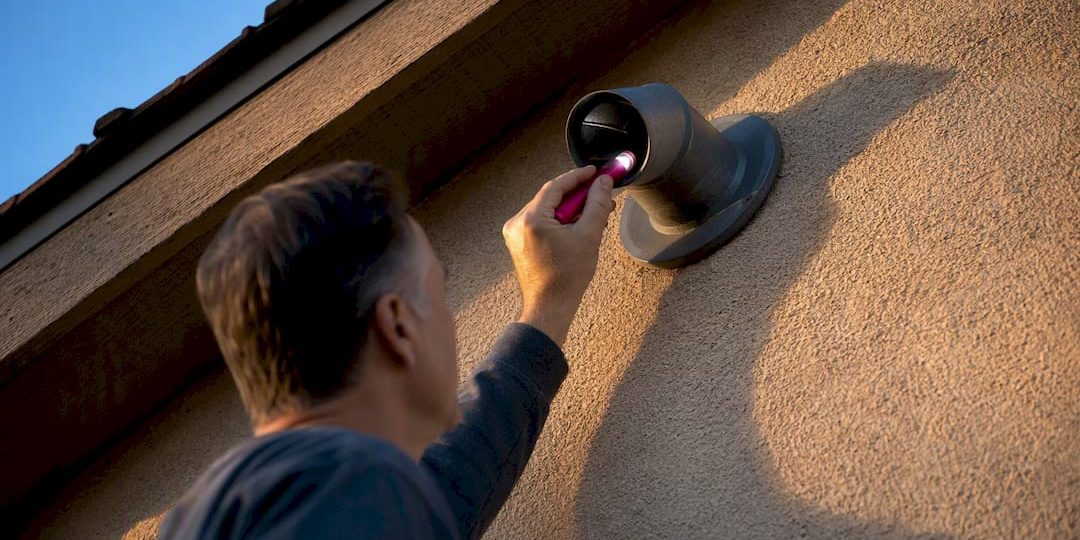
Outdoor intakes matter just as much, especially for high-efficiency furnaces with direct-vent or PVC intake pipes running to an exterior wall. After storms, check that leaves, spider webs, snow, or nesting insects haven’t blocked the intake or exhaust termination points outside your home. A blocked exhaust vent can force combustion gases back into the furnace room instead of venting outside, which ties directly into the carbon monoxide risks covered elsewhere in this checklist.
If your home has a crawlspace or basement furnace, also check that nothing has fallen against floor registers or been stacked in front of a return grille during a move or renovation. It sounds obvious until you realize how often a couch ends up shoved against a vent for six months straight.
Should You Check and Calibrate Your Thermostat?
Yes, and it’s one of the easiest things on this entire furnace maintenance checklist to skip because the thermostat feels unrelated to the furnace itself. It isn’t. A miscalibrated thermostat can make a perfectly healthy furnace seem broken, or mask a real problem by cycling the system in a way that hides symptoms.
Start with a basic accuracy test. Place a separate thermometer near the thermostat, wait 15 minutes, and compare readings. A gap of more than 2 degrees usually means recalibration or replacement is worth considering. Older mechanical thermostats drift out of calibration over years; smart thermostats rarely do, but their sensors can be thrown off by nearby heat sources like a lamp or direct sunlight.
Next, run a response test. Bump the setpoint up 5 degrees and time how long it takes the furnace to kick on. Anything beyond a couple of minutes on a system in good working order suggests either a thermostat wiring issue or a furnace ignition delay worth mentioning to your technician.
If you have a programmable or smart thermostat, check the battery status and confirm the schedule still matches your actual routine. A stale schedule set two winters ago for a work pattern you no longer follow wastes energy every single day it runs unnoticed.
Why Do Moving Parts Need Lubrication?
Furnaces have fewer moving parts than most home appliances, but the ones they do have take a beating over a heating season. The blower motor bearings and, on older units, the blower belt and pulley system all rely on lubrication to run quietly and last.
Modern blower motors are frequently sealed and permanently lubricated, meaning there’s nothing for a homeowner to add. Older motors, though, often have small oil ports designed for exactly this purpose. If your furnace is more than 15 years old, a technician should check during the annual tune-up whether the motor has accessible lubrication points and service them with the correct lightweight oil, not household oil, which can gum up over time.
Bearings that run dry don’t fail quietly. They start with a faint squeal, progress to a grinding noise, and eventually seize, taking the blower motor with them. Catching that squeal during your monthly listening check, or having a technician spot early wear during the fall visit, is far cheaper than replacing a motor mid-winter.
This is squarely a “needs a pro” task on the DIY versus professional divide. Opening the blower compartment, identifying oil ports correctly, and using the right lubricant in the right amount is easy to get wrong, and over-lubrication causes its own problems by attracting dust into the motor housing.
How Do You Check the Blower Motor and Belts?
The blower motor is what actually pushes warm air through your ducts, and it’s one of the hardest-working components in the entire system. A failing blower doesn’t always cut off heat entirely. More often, it just makes the system less effective, running longer to reach the same temperature while your energy bill quietly climbs.
During the fall test cycle, listen closely to the blower’s sound. A healthy motor hums evenly. A worn one whines, clicks, or vibrates enough that you can feel it through the cabinet. On furnaces old enough to use a belt-driven blower rather than a direct-drive motor, visually inspect the belt for cracking, glazing, or fraying, and check that it’s properly tensioned. A loose belt slips and squeals; an over-tightened one wears out bearings faster.
Technicians go further during the annual visit, checking amperage draw against the motor’s rated specifications to catch a motor that’s struggling before it fails outright. They’ll also inspect the blower wheel itself for dust buildup, which is more common than people expect and can throw the wheel out of balance, causing vibration that eventually damages the motor.
Replacing a blower motor is not a homeowner project, given the electrical disconnection and precise reassembly involved. But you can absolutely extend its life by keeping filters clean, since a clogged filter forces the blower to work harder against restricted airflow every single cycle it runs.
How Do You Inspect the Flue Pipe for Damage?
The flue pipe carries combustion byproducts, including carbon monoxide, safely outside your home. When it’s compromised, the consequences skip straight past “inconvenient” to “dangerous.”
From the outside, check where the flue exits your roof or exterior wall for visible rust, corrosion, or gaps in the pipe joints. Metal flue pipes on older furnaces are especially prone to rusting through over time, particularly in humid climates or homes where the pipe runs through an unconditioned attic. PVC intake and exhaust pipes on high-efficiency furnaces hold up better against corrosion but can crack from age or physical impact.
Inside, if you can safely view the connection at the furnace itself, look for soot staining around joints, which often signals a leak in the flue connection rather than a clean exhaust path. Any staining, no matter how faint, is worth a professional look before the next heating cycle.
This is one area where DIY inspection has real limits. A visual check from the ground catches obvious problems, but full flue inspection, especially checking for internal blockage from nesting animals or assessing pipe integrity inside walls, requires a technician with the right tools and access. Combined with the combustion analysis mentioned earlier, a flue inspection during your annual tune-up closes the loop on making sure exhaust gases go where they’re supposed to, not back into your living space.
How Do You Check the Pilot Light or Ignition System?
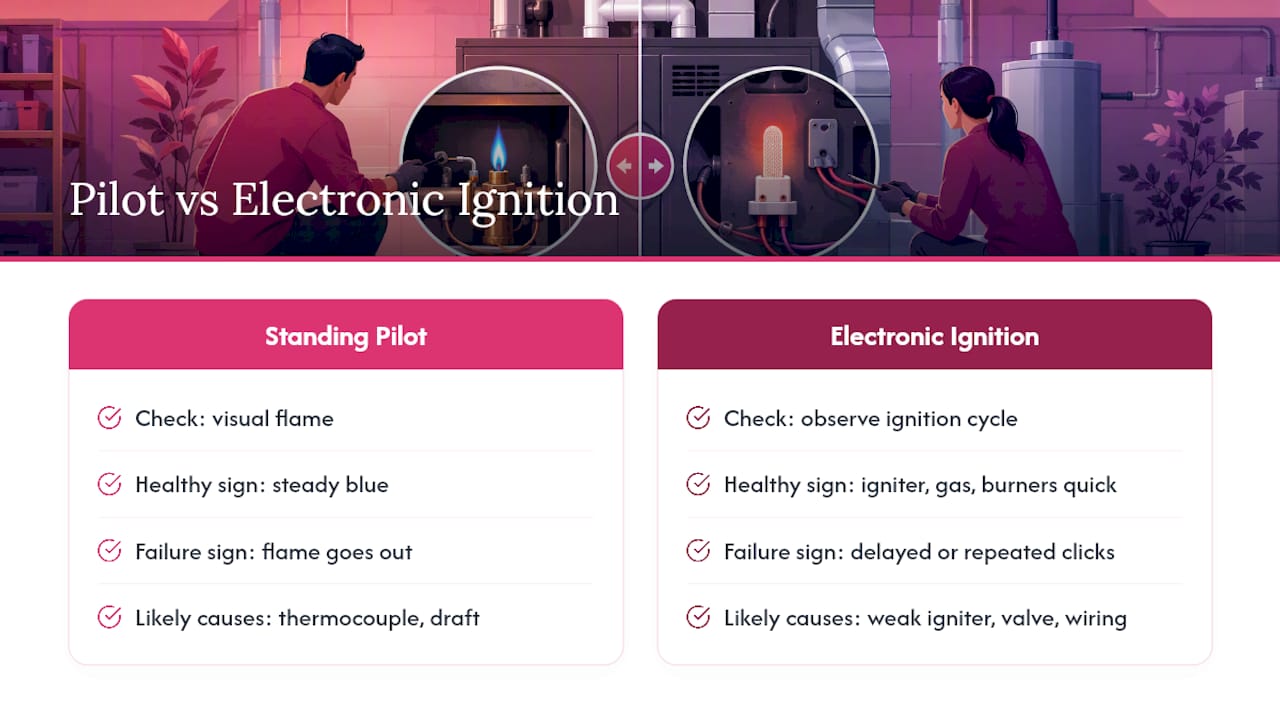
Most furnaces built in the last two decades have moved away from standing pilot lights toward electronic ignition, either hot surface igniters or intermittent pilot systems that spark only when heat is called for. Either way, this system is what actually starts combustion, and it’s worth understanding which type you have.
If your furnace still uses a standing pilot light, check that the flame burns steady and blue, wrapping around the thermocouple evenly. A pilot that keeps going out usually points to a failing thermocouple or a draft issue, both fixable but both requiring a technician to diagnose correctly.
For electronic ignition systems, the check is less visual and more behavioral. Watch a full ignition cycle during your fall test run. The igniter should glow, the gas valve should open, and the burners should light within a few seconds, without repeated clicking or delayed ignition. A hot surface igniter that’s cracking or weakening often causes a delayed or failed light on the first attempt, followed by a successful second try. That pattern is an early warning sign, not something to shrug off as normal.
Technicians test ignition system voltage and response time with meters during the annual visit, catching a weakening igniter before it fails completely on a cold morning. This is another area that sits firmly on the professional side of the checklist. Diagnosing ignition problems involves the gas valve and electrical components, exactly the combination ENERGY STAR flags as outside safe DIY territory.
How Are Safety Controls and Limit Switches Tested?
Every furnace has a set of safety switches working quietly in the background, and most homeowners never think about them until something goes wrong. The high-limit switch shuts the furnace down if internal temperatures climb too high, usually from restricted airflow, preventing overheating that could otherwise start a fire or crack the heat exchanger from thermal stress.
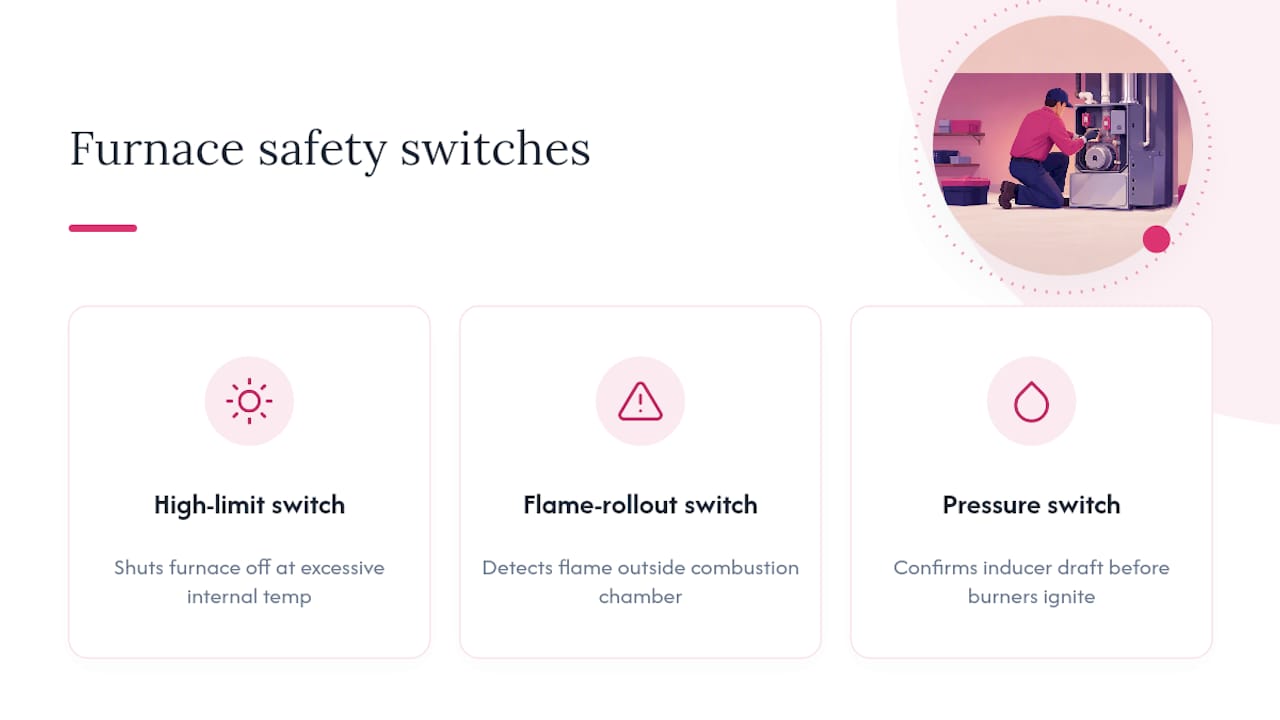
There’s also a flame rollout switch, which detects flame escaping outside its intended combustion chamber, a serious fault condition, and a pressure switch that confirms the inducer motor is creating proper draft before allowing gas flow to the burners. These switches exist specifically to shut the system down safely rather than let a fault condition continue.
During a professional tune-up, technicians test each switch’s response using specialized testing procedures, not just a visual check. They confirm the high-limit switch trips at the correct temperature, the pressure switch responds accurately to draft changes, and the flame rollout switch hasn’t been tripped or damaged by a past combustion issue.
This is exclusively professional territory. Testing these switches correctly requires understanding your specific furnace’s control board logic and the tools to measure switch response without creating a new hazard in the process. A homeowner’s role here is simpler: if your furnace shuts off unexpectedly and won’t restart, don’t keep resetting it repeatedly. That’s often a safety switch doing its job, and repeated overrides can mask a real problem until it becomes a dangerous one.
Why Tru Comfort Built This Checklist the Way We Did
We put this list together because too many service calls we take in New River start with something a homeowner could have caught a month earlier, or a DIY attempt that went past what’s actually safe without training. Our NATE-certified technicians handle the heat exchanger inspections, combustion testing, and switch diagnostics that this checklist flags as pro-only work, every day, on real furnaces in real Arizona homes. If you want that level of eyes on your system before winter, scheduling a tune-up is the next step.
Skip the Annual Scramble With a Maintenance Plan
Booking a technician every fall works fine until the year you forget, and that’s usually the year something fails. Maintenance plans handle the scheduling problem entirely: customers get priority booking ahead of the seasonal rush, a documented inspection report after every visit for warranty records, and member pricing on any repairs that come up along the way.

Compare that to calling around for quotes every October, hoping someone has an opening before the first cold week hits. A plan takes that gamble off the table and keeps your furnace, and your carbon monoxide risk, in check year over year. If your system is getting up in years, it’s also worth reading about when replacement makes more sense than another repair. While you’re prepping the house for cooler nights, sealing up drafts around exterior doors, as covered in this guide on winterizing your doors, pairs well with a furnace that’s already running efficiently. Ready to get on the schedule? Check out the Tru Comfort Advantage page and book your fall tune-up before the season fills up.