
Is an HVAC Maintenance Plan Worth It? An Honest Look for Arizona Homeowners
A maintenance plan is worth it when it gets a qualified technician to your system on a set schedule, before the season starts, for less than the cost of one avoidable breakdown. It is not worth it when it is a coupon book, a vague “inspection” or a way to book upsells. In the Arizona desert, where air conditioners run for most of the year, the math usually leans toward yes, with conditions. Below is how to check that for your own home.
- A plan pays off through three things: fewer surprise failures, priority scheduling when the heat hits, and small problems caught while they are still cheap.
- Tune-up savings on the energy bill are modest on their own. The Department of Energy points to about 5% from tuning up existing systems, so do not buy a plan expecting your bill to drop in half.
- A tune-up is one visit. A plan is a tune-up (or two) plus the terms around it: scheduling, repair pricing, and what happens in an emergency. Read those terms before the price.
- Skip a plan if your system is past its replacement age or its ducts and sizing are the real problem. Spend on fixing that first.
- Ask whether the technician is certified and paid on commission. Honest recommendations are the real product.
Table of Contents
- What you are actually buying
- Is the maintenance itself worth doing?
- Where a plan earns its money
- What it costs, and how to judge the price
- When a plan is probably not worth it
- Tune-up or plan: which fits you
- How to choose a plan
- Our perspective
- Our maintenance plans
- Getting the most from any plan
- FAQ
- Sources
What you are actually buying
People use “tune-up” and “maintenance plan” as if they were the same thing. They are not.
A tune-up is a single service visit. A technician checks, cleans and measures, hands you a report, and leaves. You pay for that visit at that moment.
A maintenance plan, sometimes called a service agreement or membership, is a recurring arrangement. It normally bundles one or two scheduled visits a year with terms that apply the rest of the time: how soon you get scheduled, whether there is a discount on repairs, and whether after-hours calls cost extra. The visit itself is the same kind of work as a tune-up. The difference is the commitment and the terms that come with it.
That is why the “worth it” question has two parts. First, is the maintenance work itself worth doing? Second, is the plan wrapper better than paying for visits one at a time? We take them in that order.
If you want to see what a single visit costs and what it should include, our guide to what an HVAC tune-up really costs covers it.
Is the maintenance itself worth doing?
Yes, and the evidence is fairly consistent.
ENERGY STAR says dirt and neglect are the top causes of heating and cooling system failure and inefficiency. It also notes that poor airflow and dirty filters can cut efficiency by up to 15%, and that improper installation can cost up to 30%. Those are large numbers for something a visit can often catch.
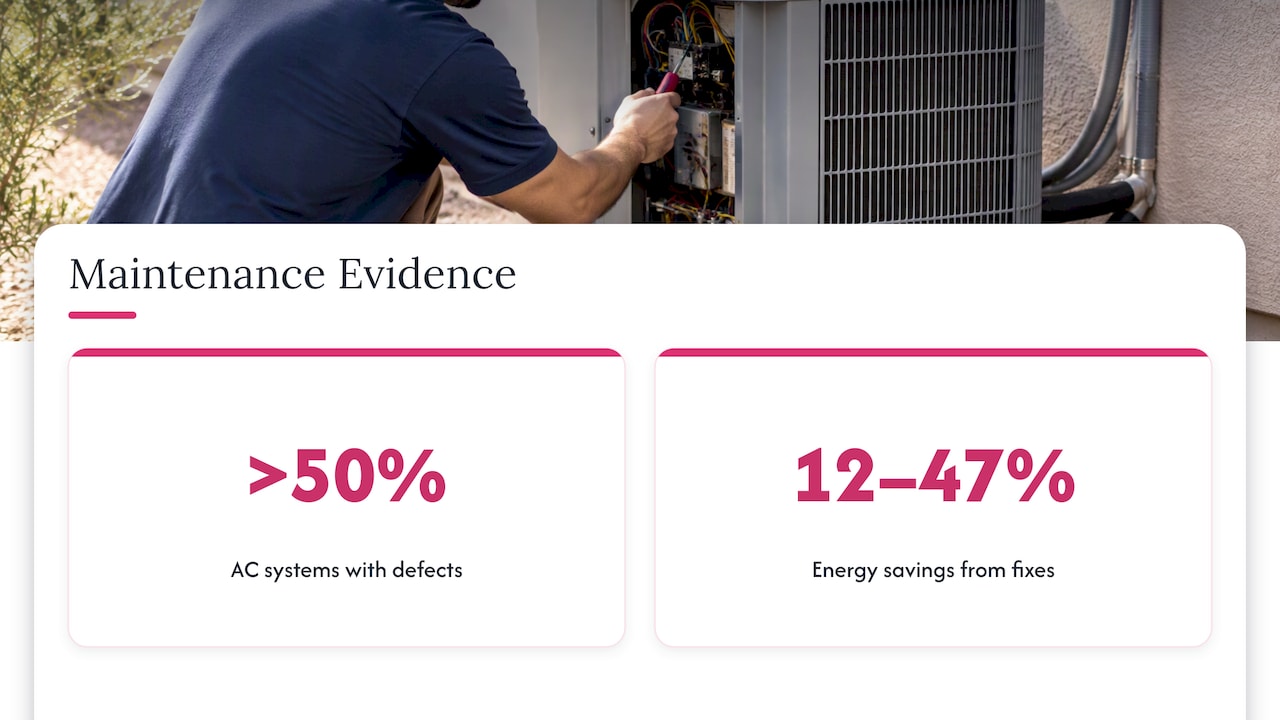
The Department of Energy’s air conditioner diagnostics guideline adds that field studies have found more than half of installed AC systems have significant defects. The same document reports that fixing airflow and refrigerant charge problems together has shown energy savings of 12% to 47%. That range is wide on purpose: results depend on what is wrong with the system to begin with.
What a homeowner can and cannot do
You can handle filters. ENERGY STAR recommends checking them at least every three months, and monthly in heavy-use seasons. Our HVAC maintenance schedule and AC maintenance checklist spell out what to do between visits.
You should not handle the rest. ENERGY STAR’s guidance is that refrigerant charging and coil cleaning call for a professional contractor, along with checks for safety issues such as a cracked heat exchanger or a bad gas connection. Coil cleaning in particular is delicate work: bent fins or exposed electrical parts turn a cheap job into an expensive one.
So the maintenance is worth it. The next question is whether you need a plan to get it.
Where a plan earns its money
Priority when everyone is calling
Contractors get busy once summer and winter arrive, which is why ENERGY STAR suggests scheduling pre-season check-ups. In Arizona the busy season is long and the stakes are real. A system that fails in July is not an inconvenience; it is a health concern for children, older adults and pets. If a plan moves you to the front of the line, that has value you cannot get by phoning on the worst day of the year.
Fewer emergency bills
An emergency call usually costs more than a planned visit, and you have no room to compare options when the house is 90 degrees inside. A plan does not make failures impossible. It lowers the odds that a worn capacitor, a dirty coil or a low refrigerant charge is the thing that quits during a heat wave.
Small problems found early
The best case for a plan is a technician who sees the same system every year. They notice that a contactor is pitting, that a blower motor is drawing more current than last spring, or that a drain line is starting to clog. A one-off tune-up from a different company each year does not build that history.
Paperwork and reminders
This sounds minor. It is not. Most missed maintenance is forgotten maintenance. A plan that schedules itself and sends a reminder means the visit actually happens. If you are a landlord or property manager with several units, that regularity matters even more.
What it costs, and how to judge the price
We do not publish a flat plan price, because it depends on how many systems you have, their type and age, and whether the property is residential or commercial. We will quote you for your actual property.
For a rough outside reference, one cost-comparison site estimates typical HVAC maintenance in Phoenix at $270 to $430 per year, with a typical figure around $340, assuming a visit before each season. Treat that as a ballpark from a third-party model, not a quote. Prices vary by contractor, equipment and what the agreement includes.
Here is a simple way to test a price:
- Count the visits. In a climate with both heavy cooling and real winter nights, two visits a year (AC in spring, furnace in fall) is the sensible pattern.
- Price the same visits individually. Ask a contractor what a standalone AC tune-up and a standalone furnace check cost. If the plan is not cheaper or close, the extras must be worth it.
- Value the terms. Is there priority scheduling? A repair discount? No extra charge for after-hours calls? Put a realistic dollar figure on each.
- Compare with your repair history. If you have had two or three repair calls in the last few years, a plan that heads off even one is likely to pay.
A plan whose only benefit is “we will show up once a year” is only worth it if it is cheaper than a single visit would be, and it rarely is.
When a plan is probably not worth it
Honesty matters here, because an article that says “always buy one” is a sales pitch.
Your system is at the end of its life. ENERGY STAR says to consider replacing central air conditioning that is more than 10 years old, and furnaces or boilers more than 15 years old. In Arizona, long cooling seasons put heavy hours on equipment, so do not assume yours will last as long as the national figures. If you are at or past that point, a tune-up cannot make a worn-out compressor efficient. Our guide on when to replace heating and air conditioning shows how to decide, and ENERGY STAR notes that a certified replacement can cut annual energy bills by nearly $140, depending on location.
The real problem is the installation or the ducts. The Department of Energy’s guidance says quality installation matters as much as maintenance: many systems run poorly because they were oversized or never properly commissioned. The DOE diagnostics guideline is blunt that a badly oversized system or poorly designed ductwork will not reach peak efficiency however well it is maintained. A good plan visit should at least flag this. If it does, deal with the cause. Our page on what to demand before approving AC work explains what proper sizing and testing look like, and our duct installation service addresses the duct side.
You will not use the visits. If you are the kind of owner who will cancel or ignore the appointments, paying up front is a waste. Pay per visit instead.
The plan is built on upsells. If the technician is paid a commission on what they find, every inspection becomes a sales call. That is the plan to avoid, and no discount makes up for it.
Tune-up or plan: which fits you
| Situation | Better fit |
|---|---|
| Newer system, no history of problems, you are organized | Single tune-ups each spring and fall |
| System 7 to 10 years old, running hard most of the year | Maintenance plan |
| Rental or multi-unit property | Maintenance plan, for consistency and priority |
| Older system near replacement age | Inspection and a replacement estimate, not a long plan |
| Problems traced to ducts or sizing | Fix the cause first, then maintain |
| Elderly or medically vulnerable household members | Maintenance plan, for priority response |
How to choose a plan
Compare plans on what is in writing, not what is in the brochure.
- What the visit covers. Look for refrigerant charge and airflow measurements, coil and blower inspection, electrical checks, drain line, and for furnaces a safety check of the heat exchanger and gas connections. A “10-point look-over” without measurements is a weak visit.
- Who does the work. The Bureau of Labor Statistics notes that technicians need mechanical aptitude, problem-solving and communication skills. Ask whether technicians are NATE-certified and how they are paid.
- Response terms. Priority scheduling, after-hours charges and a written response window.
- Repair pricing. Is there a discount on parts and labor, and is it stated as a number?
- Cancellation terms. You should be able to leave without a penalty if service falls short.
- A written report. After each visit you should get readings, findings and photos where relevant, not just an invoice.
Our perspective
We are a family-owned company in New River, and we want to be plain about how we think about this.
Maintenance is worth it. A plan is worth it when it is honest. Our technicians are NATE-certified and non-commissioned, so nobody gains from telling you something needs replacing when it does not. That changes what a visit looks like: we tell you what is working, what is wearing, and what can wait. Sometimes the answer is “your system is fine, see you in the fall.”
We also think too many plans are sold as a cure-all. A tune-up will not fix a system that was sized wrong or ducts that leak. If that is what we find, we say so, even when it means recommending work that has nothing to do with the plan.
And we think timing matters more than people expect. Booking in spring and fall, before the rush, costs less stress and often less money than waiting for the first 110-degree week. That is where a plan helps most: you are not in the queue, you are already on the schedule.
Our maintenance plans
The Tru Comfort Advantage HVAC maintenance plans are built for homeowners, business owners and property managers in New River and the surrounding area. They are designed to give you cost savings and peace of mind, with emergency service available if something goes wrong. We quote based on your equipment, so get in touch and we will tell you what makes sense for your property, including whether a plan is the right move at all.
Looking for a specific service? See our air conditioner maintenance, repair and installation page or our furnace services.
Getting the most from any plan
Whichever provider you pick, a few habits make the plan pay for itself.
- Book before the season. Spring for cooling, fall for heating. Our fall HVAC maintenance checklist covers what to prepare, including carbon monoxide safety.
- Do your part. Change filters on schedule and keep the outdoor unit clear. See our guidance on condenser clearance.
- Keep the reports. They show how readings change from year to year, and they help if you sell the house.
- Act on the findings. A report that flags a failing part is only useful if you deal with it. Ask which items are urgent and which can wait.
- Learn the warning signs. Weak airflow, odd noises, short cycling and rising bills all mean you should call sooner. Our list of ten signs your AC may need maintenance is a good start.
FAQ
Are HVAC maintenance plans worth it?
For most Arizona homes with a system under about 10 years old, yes, mainly for the priority scheduling and the early detection of small faults. They are less compelling for very old equipment or for homes with sizing and duct problems. Compare the plan price to what the same visits would cost one at a time.
What is the difference between a tune-up and a maintenance plan?
A tune-up is a single visit. A plan covers recurring visits plus terms such as priority scheduling and repair pricing. The work on each visit is similar; the plan adds commitment and convenience.
How often should I have my system serviced?
Once before each heavy-use season is the standard approach: the AC in spring and the furnace in fall. ENERGY STAR recommends annual pre-season check-ups by a contractor. For how this plays out locally, see our guide on how often to service your AC.
Will a maintenance plan lower my energy bills?
A little, in many cases. The Department of Energy cites roughly 5% from tuning up existing systems, with larger savings only when bigger defects such as low refrigerant charge or poor airflow are found and fixed. The bigger payoff is usually avoiding a breakdown.
Can I just change my filters and skip professional service?
Filters matter, but they are not the whole job. Refrigerant charge, coil condition and electrical and gas safety checks need a trained technician and the right instruments.
Sources
- ENERGY STAR: How to Keep Your HVAC System Working Efficiently
- ENERGY STAR: Maintenance Checklist
- ENERGY STAR: When is it time to replace?
- DOE: Measure Guideline, Air Conditioner Diagnostics, Maintenance, and Replacement
- DOE: HVAC Quality Installation
- U.S. Bureau of Labor Statistics: HVAC Mechanics and Installers
- Ashota: HVAC Maintenance Cost in Phoenix, AZ