Variable Speed Blower Benefits: What You Actually Get
A variable speed blower gives you steadier room temperatures, better humidity control, quieter airflow and lower fan energy use than a standard single-speed blower. It does this by ramping its speed up and down gradually and holding airflow steady, instead of slamming on at full blast and shutting off. The benefits are real, but they depend on the equipment it is installed in, the condition of your ducts and how you run your fan. This guide covers each benefit, the numbers behind it, and the cases where the upgrade does not pay for itself.
TL;DR
- A variable speed blower modulates across a continuous range and holds airflow steady, so it runs longer at lower speeds, with fewer temperature swings and less noise.
- Federal research backs lower fan energy use, quieter ramping and better dehumidification, and a variable speed motor can use far less power than a single-stage motor when it runs continuously at low speed.
- Retrofitting a motor into an older furnace rarely pays back on energy savings alone. It makes the most sense when the furnace has 10 or more years of life left and the fan runs often.
- Ducts and equipment sizing decide how much of the benefit you actually feel.
Table of Contents
- What a variable speed blower is
- What controls the speed
- The benefits, one at a time
- Variable speed vs. single-speed vs. multi-speed
- What you need to get the full benefit
- Is a retrofit worth it?
- Running the fan: the thermostat setting
- How to tell whether the blower is working properly
- Our perspective
- Let us look at your system
- FAQ
- Sources
What a variable speed blower is
The blower is the fan inside your furnace or air handler that pushes air through the ducts. In a basic system it is a single-speed motor: on or off, one speed, whatever the ducts are doing. A variable speed blower motor is an ECM (electronically commutated motor) that modulates continuously across its range and holds airflow constant by adding power as system resistance rises. A dirty filter, a closed register or a restrictive duct run all add resistance. A single-speed motor simply moves less air when that happens. A variable speed motor compensates.
Two terms get mixed up constantly, so here is the distinction. “Variable speed” describes how the motor is controlled. “ECM” describes how it is built, with a brushless permanent magnet design. All variable speed motors are ECMs, but not all ECMs are variable speed. Some ECMs are constant-torque designs that use preset speed taps chosen at installation. They are more efficient than older motors, but they do not modulate across a continuous range. When a quote says “ECM,” ask which kind.
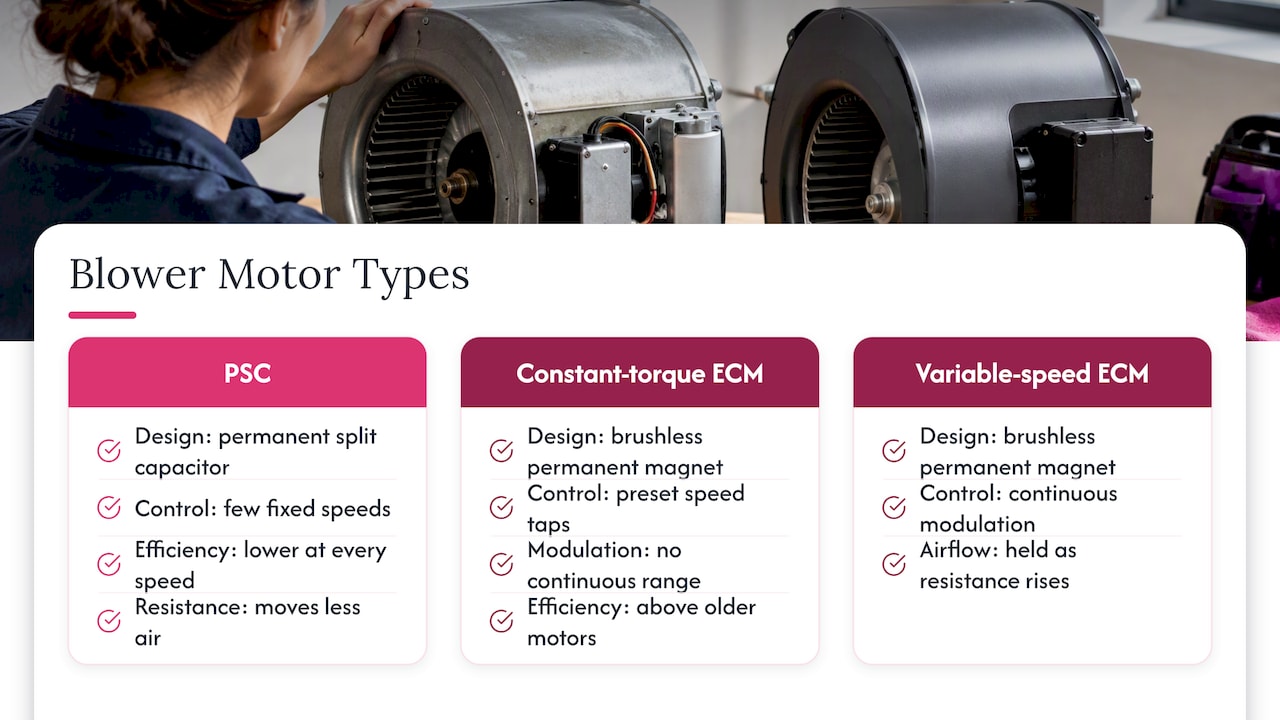
The older design you are probably comparing against is the PSC (permanent split capacitor) motor. It has a few fixed speeds, usually chosen once at installation, and it is less efficient at every one of them.
What controls the speed
You do not set a variable speed blower with a dial. The system control board decides. According to the ECM textbook, the speed comes from a combination of the manufacturer’s programming, the airflow and comfort settings an installer selects, and real-time data on what the system is doing: heating, cooling or fan only. The motor’s onboard electronics watch its RPM and adjust torque to deliver the airflow that was requested. The equipment manufacturer writes a program unique to each model and size, defining how much air each demand needs.
That last point matters for your contractor choice. The motor is only as good as the settings behind it. A variable speed blower set up with the wrong airflow targets will not deliver what the brochure promises. We come back to this under the setup section below.
The benefits, one at a time
More even temperatures
A single-speed system blasts air, satisfies the thermostat and stops. Rooms swing warm and cool between cycles. A variable speed blower runs at a lower speed for longer, so the air keeps moving and the house stays closer to the set point. The ECM textbook lists more precise airflow and outlet temperatures and fewer temperature swings among the benefits for variable speed furnace blowers.
Slow, steady airflow also reduces stratification. Mixing air from floor to ceiling makes the temperature more uniform, which helps in two-story homes where the upstairs always runs hot in summer and the downstairs always feels cold in winter. Carrier describes the same effect, saying variable speed air handlers make gradual airflow adjustments for more consistent temperatures.
Better humidity control
When a cooling system runs, moisture condenses on the evaporator coil and drains away. Air that moves slowly across a cold coil stays in contact with it longer, so more moisture comes out. That is why the Building America Solution Center, a U.S. Department of Energy program, notes that ECM fans can improve dehumidification. Variable speed blowers often start at a lower speed to help with this, then ramp up.
This matters most in humid climates. In a dry desert like ours, dehumidification is a smaller part of the picture, and the comfort gain comes mostly from steadier temperatures and quiet. Be skeptical of any pitch that treats humidity control as the main reason to upgrade in Arizona.
Quieter operation
Part of the noise from a forced-air system is the sudden start and the rush of air at full speed. ECM motors ramp up and down slowly, which removes the abrupt whoosh at the start of each cycle. Running at lower speed most of the time also keeps air noise at registers down. If you have a system you can hear from the bedroom, this is often the benefit people notice first.
Blower speed does not fix every noise. A squeal or grinding is a mechanical problem, not a speed problem. If that is what you hear, read our guide on blower motor squealing. Loud rattling from the burner side is a separate component, covered in our piece on inducer motor noise.
Lower electricity use
This is the benefit with the most numbers attached, and the one most often oversold. A few figures worth knowing:
- A variable speed motor running continuously at half speed may use up to 75% less power than a single-stage motor moving the same amount of air. That reflects how fan power drops sharply as speed drops.
- A 2016 trade article reported that high-efficiency ECM motors can save roughly 25% on annual operating costs compared with PSC motors.
- A 2014 field study of retrofit furnace fan motors in upstate New York found replacement motors used 38% less power on average. The same study found cooling season savings in a cold climate were on par with heating season savings, because the fan runs in both seasons.
The same trade article carries a warning that applies to every number above: savings charts often assume continuous operation, and your habits may not match that. A blower that runs only when the thermostat calls will save less than one that circulates air all day. The biggest savings come from the fan running a lot, at low speed.
Better filtration and circulation
Slower, longer cycles give the air more time to pass through your filter. The Building America Solution Center notes that ECM fans give circulating air more time to interact with filters. The effect only helps if the filter is clean and appropriate for your system, so pair the upgrade with a sensible filter routine. Our HVAC maintenance schedule lays out how often to change them.
Longer motor life
ECM motors have an expected lifespan of about 90,000 hours, roughly 10 years, compared with 40,000 to 50,000 hours, about 5 years, for PSC motors. Treat these as design expectations, not guarantees. Dust, heat, moisture and electrical problems shorten any motor’s life.
Variable speed vs. single-speed vs. multi-speed
| Feature | Single-speed (PSC) | Multi-speed (PSC or constant-torque ECM) | Variable speed ECM |
|---|---|---|---|
| Speed settings | One | A few fixed taps | Continuous range |
| Airflow when ducts get restrictive | Drops | Drops | Held steady, within limits |
| Start and stop | Abrupt | Abrupt or semi-gradual | Gradual ramping |
| Humidity control | Basic | Moderate | Better |
| Fan-only circulation cost | Highest | Moderate | Lowest |
| Typical equipment | Basic furnaces and air handlers | Mid-range equipment | Two-stage, multi-stage and modulating equipment |
Variable speed motors are typically found in two-stage, multi-stage and modulating high-end furnaces, air handlers, package systems and geothermal systems. That is a useful clue: the blower is usually part of a package, not something you pick in isolation.
What you need to get the full benefit
A variable speed blower is not a magic part. Three conditions decide whether you feel it.
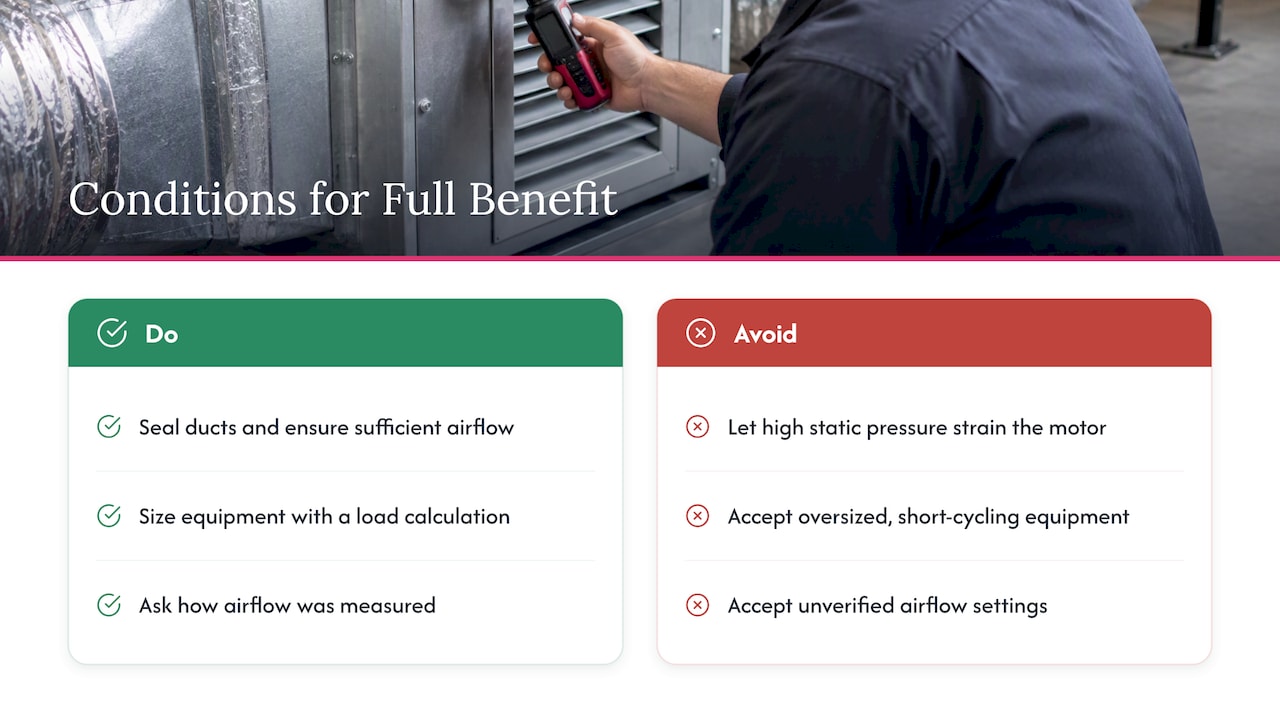
Well-sealed, adequate ducts. ENERGY STAR notes that properly sized, higher-efficiency equipment with variable-capacity operation can adjust for comfort and efficiency, and that ducts should be well sealed and provide sufficient airflow. The ECM textbook adds a limit: high static pressure can make a variable speed motor use more energy and may prevent it from maintaining airflow. A motor straining against undersized ducts is a wasted upgrade. If ducts are the weak link, see our pages on ductwork cost per linear foot and air balancing.
Right-sized equipment. An oversized system short-cycles no matter how smart its fan is. A proper load calculation matters more than any motor feature. Our high-efficiency HVAC upgrade guide explains Manual J load calculations and what a full upgrade involves.
Correct setup. Because installer-selected airflow settings feed the motor’s program, commissioning matters. Ask whoever installs the equipment how they set and verified airflow, and whether they measured it. A contractor who cannot answer that is guessing.
Is a retrofit worth it?
This is where honesty saves you money. The 2014 Consortium for Advanced Residential Buildings study of retrofit motors found the average installed cost was about $475, and that heating and cooling savings alone usually did not justify it. Cost-effectiveness improved with right-sized equipment, low operating pressures and frequent fan-only use. The study suggested a retrofit works best when the existing furnace has at least 10 years of life left and the fan often runs in fan-only mode for circulation. That study is more than a decade old and prices have changed, so treat the dollar figure as a reference point, not a quote.
A practical way to decide:
- Furnace or air handler under about five years old, and the motor is PSC: a retrofit might make sense if you want continuous circulation and your ducts are in good shape.
- Equipment nearing the end of its life: put the money toward replacement and choose a system that includes a variable speed blower from the start. Our guide on when to replace heating and air conditioning helps you judge the timing.
- A failed blower motor on a decent system: compare the repair or replacement cost of a like-for-like motor against an upgrade. Start with our page on furnace blower motor replacement cost.
- Ducts leaking, undersized or crushed: fix those first. No blower will outrun bad ductwork.
Because our technicians are non-commissioned, we have no reason to push a motor upgrade where it will not help. If a repair is all you need, that is what we will tell you.
Running the fan: the thermostat setting
A variable speed blower makes continuous fan operation much cheaper than it is with an older motor, which is part of why people buy one. But the right thermostat fan setting depends on whether you have a PSC or an ECM motor, and getting it wrong on a PSC motor costs money. Our page on the thermostat fan setting for PSC vs. ECM walks through it.
How to tell whether the blower is working properly
You can do a few safe checks without opening any panel. Notice whether the system starts gently or with a bang, whether airflow at the registers feels consistent from room to room, whether the filter is clean, and whether you hear squealing, grinding or rhythmic knocking. A weak airflow complaint is often a dirty filter, closed vents or a blocked return, not the motor.
Beyond that, ECM motors are not like old motors. They take line voltage and a control signal from the board, and testing them involves live electrical components. Our guide to five safe checks for furnace blower motor trouble covers what is reasonable for a homeowner. If you are comfortable with electrical testing, our page on testing a blower motor with a multimeter explains the basics, but for an ECM, a failing control module or board can look just like a failing motor. That diagnosis is best left to a certified technician. Turn the power off at the breaker before opening anything, and call a professional if you smell burning, see scorching or the system trips the breaker.
If your system stops cooling or heating in extreme weather, do not wait. Our AC not blowing cold air guide covers common causes, and our emergency line is there for the rest.
Our perspective
We see variable speed blowers two ways: installed correctly and delighting homeowners, or installed on top of a system with problems and disappointing them. The difference is almost never the motor.
Here is what we tell customers in New River. First, the blower is the part you feel, but the ducts, the sizing and the airflow settings are the part that determines the result. A premium motor on a leaky duct system is money spent in the wrong place. Second, in a climate where the cooling season is long and the fan runs for months, a motor that sips power at low speed is worth more than it would be in a mild region. Long fan runtime is exactly the condition the research says makes the economics work. Third, be wary of anyone quoting a precise savings number without asking how you run your fan.
Our technicians are NATE-certified and non-commissioned, so what we recommend is based on what your system needs, not on what earns us more. Sometimes the honest answer is a simple repair. Sometimes it is a system replacement with a variable speed blower built in. We would rather explain the difference and let you decide.
Let us look at your system
If you are weighing a variable speed upgrade, a motor replacement or a full system change, we can inspect your blower, ducts and airflow and tell you what is worth doing. See our air conditioner services and furnace services for installation, repair and maintenance. A yearly tune-up keeps filters, motors and airflow in check, and our Tru Comfort Advantage maintenance plans are built for that.

FAQ
Is a variable speed blower worth the extra cost?
It is worth it when it comes with the right equipment, your ducts are in good shape and your fan runs a lot. Research on retrofits found that heating and cooling savings alone usually did not cover the installed cost. If you are replacing a system anyway, the added cost of a variable speed blower is far easier to justify.
What is the difference between a variable speed blower and an ECM motor?
Variable speed describes how the motor is controlled, and ECM describes how it is built. Every variable speed motor is an ECM, but some ECMs only offer preset speeds. Ask your contractor which type is in the quote.
Does a variable speed furnace blower help with air conditioning too?
Yes, because the same blower moves air for both heating and cooling. The field study of retrofit furnace motors found cooling season savings in a cold climate were comparable to heating season savings. In a long, hot Arizona cooling season, that matters even more.
Can I add a variable speed blower to my existing furnace?
Sometimes. Retrofit motors exist, but compatibility depends on the furnace, its control board and the duct system. A technician should check static pressure and the equipment’s age first, since a retrofit pays off most on furnaces with 10 or more years of life left.
What controls the speed of the blower?
The system control board does. It combines the manufacturer’s programming, the airflow settings picked during installation and real-time demand from the thermostat. You do not adjust the speed directly.
Sources
- Are Variable-Speed Blower Motors Worth It? Cost vs Benefit
- ECM vs Variable Speed Motor: What’s Actually the Difference
- ECM Textbook v1.5
- ECM Air Handler Fans, Building America Solution Center
- Evaluation of Retrofit Variable-Speed Furnace Fan Motors
- Variable Speed Technology, Goodman
- B5 Air Handler Variable Speed Blower Kits, Rheem
- What Is an Air Handler?, Carrier
- Examining the Benefits of ECMs, ACHR News
- Clean Heating and Cooling, ENERGY STAR