Furnace Blower: 5 Safe Checks for Motor Trouble at Home
Weak airflow, a humming sound with no spin, or a furnace that short-cycles usually points to blower motor trouble, often a failed capacitor or a dirty filter choking airflow rather than the motor itself. Before anything else, turn off the furnace switch and the breaker, then check the filter. If you smell burning or see scorched wiring, stop and call a professional right away.
TL;DR:
- Shut off the furnace switch and breaker before inspection, then check the filter and clear vents; replace filters every one to three months.
- A PSC motor that hums without spinning often has a failed capacitor, while an ECM may show intermittent operation, error codes, or changing speeds.
- Call a technician for burning smells, smoke, sparking, or repeated breaker trips; capacitors can retain a dangerous charge after power is shut off.
- Blower and inducer motor repairs commonly cost $200 to $500, depending on motor type, access, labor rates, and diagnostic fees.
Table of Contents
- Common symptoms of a failing furnace blower motor
- Quick homeowner checks you can safely do now
- Common mechanical and electrical causes explained
- Blower motor types and what symptoms each type commonly shows
- When to stop and call a professional and expected repair and replacement costs
- Preventive maintenance steps that reduce blower motor failure risk
- Tru Comfort’s practical diagnostic tips and local-service option
- Author perspective: practical priorities for homeowners
- Keep your furnace running smoothly with professional support
- FAQ
- Sources
Common symptoms of a failing furnace blower motor
A struggling blower motor rarely fails quietly. The signs usually show up as airflow problems, strange noises, or electrical hiccups, and each type points toward a different likely cause.
Weak or no airflow from the vents, along with rooms that stay cold while others heat normally, is one of the clearest indicators. A motor that hums steadily but never spins the fan blade often has a failed start or run capacitor, a common failure mode where the motor draws power but can’t build enough torque to start. Squealing or grinding noises typically mean worn bearings, while rattling suggests a loose panel, screw, or fan blade.
- Weak airflow or noticeably cold rooms despite the furnace running.
- Humming with no fan movement, often tied to a bad capacitor.
- Squealing, grinding, or rattling noises from the blower compartment.
- Blower running nonstop or the system short-cycling on and off.
- Tripped breakers or a sudden jump in your energy bill.
A blower that runs constantly or a furnace that short-cycles, turning on and off in rapid bursts, can mean the limit switch is shutting the system down to prevent overheating, which looks like motor failure but often isn’t. Tripped breakers and climbing energy bills round out the list, since a motor working harder than it should pulls more current and wastes more power doing it.
Quick homeowner checks you can safely do now
Most blower motor symptoms can be narrowed down with a few minutes of safe, simple checks before you ever pick up a phone.
- Turn off the furnace at the wall switch and shut off the breaker before touching any panel.
- Pull the air filter and check it against the light. A clogged filter is a leading cause of restricted airflow that can overheat the system and trigger a shutdown that mimics motor failure.
- Confirm registers and return vents are open and unblocked by furniture or rugs.
- Open the blower access panel and look for obvious debris, loose screws, or a panel that wasn’t seated properly, since many furnaces won’t run with the panel ajar.
- Scan the capacitor and wiring for bulging, leaking residue, scorch marks, or a burning smell.
Pro Tip: If the filter is gray, bent, or hasn’t been changed in more than three months, replace it first. It solves more airflow complaints than any other single fix.
If you see a bulging or leaking capacitor, burnt wiring, smoke, or smell anything electrical, stop the DIY checks and call a technician. Those are signs of a developing electrical fault, not a simple fix.
A basic voltage check with a multimeter can confirm whether the motor is receiving power, and our multimeter testing guide walks through the safe sequence. That said, most electrical diagnostics, especially anything involving capacitors or live wiring, are best left to a trained technician, since a discharged capacitor can still hold a dangerous charge.
Common mechanical and electrical causes explained
Knowing what’s behind a symptom helps you understand whether you’re looking at a quick fix or a bigger repair.
- Capacitor failure: a weak or dead start/run capacitor often produces the classic hum-with-no-spin symptom, since the motor has power but no starting torque.
- Bearing wear: grinding or squealing noises usually signal bearings breaking down, and a seized shaft is the end stage of that wear, where the motor hums but can’t turn at all.
- Restricted airflow: dirty filters or blocked ducts raise static pressure and force the blower to work harder, and research on residential airflow faults shows these air-side issues are often distinguishable from true motor problems with basic checks.
- Electrical issues: tripped breakers, voltage drops, or intermittent power can make a perfectly good motor act like a failing one.
Motors also degrade over time from thermal stress, humidity, and contamination, and federal research on motor systems notes that insulation and bearing damage accelerate under excess heat or moisture exposure. That’s why a dirty filter left unchanged for months can quietly shorten a motor’s life long before it fails outright. Getting the root cause right matters, since a capacitor swap costs far less than a full motor replacement, and treating the wrong problem wastes money without fixing the symptom.
Blower motor types and what symptoms each type commonly shows
Furnaces generally use one of two motor types, and the type affects both the symptoms you’ll notice and how a technician diagnoses them.
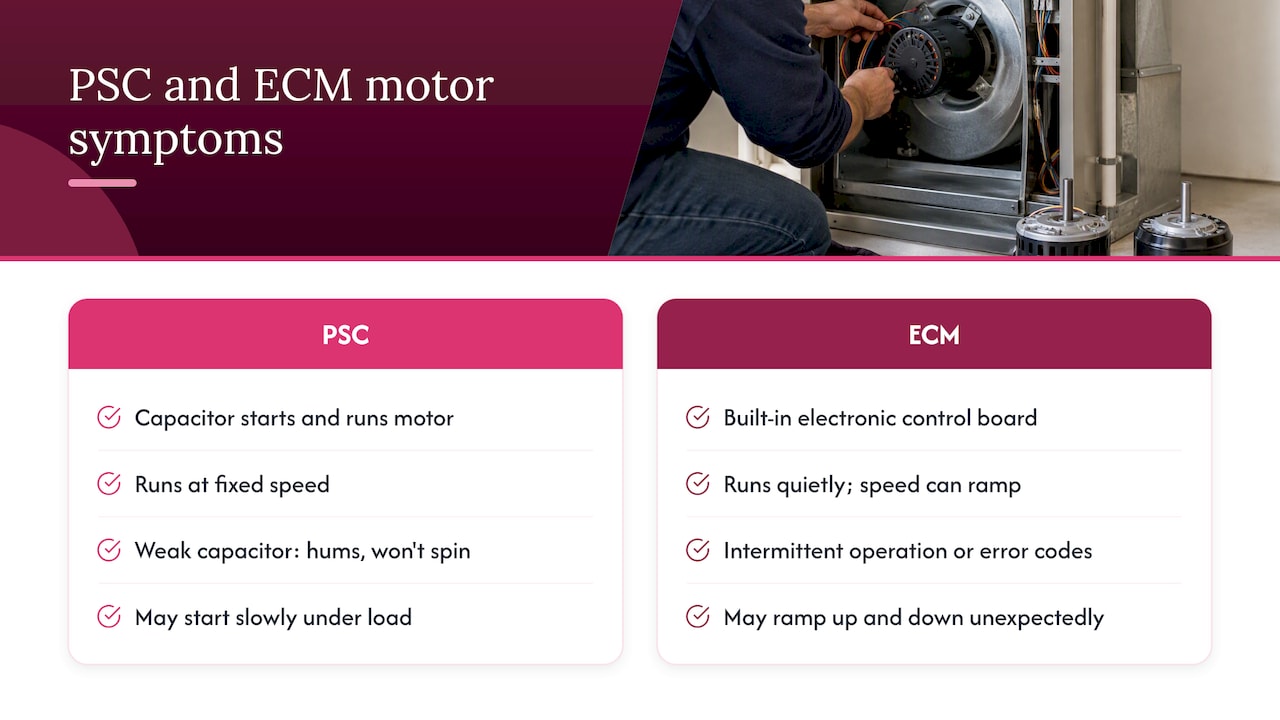
PSC (permanent split capacitor) motors rely on a start or run capacitor to get moving and keep running at a fixed speed. When that capacitor weakens, the classic symptom is a motor that hums but won’t spin, or one that starts slowly and struggles under load.
ECMs (electronically commutated motors) are quieter and run on a built-in electronic control board rather than a simple capacitor. Faults in these motors tend to show up differently, as intermittent operation, error codes, or a blower that ramps up and down unexpectedly rather than simply refusing to start. Because ECMs involve electronic controls, diagnosing a fault usually takes more specialized testing equipment than a PSC motor needs, which can affect both the diagnostic time and the repair cost.
When to stop and call a professional and expected repair and replacement costs
Some symptoms are safe to investigate yourself. Others mean it’s time to step back and call in a technician.
- A burning smell or visible smoke from the furnace cabinet.
- Repeated breaker trips after you reset it.
- Visible sparking near the blower or control board.
- Persistent short-cycling that doesn’t resolve after a filter change.
Replacement costs for blower or inducer motors commonly fall between $200 and $500, depending on the motor type, how accessible it is, local labor rates, and whether a diagnostic fee applies. Our blower motor replacement cost breakdown covers what typically drives that range higher or lower for a given furnace. A technician’s quote usually includes the diagnostic visit, the motor itself, labor, and a check of related components like the capacitor and wiring, since replacing a motor without addressing a failing capacitor often leads to a repeat failure.
Preventive maintenance steps that reduce blower motor failure risk
A little routine attention goes a long way toward keeping a blower motor out of trouble.
- Replace the air filter every one to three months, and choose a filter rated for your system rather than the thickest one available.
- Keep return vents and registers clear of furniture, rugs, and curtains so air can move freely.
- Check ducts periodically for compressions or leaks, since even minor duct restrictions can raise pressure loss and force the blower to work harder than it should.
- During an annual tune-up, have a technician check the capacitor, tighten electrical connections, and lubricate parts where the motor design calls for it.
Pro Tip: Mark your filter replacement date on the furnace cabinet with a marker. It’s a small habit that prevents one of the most common causes of blower strain.
Our furnace maintenance checklist breaks these steps into a few short monthly tasks, and a maintenance plan can keep this on a schedule without you having to remember it.
Tru Comfort’s practical diagnostic tips and local-service option
We have technicians who focus on honest, non-commissioned diagnostics rather than pushing unnecessary replacements. Our multimeter testing guide and our breakdown of squealing noise causes cover the same listening and visual checks our technicians use in the field. Blower and inducer motor repairs commonly run $200 to $500, and emergency service is available when red flags like burning smells or repeated breaker trips show up.
Author perspective: practical priorities for homeowners
Most blower motor symptoms trace back to a dirty filter or a failing capacitor, not a dead motor. Check the simple things first, and don’t poke around live electrical components you’re not trained to handle. Beyond that, a NATE-certified technician and a regular maintenance schedule will catch small problems before they become expensive ones.
Keep your furnace running smoothly with professional support
When a filter change and a visual check don’t solve the problem, we offer the diagnostic experience to find the real cause instead of guessing. Our technicians are NATE-certified and non-commissioned, so the fix you get is the one your furnace actually needs.

- Furnace diagnosis and blower motor repair or replacement.
- Furnace repair services for New River homeowners dealing with airflow or noise problems.
- Tru Comfort Advantage maintenance plans to catch capacitor and bearing wear before they fail.
We keep cost ranges transparent and recommendations honest. Reach out to schedule a furnace repair visit and get your blower checked before a small issue turns into a no-heat emergency.
FAQ
How do you know your blower motor is going out?
Watch for weak airflow, humming with no fan movement, grinding or squealing noises, or a furnace that short-cycles repeatedly. A sudden jump in your energy bill alongside any of these signs is another strong indicator the motor is working harder than it should.
How do you replace a blower motor on a furnace?
Replacing a blower motor involves shutting off power to the furnace, removing the blower assembly, disconnecting the old motor and wiring, installing the new motor, and testing airflow and amperage draw before closing the panel. Because this involves live electrical components and precise reassembly, it’s typically handled by a licensed technician rather than as a DIY project.
How much should it cost to replace a furnace blower motor?
Blower and inducer motor repairs commonly fall between $200 and $500, depending on motor type, accessibility, and local labor rates. Our detailed cost breakdown explains what pushes a quote toward the higher or lower end of that range.
Will the AC work if the blower motor is bad?
No, since the same blower motor that pushes heated air through your ducts also circulates cooled air for the air conditioning side of the system. A failing blower typically affects both heating and cooling performance at once.
Sources
- Furnace blower motor repair & replacement guide | Carrier
- Motor systems management and failure mechanisms | U.S. Department of Energy
- Fault detection method for residential HVAC systems | ASHRAE