
SEER Rating Savings: What a Higher SEER Really Saves
A higher SEER rating means your air conditioner uses less electricity to deliver the same cooling, so every point you add trims your summer bill. How much it trims depends on what you are replacing, how many hours your system runs and what you pay per kilowatt-hour. Going from a 10 SEER unit to a 15 SEER unit can cut cooling electricity by about a third. Going from 13 to 15 saves far less. This guide shows you the math so you can judge for yourself, with Arizona summers in mind.
TL;DR
- SEER is cooling output over a season divided by electricity used. Higher is more efficient, and the savings shrink as the starting number climbs.
- Since January 1, 2023, efficiency is rated in SEER2, which is not directly comparable to the old SEER number.
- Savings = system size × (1/old SEER − 1/new SEER) × annual full-load hours × your electric rate. Old, low-SEER units gain the most.
- In a hot climate like ours, high-efficiency equipment pays back faster because the system runs more hours, but only if the ducts, sizing and installation are right.
- A federal tax credit of up to $600 applies to split-system central air conditioners at 17.0 SEER2 and 12.0 EER2 or better.
Table of Contents
- What SEER measures
- What the federal minimums are now
- How to calculate your own SEER savings
- What real-world studies and DOE estimates show
- What a 20-year-old air conditioner is likely to be rated
- Why savings in Arizona can be bigger, and why they can disappoint
- Tax credits and rebates that change the math
- How to decide whether to upgrade
- Our perspective
- Get a replacement quote built on your numbers
- FAQ
- Sources
What SEER measures
SEER stands for seasonal energy efficiency ratio. The Department of Energy describes it as the total cooling a system delivers over a season divided by the total electricity it consumes (DOE central air conditioner standards FAQ). Think of it like miles per gallon for cooling. A 16 SEER unit moves more heat out of your house per kilowatt-hour than a 10 SEER unit does.
Two details matter for savings:
- It is a lab rating. It reflects standardized test conditions, not your attic, your ducts or your thermostat habits.
- It is seasonal. It averages performance across a range of outdoor temperatures. A Phoenix-area July afternoon at 110°F is harder on a system than the test average, which is one reason installation quality and sizing matter as much as the label.
SEER versus SEER2
The Department of Energy changed the testing procedure effective January 1, 2023, and cooling efficiency is now reported as SEER2 (DOE FEMP guidance on residential central air conditioners). The new test uses tougher conditions, including more realistic airflow resistance in the ductwork, so SEER2 numbers come out lower than the old SEER for the same equipment. The two scales are related but not directly comparable. A 14.3 SEER2 unit is not “worse” than a 15 SEER unit from a few years ago. It is closer to the same thing measured with a stricter ruler.
When you compare quotes, compare SEER2 to SEER2. If an old nameplate or a used listing shows SEER, do not mix them in your savings math without noting the difference.
What the federal minimums are now
Federal rules set a floor for new equipment, and the floor depends on where you live and what you buy. For split-system central air conditioners under 45,000 Btu/hr, the minimum is 13.4 SEER2 in the North and 14.3 SEER2 in the Southeast and Southwest. Heat pumps have a nationwide minimum of 14.3 SEER2 (DOE standards FAQ).
That answers a common question: is 14.3 SEER good? In Arizona, which sits in the Southwest region, 14.3 SEER2 is the legal minimum for a new split-system air conditioner of that size. It is a baseline, not a high-efficiency unit. If a quote lands exactly at the minimum, you are buying the least efficient new system the law allows.
| Equipment (split system, under 45,000 Btu/hr) | Minimum efficiency |
|---|---|
| Air conditioner, North | 13.4 SEER2 |
| Air conditioner, Southeast and Southwest (includes Arizona) | 14.3 SEER2 |
| Heat pump, nationwide | 14.3 SEER2 |
How to calculate your own SEER savings
The Department of Energy’s technical guidance for units under 5.4 tons gives a simple energy-savings formula (DOE Uniform Methods Project, unitary air conditioners chapter):
kWh saved = size in kBtu/hr × (1 ÷ old SEER − 1 ÷ new SEER) × equivalent full-load hours
Multiply the kWh saved by your electric rate to get dollars. Here is what each input means:
- Size. A 3-ton system is 36 kBtu/hr (one ton is 12 kBtu/hr).
- Old SEER and new SEER. Use the same scale for both.
- Equivalent full-load hours (EFLH). The number of hours per year the system would run at full output to deliver your annual cooling. This is the input that varies most by climate and by household. A home that cools from April through October in the desert has far more hours than one in a mild coastal city.
- Electric rate. Check your latest bill for the price per kWh and any time-of-use pricing.
A worked example
The numbers below are an illustration, not a quote or a prediction for your home. We assumed a 3-ton system, 1,800 full-load hours a year and an electric rate of $0.15 per kWh. Swap in your own figures.
| Upgrade | kWh saved per year | Dollars saved per year at $0.15/kWh |
|---|---|---|
| 10 SEER to 15 SEER | about 2,160 | about $324 |
| 10 SEER to 18 SEER | about 2,400 | about $360 |
| 13 SEER to 15 SEER | about 665 | about $100 |
| 13 SEER to 18 SEER | about 1,300 | about $195 |
Two patterns stand out. First, the jump from a very old unit to a decent modern one captures most of the savings. Going from 10 to 15 saves about 2,160 kWh, while pushing that new unit from 15 to 18 adds only about 240 kWh more. Second, replacing a 13 SEER system with a 15 SEER system saves roughly a third as much as replacing a 10 SEER system. Efficiency gains have diminishing returns because the formula uses 1 divided by SEER, not SEER itself.
What real-world studies and DOE estimates show
The published numbers vary with climate and assumptions, which is a reason to treat any single “you will save X%” claim with care.
- The Department of Energy’s 2010 consumer guide says upgrading from an older 9 SEER unit to a 14 SEER system can reduce cooling energy use by more than 35% (DOE Guide to Home Heating and Cooling).
- For a residential central air conditioner in hot-humid regions, moving from a 13.4 SEER2 unit to a 15.2 SEER2 ENERGY STAR unit yields about $1,853 in lifetime energy cost savings, based on 2023 DOE estimates. The most efficient models available can save up to $6,724 over their life versus less efficient ones in those climates (DOE FEMP).
- A Florida field study run between 2010 and 2014 projected $324 in annual energy cost savings for a SEER 21/22 heat pump compared with a SEER 13 system (Building America case study).
Those figures come from hot-humid climates, not the Sonoran Desert, so treat them as the right order of magnitude rather than a promise. The common thread is that lifetime savings run from hundreds to several thousand dollars, and the biggest gains come from replacing the least efficient equipment.
What a 20-year-old air conditioner is likely to be rated
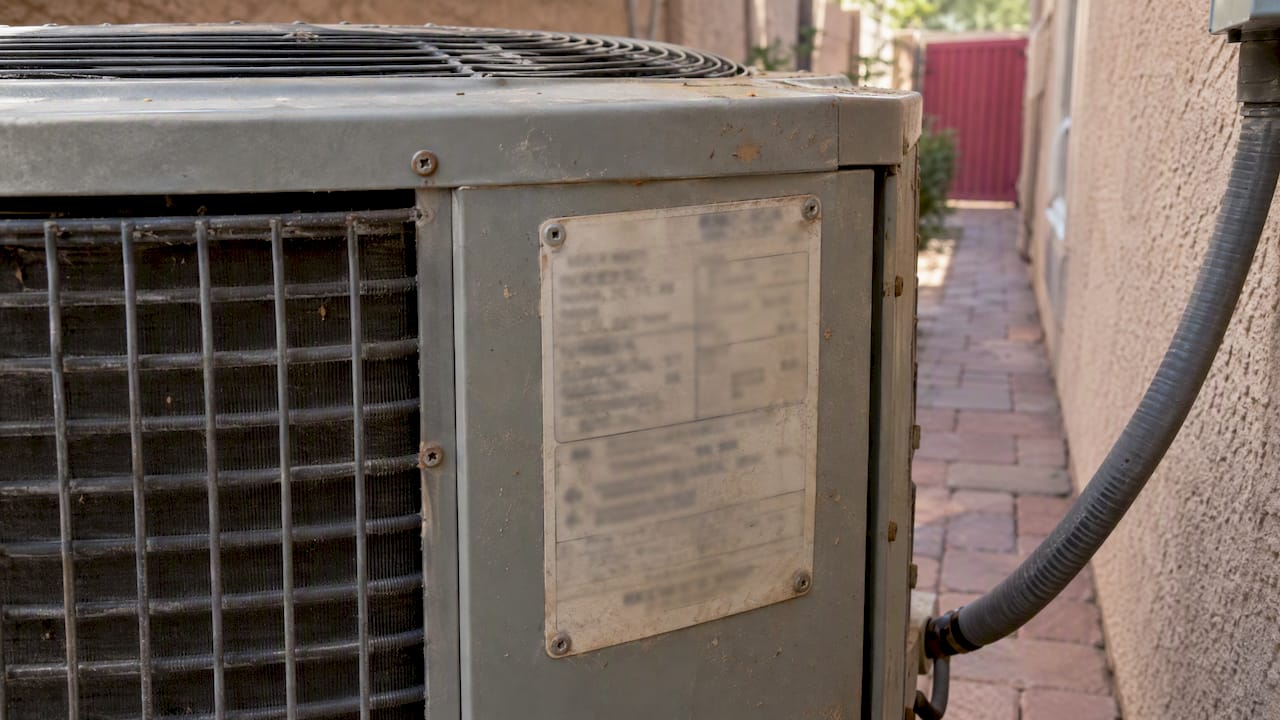
There is no single answer, because the label depends on the model, but a system that old was built to much weaker standards than today’s. Many central air conditioners from that era sit somewhere around 10 to 13 SEER, and units from the early 1990s or before can be lower still. Check the nameplate on the outdoor unit, which lists the model number, and the model number can be matched to the manufacturer’s literature for its rating.
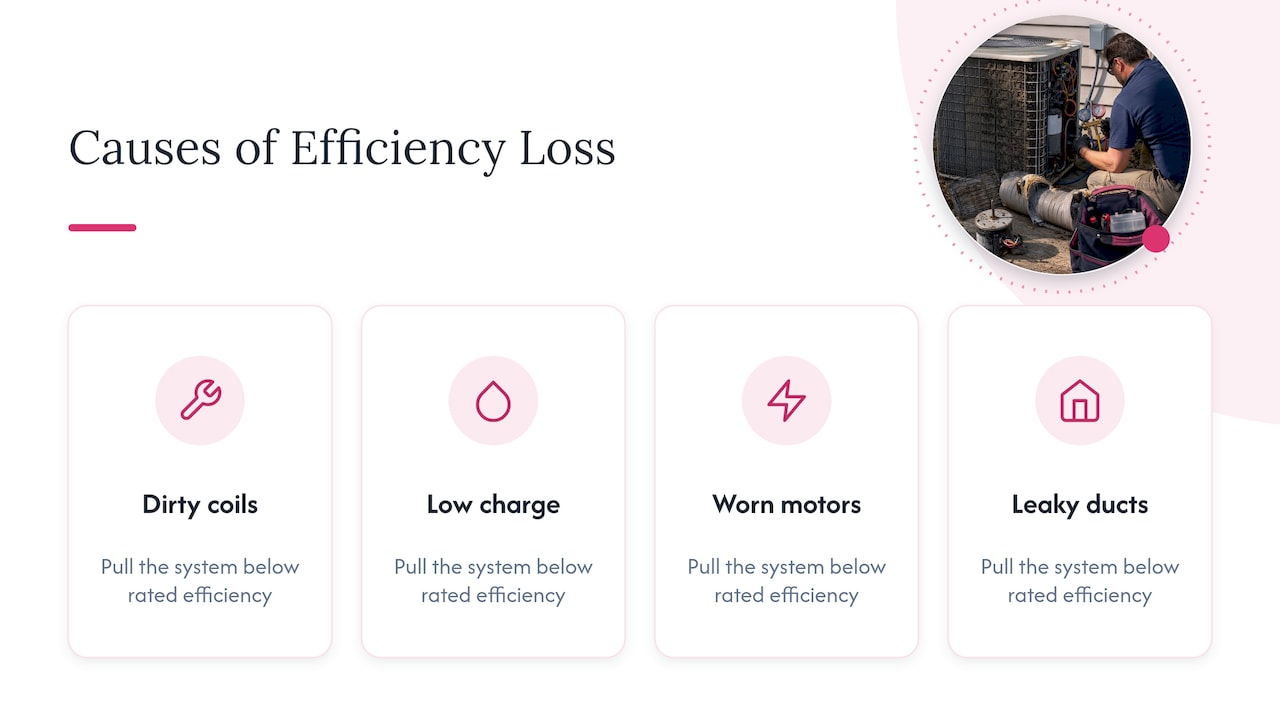
There is a second effect the label does not show. Dirty coils, low refrigerant charge, worn motors and leaky ducts all pull a system below its rated efficiency over time. Your old unit may be delivering less than its nameplate says, so the real savings from replacement can be larger than the formula predicts. The Department of Energy’s consumer guidance notes that systems more than 15 years old can save on electric bills by investing in new equipment (DOE Consumer Guide to Home Heating and Cooling). If your unit is in that range and starting to cost you in repairs, our guide on when to replace heating and air conditioning walks through the decision.
Why savings in Arizona can be bigger, and why they can disappoint
Savings depend on climate, usage and installation, and cost effectiveness compares lifetime savings with the upfront premium for efficiency (DOE FEMP). Our region helps on the first two. Long, hot cooling seasons mean high full-load hours, and high hours multiply every point of SEER you buy. You can see how long the heat lasts in our look at how hot Anthem and New River get in summer.
Installation is where savings are most often lost. The rating assumes the system is sized correctly and moves the right amount of air. Common ways a high-SEER unit underperforms:
- Wrong size. A system sized by rule of thumb instead of a load calculation short-cycles or runs too long. A proper Manual J calculation avoids this, which is why we explain it in what to demand before approving AC work.
- Leaky or undersized ducts. Efficient equipment on poor ductwork wastes what you paid for. Duct problems can be fixed separately, and we cover duct installation and air balancing.
- A hot attic and a poorly insulated envelope. ENERGY STAR advises optimizing attic insulation before installing new equipment so you do not pay to cool heat that did not need to get in (ENERGY STAR tax credit page).
- Blocked airflow around the condenser. Tight spaces and sun exposure cut capacity. See condenser clearance and unit sun exposure.
- Skipped maintenance. Dirty coils and filters erase part of the gain. A maintenance schedule keeps the equipment near its rated performance.
Tax credits and rebates that change the math
Incentives reduce the upfront premium, which is the other half of the payback equation. As of January 1, 2025, a federal tax credit of up to $600 is available for split-system central air conditioners that meet or exceed 17.0 SEER2 and 12.0 EER2 (ENERGY STAR). Tax rules can change, so confirm the current terms on that page and with your tax preparer before you buy.
Some utilities also offer rebates, and the DOE notes that these exist for high-efficiency equipment (DOE FEMP). Check your electric provider’s website for current programs, because amounts and eligibility change. Ask your installer to put the exact model’s SEER2 and EER2 on the quote so you can claim anything you qualify for.
How to decide whether to upgrade
Use this short checklist before you pay for a higher number.
- Find your current rating. Read the outdoor unit’s nameplate and note the age.
- Pull 12 months of bills. Look at the gap between your spring and peak summer usage to see what cooling costs you now.
- Run the formula with a few candidate SEER2 values, using your own rate.
- Compare the extra cost of each step up with the extra yearly savings. If moving from 15 to 18 adds $2,000 to the quote and saves $60 a year, the number is not working for you. If the step is small and the savings meaningful, it is.
- Factor in repairs. A system with a failing compressor or repeated service calls has a cost beyond the electric bill. Our article on the best time to replace an AC covers repair-versus-replace thinking.
- Check financing. Measure guidance from the Department of Energy found that replacing a 13 SEER system with a 15 SEER system in a typical 1,800-square-foot house may be justified when low-interest financing is available, since the savings can cover the payment (Building America measure guideline).
The honest conclusion: if you are replacing a 10 SEER or older system, a modern high-efficiency unit will probably earn its premium. If you are replacing a relatively recent 14 or 15 SEER system that still works, a new one rarely pays for itself on efficiency alone.
Our perspective
We get asked about SEER constantly, and the most useful thing we can tell homeowners is that the number on the box is only a third of the story. We see high-efficiency systems in New River homes that never hit their rating because the ducts leak into a 140°F attic, or the unit was sized by square footage alone. We also see modest-rated systems that run beautifully because the load was calculated, the airflow was measured and the installation was tested.
Our technicians are NATE-certified and non-commissioned, so our recommendation does not change with the price of the equipment. That lets us say things a salesperson paid on the sale might not: if your 14 SEER system is healthy, keep it and maintain it. If it is 20 years old and failing, replace it and spend your money on the right size and the ducts before you chase the last few SEER points. Ask any installer for the Manual J load calculation, the exact model’s SEER2 and EER2, and a test-out of airflow when the work is done.
Get a replacement quote built on your numbers
If you have a unit that is 15 years old or older, or your summer bills keep climbing, we can inspect it, tell you its real condition and price an upgrade with the load calculation behind it. See our air conditioner installation, repair and maintenance services or read how we approach a high-efficiency HVAC upgrade. If you would rather protect the system you have, our Tru Comfort Advantage maintenance plans keep it running close to its rated efficiency.
FAQ
How many SEER is considered high efficiency?
Any new split-system air conditioner must meet at least 14.3 SEER2 in the Southwest, so high efficiency means clearly above that. ENERGY STAR’s tax credit threshold of 17.0 SEER2 with 12.0 EER2 is a useful marker for top-tier equipment (ENERGY STAR). Whether it is worth buying depends on your run hours and price premium.
Is 14.3 SEER good?
It is the legal minimum for a new split-system air conditioner under 45,000 Btu/hr in the Southwest, expressed in SEER2. That makes it an acceptable baseline and a big improvement over a 20-year-old unit, but not a high-efficiency choice. If the price difference to the next tier is small, the upgrade is often worth pricing.
What is the typical SEER rating of a 20-year-old air conditioner?
Often somewhere around 10 to 13 SEER, and lower if the unit was built in the early 1990s or earlier. The exact figure is on the outdoor unit’s nameplate and the manufacturer’s literature for the model number. Worn components can leave the system performing below that rating.
How much will a higher SEER save me each year?
It depends on size, full-load hours and your electric rate. Using the DOE formula with a 3-ton system, 1,800 hours and $0.15 per kWh, a 10 to 15 SEER upgrade saves about $324 a year, while a 13 to 15 upgrade saves about $100. Your numbers will differ, so run the formula with your own bill.
Sources
- DOE central air conditioner standards FAQ
- DOE FEMP: purchasing energy-efficient residential central air conditioners
- DOE Uniform Methods Project: unitary air conditioners chapter
- DOE Guide to Home Heating and Cooling
- Building America case study on improved duct systems
- DOE Consumer Guide to Home Heating and Cooling
- ENERGY STAR central air conditioner tax credit
- Building America air conditioner diagnostics measure guideline