Undersized Return Air: Symptoms, Causes and Fixes
Undersized return air means your system can’t pull back as much air as the blower tries to move. The blower strains, rooms stop getting the air they need, and the equipment runs longer for less comfort. The usual causes are a return duct or grille that is too small, a filter that is too restrictive, or closed rooms with no way for air to get back. The fix starts with measuring, not guessing.
We see this in homes around New River, AZ, where a new system gets paired with old ductwork. This guide covers what undersized return air looks like, why it happens, what you can safely check yourself, and what a proper repair involves.
TL;DR
- Your blower can only push out as much air as it can pull in. Too little return air means weak airflow, noise, hot and cold rooms, and a stressed blower motor.
- Studies cited by ACCA found that about 80% of homes have undersized return duct systems, so this is common, not rare.
- The restriction is often at the grille, the filter or a closed bedroom door, not the main duct.
- Don’t add return vents or swap in a thicker filter on a hunch. Static pressure measurements show where the bottleneck is.
Table of Contents
- How return air works
- Symptoms of undersized return air
- What causes it
- What you can check yourself
- Why measuring beats guessing
- Fixes that work
- Our perspective
- Getting it diagnosed in New River
- FAQ
- Sources
How return air works
Your forced-air system is a loop. The fan pushes conditioned air through supply ducts to the rooms, and the fan gets its air from return ducts that bring it back to the equipment. If the return side is too small, the fan is trying to drink through a narrow straw.
Think of it as two halves of one pipe. A supply side sized perfectly does nothing if the return can’t keep up. The fan simply moves less air than the equipment was designed for, and every part downstream suffers: the coil, the heat exchanger and the blower motor.
If you aren’t sure which vents in your house are which, our guide on telling supply and return vents apart takes four quick checks.
Symptoms of undersized return air
No single sign proves it. Several together point strongly that way.
Noise at the return
A whistle, rumble or roar at the return grille means air is squeezing through too small an opening at high speed. Professional guidance targets return grille velocities below roughly 350 to 500 feet per minute for quiet operation. A grille that sounds like a hair dryer is well past that.
Weak airflow at the supply registers
You stand at a register and the air feels thin, even though the system runs constantly. Less return means less total airflow, which shows up everywhere.
Rooms that never feel right
A bedroom that stays hot in July or cold in January is often blamed on the AC or furnace. Frequently it is a return problem. When a closed room has no path back, the room becomes pressurized and blocks new conditioned air from entering. If your trouble spot is upstairs, see our walkthrough on uneven cooling upstairs.
Doors that slam or hold shut
If a bedroom door pushes open or pulls shut when the system starts, that room is under pressure imbalance. It is one of the easiest clues to test: close the door, turn on the fan, and listen and feel.
Short or constant run times and higher bills
The system struggles to hit the thermostat setting, so it runs longer. EPA guidance says leaky, poorly performing ducts can cut a system’s efficiency by as much as 20%, which means higher utility bills. In an Arizona summer, that is not a small number.
A frozen evaporator coil
Low airflow across the coil lets it get too cold. Ice forms, and then airflow drops further. If your AC keeps icing up and you have already replaced the filter, restricted return air is a prime suspect.
Overheating furnace or a stressed blower
On the heating side, restricted airflow can push a furnace to overheat and shut off on its limit switch. The blower motor also works harder against high resistance, which generates heat and shortens its life.
Sweating ducts
The ACCA piece lists duct sweating among the results of an undersized return system, along with reduced comfort, poor supply airflow and lower efficiency.
What causes it
Most people picture one skinny duct. The reality is more varied.
Too-small return ducts or drops
Homes built with a single central return, or with a return sized for an older, smaller system, are common. When a larger or higher-airflow system replaces it, the old return becomes the bottleneck.
A restrictive grille
Technicians often find the primary restriction at the grille, not the duct behind it. A decorative grille with narrow slats can have a small net free area. ACCA-linked guidance calls for a grille whose net free area is about 1.5 times the cross-sectional area of the return duct.
The wrong filter
Many people assume a bigger or denser filter solves airflow. A high-MERV filter on an already restricted system can raise static pressure and make things worse. If you want better filtration, it usually means a larger filter surface (a deeper media cabinet or more filter area), set up by someone who has checked the system’s pressure first.
No return path from closed rooms
This is a systemic issue. A central return can be perfectly sized and still fail a bedroom with the door shut. Practitioners warn that door undercuts are not an approved solution under ACCA Manual D. The better answers are jumper ducts, transfer grilles or dedicated ducted returns.
Leaky returns
This one is about safety as well as efficiency. A leaky return can create low pressure that backdrafts flue gases, including carbon monoxide, into the living space in homes with gas furnaces or gas water heaters. We cover the sealing side in our leaky air duct guide.
Mismatched equipment
A new high-efficiency furnace or an upsized AC on old ducts is a classic setup. If your equipment may be too big for the house, check our list of oversized AC symptoms, because oversizing and undersized returns often show up together.
What you can check yourself
These steps are safe for a homeowner and cost nothing. They help you describe the problem to a technician. They do not replace measurement.
- Check the filter. Is it clogged, or a very dense one for a system never designed for it? Swap in a clean standard filter and note any change in noise or airflow.
- Look at the return grille. Is it blocked by furniture, a rug or a decorative cover? Is it small compared with the system’s size?
- Run the door test. With the system running, close a bedroom door. Does the room get weaker airflow, does the door push, does the noise change?
- Listen. Whistling or rumbling at the return is a clue. Note when it started.
- Check the coil and furnace history. Any icing, or furnace shutting off on high limit, goes on your list for the technician.
Our three free DIY return air checks go step by step through the first few of these.
Don’t cut a bigger hole in a return, add a return vent to a random room or tape over grilles. You can create a worse imbalance, and if the system has combustion appliances, you can create a safety problem.
Why measuring beats guessing
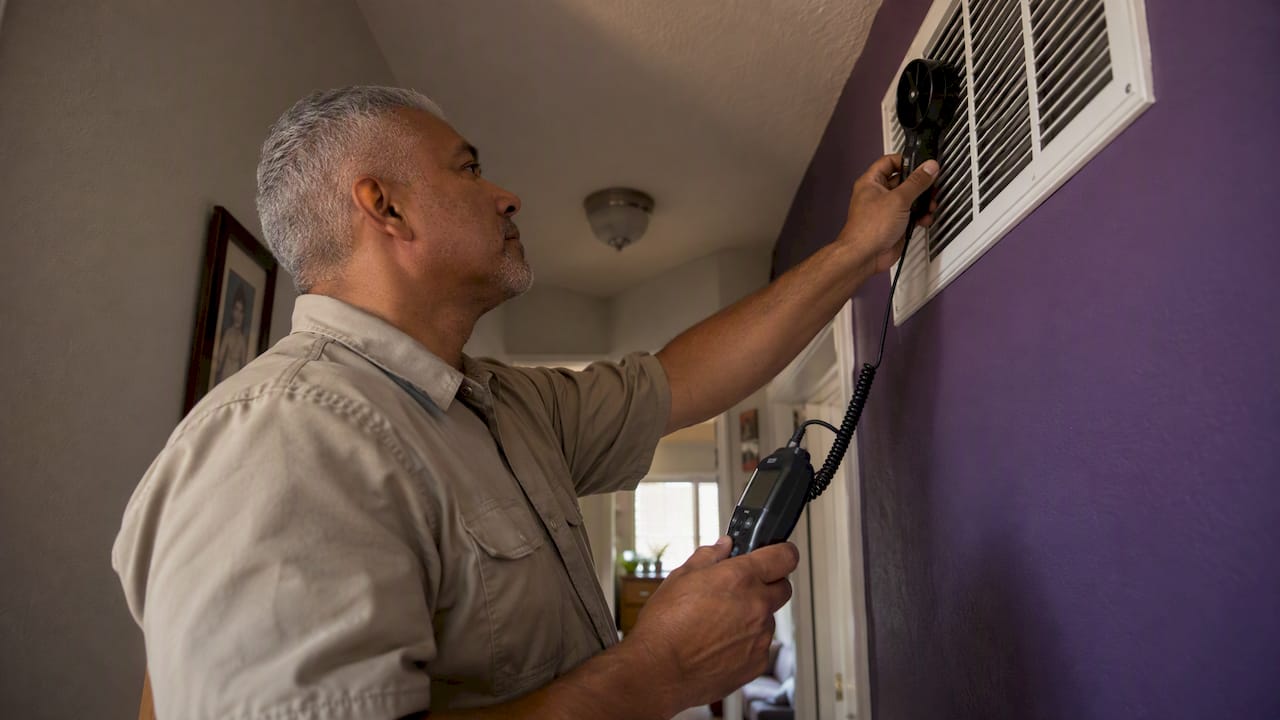
“Not enough air” is a feeling, not a measurement. The industry saying is diagnostics over guessing. Instead of adding more return everywhere, a professional uses static pressure readings to find the exact bottleneck. Without that, a fix can swing from undersized to oversized and disrupt the whole system’s balance, which can shorten equipment life, according to ACCA’s discussion of return sizing.
A proper diagnostic typically includes:
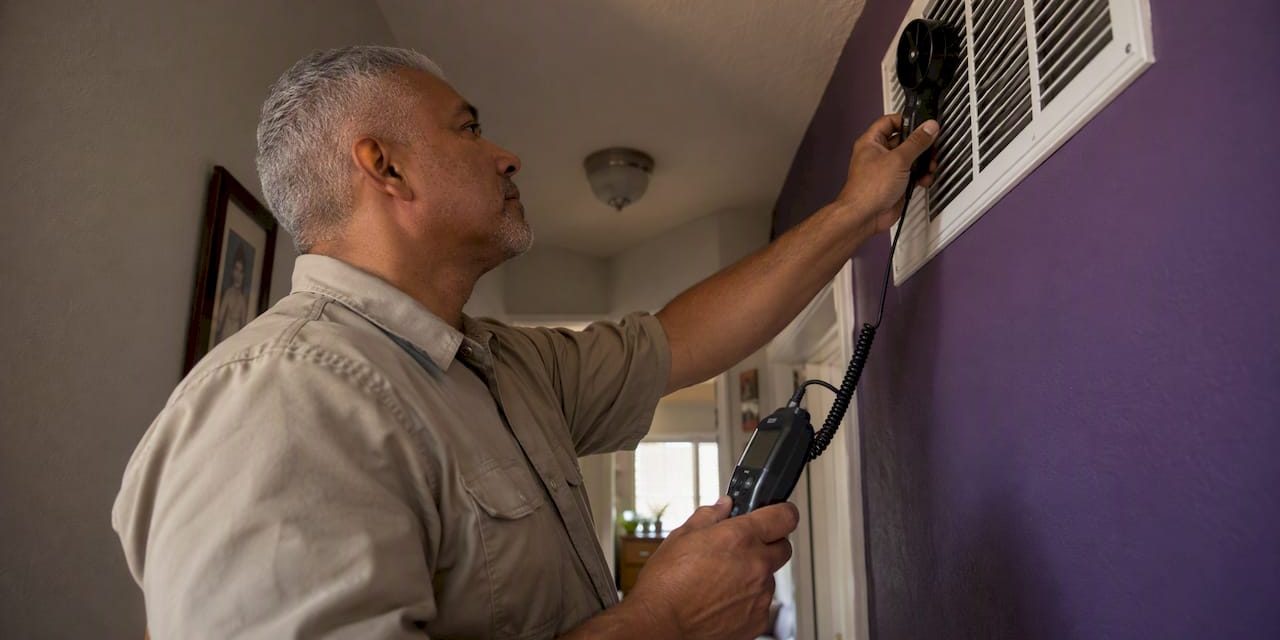
- Total external static pressure (TESP). Measured across the equipment, it tells you how hard the blower is working against the ducts. The return side reading shows how much of that is the return.
- Airflow measurement. Actual cubic feet per minute at the equipment or at the registers, compared with what the system is designed to move.
- Pressure differences between rooms. Closed-door readings show where a return path is missing.
- Grille and filter drop. Pressure loss across each component pinpoints which part is the choke point.
Professional standards aim for return systems designed for low resistance. The research we reviewed cites a target pressure loss of under 0.05 inches of water column for the return in a well-designed layout. If you want to understand the test itself, see how a TESP test restores lost airflow and why air balancing starts with measuring ducts and not with adjusting dampers.
Fixes that work
The right repair depends on what the measurements show. These are the common ones, roughly from simplest to most involved.
| Problem found | Typical fix | Scope |
|---|---|---|
| Restrictive grille | Replace with a larger, high-free-area grille | Small |
| Dirty or overly dense filter | Larger filter area or appropriate filter type | Small |
| Closed room, no return path | Jumper duct, transfer grille or dedicated ducted return | Moderate |
| Undersized return drop | Enlarge the duct and use smooth transitions | Moderate |
| One central return for the whole house | Add return pathways in the right places | Larger |
| Leaky return | Seal, then run a combustion safety test | Moderate |
A few details matter more than they look:
- Enlarging an undersized return drop is better when it also uses turning vanes or smooth elbows. Contractors who do this work are not cited here because the point is simple: sharp turns add resistance.
- After any duct sealing or modification in a house with combustion appliances, a technician should run a combustion safety test, as Department of Energy guidance explains.
- Where a room has no return, Building America guidance notes that rooms without adequate return airflow can impede supply airflow through overpressure.
If the existing ductwork is too far gone, partial redesign or new runs may be the cheaper answer in the long run. For what that can mean, see our page on ductwork cost per linear foot, and for sealing costs, our duct sealing cost breakdown.
Our perspective
We are a family-owned HVAC company in New River, and our technicians are NATE-certified and non-commissioned. That second part matters most with return air problems, because the tempting answer is always the one that sells more equipment.
When a homeowner says a room won’t cool, the easy sale is a bigger AC. Most of the time that makes it worse. A system that can’t breathe won’t cool better with a larger compressor. So we start by asking what the system is doing, measuring pressure and airflow, and only then talk about what to change.
We also hear a lot of “I just need a thicker filter” or “just add a vent in that room.” Both can be right in a narrow case and wrong in most. A return fix that isn’t measured is a coin flip, and the cost of being wrong is a system that still doesn’t work and a bill you didn’t need.
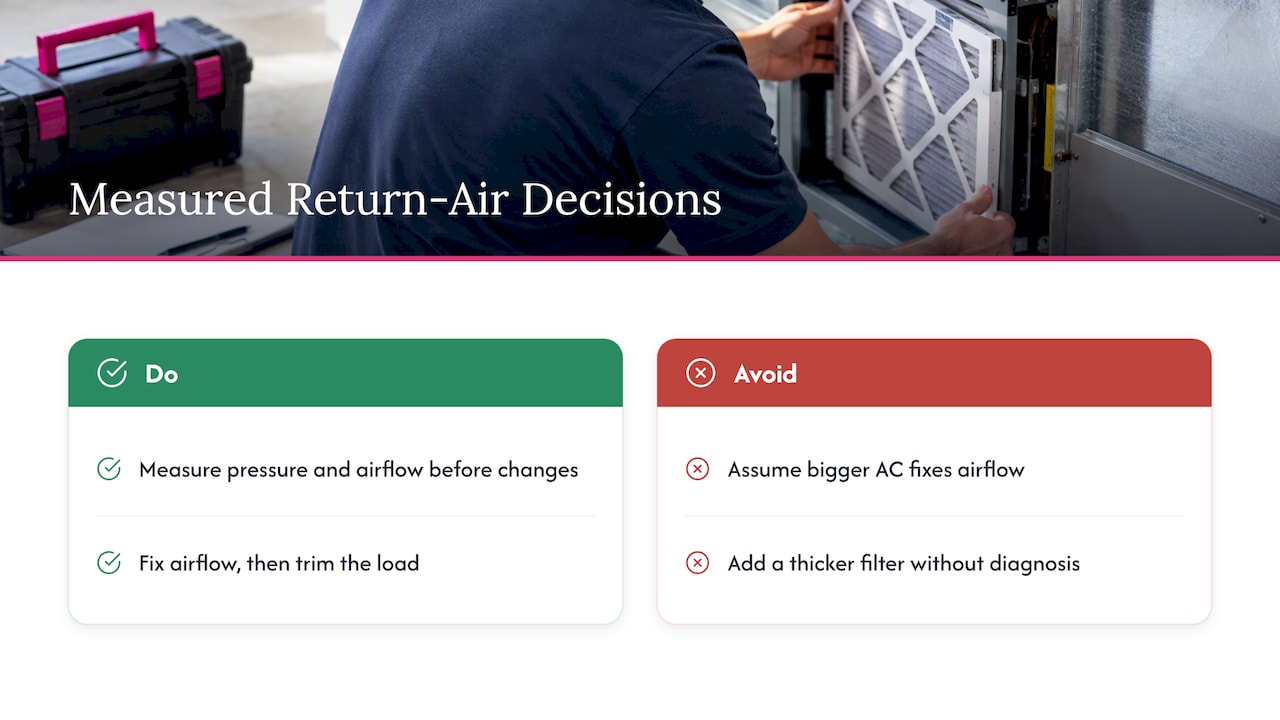
One more thing we say plainly: cooling load and airflow are separate problems. Reducing heat gain, for example with roof treatment to cut cooling demand, can lower how hard your AC has to work. It will not fix a return that is too small. Do both in the right order: fix airflow, then trim the load.
If we find your return is fine and the problem lies elsewhere, we will tell you that too.
— Brett
Getting it diagnosed in New River
If your symptoms match, book a diagnostic instead of replacing parts. Tru Comfort handles air conditioner repair and maintenance, furnace work and air duct installation for homes and businesses in New River and surrounding areas. If your system quit during an Arizona heat wave, our emergency HVAC service is there for it.
If you are planning a replacement, ask any contractor, including us, how the return side was evaluated before approving the job. Our guide to the AC installation process lists what to ask for. Our Tru Comfort Advantage maintenance plans also keep filters, coils and airflow checked each year, so a developing restriction gets caught early.
FAQ
What happens if return air is undersized?
The blower can’t draw enough air, so total airflow drops. You get noise at the return, weak supply air, uneven rooms and longer run times. Over time the blower motor runs hotter, coils can ice up, and a furnace can overheat.
Can a filter that is too thick or dense cause this?
Yes. A high-MERV filter in a system that is already restricted can increase static pressure and worsen airflow. Before changing filter type, have a technician measure pressure so the filter fits what the system can handle.
Does adding another return vent fix it?
Sometimes, but not by default. The restriction may be at the grille, the filter or a closed room with no path back. A static pressure test tells you which, so you add return capacity only where it helps.
Are door undercuts enough to let air return from bedrooms?
Usually not. The guidance behind ACCA Manual D does not approve them for this. Jumper ducts, transfer grilles or a dedicated return duct do the job properly.
Is this a safety issue or only a comfort issue?
Both, in some homes. Leaky return ducts can pull flue gases, including carbon monoxide, back into living space where gas appliances are present. Any duct modification in such a home should be followed by a combustion safety test, and a working carbon monoxide alarm is a must.
Sources
- Increasing Comfort, Energy Efficiency and Revenue by Properly Sizing Return Duct Systems, ACCA HVAC Blog
- Improving the Efficiency of Your Duct System, U.S. Department of Energy
- Advanced Strategy Guideline: Air Distribution Basics and Duct Design, U.S. Department of Energy
- Strategy Guideline: Compact Air Distribution Systems, U.S. Department of Energy
- Guide to Energy Efficient Heating and Cooling, EPA