Change Filters Every 1–3 Months: HVAC Maintenance Schedule for Homeowners
Check or change your air filter every month to three months, depending on usage and filter type, book a professional AC tune-up in spring and a heating tune-up in fall, and run quick DIY checks on the outdoor unit, thermostat, and vents in between. That’s the whole schedule. Everything else is detail on how to execute it and when to hand the job to a licensed technician.
TL;DR:
- Monthly filter checks are crucial; fiberglass filters should be replaced every 30 days, while pleated filters can last up to 90 days depending on usage.
- Regular outdoor unit maintenance, including clearing debris and rinsing coils every three months, helps prevent airflow restrictions and cooling issues.
- Book seasonal AC tune-ups before the peak summer period and furnaces or heat pumps before cold weather to avoid higher emergency prices.
- Major repairs like refrigerant handling or gas line work require licensed professionals due to strict regulations and safety risks.
- Maintaining a documented schedule with routine checks reduces sudden failures, and enrolling in a maintenance plan can save money and secure priority service.
Table of Contents
- Seasonal HVAC Maintenance at a Glance
- Monthly and Quarterly DIY Checklist
- What Happens During a Spring AC Tune-Up
- What Happens During a Fall Heating Tune-Up
- Red Flags That Need a Professional Right Away
- Maintenance Plans, Costs, and Keeping the Schedule on Track
- What Technicians Actually Find on a First Visit
- Why Most Homeowners Get the Timing Wrong, Not the Tasks
- Tru Comfort’s Seasonal Maintenance Plans
- Sources
Seasonal HVAC Maintenance at a Glance
Think of the year in four blocks, not one long to-do list. Each season has one main job and a couple of five-minute DIY checks that catch problems before they turn into repair bills.
- March through April: Book your AC tune-up before the summer rush. Clear leaves and debris from the outdoor condenser and test your thermostat’s cooling mode.
- May through August: Check filters monthly (Arizona homeowners running AC nonstop should lean toward the 30-day end of that range). Watch for ice on the coil or weak airflow.
- September through October: Book your furnace or heat pump tune-up. Test carbon monoxide detectors and inspect visible ductwork for gaps.
- November through February: Keep filters clean, listen for odd startup noises, and confirm vents aren’t blocked by furniture or rugs.
Scheduling early in each window matters more than people think. Contractors book solid the first hot week of May and the first cold snap of November, and prices tend to run higher when you’re calling for an emergency instead of a planned visit.
Monthly and Quarterly DIY Checklist
Most of what keeps a heating and cooling system running well doesn’t require a technician. It requires about fifteen minutes a month and a handful of quick seasonal checks.
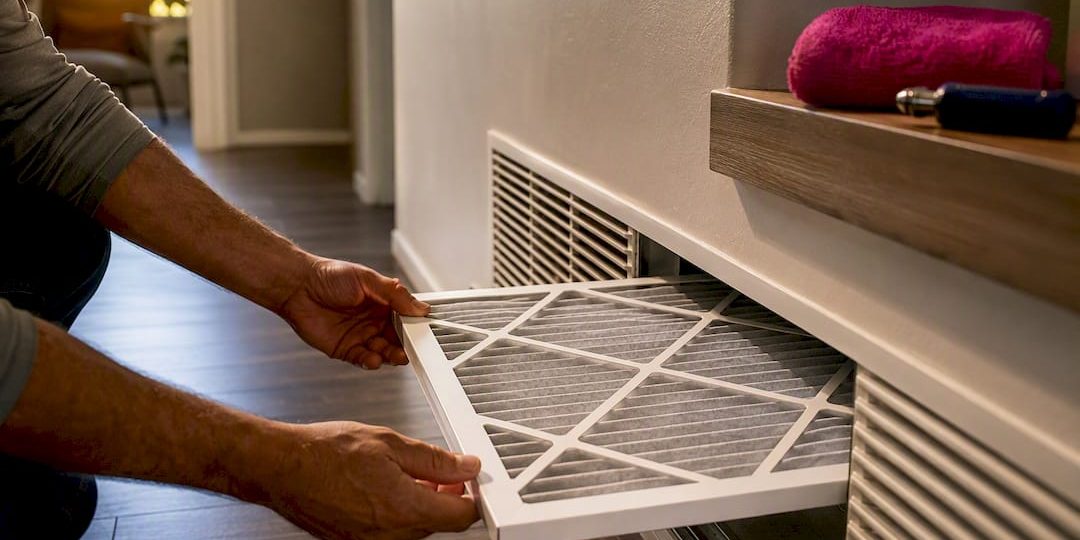
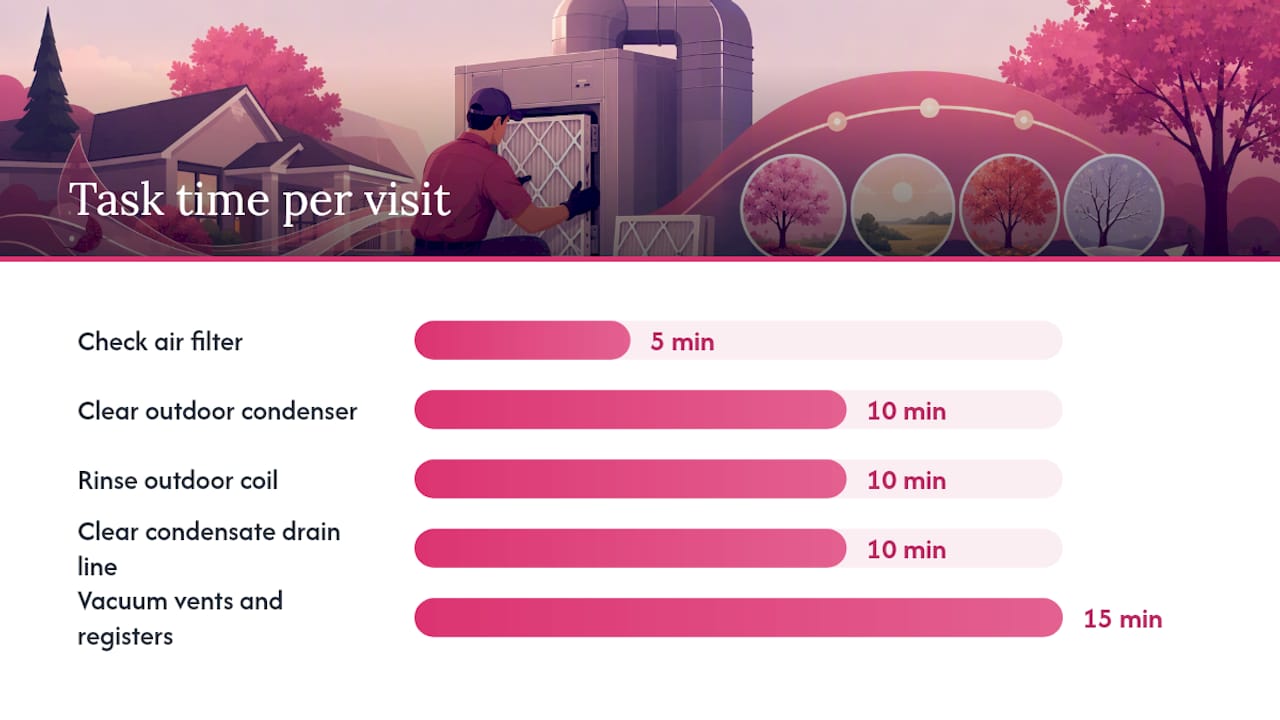
- Check the air filter (5 minutes, monthly, easy). Pull it out and hold it up to a light. If you can’t see light through it, replace it. Standard fiberglass filters need changing every 30 days; pleated filters can often stretch to 60 or 90 depending on pets, dust, and usage, according to ENERGY STAR.
- Clear the outdoor condenser (10 minutes, monthly in growing season, easy). Remove leaves, grass clippings, and dirt within two feet of the unit. Restricted airflow around the condenser is one of the most common causes of poor cooling performance.
- Rinse the outdoor coil gently (10 minutes, quarterly, easy). A garden hose on a light spray, sprayed from the inside out, clears dust buildup. Never use a pressure washer; it bends the fins.
- Clear the condensate drain line (10 minutes, quarterly, easy to moderate). A wet-dry vac at the outdoor termination point pulls out algae clogs before they cause water damage indoors.
- Vacuum vents and registers (15 minutes, quarterly, easy). Dust buildup here restricts airflow and forces the system to work harder for the same result.
- Test your thermostat programming and CO detector batteries (10 minutes, twice a year, easy). Do this alongside your seasonal tune-up bookings so you don’t forget.
- Visually inspect accessible ductwork (10 minutes, twice a year, easy). Look for disconnected joints or crushed sections in the attic or basement. Anything beyond a visual check is a job for a pro.
Tools: a flashlight, a shop vac, a garden hose, and a spare filter on hand at all times.
Pro Tip: Write the filter size in permanent marker on the return air grille. It saves you a trip back inside to check the old filter when you’re standing in the hardware store aisle.
What Happens During a Spring AC Tune-Up
A real spring tune-up typically takes between three-quarters of an hour to an hour and a half and covers multiple critical checks. Here’s what a competent technician should do:
- Clean the indoor and outdoor coils
- Check refrigerant charge and pressure (licensed technicians only)
- Test electrical connections and measure amp draw on the compressor and fan motor
- Lubricate moving parts like motor bearings
- Inspect and clear the condensate drain
- Calibrate the thermostat
- Run a full system startup and cooling performance test
Pricing shapes vary by region and scope, but a single visit commonly falls in the $75 to $250 range, according to HVACDatabase. Ask the technician for written notes or photos of anything found, especially refrigerant readings and amp draws. That documentation matters later if you file a warranty claim or sell the house, since manufacturers often require proof of regular maintenance to honor coverage.
What Happens During a Fall Heating Tune-Up
Fall visits are about safety first, efficiency second. A furnace or heat pump running with a hidden problem doesn’t just waste energy. It can put carbon monoxide into your home.
- Inspect the heat exchanger for cracks or corrosion
- Test burner ignition and flame pattern
- Check the flue and venting for blockages or leaks
- Run a carbon monoxide safety test
- Clean and adjust the blower assembly
These checks are safety-critical, not optional upsells. A cracked heat exchanger can leak combustion gases into the air stream, and a blocked flue can back up carbon monoxide into the house. Book this visit in September or early October, before the first cold front sends every homeowner in your area scrambling for the same appointment slots. Keep the technician’s report on file. It’s the same documentation a home inspector or insurance adjuster will want to see if a heating-related claim ever comes up.
Red Flags That Need a Professional Right Away
Some symptoms mean stop troubleshooting and call someone licensed. Grinding or screeching noises, a system that short-cycles (turning on and off every few minutes), a sudden jump in your utility bill with no change in usage, water pooling near the indoor unit, or a carbon monoxide alarm going off all warrant an immediate professional visit, not a wait-and-see approach.
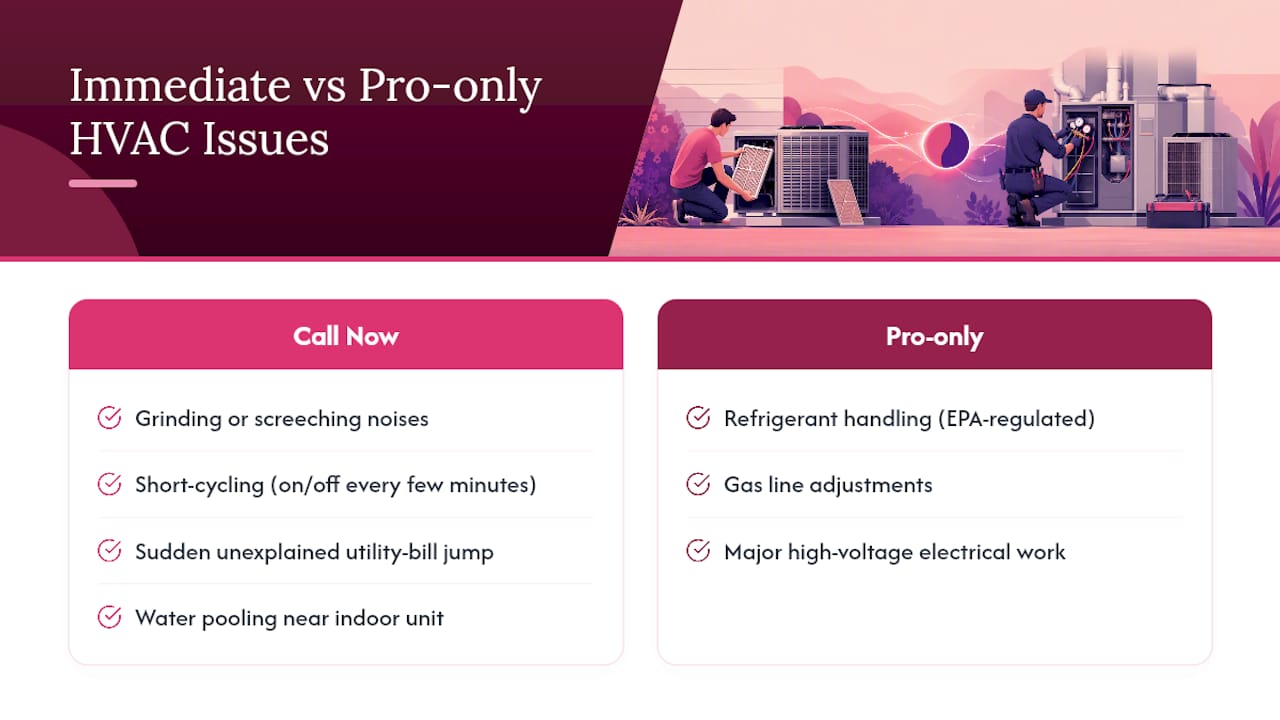
Certain tasks are pro-only regardless of how handy you are. Refrigerant handling is regulated under EPA rules and requires certification to purchase or work with. Gas line adjustments and major electrical work carry real fire and carbon monoxide risk if done wrong, which is why Business Insider’s HVAC guide draws a hard line between filter changes and anything involving gas, refrigerant, or high-voltage components.
A documented maintenance log, kept from your first tune-up onward, supports both warranty claims and resale value when a system eventually needs replacement or repair under coverage.
Maintenance Plans, Costs, and Keeping the Schedule on Track
Homeowners generally choose one of two paths: pay per visit, or enroll in an annual plan that bundles two seasonal tune-ups. Plans typically add priority scheduling during heat waves and cold snaps, plus discounts on repairs, which is often where they pay for themselves compared to two separate ad-hoc service calls, according to Trane’s maintenance guidance.
- Set two recurring calendar reminders now: one for March/April, one for September/October
- Add a monthly reminder for filter checks, tied to whatever day you pay rent or a mortgage
- Keep every service report, even the ones that turn up nothing wrong
- Ask a prospective provider how many visits are included, what’s covered in each visit, and their typical response time for emergency calls
When comparing plans or one-off visits, check the real cost breakdown so you know what you’re paying for versus what’s marketed as an add-on.
What Technicians Actually Find on a First Visit
Those three issues rarely show up as an emergency. They show up as a slow creep in your utility bill and a system that runs longer than it should to hit the same temperature. Tru Comfort’s NATE-certified technicians, maintenance plans, and emergency service availability exist because most HVAC failures aren’t sudden. They’re the result of six months of small things nobody checked.
Why Most Homeowners Get the Timing Wrong, Not the Tasks
The tasks in a good maintenance schedule aren’t complicated. Change the filter, clear the condenser, book two seasonal visits. Where homeowners actually go wrong is timing: waiting until the AC struggles on the first 100-degree day to call for a tune-up, or ignoring the furnace until a cold snap forces the issue.
That reactive pattern is exactly backward from what ENERGY STAR and the Department of Energy both recommend, which is booking the visit before the season demands it, not after. A tune-up in March costs the same labor as one in June, minus the wait and the higher odds of a breakdown mid-heat wave.
If there’s one habit worth building over any other, it’s the calendar reminder for filter checks. It’s the cheapest task on this whole list and the one most consistently skipped. A $15 filter changed on schedule does more for your system’s lifespan than almost anything a technician does during a once-a-year visit, simply because it works every single day the system runs, not just twice a year.
Tru Comfort’s Seasonal Maintenance Plans
A local service provider offers an alternative to piecing together tune-up appointments on your own every year. Instead of remembering to call twice a year and hoping for an open slot, an annual plan locks in your spring and fall visits automatically, with priority scheduling ahead of the seasonal rush and discounts on any repairs a visit turns up.

Some maintenance plans include two seasonal tune-ups, priority booking during heat waves and cold fronts, repair discounts, and access to emergency service when something goes wrong outside the normal schedule. Before you call, have your system’s make and model and the date of your last service ready, if you know it. If you’re not sure whether your current setup needs a repair, a tune-up, or something bigger, the AC maintenance checklist is a useful starting point, and homeowners weighing whether their whole system is due for a bigger fix can also review when to replace heating and air conditioning. Ready to get on a real schedule instead of guessing? Reach out to Tru Comfort to enroll in a maintenance plan or book your next seasonal visit.
Sources
- Maintenance Checklist | ENERGY STAR
- Guide to Home Heating and Cooling (DOE)
- How to schedule seasonal HVAC maintenance (HVACDatabase)