

Identify Supply vs Return Vents in 4 Fast Checks for Homeowners
A supply vent blows conditioned air into a room; a return vent pulls room air back toward the HVAC system to be filtered and reconditioned. Supply vents usually sit smaller with adjustable slats you can angle or close, while return vents are larger, fixed, and often hold the filter. If you’re not sure which is which, the fastest way to check is the hand or paper test, covered next.
TL;DR:
- Return vents are typically larger, fixed, and located near the floor or hallway to pull back air efficiently, while supply vents are smaller with adjustable slats aimed to distribute conditioned air.
- Blocking or closing returns or supplies can cause increased duct pressure, system strain, longer run times, and uneven temperatures, especially when done repeatedly or excessively.
- Proper return sizing, usually 1.5 times the duct cross-sectional area, and adequate airflow paths in each room are crucial for energy efficiency and filtration effectiveness.
- DIY fixes like blocking vents or stacking boxes are unsafe and can lead to duct noise, system damage, or coils freezing, requiring professional diagnostics for persistent issues.
- Homeowners should prioritize simple maintenance like regular filter changes and grille cleaning but seek qualified technicians for pressure imbalance, duct leaks, or ongoing discomfort.
Table of Contents
- Supply vs Return Vents: The Hand and Paper Test
- Where Supply and Return Vents Sit in a Typical Home
- Why Both Vent Types Matter for Comfort and Air Quality
- Common Vent Problems and Safe Fixes You Can Try First
- Basic Vent Maintenance Homeowners Can Handle
- When a Vent Problem Needs a Technician, Not a DIY Fix
- What Homeowners Get Wrong About Vent Balancing
- Getting Professional Help With Vent and Duct Issues
- Sources
- FAQ
Supply vs Return Vents: The Hand and Paper Test
You don’t need any tools to identify a vent correctly. With the system running (heat or air conditioning, either works), try this:
- Hold your hand a few inches from the grille.
- Feel for airflow direction. Air moving out means supply. Air pulling toward the grille means return.
- No system running? Hold a single sheet of paper or a tissue near the opening instead. A supply vent pushes the paper away; a return vent pulls it flat against the grille.
- Check for physical dampers. If you can see and adjust angled slats or a lever, it’s almost certainly supply.
Visual cues back this up, but they’re not absolute:
- Supply vents are usually smaller, with adjustable slats you can angle or close.
- Return vents are larger, fixed grilles, frequently with a removable panel hiding the air filter.
- Ceiling returns are common in single-story homes with a central air handler in the attic.
- Floor-level supply registers show up in older homes with gravity or radiator-converted duct systems.
- A return vent with no filter slot usually means the filter lives at the equipment instead.
If a room has no return vent at all, that’s not necessarily a mistake. Many homes use one central return per floor rather than one per room.
Where Supply and Return Vents Sit in a Typical Home
Supply vents tend to live high on a wall or in the ceiling, aimed to spread air across a room before it settles. Return vents show up in hallways, on lower walls, or near the floor, positioned to pull air back efficiently as it cools or warms and drifts downward.
Size differences aren’t cosmetic. A return grille handles the airflow volume for an entire zone or floor, not just one room, so its face area has to be larger to avoid choking the system.
- Hot climates like Arizona often favor ceiling supply registers to push cool air down efficiently.
- Older homes built before central air retrofits sometimes retain floor registers from a converted gravity furnace system.
- Multi-story homes usually need at least one return per floor, not just one for the whole house.
None of these variations mean a system is wrong. They just reflect the era and layout a house was built around.
Why Both Vent Types Matter for Comfort and Air Quality
Supply and return vents work as a pair, not independently. Supply vents deliver conditioned air; return vents complete the loop by pulling that air back to the equipment, where it passes through the filter and gets reheated or recooled. Starve one side of that loop and the whole system suffers.
A blocked or undersized return forces the blower to work harder against resistance it wasn’t designed for. The results show up fast: longer run times, uneven room temperatures, and a filter that’s straining to clean air it barely has room to pull through.
Return sizing has real engineering behind it. Building America guidance recommends return grille net free area run roughly 1.5 times the cross-sectional area of the return duct, with face velocity kept under set thresholds to limit pressure loss.
- Every room with a supply register needs a clear return path, whether that’s a dedicated grille, a transfer grille, or a properly sized duct.
- Restricted returns don’t just waste energy. They can measurably reduce filtration effectiveness because less air moves through the filter media per cycle.
- A door undercut alone rarely counts as adequate return path in a tightly built, energy-efficient home, as explained in how new interior doors improve energy efficiency in older Portland homes.
Common Vent Problems and Safe Fixes You Can Try First
Closing supply registers to “push more air” somewhere else, or stacking boxes in front of a return, feels harmless. It isn’t. Both actions spike static pressure in the ductwork, and that pressure has to go somewhere: a noisier blower, a stressed motor, or in cooling mode, a frozen evaporator coil.
Start with the low-risk checks before touching anything mechanical:
- Confirm nothing is physically blocking the grille (furniture, rugs, curtains, boxes).
- Open all supply registers fully rather than closing several to “redirect” airflow.
- Feel for the expected suction or airflow at each vent to confirm it matches its labeled function.
- Check that the return’s filter access panel isn’t painted shut or wedged behind trim.
Pro Tip: If a room runs hot or cold no matter what you do with the vents, don’t keep closing others to compensate. That’s exactly the behavior that spikes duct pressure and shortens equipment life.
Medium-term fixes that actually address the root cause include installing a transfer grille above a door, adding a proper door undercut sized for airflow (not just clearance), or having a technician install a passive airflow regulator at a register neck. If closing vents hasn’t solved uneven room temperatures after a season, the issue is almost always pressure balance, not vent count.
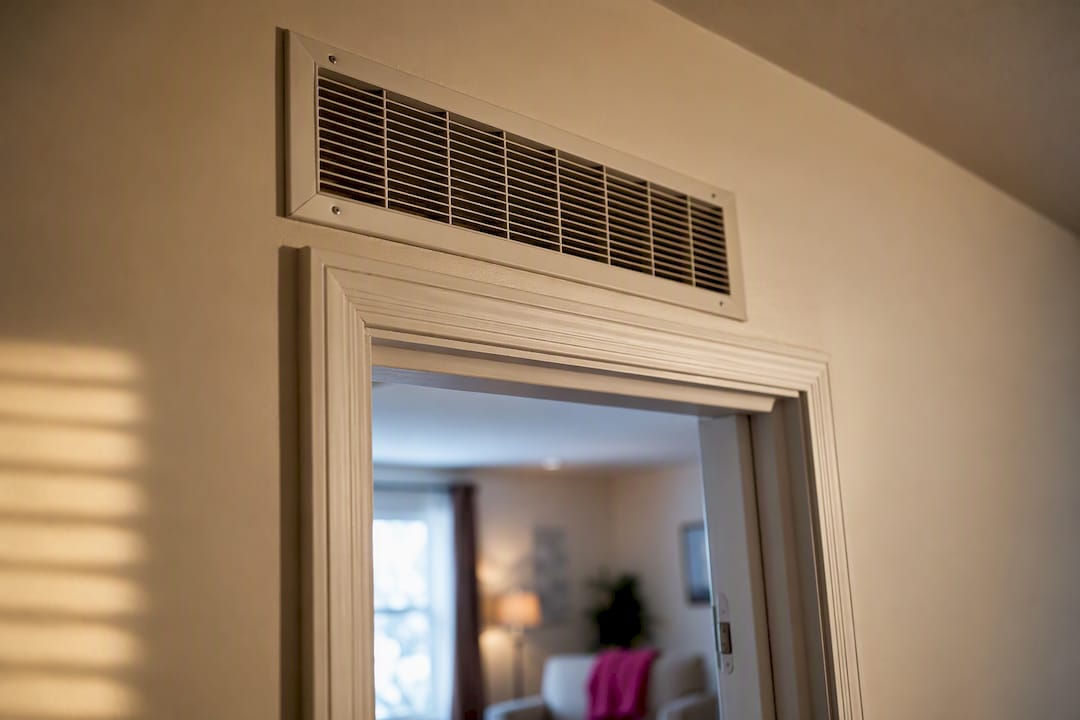
Basic Vent Maintenance Homeowners Can Handle
Grilles and filters are the two maintenance jobs within easy reach for most homeowners, and neither requires tools beyond a screwdriver and a vacuum.
- Vacuum grilles monthly with a brush attachment to clear dust buildup, and wash removable metal covers with soap and water every few months.
- Replace standard filters every one to three months, more often with pets or allergy concerns; check manufacturer guidance before upgrading MERV rating, since a denser filter can restrict airflow if the system wasn’t sized for it.
- Schedule duct cleaning, duct sealing, or professional airflow balancing if grilles stay dusty fast, rooms won’t hold temperature, or you notice whistling at the vents.
Because return vents often house the filter access point, keeping that panel clear makes the whole maintenance routine faster. A maintenance checklist helps keep the schedule consistent instead of reactive.
When a Vent Problem Needs a Technician, Not a DIY Fix
Some symptoms point past anything a grille cleaning or filter swap can solve. Persistent hot or cold rooms despite balanced-looking vents, whistling or rattling ductwork, a system that short cycles on and off, or ice forming on the evaporator coil all signal a pressure or duct problem that needs measurement equipment, not guesswork.
A qualified technician checks things a homeowner can’t easily verify: static pressure readings, duct leakage, whether the return is actually sized for the system’s airflow demand, and whether manual balancing dampers need adjustment. Qualified technicians provide this kind of diagnostic work and offer emergency service when a coil freeze or short-cycling issue can’t wait for a scheduled slot.
- Rooms that stay uncomfortable no matter how vents are adjusted
- Ductwork noise that gets louder over time
- Visible ice or frost on indoor coil components
- A system that’s replaced filters and cleaned grilles but still underperforms
If ductwork itself turns out to be undersized or leaking, that’s a repair job, not a vent-adjustment job.
What Homeowners Get Wrong About Vent Balancing
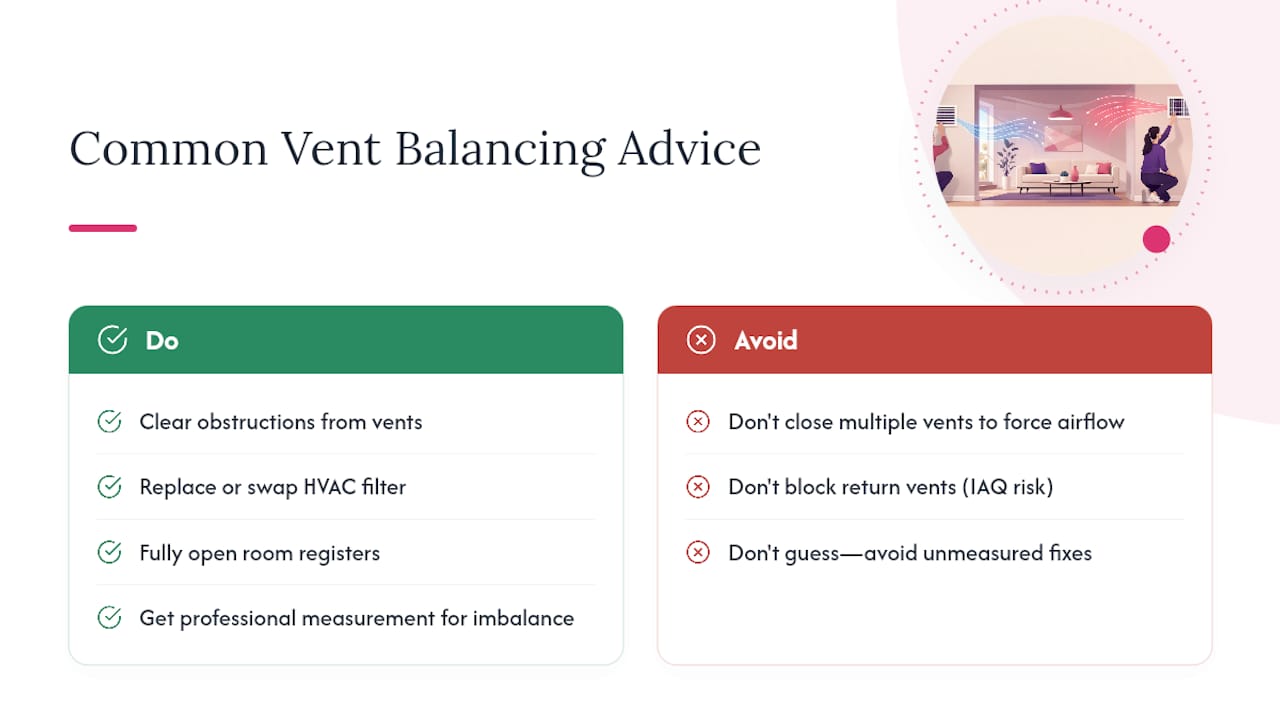
The most common mistake isn’t ignorance. It’s overcorrection. People notice one room running hot, close three vents in other rooms to “push air there,” and wonder why the system gets louder and the hot room stays hot anyway.
Most vent problems have a small, safe fix: a cleared obstruction, a swapped filter, a fully opened register. But pressure imbalance, undersized returns, and duct leaks need actual measurement, and that’s where guessing stops helping. Blocking a return to quiet a room is never worth the indoor air quality tradeoff.
Getting Professional Help With Vent and Duct Issues
If you’ve done the paper test, cleared the obstructions, swapped the filter, and a room still won’t hold temperature, the problem is usually in the ductwork or the balance between supply and return, not the vents themselves. That’s a different job than tightening a damper.

Trucomfortaz handles the diagnostics homeowners can’t do with a hand test alone: static pressure readings, duct leakage checks, return sizing evaluations, and manual balancing damper adjustments. When the fix calls for a transfer grille, additional ductwork, or a properly sized return path, their technicians install it correctly the first time instead of leaving you to guess at a solution from a forum post. For readers dealing with a room that’s chronically too hot or too cold, or a system that’s been closing vents to compensate for years, scheduling an HVAC inspection is the direct next step. It’s a paid service, not a DIY substitute, but it’s the option that actually measures the problem instead of guessing at it.
Sources
- Advanced Strategy Guide: Air distribution basics and duct design (Building America)
- Pressure Balancing Supply and Return Ducts in Existing Homes | Building America Solution Center (PNNL)
- Return air vent importance | Trane
FAQ
How do I know if my vent is supply or return?
Hold your hand or a sheet of paper near the grille while the system runs. If air blows out or the paper is pushed away, it’s supply; if air is pulled in or the paper sticks to the grille, it’s return.
What is the $5,000 rule for HVAC systems?
Some technicians use rough guidelines to help homeowners decide between repair and replacement, considering repair cost and system age, but a technician’s assessment of your specific system matters more than any fixed number.
How far away should a return vent be from a supply vent?
There’s no single required distance, but returns and supplies should be positioned so conditioned air has to travel through the room before being pulled back, rather than short-circuiting directly from one to the other. A technician evaluating your layout can confirm whether placement is causing poor circulation.
Can I use a return grille for supply?
No. Return grilles lack the dampers and airflow design supply vents need to direct conditioned air properly, and swapping their function can throw off the system’s pressure balance. If a room needs an additional supply outlet, that requires a properly installed duct run, not a repurposed return grille.