Summer AC Prep: A Practical Checklist for Arizona Homes
The best way to prepare your AC for summer is to do the simple jobs yourself in early spring (change the filter, clear the outdoor unit, check the thermostat and drain) and book a professional tune-up before the first heat wave. In the desert Southwest, the cooling season starts early and runs long, so a system that fails in June is a system that was never checked in March. Here is what to do, in what order, and what to leave to a licensed technician.
TL;DR
- Replace or clean the air filter now, then check it monthly through the cooling season, per ENERGY STAR guidance.
- Clear weeds, leaves and debris from around the outdoor unit, and rinse the coils gently with a garden hose, never a pressure washer.
- Test the thermostat and the condensate drain before you need them, and watch for weak airflow, warm air or odd noises.
- Book a pre-season professional check-up in spring, before the summer rush. Refrigerant work belongs to a certified technician only.
- Have an old system (12+ years) evaluated before it quits in July.
Table of Contents
- Why spring prep matters more in Arizona
- Step 1: Replace or clean the air filter
- Step 2: Clear and clean the outdoor unit
- Step 3: Check the thermostat
- Step 4: Look at the condensate drain
- Step 5: Walk the ductwork and vents
- Step 6: Turn it on early and test it
- What to leave to a professional
- When prep reveals it is time to replace
- Let us handle the prep
- FAQ
- Sources
Why spring prep matters more in Arizona
Nearly half of the energy used in a home goes to heating and cooling, according to ENERGY STAR. In a climate where your AC may run most of the day for months, small problems become expensive ones. A dirty coil makes the system run longer. A clogged drain can cause water damage. A struggling system fails on the hottest afternoon, which is also when every repair company is booked solid.
The agencies that publish guidance on this agree on the basics. The U.S. Department of Energy says to have air conditioners inspected in spring, and ENERGY STAR advises checking the cooling system in spring to avoid the summer rush. The EPA also lists annual pre-season check-ups among the steps that keep cooling equipment dependable during extreme heat.
A practical timeline for our area:
| When | What to do |
|---|---|
| Late winter to early spring | Replace the filter, clear the outdoor unit, test the thermostat, schedule a professional tune-up |
| Before the first hot stretch | Run the system for a full cycle and watch for problems |
| All summer | Check the filter monthly, keep the drain and outdoor unit clear |
| Early fall | Check for wear after a hard season and plan any replacement |
For a deeper look at frequency, see our guide on how often to do regular maintenance on a house AC unit.
Step 1: Replace or clean the air filter
This is the cheapest and most effective job on the list. ENERGY STAR recommends that you inspect, clean or change filters once a month, and warns that a dirty filter can raise energy costs and damage equipment, leading to early failure. The Department of Energy notes that routinely replacing or cleaning filters can lower an air conditioner’s energy use by 5 to 15 percent.
How to do it:
- Turn the thermostat to off.
- Find the filter slot at the return grille or at the air handler. Note the size printed on the frame.
- Slide out the old filter and check the arrow, which shows the airflow direction.
- Insert the new filter with the arrow pointing toward the air handler or furnace, away from the return.
- Write the date on the frame so you know when it was last changed.
Homes with pets, dust from desert winds or nearby construction clog filters faster than the average. Our HVAC maintenance schedule for homeowners explains how to choose between changing every month or every few months based on your household.
Step 2: Clear and clean the outdoor unit
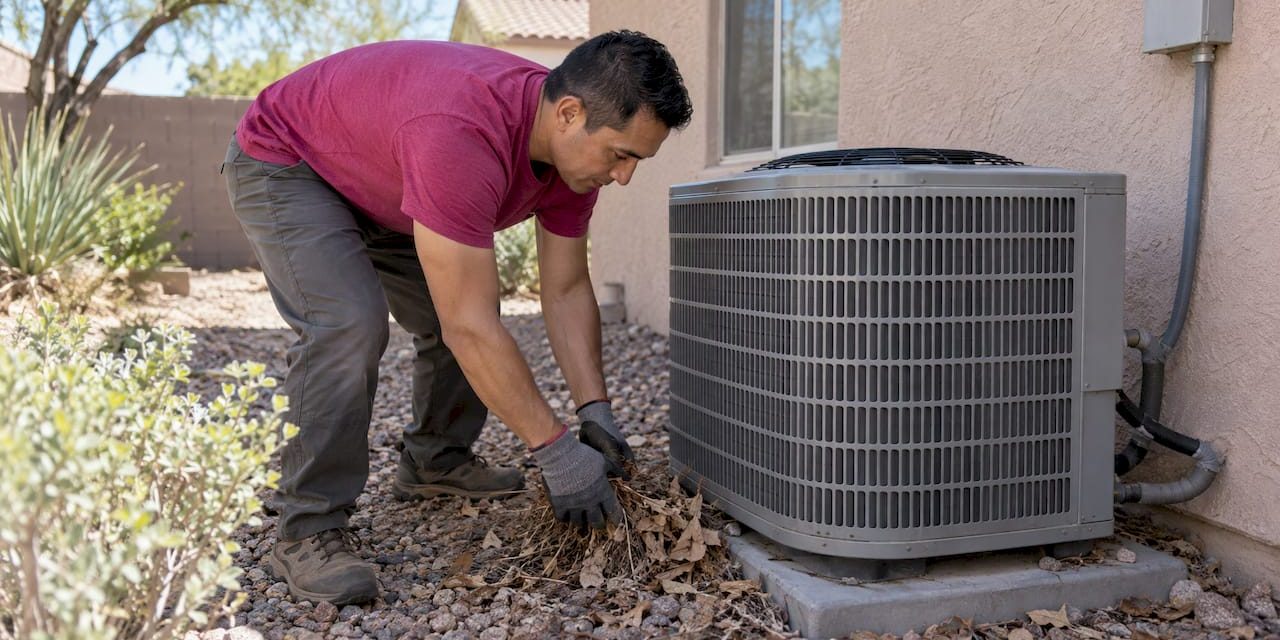
The outdoor condenser has one job: dump the heat pulled out of your house. If plants, leaves, or storage items crowd it, it cannot do that well. The Department of Energy advises clearing weeds and debris around outdoor units, and Carrier suggests keeping a two-foot radius around the condenser free of debris and overgrown vegetation.
If you want to know exactly how much room different unit layouts need, we cover it in AC condenser clearance.
A safe way to clean it
- Shut off power at the disconnect box next to the unit and at the breaker.
- Remove leaves, cottonwood fluff and trash from the top and sides.
- Brush the fins gently with a soft-bristle brush, moving up and down, not side to side, as The Spruce explains. Fins bend easily.
- Rinse with a garden hose. Lowe’s cautions against a pressure washer because the force can damage the fins.
- Let it dry before restoring power.
The EPA also lists washing dust and dirt from cooling coils as part of seasonal prep. If the coils look heavily caked, or the fins are flattened in patches, that is a job for a technician with the right coil cleaner and fin comb.
Think about sun and shade
Shade helps, but the order matters. Before you plant anything near the unit, read our advice on shading your house before shading the AC unit, which explains the clearance to keep. The same logic applies to your roof and windows: less heat coming in means less work for the compressor. If you are planning bigger upgrades, look at energy-efficient roofing options and insulating windows that cut household energy use.
Step 3: Check the thermostat
A thermostat that reads wrong or is set poorly makes the whole system look bad. ENERGY STAR says to check thermostat settings so the system keeps you comfortable at home and saves energy while you are away.
Quick tests:
- Replace the batteries if your model uses them.
- Set the temperature several degrees below the room temperature and confirm the system starts and the vents blow cool air.
- Make sure no lamp, TV or other heat-producing appliance sits near the thermostat. The Department of Energy notes that such devices can make the air conditioner run longer and more often.
- Check that the schedule matches your summer routine, not your winter one.
A ceiling fan lets you raise the thermostat setting by about two degrees without losing comfort, which can cut cooling costs by up to 14 percent. ENERGY STAR also says homes with high bills, or empty for much of the day, can save roughly $100 a year with a certified smart thermostat, per the Department of Energy.
One more setting worth knowing: the fan setting. Depending on your blower motor type, the right choice changes. We explain it in thermostat fan setting for PSC vs ECM.
Step 4: Look at the condensate drain
Your AC pulls moisture from the air, and that water has to go somewhere. A blocked drain line can back up into the pan and cause water damage near the air handler. ENERGY STAR lists checking and inspecting the condensate drain on its maintenance checklist, and the Department of Energy recommends checking the drain too.
What you can do yourself: look at the drain line outlet for dripping when the system runs, check the pan under the indoor unit for standing water, and look for stains or musty smells near the air handler. If you see water in the pan or the line seems clogged, have a technician clear it. A drain problem ignored through July becomes a ceiling stain by August.
Step 5: Walk the ductwork and vents
Open every supply vent and make sure furniture, rugs or curtains are not blocking it. Then look at any ducts you can see in the attic or garage for disconnected, crushed or sagging sections, something the Department of Energy specifically tells homeowners to check.
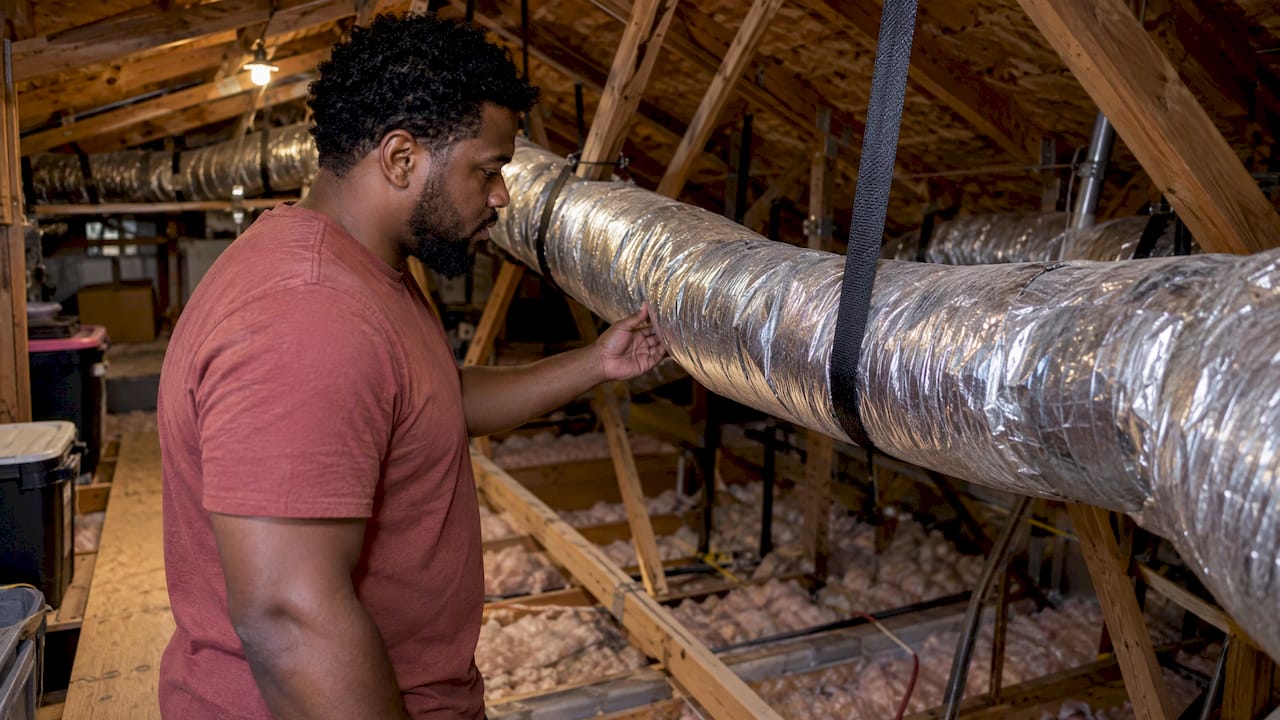
This matters because ducts are where cooled air gets lost. ENERGY STAR says sealing and insulating ducts can improve heating and cooling efficiency by as much as 20 percent, and sometimes much more. In an Arizona attic, where temperatures climb well above the living space, leaking ducts are especially costly.
If you suspect leaks, read how to fix leaky air ducts and when a pressure test is needed and what duct sealing typically costs. For new or replacement runs, see our air duct installation services.
Step 6: Turn it on early and test it
Do not wait for the first 105-degree day. Run the system on a mild day and walk through the house:
- Does the outdoor fan spin and the air from the vents feel noticeably cool?
- Is airflow strong at every room, or weak at some?
- Do you hear grinding, squealing, rattling or clicking you did not hear last year?
- Do you smell anything burning or musty?
Weak airflow, warm air from vents and unusual noises are the early warning signs Southern Living highlights as reasons to call for professional repair. We list more in ten signs your home AC unit may need maintenance, and if the air is simply not cold, start with our not-blowing-cold-air guide.
If the unit does not restart right away after you switch it off and on, give it a few minutes. Some units deliberately delay the compressor start, as Daikin explains. More on that in the FAQ below.
What to leave to a professional
The homeowner checklist stops where tools, training and licensing begin. ENERGY STAR says annual maintenance should include checking refrigerant levels, cleaning the evaporator and condenser coils, inspecting the condensate drain, tightening electrical connections, and checking system controls. The Department of Energy likewise recommends hiring a certified professional for work beyond basic maintenance.
Refrigerant is not a DIY job
The EPA says refrigerant work should be handled by a technician with Section 608 certification. It also tells homeowners to ask that leaks be located and repaired rather than just topping off the system, and it prohibits intentionally venting refrigerant. See the EPA’s homeowner FAQ. If a contractor offers to just add refrigerant every spring, ask where the leak is.
What a good pre-season visit covers
- Thermostat settings and controls
- Electrical connections and the system’s start, run and shutoff cycle
- Indoor and outdoor coil cleaning
- Refrigerant charge check
- Condensate drain inspection
- Blower adjustments for proper airflow
That list follows the ENERGY STAR guide to energy-efficient heating and cooling. For a printable version of the whole routine, use our AC maintenance checklist. Property managers can use the commercial HVAC maintenance checklist for larger buildings.
Note that under ANSI/ACCA 4 QM, contractors are responsible for inspecting systems and recommending corrective actions, while homeowners remain responsible for required maintenance. In plain terms: the tech tells you what the system needs, and the follow-through is yours.
Our perspective
We see the same pattern every spring. A homeowner calls in June because the house will not cool, and what we find is a filter that has not been changed in a year, a condenser buried in weeds, or a drain line that clogged months ago. None of it is exotic. All of it was cheaper to fix in March.
That is why we believe in doing the small things early and booking a real inspection before the season, not after the breakdown. Our technicians are NATE-certified and non-commissioned, so when we tell you your system needs something, the recommendation is built around your home, not a sales target. If your system is fine, we will say so.
We also think a maintenance relationship beats a string of emergency calls. That is the idea behind our Tru Comfort Advantage maintenance plans: regular attention, fewer surprises, and a technician who already knows your equipment.
When prep reveals it is time to replace
Sometimes the checklist turns up a bigger answer. ENERGY STAR advises that if your air conditioning system is more than 12 years old, replacing it with an ENERGY STAR certified unit may cut cooling costs by up to 30 percent. Age is only one factor. Repeated repairs, uneven cooling and rising bills matter too.
If you are weighing it, our guides on when to replace heating and air conditioning and the best time to replace an AC lay out the decision. And if you do replace, do not approve the work blind: read what to require on an installation, including Manual J, AHRI matching and a test-out. Replacing a system in spring, before the rush, also gives you more scheduling choice than doing it in a July emergency.
Renters have a different question: who handles all this? See how long a landlord has to fix AC.
Let us handle the prep
If you would rather have a professional run the whole checklist, we provide air conditioner maintenance, repair and installation for homes and businesses in New River and the surrounding area. Our technicians are NATE-certified and non-commissioned, and our Tru Comfort Advantage maintenance plans are designed to keep your system on a regular schedule, with added cost savings and peace of mind.

If your system quits in the middle of a heat wave, we also offer emergency HVAC service. Contact us for current scheduling and plan details.
FAQ
What is the 3-minute rule for air conditioners?
Some air conditioners intentionally delay the compressor for about three minutes after a quick restart or mode change, which protects it from excessive restart load, according to Daikin. TOSOT describes the same protection after a power outage or when the unit is switched off and on within three minutes. If your unit does not start right away, wait a few minutes before assuming it is broken. Avoid flipping the breaker repeatedly.
What is the $5,000 rule for AC?
It is a rule of thumb some homeowners use: multiply the system’s age by the repair quote, and if the result is above $5,000, replacement is worth considering. It is a rough guide, not a standard. Age, repair history, refrigerant type and efficiency matter as well, and ENERGY STAR points to the 12-year mark as a time to look at replacement. A technician can give you both numbers side by side.
How early should I schedule summer AC maintenance?
Spring, before temperatures climb. ENERGY STAR recommends annual pre-season contractor check-ups and suggests checking the cooling system in spring to avoid the summer rush. In Arizona, that means scheduling in late winter or early spring, when appointments are easiest to get.
Can I add refrigerant myself if my AC is not cooling?
No. The EPA says refrigerant work should be done by a Section 608 certified technician, and a low charge usually means a leak that should be found and repaired rather than topped off. If your AC is blowing warm air, start with the filter and thermostat, then call a pro.
Sources
- ENERGY STAR: Maintenance Checklist
- ENERGY STAR: Heat & Cool Efficiently
- ENERGY STAR: A Guide to Energy-Efficient Heating and Cooling
- ENERGY STAR: Cooling Factsheet
- U.S. EPA: Extreme Heat
- U.S. EPA: Homeowners and Consumers FAQ
- U.S. DOE: Tips for Lowering Your Cooling Costs
- U.S. DOE: Tips for Lowering Your Cooling Costs (2014)
- U.S. DOE: Guide to Home Heating and Cooling
- U.S. DOE: Energy-Saving Hacks To Beat the Summer Heat
- ACCA Standard 4 QM
- The Spruce: How to Clean an Outdoor AC Unit
- Carrier: How to Clean an AC Unit
- Lowe’s: How to Clean an Air Conditioning Unit
- Southern Living: 6 Things To Do Before You Turn On Your Air Conditioner
- Daikin: Air conditioner does not start immediately