Energy Efficient HVAC in Arizona: What to Buy and Ask
An energy-efficient HVAC system in Arizona is a properly sized, well-installed system with tight ducts and a SEER2 rating above the federal minimum for the Southwest. The rating on the box is only part of it. In a climate where cooling does most of the work, sizing, airflow and duct quality decide whether the efficiency you paid for shows up on your bill.
This guide covers the numbers to know, the installation details that matter most, how to compare brands, and where rebates can take some of the cost off.
TL;DR
- Arizona sits in the DOE’s Southwest region, where new split-system air conditioners under 45,000 Btu/h must be at least 14.3 SEER2.
- A higher rating helps, but installation problems such as oversizing, wrong refrigerant charge and leaky ducts can cancel it out.
- Ask for a Manual J load calculation before anyone sizes your system.
- Compare brands on efficiency at high temperatures, warranty terms, parts support and the quality of the local installer, not on name alone.
- Utility rebates from SRP and TEP, plus income-based programs, can lower the upfront cost. Check each program’s current rules before you sign.
Table of Contents
- Why efficiency works differently in Arizona
- What SEER2 rating to look for in Arizona
- Why installation matters as much as the rating
- How to compare AC brands for Arizona
- Heat pumps in Arizona
- Rebates and incentives that can lower the cost
- A practical efficiency checklist
- Talk to us about your system
- FAQ
- Sources
Why efficiency works differently in Arizona
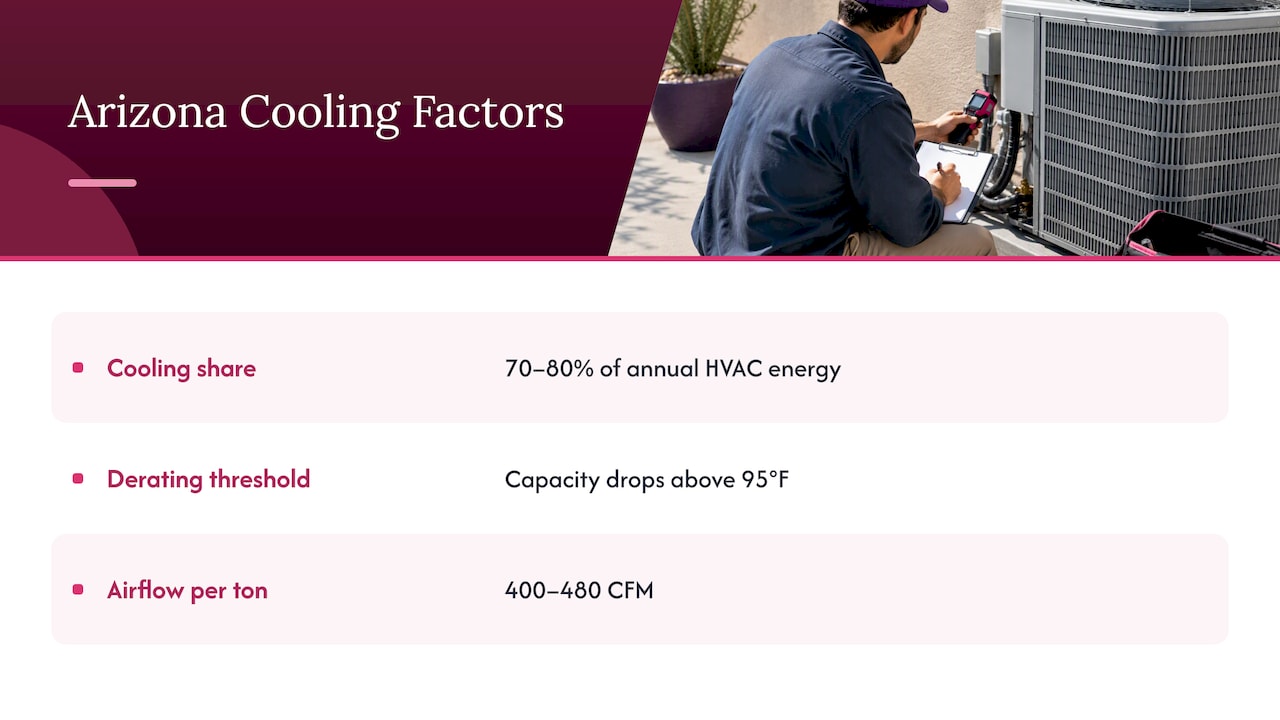
Cooling is the big load here. One industry source puts cooling at roughly 70 to 80% of annual HVAC energy use in the Phoenix Valley, so a few points of efficiency in your air conditioner matter far more than they would in a mild climate.
Heat also changes how equipment behaves. The same source notes that cooling capacity drops noticeably once outdoor temperatures climb above 95°F, a effect called derating. In Anthem and New River, summer afternoons regularly run well beyond that, which is why a system that looks fine on paper can struggle on the hottest days. If you want a sense of what your system faces, we wrote up how hot Anthem and New River get in summer.
The climate is also dry. A U.S. Department of Energy retrofit study for hot, dry climates found that larger indoor coils and airflow of 400 to 480 CFM per ton can improve useful (sensible) cooling, because humidity removal is a smaller part of the job than in the Southeast. A good installer here designs for that, rather than copying a setup built for humid regions.
What SEER2 rating to look for in Arizona
SEER2 is the current way to measure seasonal cooling efficiency. It is the cooling delivered over a season divided by the electricity used, tested under the updated method that ENERGY STAR describes in its central air conditioner specification. Higher is better.
The minimum you cannot go below
Since January 1, 2023, the DOE standard for the Southwest region, which includes Arizona, requires:
| Split-system AC capacity | Minimum SEER2 | Minimum EER2 |
|---|---|---|
| Below 45,000 Btu/h, SEER2 under 15.2 | 14.3 | 11.7 |
| Below 45,000 Btu/h, SEER2 of 15.2 or higher | 15.2 or higher | 9.8 |
| 45,000 Btu/h and above | 13.8 | Not applicable here |
In plain terms, nothing sold today for a typical Arizona home should fall below 14.3 SEER2. The question is how far above it to go.
So what is the best SEER2 for Arizona?
There is no single magic number, and we would not pretend otherwise. Because cooling runs so many hours here, the extra cost of a higher-rated unit tends to pay back faster than in cooler states, and the savings grow the longer you run it. But the rating is measured under standardized conditions. Look at two things beside it:
- EER2. This measures efficiency at a single hot operating point, which is closer to a July afternoon than the seasonal average. In a desert climate, a strong EER2 is worth asking about.
- Staging. Two-stage and variable-speed equipment can run at lower output most of the day, which helps comfort and efficiency, provided it is sized and installed correctly.
A practical way to decide: ask your contractor for the SEER2 and EER2 of two or three options, the installed price of each, and what each would be expected to cost to run for your home. Then pick the point where the extra efficiency stops paying for itself within the time you plan to stay.
Why installation matters as much as the rating
A high number on the nameplate does not guarantee efficient operation. EPA’s HVAC Quality Installation fact sheet says more than half of U.S. residential systems were believed to perform poorly because of installation issues. The DOE’s purchasing guidance lists the usual culprits: oversizing, improper refrigerant charging and leaky ducts, which cause efficiency losses, discomfort and shorter equipment life.
Sizing: bigger is not better
Most homeowners assume a larger unit cools better. In practice an oversized system cools the air quickly, shuts off, and repeats. That short cycling increases compressor wear and lowers seasonal efficiency, and it leaves some rooms uneven.
EPA says proper sizing should use Manual J or an equivalent heat gain and loss calculation, followed by Manual S or an equivalent method for selecting equipment. That is not a rule of thumb based on square footage or a copy of what the old unit was. If an estimate shows up without any load calculation, ask for one. We explain why in our guide on asking for Manual J before sizing, and in what a proper AC installation process looks like.
SRP takes this seriously too: its rebate program requires Manual J load calculations with applications for single-stage systems.
Ducts: where Arizona homes lose the most
Many Arizona homes have ducts running through hot attics. EPA ENERGY STAR says ducts in unconditioned spaces can lose 10 to 30% of heating and cooling energy, and that insulating them or moving them into conditioned space reduces that loss. When your attic reaches extreme temperatures, that is a lot of cooling being wasted before it reaches a room.
A DOE Building America case study from Tucson describes the efficient approach: professional sizing, mastic-sealed and leakage-tested ducts, ducts inside the conditioned envelope, and transfer grilles or a central return to equalize pressure. Another Tucson case study paired a conditioned attic with R-38 roof-deck insulation and modeled 41% energy savings versus the Building America benchmark, even with only 12-SEER equipment. That tells you what ducts and envelope can do.
Sealing and testing ducts is skilled work, and proper air vent and duct cleaning, repair and replacement are part of keeping a system moving air the way it was designed to. If your ducts are old, leaky or undersized, replacing them can do more for your bill than a higher-SEER2 condenser alone. See our air duct services and our ductwork cost per linear foot guide.
The envelope shrinks the system you need
A Phoenix-area ACEEE study found that reducing solar and envelope loads, using low-solar-heat-gain windows, moving the air handler indoors, shortening and insulating ducts, and choosing a more efficient air conditioner reduced the required cooling equipment size by 25% in the prototype home. The study is older, but the logic holds: the less heat your home gains, the smaller and cheaper the system that cools it. Shading also helps the outdoor unit; see how to shade the house before the AC unit and how much condenser clearance it needs.
How to compare AC brands for Arizona
People search for the best AC brand in Arizona and expect a ranked list. We will not give you one, and a list would not serve you well. Most major manufacturers make equipment at several efficiency levels, and a premium unit that is poorly installed will lose to a mid-range unit that is installed carefully. Compare on these factors instead:
- Rated efficiency at your size. Check SEER2 and EER2 for the exact model and capacity, not the brand’s best line.
- Performance in extreme heat. Ask how the unit holds capacity above 95°F, since derating is real in Arizona.
- Compressor and staging type. Single-stage, two-stage and variable-speed units differ in comfort, noise and how well they handle long runtimes.
- Warranty terms. Compare parts and compressor coverage, whether labor is covered, and what registration or professional installation the warranty requires.
- Parts and service support. A brand is only as good as the local availability of parts and trained technicians. Ask who will service it in five years.
- The installer. Credentials such as NATE certification show a technician has been tested on HVAC knowledge, and a company that does a load calculation and tests the finished system matters more than any logo.
- ENERGY STAR certification. It confirms that a model meets ENERGY STAR efficiency criteria, and many rebates require qualifying efficiency ratings.
Also ask how long you can expect the equipment to last in the desert. Our piece on how long AC units last in Arizona and our advice on when to replace an AC can help you time the decision.
Heat pumps in Arizona
Heat pumps cool like an air conditioner and also heat. For Arizona’s mild winters, they are an option many homeowners now consider in place of a furnace and AC pair. If you have a gas furnace, our furnace services cover installation, repair and maintenance. Whichever way you go, the same rules apply: size the system with Manual J, seal the ducts and have the charge and airflow checked at startup.
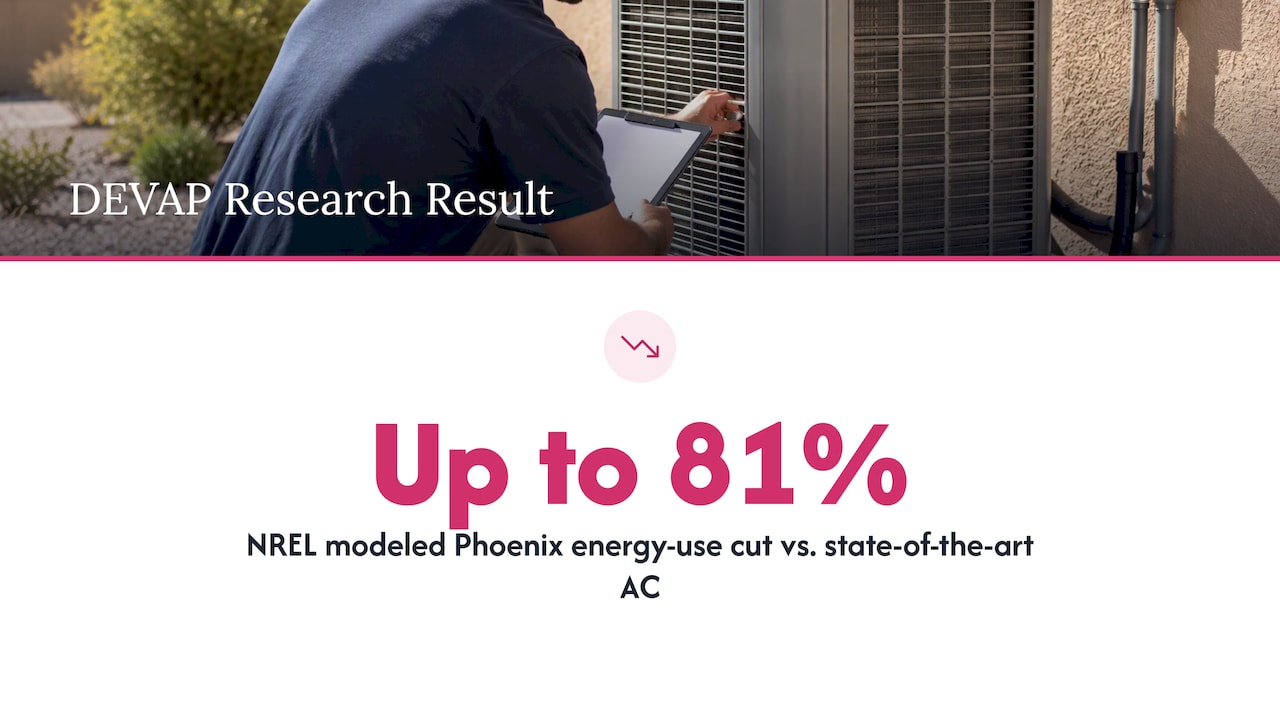
For newer technology, NREL modeled that its DEVAP air conditioner could cut energy use by up to 81% in Phoenix compared with state-of-the-art air conditioning. It is a research result and not a product you can buy at the corner supplier today, but it shows how much room there is to improve cooling in dry climates.
Rebates and incentives that can lower the cost
Efficiency upgrades often come with money back. These programs change, so read each program’s page for current rules and deadlines before you buy.
- SRP. Residential electric customers can receive $75 to $225 per ton for qualifying high-efficiency central AC, heat pumps and mini-splits, installed by a licensed Arizona contractor. The rebate has an end date, so check SRP for the current one. Paperwork mistakes cost people rebates; our SRP rebate checklist walks through it.
- TEP. The Efficient Home Program offers rebates up to $720 for heat pump quality installations and $600 for air conditioner quality installations, when done by a participating contractor.
- Efficiency Arizona. For income-eligible households, TEP’s Efficiency Arizona program provides rebates covering a percentage of costs, up to $14,000 per household, for high-efficiency HVAC equipment and appliances.
- Federal tax credit. Under the Inflation Reduction Act, ENERGY STAR describes savings of up to 30% of project costs and a credit of up to $2,000 for heat pump upgrades. Confirm current eligibility with a tax professional.
Which utility you have matters. SRP and TEP serve different areas, so start with the one that bills you, and ask your contractor whether they are set up for that program.
Our perspective
We are NATE-certified and non-commissioned, and that shapes how we talk about efficiency. When a technician is not paid on what you buy, the honest answer is often the less exciting one: the best upgrade is the one your house actually needs.
In our experience, most efficiency problems we see start before the equipment is chosen. A system gets picked by square footage, the ducts are left as they were, and nobody tests the result. We would rather run a load calculation, look at your ducts, and then tell you whether a higher-efficiency system, a duct repair or a maintenance visit gives you the most for your money.
We also believe in keeping what you install working well. That is why we offer maintenance plans, so the charge, airflow and filters stay where they were set on day one.
Brett
A practical efficiency checklist
- Get a Manual J load calculation before choosing capacity.
- Have your ducts inspected for leaks, poor insulation and crushed runs, especially if they sit in the attic.
- Compare SEER2 and EER2 for two or three options, and ask about staging.
- Confirm refrigerant charge and airflow are measured and documented at startup.
- Check rebate rules with your utility before you sign a contract, since some require pre-approval or specific paperwork.
- Plan maintenance. Following a filter and maintenance schedule and using an AC maintenance checklist keeps performance close to its rating. DOE guidance says regular maintenance, including refrigerant charging and filter replacement, helps maintain peak performance.
- Layer upgrades. ENERGY STAR says HVAC, attic sealing and insulation, and smart thermostats are designed to work together to improve savings and comfort.
Talk to us about your system
If you are replacing an aging system or wondering why your bills are high, we can look at sizing, ducts and equipment options with you. Our NATE-certified technicians do not work on commission, so you get a recommendation based on your home.
See our air conditioner installation, repair and maintenance services, or look at the Tru Comfort Advantage maintenance plans to keep a new system at its rated performance. For a deeper look at upgrades, read our high-efficiency HVAC guide for homeowners.
FAQ
What is the best SEER2 rating for Arizona?
The legal floor for split-system air conditioners under 45,000 Btu/h in Arizona is 14.3 SEER2. Beyond that, a higher rating usually pays back faster in Arizona because cooling runs so many hours. Check EER2 as well, and make sure the system is sized with Manual J, since poor installation can erase the gain.
Which AC brand is best for Arizona?
No single brand wins for every home. Compare the efficiency of the specific model, how it performs in high heat, the warranty terms, local parts and service support, and who installs it. A careful installer and a tested system matter more than the name on the unit.
Is a bigger air conditioner better in the desert?
No. An oversized unit short-cycles, which wears the compressor and lowers seasonal efficiency. A Manual J load calculation sets the right capacity for your home’s size, windows, insulation and orientation.
Can I get a rebate for a new high-efficiency AC?
Often, yes. SRP and TEP both offer residential rebates for qualifying equipment, and income-eligible households may qualify for larger amounts through Efficiency Arizona. Each program has its own equipment, contractor and paperwork requirements, so confirm them before you buy.
Sources
- Arizona Climate and HVAC System Demands
- Retrofitting Air Conditioning and Duct Systems in Hot, Dry Climates (DOE)
- ENERGY STAR Version 6.1 Central Air Conditioner and Heat Pump Specification
- DOE 2023 Central AC Standards FAQ
- ENERGY STAR HVAC Quality Installation Fact Sheet
- Purchasing Energy-Efficient Residential Central Air Conditioners (DOE FEMP)
- ENERGY STAR HVAC Quality Installation Sponsor Guide
- SRP Air Conditioner Rebates
- ENERGY STAR Duct Insulation Fact Sheet
- DOE Building America Case Study: John Wesley Miller Companies
- DOE Building America Case Study: CDC Realty
- Systems Interactions and Energy Savings in a Hot Dry Climate (ACEEE)
- NREL DEVAP Air Conditioning Technology
- TEP Efficient Home Program
- TEP Efficiency Arizona
- ENERGY STAR Home Upgrade Messaging for Service Provider Partners