
Stop a Fire Risk: How Homeowners Spot AC Contactor Failure Fast
The three most reliable signs of a failing AC contactor are the outdoor fan spinning while the compressor stays silent, a loud buzzing or rapid chattering coming from the outdoor unit, and visible pitting or burn marks on the contacts. If you spot any of these, turn off power at the breaker if anything smells hot or looks scorched, then call a NATE-certified technician. HVAC professionals can confirm the diagnosis with tools no homeowner should use unsupervised, per National Electrical Code safety standards.
TL;DR:
- The most reliable signs of a failing AC contactor include visible pitting or burn marks, a loud buzzing, and the outdoor fan running while the compressor remains silent.
- Contactor failure is caused by repeated arcing, corrosion, electrical overloads, or poor installation, which accelerate wear and can lead to welded contacts or sticking.
- Running the system with a faulty contactor poses a fire risk and can cause compressor damage, so burner smells, arcing, or melted wiring require immediate professional repair.
- Homeowners can perform basic visual checks and breaker resets but must leave live voltage testing and contactor replacement to licensed technicians.
- Replacing an AC contactor typically costs a few hundred dollars and has a lifespan of five to ten years under normal conditions.
Table of Contents
- Common Signs of a Bad AC Contactor
- Safe Checks You Can Run Before Calling for Service
- What Actually Causes AC Contactor Failure
- Can You Run the AC With a Bad Contactor?
- Electrical Safety Rules and When to Call a Pro
- How Some HVAC Technicians Diagnose Contactor Problems
- A Straight Answer on What This Really Means for Your AC
- Get a Straight Answer on Your Contactor, Fast
- Sources
- FAQ
Common Signs of a Bad AC Contactor
A contactor is the electromechanical switch that lets your thermostat’s low voltage signal tell the compressor and outdoor fan to turn on. When it fails, the symptoms tend to fall into three buckets: what you hear, what you see, and how the system behaves.
Start with sound. A single click followed by a fading hum usually points to a capacitor problem, not the contactor. But rapid, repeated clicking or a persistent buzz from the outdoor unit while the system tries to start is a classic contactor complaint, often caused by a worn or misaligned contact plate.
Performance issues follow a pattern too. The system that won’t turn on at all, despite the outdoor fan spinning, is telling you the contactor never pulled in to complete the circuit to the compressor. The opposite problem, an AC that won’t shut off even after the thermostat is satisfied, usually means the contacts have welded shut from repeated arcing.
Watch for these observable symptoms:
- Outdoor fan runs, but the compressor stays completely silent
- Clicking, chattering, humming, or buzzing from the outdoor unit
- Short cycling or inconsistent cooling that varies room to room
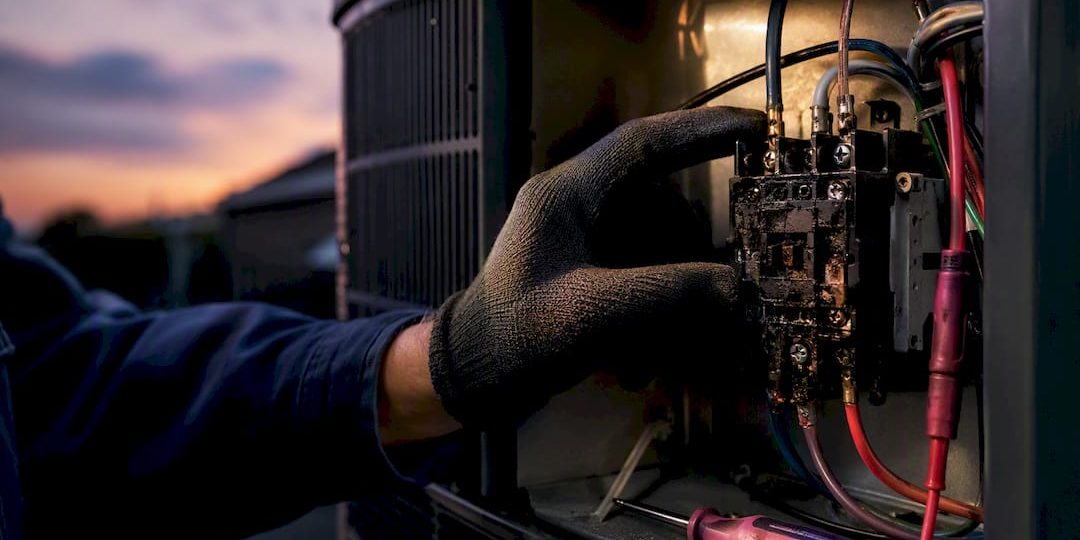
- Visible pitting, burn marks, or a melted plastic casing on the contactor
- Loose, corroded, or scorched wire terminals at the contactor
- Delayed startup, where the system takes several seconds longer than usual to kick on
Contactors commonly fail with exactly this mix of symptoms: intermittent operation, pitted or burnt contacts, sticking, and buzzing during operation, according to a technical primer from Schneider Electric. Visible pitting or burn marks are considered a high-confidence sign that the part needs replacing, not just cleaning.
Safe Checks You Can Run Before Calling for Service
Before you assume the worst, rule out the easy stuff. A dead thermostat battery or a tripped breaker causes symptoms that look identical to contactor failure but cost nothing to fix.
- Check the thermostat. Confirm it’s set to cool, has power, and the temperature setting is actually below room temperature.
- Check the breaker panel. A tripped breaker for the outdoor unit will stop the compressor from ever getting a signal.
- Run the listening test. Stand near the outdoor unit when the system calls for cooling. Silence from the compressor while the fan spins suggests the contactor never closed. A click followed by a hum that fades points toward the capacitor instead, according to troubleshooting guidance from RepairMeYourself. For a deeper look at capacitor-specific symptoms, this AC capacitor failure guide walks through the difference.
- Do a visual inspection with power off. Cut power at the breaker, remove the outdoor unit’s access panel if you’re comfortable, and look for scorch marks, pitting, or a burning smell near the contactor.
Pro Tip: Take a short video of the sound and a photo of anything that looks burned before you call. It cuts diagnostic time down significantly when the technician knows what to expect before they arrive.
Technicians confirm a contactor problem by checking the 24 volt control coil and measuring resistance across the contacts. That’s a job for a meter and training you shouldn’t attempt on live equipment. If your checks above point to the contactor, your homeowner observations are enough. Stop there and schedule service.
What Actually Causes AC Contactor Failure
Contactors don’t fail randomly. Every time the contacts close, a small electrical arc jumps across the gap, and that arc slowly pits and roughens the metal surface. Over thousands of cycles, arcing at the contact points increases resistance and generates heat, which accelerates wear until the contactor sticks, chatters, or fails outright.
Several conditions speed that process up:
- Contact wear and arcing from normal use, worse in systems that short-cycle frequently
- Coil burnout, often from voltage spikes or a control circuit that’s drawing more current than the coil was built to handle
- Contamination, where dust, moisture, or corrosion builds up on the contacts and interferes with a clean connection
- Electrical overloads and voltage spikes, common during storms or on older, shared circuits
- Incorrect sizing or poor installation, which puts constant stress on a part that was never rated for the load
Electrical overloads, mechanical wear, coil failure, and harsh outdoor environments are consistently named as the leading causes of premature contactor failure by ContactorDepot’s technical breakdown. A contactor exposed to Arizona dust and monsoon humidity wears differently than one in a cleaner climate, which is part of why regional maintenance schedules matter.
Can You Run the AC With a Bad Contactor?
Running the system on a pitted or partially welded contactor is a real fire risk. Overheated contacts can melt the surrounding plastic housing, and a welded contactor that won’t release can run the compressor continuously until something burns out or trips a breaker repeatedly.
Light surface pitting sometimes gets cleaned as a stopgap, but chattering, burn marks, or welded contacts mean full replacement, not cleaning. Contactors typically last several years, and replacement is commonly priced in the low hundreds of dollars for parts and labor combined, though costs vary by region and unit. A technician confirms the call with a visual inspection, a resistance test across the contacts, and a check of the 24 volt coil before recommending replacement over repair.
Electrical Safety Rules and When to Call a Pro
Homeowners can safely handle visual checks, thermostat troubleshooting, and breaker resets. Anything involving live voltage testing or contactor replacement belongs to a licensed technician, full stop.
Call immediately if you notice:
- A burning smell near the outdoor or indoor unit
- Visible arcing, sparks, or smoke
- Melted wiring, casing, or insulation
- A breaker that keeps tripping no matter how many times you reset it
Pro Tip: When you call, describe exactly what you heard and saw, including timing (does it happen every startup, or only sometimes?). That detail helps the dispatcher send a tech with the right replacement part already in the truck.
Some HVAC providers staff NATE-certified technicians for this kind of electrical diagnostic work, where a wrong guess risks a bigger repair bill or a real safety hazard.
How Some HVAC Technicians Diagnose Contactor Problems
This guide reflects standard triage logic used by NATE-certified technicians in the field: safe homeowner observations first, then licensed electrical testing, then a repair or replacement decision backed by actual measurements instead of guesswork.
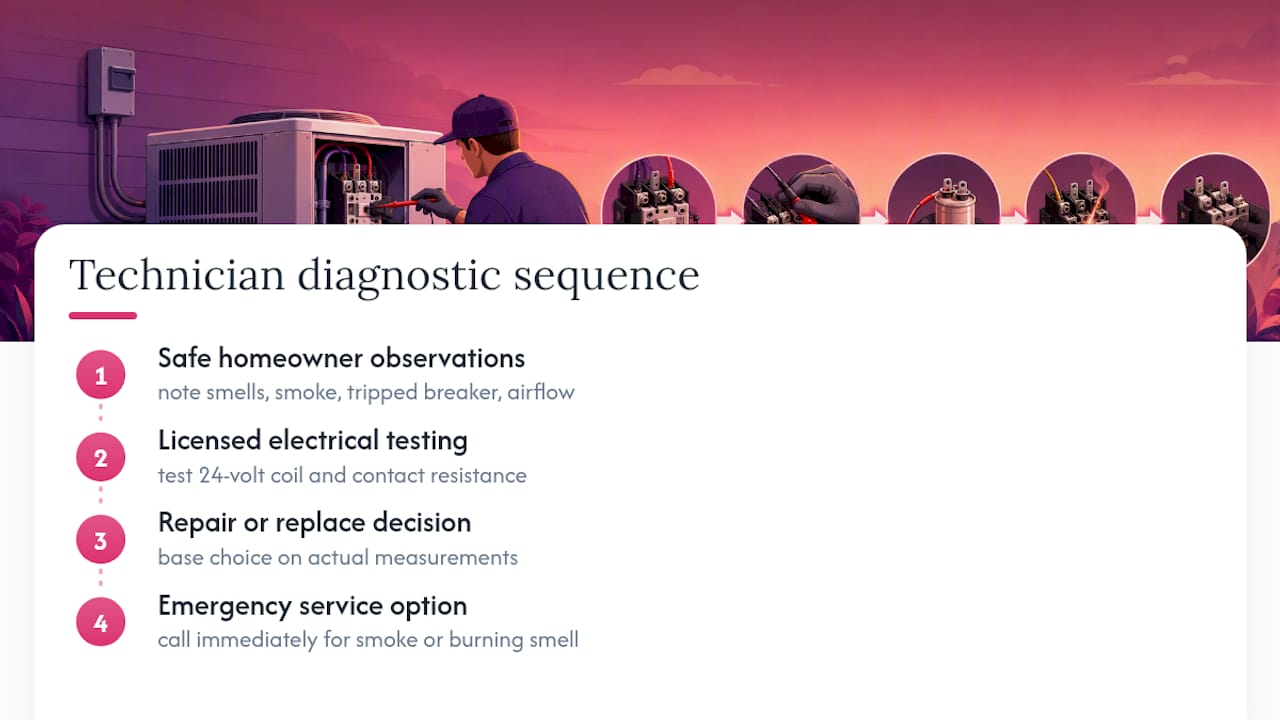
Some HVAC providers also offer emergency service for burning smell, smoke, or tripped breaker scenarios that require immediate attention. If your symptoms point more toward reduced airflow than a dead compressor, the AC not blowing cold air guide and the AC maintenance checklist cover adjacent issues worth ruling out first.
A Straight Answer on What This Really Means for Your AC
Most contactor problems are genuinely fixable, and catching the symptoms early, that chatter, that fan-running-alone silence, saves you from a bigger compressor repair down the line. The electrical part of this job isn’t a DIY afternoon project, and that’s fine. Your job is observation: note the sound, snap a photo if it’s safe to look, and get a professional in before a minor pitting problem turns into a welded contactor and a dead system on the hottest day of the year.
Get a Straight Answer on Your Contactor, Fast
Some family-owned HVAC providers with NATE-certified technicians send technicians who test the contactor with a meter instead of swapping parts on a hunch, and provide transparent estimates before starting any work.

A typical visit starts with the same safety checks covered above: thermostat, breaker, then a live inspection of the contactor and surrounding wiring. If replacement is the right call, you’ll know the cost and the reasoning before the tech touches anything. Start by booking through Trucomfortaz’s air conditioner services page, and if you want to head off the next failure, the AC maintenance checklist outlines the upkeep that keeps contacts clean and coils from burning out early.
Sources
- AC Contactor: Working Principle & How It Works | Schneider Electric
- Why is the AC Fan Running But Compressor Not Starting? (Fixed) | RepairMeYourself
FAQ
Will the AC fan run if the contactor is bad?
Yes. A common contactor failure symptom is the outdoor fan spinning normally while the compressor stays silent, since the fan and compressor draw power through separate paths inside the contactor.
What does it typically cost to replace an AC contactor?
Contactor replacement is commonly priced in the low hundreds of dollars for parts and labor combined, though the exact price depends on your unit and region. Trucomfortaz provides a transparent estimate before starting any repair.
How long do AC contactors usually last?
Most contactors last five to ten years under normal conditions, though heat, dust, and frequent short-cycling can shorten that lifespan considerably.
Can an AC unit run without a working contactor?
No. Without a functioning contactor, the compressor and outdoor fan never receive the signal to start, so the system can’t produce cool air even if the indoor blower still runs.