
Ductwork Lifespan: How Long Ducts Last and When to Replace
Most ductwork lasts 15 to 30 years. A U.S. Department of Energy-backed decision guide puts the range there, and says material, installation quality and the environment around the ducts decide where your system lands. A sheet metal trunk line in a well-sealed home can outlast the furnace and the AC twice over. A flexible duct baking in a desert attic may not.
This guide explains what actually wears ducts out, how to tell a duct that needs sealing from one that needs replacing, what replacement costs, and what to ask before anyone sells you a new system.
TL;DR
- Plan on 15 to 30 years for ducts overall. Flexible duct sits at the short end, rigid sheet metal at the long end.
- Age alone is not a reason to replace. Leaks, crushed sections, wet or missing insulation and poor airflow are.
- Typical homes lose 20 to 30 percent of conditioned air to duct leaks, and many leaky systems can be sealed instead of replaced.
- Replacing a 2,000-square-foot home’s ducts commonly runs $2,000 to $4,500, so get a duct evaluation before you replace an AC or furnace.
- In Arizona, attic heat is the biggest factor shortening duct life.
Table of Contents
- How Long Do Air Ducts Last?
- What Wears Ducts Out
- Signs Your Ducts Need Replacing
- Seal, Repair or Replace?
- What Duct Replacement Costs
- Do Not Replace the Equipment Without Checking the Ducts
- How to Make Ducts Last Longer
- Our Perspective: What We Tell Homeowners About Ducts
- When You Are Ready for a Duct Assessment
- FAQ
- Sources
How Long Do Air Ducts Last?
The honest answer is a range, not a number. Search results will tell you 10 to 15 years in one place and 20 to 30 in another. Both are right for some homes, because they describe different materials in different conditions.
Here is a practical way to read the ranges:
| Duct type | Typical lifespan | What shortens it |
|---|---|---|
| Rigid sheet metal (galvanized steel) | 20 to 30 years or more | Corroded seams, failed mastic, moisture |
| Fiberboard | Often 10 to 15 years | Moisture, physical damage, deteriorating facing |
| Flexible (wire coil, plastic liner, insulation) | Roughly 10 to 20 years | Heat, sagging, kinks, torn jackets |
The flexible and fiberboard figures come from This Old House’s duct replacement guide, which notes that flexible duct is usually the cheapest to install but may not last as long as rigid options. The DOE-backed guide’s 15 to 30 year span covers the whole field.
Notice what is missing from that table: a birthday. Ducts do not expire on a schedule. They fail in specific, observable ways, and most of those failures start at joints, connections and insulation, not in the metal itself.

What Wears Ducts Out
Heat and attic temperatures
Ducts in a vented attic are, for practical purposes, outdoors. A Building America guideline from the Department of Energy describes ducts in unconditioned spaces like vented attics and crawl spaces as losing a significant amount of temperature and efficiency. In Arizona, summer attics get far hotter than the outside air, which cooks plastic liners, dries out sealants and makes insulation jackets brittle. If your home is in New River, Anthem or the surrounding desert, expect flexible ducts in the attic to age toward the short end of any national range.
Failed seals and tape
Most duct problems live at the joints. A common culprit is cloth-backed “duct tape,” which ENERGY STAR notes is a poor choice for sealing ducts. Professionals use mastic sealant or metal foil tape, which stay airtight and fire-resistant for the long term. If a previous contractor or a handyman taped your ducts, expect those seals to have let go in the heat.
Crushed, kinked or sagging runs
Flexible duct is easy to install and easy to ruin. The DOE-backed guide notes that compressing a flexible duct by just 15 percent can increase pressure loss by 400 to 800 percent. A run that was stepped on during a past repair, or that sags between joists, can choke a room’s airflow long before the material itself gives out. Sealing cannot fix that. The run has to be straightened, supported or replaced.
Moisture and condensation
In humid conditions, uninsulated or poorly insulated ducts can sweat on cool surfaces, and that can lead to related moisture problems, as the same Building America guideline explains. Arizona is dry most of the year, but monsoon season, a leaking evaporator coil or a roof leak can still soak insulation. Wet insulation loses its value and can lead to the kind of growth described in our guide to mold in air ducts.
Rodents, repairs and remodels
Attic and crawl space ducts get chewed, crushed and disconnected by pests and by anyone who works in those spaces. Remodels often add or reroute a run without a proper calculation, which leaves a room under-served for years.
Signs Your Ducts Need Replacing
You do not need to wait for a failure. These are the symptoms that point to the ducts rather than the equipment:
- Rooms that never get comfortable. A bedroom that is always hotter than the thermostat reading often has a disconnected, crushed or undersized run.
- High energy bills with no change in habits. ENERGY STAR says about 20 to 30 percent of the air moving through a typical duct system is lost to leaks.
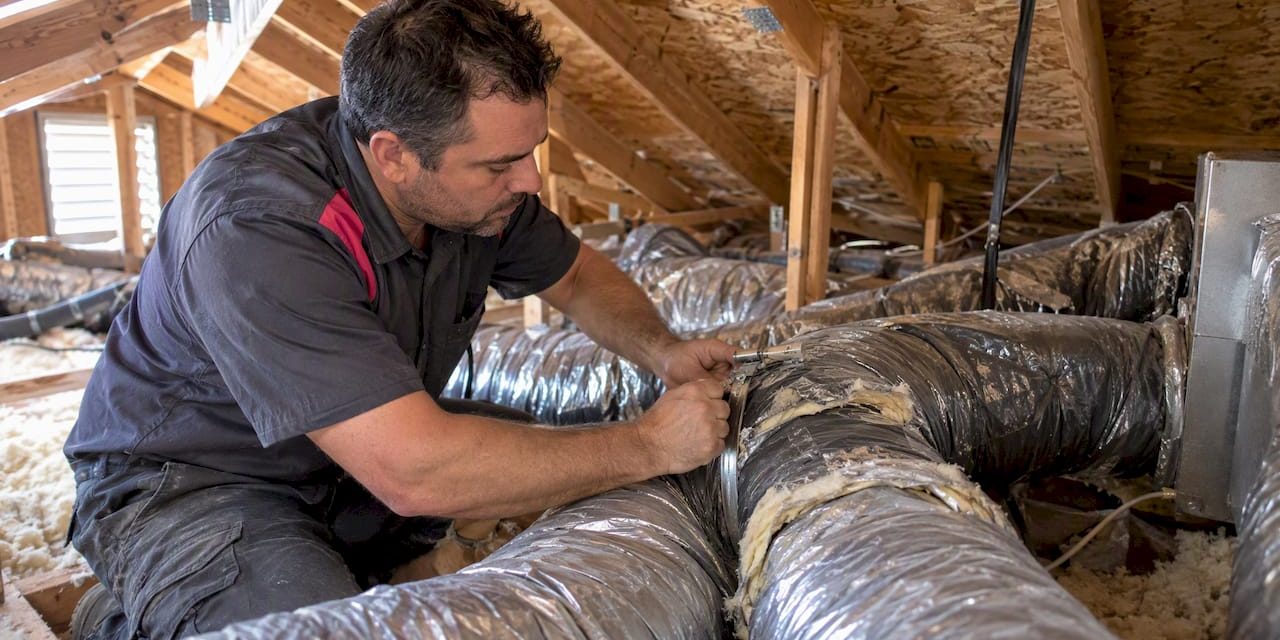
- Visible damage in the attic or crawl space. Look for torn jackets, sagging runs, gaps at the boots, flattened sections, and insulation that is wet, stained or missing.
- Dust that returns right after cleaning. Leaks on the return side pull attic or wall-cavity air, dust and insulation particles into the system. ENERGY STAR describes sealing as protecting indoor air quality as well as efficiency.
- Weak airflow at registers. Check this alongside a dirty filter first. Our HVAC maintenance schedule covers filter timing.
- Musty smells when the system starts. That points to moisture somewhere in the duct path.
- Noise. Whistling, rattling or popping can mean loose connections, undersized runs or crushed sections.
- Old ducts and a new system. If you are replacing an AC or furnace, this is the moment to inspect the ducts, because the new equipment will be limited by them.
One safety point deserves its own mention. On homes with fuel-burning appliances, leaky ducts can contribute to backdrafting, where combustion gases like carbon monoxide are drawn back into the living space. If you smell exhaust, have symptoms such as headaches or dizziness, or a carbon monoxide alarm sounds, leave the house and call 911 or your gas utility before you call a contractor.
Seal, Repair or Replace?
This is the question that matters, and it is where a trustworthy contractor earns their keep. The DOE-backed guide says a professional evaluation is needed to decide whether a system needs replacement or just sealing.
Sealing and repair usually make sense when:
- The ductwork is mostly intact, correctly sized and supported
- The problems are leaky joints, disconnected boots or failing tape
- Insulation is in decent shape or can be patched
- Testing shows leakage you can fix at the seams. Our article on the duct leakage test explains what the numbers mean, and the duct sealing cost guide covers the budget
Replacement usually makes sense when:
- Flexible runs are crushed, collapsed or sagging throughout
- Insulation is soaked, degraded or falling off across large areas
- Ducts are undersized for the system, so rooms are chronically uncomfortable
- Sections are corroded, rodent-damaged or contaminated
- The ducts are in a hot attic and you can move them into conditioned space
That last point is worth a closer look. The DOE’s Building America program says that keeping ducts inside the home’s thermal envelope is the most effective strategy for long-term performance. It costs more upfront, but it can deliver the highest long-term energy savings. If you are already opening up the ducts, ask whether a redesign makes sense.
A note on the “20-year rule”
Some sites say ducts must be replaced at 20 years. We would not put it that way. Age is a reason to inspect, not a verdict. A 25-year-old metal system with sound seams and dry insulation can be worth keeping. A 9-year-old flexible system that was installed with tight bends and tape-only joints may already be failing.
What Duct Replacement Costs
Costs vary by home size, material, access and how much of the system you replace. Angi’s 2026 data shows a national average of about $1,250, with most homeowners spending between $452 and $2,181, and projects for a 2,000-square-foot house typically ranging from $2,000 to $4,500. Those are national figures. Attic access, home layout and local labor rates in Arizona can move your quote either way.

If you want to compare quotes line by line, our guide to ductwork cost per linear foot breaks down what you are paying for.
People also ask about the “$5,000 rule” in HVAC. It is shorthand for a decision heuristic, not a regulation: per the ACCA’s HVAC blog, the idea is that when repair costs exceed about half the cost of a new system, replacement is generally recommended. The same source points out that when ducts are involved, fixing the building envelope or the ducts first can sometimes let existing equipment perform adequately.
Do Not Replace the Equipment Without Checking the Ducts
This is the most expensive mistake in residential HVAC. The ACCA notes that a common error is replacing the unit without evaluating the ductwork. If ducts are undersized, leaking or damaged, even a high-efficiency unit will underperform. A good contractor evaluates the whole system, including supply and return balance, before recommending anything.
Before you approve any equipment job, ask:
- Did you inspect the ducts, and can I see what you found?
- Will you measure airflow and duct leakage, or only swap the equipment?
- Will you use mastic or foil tape on every joint?
- Is the new unit sized with a load calculation, not by replacing like for like? Our page on the AC installation process lists what to demand in writing.
After any sealing job on a home with gas or other fuel-burning appliances, ENERGY STAR says the contractor should run a combustion safety test and evaluate airflow once the work is done. A new filter should be part of the project.
How to Make Ducts Last Longer
You cannot make any duct last forever, but you can avoid the failures that end them early:
- Seal with the right materials. Mastic or foil tape at every joint, never cloth duct tape.
- Keep runs supported and straight. Flexible duct needs proper hangers and gentle bends.
- Protect insulation. Fix roof and coil leaks fast. If your AC drips, see our guide on what to do when your AC is leaking water.
- Change filters on schedule. A clogged filter strains the system and can push dust through every leak.
- Stay out of the attic with your boots. Walking on flexible duct is how many crushed runs happen.
- Have the system inspected during maintenance. Ducts are easy to forget, and a yearly look catches small problems early.
Our Perspective: What We Tell Homeowners About Ducts
We are a family-owned HVAC company in New River, and our technicians are NATE-certified and non-commissioned. That matters here, because duct advice is where an upsell is easiest. A homeowner cannot see inside the attic, and a full replacement is a big ticket.
So we start from a simple rule: find out what is actually wrong before talking about what to buy. A leaky joint is a sealing job. A crushed run is a repair. A system that is undersized, soaked and sagging all the way through is a replacement, and we will say so plainly and show you why.
The other thing we say often: do not let anyone swap your AC or furnace and leave the ducts untouched without at least looking. The best new equipment in the world cannot make up for ducts that lose a quarter of the air before it reaches the room.
When You Are Ready for a Duct Assessment
If your rooms are uneven, your bills are climbing or you have never had the attic ducts inspected, we can look at the system and tell you whether it needs sealing, repair or replacement. For new runs or a full redesign, see our air duct installation services. If you also want yearly checkups so small duct and equipment problems are caught early, look at the Tru Comfort Advantage maintenance plans. For urgent problems, start at trucomfortaz.com.
FAQ
How long does ductwork last?
Expect 15 to 30 years, according to a DOE-backed duct retrofit guide. Rigid sheet metal sits at the long end and flexible duct at the short end. Hot attics, poor sealing and moisture all pull the number down.
Should I replace 20-year-old ductwork?
Not automatically. Have the ducts inspected and, ideally, tested for leakage. If the seams are sound, the insulation is dry and airflow is good, sealing and repairs may be enough. If runs are crushed, soaked or undersized, replacement will serve you better.
Can I just seal my ducts instead of replacing them?
Often, yes, when the ducts are structurally sound and the problem is leaky joints. Sealing will not fix crushed, kinked or undersized runs. Our guide to leaky air ducts explains DIY seals and when to call a professional.
How much does it cost to replace ductwork in a 2,000-square-foot house?
Angi’s 2026 figures put typical projects between $2,000 and $4,500 nationally. Your actual quote depends on material, attic access and how many runs need replacing, so get it in writing after an inspection.
Sources
- Duct Retrofit Decision Guide (DOE Building Science Education)
- Measure Guideline: Sealing and Insulating of Ducts in Existing Homes (U.S. DOE)
- Duct Sealing (ENERGY STAR)
- Benefits of Duct Sealing (ENERGY STAR)
- Hire a Professional Contractor for Duct Improvement Projects (ENERGY STAR)
- Equipment Size, Ducts, and Building Envelope (ACCA HVAC Blog)
- How Much Does Duct Replacement Cost? (Angi)
- How Much Does Air Duct Replacement Cost? (This Old House)