
Homeowners: Measure Ducts First, Then Get Air Balancing
A professional air balancing service adjusts airflow room by room so every part of your house gets the heating and cooling it needs, instead of some rooms running cold and others staying stuffy. The clearest sign you need one is a house with a working furnace or air conditioner where certain rooms stay noticeably hotter or colder than the rest no matter how you set the thermostat. If duct leaks or an oversized system are the real cause, balancing alone will not fix them.
TL;DR:
- Air balancing improves comfort by ensuring each room receives the appropriate airflow, but it cannot fix duct leaks or oversized systems.
- Proper balancing involves measuring airflow at every vent using standardized tools like flow hoods or anemometers, with adjustments followed by re-measurement.
- Costs typically range from a few hours to a full day depending on house size and complexity; additional repairs like duct sealing are usually billed separately.
- Pre-checks such as duct leakage testing and visual inspections are essential, as unsealed ducts can negate the benefits of balancing.
- Selecting certified technicians familiar with industry standards and documented measurement reports ensures the accuracy and effectiveness of the balancing service.
Table of Contents
- What air balancing is and how it affects comfort and efficiency
- When air balancing helps and where it falls short
- What a professional air balancing job looks like
- Typical cost range and timeline for a residential balancing service
- Pre-repairs and checks before you book a balancing service
- How to choose a contractor for air balancing
- Why a measured approach to air balancing matters
- Get your home’s airflow professionally balanced
- Sources
- FAQ
What air balancing is and how it affects comfort and efficiency
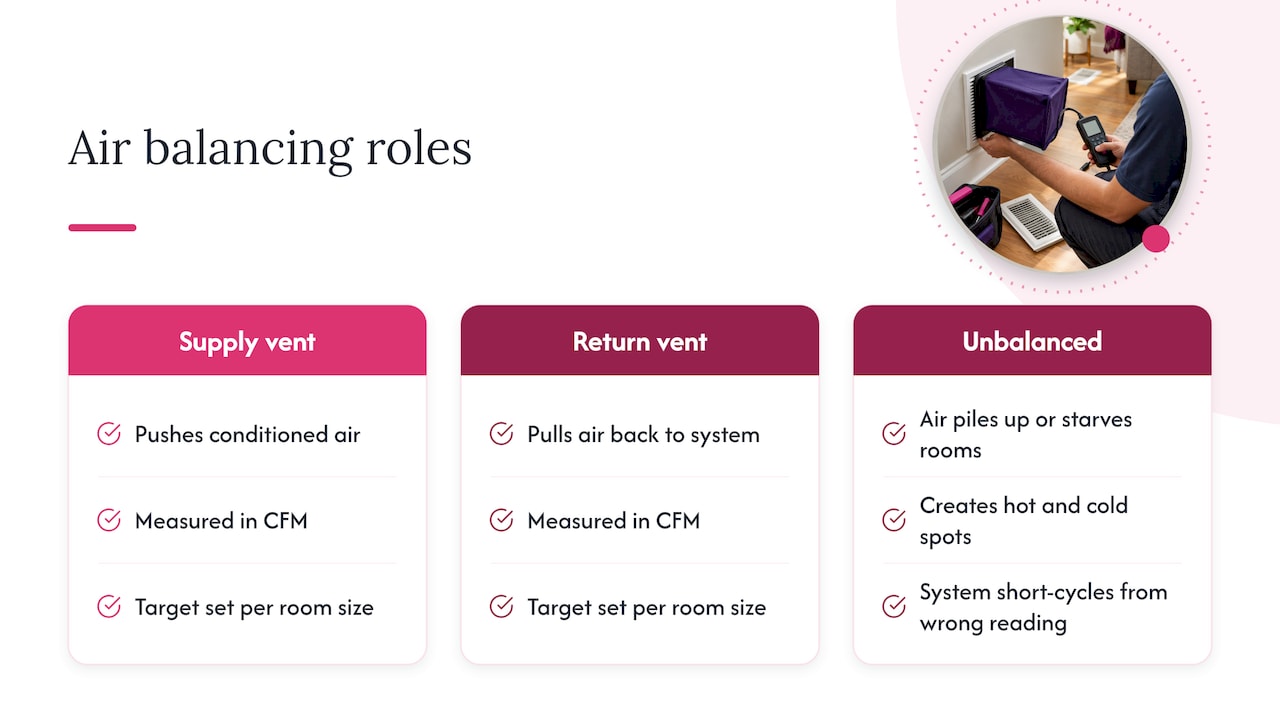
Air balancing means adjusting how much air moves through each supply and return vent so a house gets even heating and cooling. Airflow is measured in CFM, or cubic feet per minute, and every register has a design target based on the size of the room and the load it needs to cover. Supply vents push conditioned air into a room, while return vents pull air back to the system to be reconditioned. When the two are out of sync, air piles up in some rooms and starves others, which shows up as hot and cold spots or a system that short-cycles because it senses the wrong temperature at the thermostat.
Professional technicians tie their measurements to industry design standards, generally referencing ACCA’s Manual B and Manual D, which define how much air each duct run and register should deliver. Without that reference point, a technician is just guessing at what “balanced” looks like. You can get a sense of your own setup by learning to tell supply and return vents apart before a technician ever shows up.
When air balancing helps and where it falls short
Balancing typically resolves uneven room temperatures, poor humidity control, and a system that runs more than it should because airflow isn’t matching the load in each space. Homeowners usually notice steadier temperatures throughout the house, a system that cycles less erratically, and in some cases lower energy use once airflow is no longer fighting itself.
Balancing has real limits. It cannot fix an oversized system that short-cycles by nature, and it cannot compensate for ducts that are leaking heavily. The Department of Energy’s home heating and cooling guide notes that routine maintenance and duct sealing can cut heating and cooling costs by a moderate percentage, which suggests that leaky ducts undercut any gains balancing alone would deliver.
What a professional air balancing job looks like
A competent balancing job follows a repeatable sequence, not a single pass with a screwdriver. The CEE Duct Retrofit Decision Guide outlines the core workflow that most qualified technicians follow.
- The technician confirms the system is set up normally: clean filters, fan on its designed speed, and interior doors positioned the way you’d actually use the house.
- Using a flow hood or anemometer, they measure CFM at every register, then sum the readings per room and compare them to the design CFM called for under Manual D or Manual J.
- Dampers and trunk lines get adjusted where a room is running short or getting too much, and the technician re-measures after each change rather than assuming the fix worked.
- Return-side airflow gets checked too, since a starved return can throw off every supply reading downstream.
- The job ends with a written report showing before and after CFM per register along with total external static pressure, or TESP, so you have a record of what changed.
That documentation matters. According to ACCA’s guidance on duct balancing, residential tolerances of roughly plus or minus 20 percent, or about 25 CFM, are considered acceptable once the iterative adjustments are done. A report that doesn’t show numbers isn’t proof of balancing, it’s a guess with an invoice attached.
Typical cost range and timeline for a residential balancing service
Cost depends mostly on house size, the number of registers, how hard the ductwork is to access, and whether the technician finds problems that need fixing before balancing will hold. A simple single-system home with easy attic or crawlspace access takes less time than a multi-zone house with finished ceilings hiding the ducts.
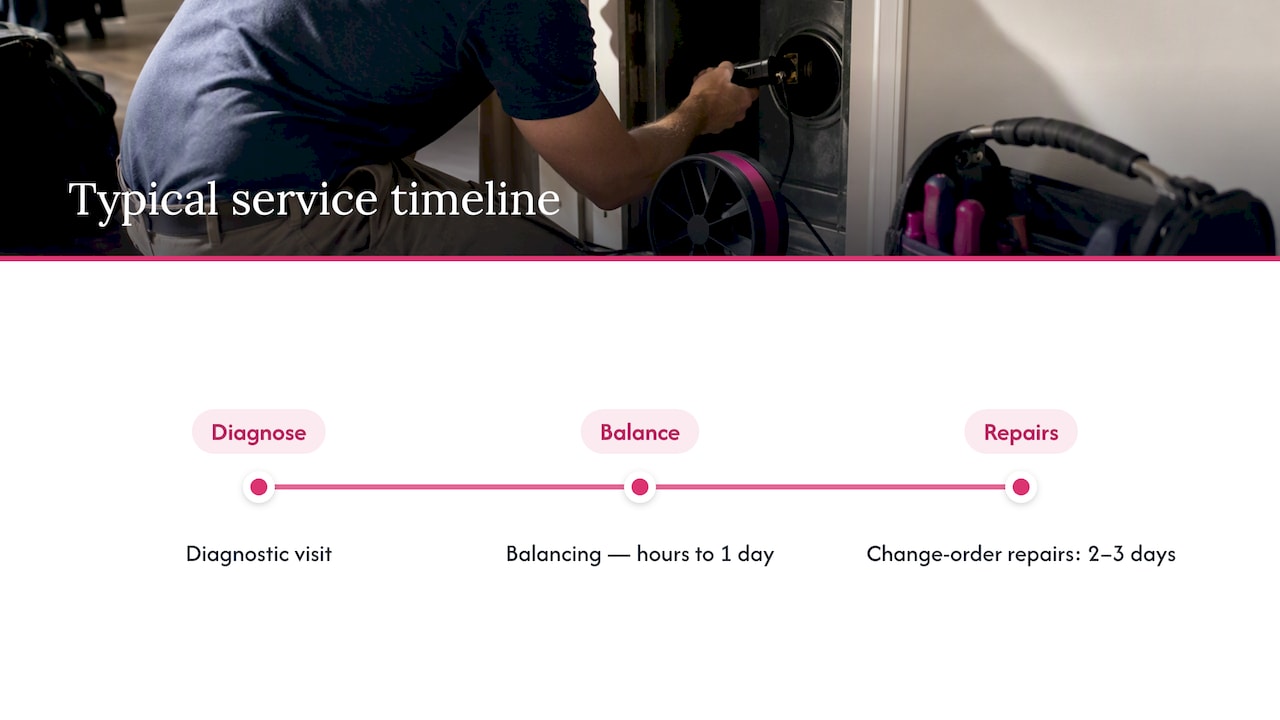
Most residential jobs run from a few hours to a full day when no repairs are needed, and up to two or three days when duct sealing or damper replacement gets added to the scope. Contractors typically present duct sealing, right-sizing work, or equipment changes as separate line items or change orders once they’ve diagnosed the problem, rather than folding them into the original balancing quote. That keeps the original diagnostic honest and lets you decide what additional work is worth doing.
Pre-repairs and checks before you book a balancing service
Balancing an airflow system that’s leaking air or missing a proper return path is a waste of money. A few checks belong on the list before anyone touches a damper.
- Ask about a duct blaster or blower door test, since typical homes lose roughly 20 percent of conditioned air to duct leakage according to ENERGY STAR’s duct sealing guidance, and that loss alone can erase any benefit from balancing.
- Have someone do a visual check of attic and crawlspace ducts for disconnected joints, crushed flex duct, or gaps that were never sealed.
- Check for return-path problems like closed interior doors or missing transfer grilles, which can pressurize rooms and quietly defeat balancing.
- If rooms were added or a system was replaced without a fresh load calculation, ask whether a Manual J and Manual D review makes sense before balancing, since undersized or oversized equipment won’t respond to damper adjustments. For guidance on proper unit replacement and disposal, check out How to Handle Air Conditioner Disposal the Right Way.
Pro Tip: Get your duct leakage tested and sealed with mastic or metal tape, never cloth duct tape, before you pay for a balancing visit.
How to choose a contractor for air balancing
Credentials tell you whether a technician actually knows the standards behind the work. NATE certification indicates the individual technician has passed a recognized competency exam, while familiarity with NEBB’s Testing, Adjusting and Balancing discipline and ACCA’s Manual B and Manual D references signals the contractor follows an established measurement framework rather than working by feel.
- Ask what tools they use to measure airflow: a flow hood or anemometer is the baseline, not a hand held in front of a vent.
- Ask what deliverable you’ll receive: a signed report with documented CFM per register, before and after, plus TESP readings, is the standard of proof.
- Ask how they handle a room that’s still off after adjustment, since iterative re-measurement is part of the process, not an extra charge.
- Watch for red flags: a quote with no mention of measurement tools, a technician who won’t discuss return-air issues, or a job finished in minutes with no documentation.
Why a measured approach to air balancing matters
The company emphasizes expert, honest, and personalized service with a commitment to building long-term relationships, offering emergency support and cost-saving maintenance plans. That structure fits a diagnostic-first approach: measure the airflow, document the numbers, and only then talk about what needs adjusting. A balancing report that shows real before-and-after figures is worth more than a technician’s word that “it feels better now.”
Get your home’s airflow professionally balanced
If your rooms run hot and cold no matter what the thermostat says, an inspection that checks ducts, returns, and airflow together beats guessing room by room. Tru Comfort’s technicians measure before adjusting anything, and if duct sealing or repair is the real issue, our air duct installation and repair services can handle that before balancing even starts.

For homes that need ongoing airflow and system checks, the Tru Comfort Advantage maintenance plans build regular inspections into your yearly routine. Visit our air conditioner services page to request an estimate or schedule a visit.
Sources
- CEE Duct Retrofit Decision Guide (2024)
- ENERGY STAR — Duct sealing brochure
- A Valuable Aid for Duct Balancing — ACCA HVAC Blog
- NEBB — Testing, Adjusting and Balancing (TAB)
- Guide to Home Heating and Cooling — U.S. Department of Energy
FAQ
How much does an air balance cost?
Cost varies with house size, register count, and whether duct repairs are needed, and most jobs range from a few hours of labor to a full day for straightforward homes. Added scope like duct sealing or damper replacement is typically quoted separately once a technician sees what the house needs.
Is air balancing worth it?
Balancing is worth it when a working system still leaves some rooms too hot or cold, since it can improve comfort and reduce unnecessary cycling. It’s less useful on its own when duct leakage or an oversized system is the real cause, since duct leakage alone can waste roughly 20 percent of conditioned air.
What is the $5000 AC rule?
This isn’t a standard used in professional HVAC guidance, and no authoritative source defines an official rule of thumb for deciding between repair and replacement, treat it as informal advice rather than an industry standard
Can I balance my own HVAC system?
You can make basic adjustments like opening or closing dampers and checking that vents aren’t blocked by furniture, but accurate balancing requires measuring CFM at each register with a flow hood or anemometer. Without that measurement, you’re adjusting airflow based on guesswork, which is why a professional duct leakage test is a more reliable starting point than trial and error.