Why Your AC Smells Musty and How to Fix It
That stale, damp odor coming from your vents is almost always microbial growth — mold, mildew, or bacteria living on a wet surface inside your cooling system. The most likely culprits are a clogged condensate drain, standing water in the drain pan, or a biofilm coating on the evaporator coil. Before you do anything else, run through these three checks:
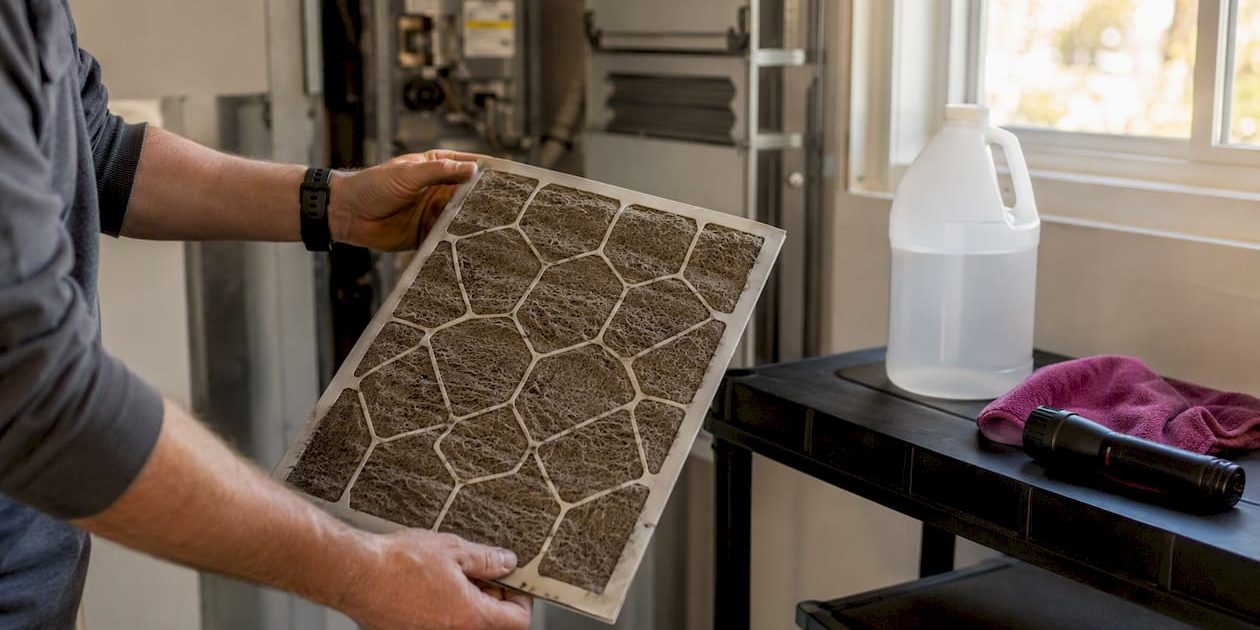
- Check the filter. Pull it out. If it’s gray, damp, or visibly dirty, replace it now. A wet filter is both a cause and a symptom.
- Look for water at the indoor unit. Find the condensate drain line exit (usually a white PVC pipe near the outdoor unit or a floor drain). No drip or visible flow during a cooling cycle means a clog.
- Switch the thermostat to AUTO and run COOL for a full cycle. If the smell fades after 30–60 minutes, the issue is likely minor surface moisture. If it stays or gets stronger, you’re dealing with something deeper.
Pro Tip: If the smell hits hardest at startup and reminds you of wet socks or a locker room, that’s “dirty sock syndrome” — a bacterial buildup on the evaporator coil, not general mildew. Don’t spray air freshener into the vents. It won’t touch the source and will make your indoor air quality worse.
For most homeowners, the DIY steps below will clear the odor. If the smell returns within a day or two, or if you see visible mold inside vents, that’s when a NATE-certified technician from a company like Trucomfortaz should take over.
Key Takeaways
A musty AC smell almost always means moisture and microbial growth inside the system — and the fastest fixes are a filter swap, a condensate flush, and a clean drain pan.
| Point | Details |
|---|---|
| Start with filter and drain | Replace the filter and flush the condensate line with 1:1 vinegar/water before anything else. |
| Dirty sock smell needs coil cleaning | A sour startup odor signals bacterial buildup on the evaporator coil, not just surface mildew. |
| Odor after 24 hours means call a pro | Persistent smell after DIY steps indicates deeper coil contamination or duct mold requiring professional service. |
| Prevention is a schedule | Flush the drain every 1–3 months, replace filters on time, and book a spring tune-up before heavy cooling season. |
| Trucomfortaz covers the full fix | NATE-certified technicians in New River, AZ handle diagnostics, coil cleaning, condensate service, and annual maintenance plans. |
Table of Contents
- Why does your AC smell musty? Causes and how to diagnose them
- Step-by-step DIY fixes to remove a musty AC smell
- How to stop musty smells from coming back
- Are musty AC smells dangerous? Health risks and precautions
- When to hire an HVAC technician and what it will cost
- Quick diagnostic checklist: match your symptom to the likely source
- What local HVAC technicians actually find most often
- Tru Comfort’s diagnostic and maintenance services for musty AC issues
- Sources
Why does your AC smell musty? Causes and how to diagnose them
A musty smell from an AC almost always traces back to moisture sitting somewhere it shouldn’t. According to HVAC specialists, a typical residential system can remove several gallons of water per day in humid conditions. When that water doesn’t drain correctly, it creates ideal conditions for mold and bacteria.
The five most common sources:
- Evaporator coil biofilm. The coil runs cold and wet every cycle. Dust and organic matter stick to it, and bacteria colonize the damp surface. This is the source of dirty sock syndrome — a sharp, sour odor that’s strongest when the system first kicks on.
- Clogged condensate drain or standing water in the drain pan. Algae and slime build up in the drain line over time, blocking flow. Water backs up into the pan and sits there, growing mold. This is frequently cited as the number-one cause of a musty AC smell.
- Dirty or wet air filter. A filter that’s overdue for replacement traps moisture along with dust. Once it’s wet, it becomes a mold surface that the blower fan pulls air through with every cycle.
- Mold inside ductwork. Ducts that run through unconditioned attics or crawl spaces can collect condensation on the interior, especially if they’re leaky or poorly insulated. The smell tends to be diffuse and present at every vent rather than concentrated near the indoor unit.
- Seasonal first-start odor. After weeks or months of sitting idle, any residual moisture on the coil or in the drain pan can produce a brief musty smell when you first run the system. This usually clears within an hour.
Diagnosing by timing and location:
- Smell only when COOL is running, strongest at the vents → coil biofilm or duct mold
- Smell near the furnace closet or air handler even when the system is off → standing water in the drain pan or a nearby moisture source
- Smell at startup only, fades quickly → seasonal idle moisture. Likely minor
- Smell at startup, sour/wet-sock character, persists through the cycle → dirty sock syndrome, bacterial coil buildup
- Smell constant and at every vent equally → duct contamination, possibly combined with coil or drain issues
Dirty sock syndrome and general mildew odor feel similar but behave differently. Bacterial buildup on the coil tends to produce a sharper, more pungent smell that peaks at startup and eases as the system runs. General mildew from standing water or duct mold is flatter and more constant. Knowing which you’re dealing with helps you target the right fix first.
Step-by-step DIY fixes to remove a musty AC smell
Work through these in order. Each step takes 10–30 minutes, and most homeowners can complete steps 1–4 without any special tools.
What you’ll need: rubber gloves, a flashlight, a shop vacuum, distilled white vinegar, a bucket, a replacement filter rated for your system, and a foaming no-rinse coil cleaner (available at hardware stores) if you’re comfortable going to step 5.
Safety first: Turn the system off at the thermostat AND flip the breaker for the air handler before opening any panels. Do not touch refrigerant lines. Avoid bleach directly on coils — it corrodes aluminum fins. If you see heavy visible mold, wear an N95 respirator before disturbing it.
- Turn off power and replace the filter. Pull the old filter, note the size, and install a fresh one. A MERV 8–11 filter balances airflow and particle capture without restricting the system. Don’t go higher than your system’s rated MERV without checking the manual. Too restrictive and you’ll freeze the coil.
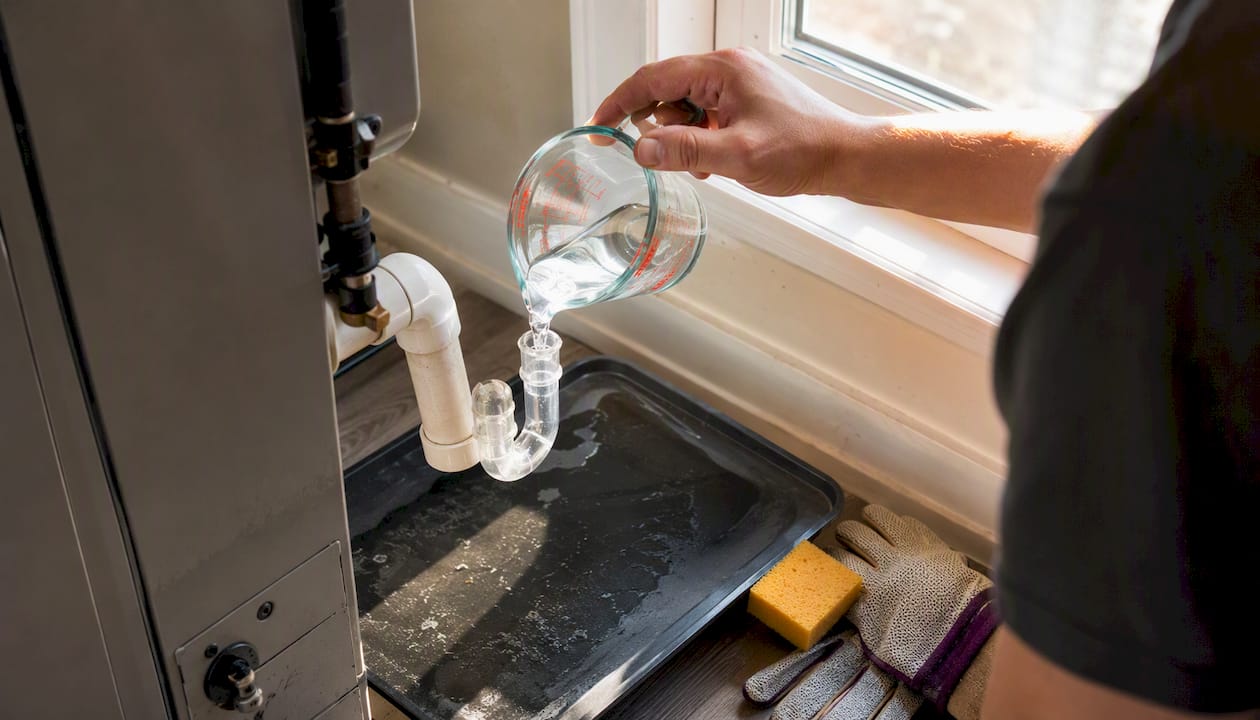
- Locate and flush the condensate drain line. The drain line is usually a 3/4-inch white PVC pipe running from the air handler to a floor drain or outside. Find the access port (a capped T-fitting near the air handler) and pour a 1:1 mix of distilled white vinegar and water — about one cup of each — directly into it. Let it sit for 30 minutes, then flush with plain water. Professionals recommend doing this every 1–3 months during cooling season to prevent clogs from reforming.
- Empty and clean the drain pan. The drain pan sits directly under the evaporator coil. Use the shop vacuum to pull out any standing water, then wipe the pan with a diluted vinegar solution. A dry pan is a pan that can’t grow mold.
- Clean vent covers and accessible duct openings. Remove vent grilles and wash them with warm soapy water. Shine a flashlight into the duct opening and wipe down any visible dust or debris within reach. Don’t go deeper than you can see clearly.
- Treat the evaporator coil. If you’re comfortable accessing the air handler’s evaporator coil, apply a foaming no-rinse coil cleaner according to the product directions. The foam expands into the fins, loosens biofilm, and drains away with condensate. Professionals use non-corrosive foaming cleaners specifically to avoid damaging the fins — use the same type. If the coil is heavily soiled or you’re not sure what you’re looking at, stop here and call a technician.
- Restore power and run the system for a full cycle. Monitor the smell over the next few hours. Minor cases often clear within 2–4 hours. More significant contamination may take up to 24 hours to fully dissipate. If the odor returns within a day or two after cleaning, you’re dealing with deeper coil contamination or duct mold that needs professional attention.
Pro Tip: Set your thermostat fan to AUTO, not ON. When the fan runs continuously, the coil never fully dries between cooling cycles — that constant dampness is exactly what bacteria need. AUTO mode lets the coil dry out, which cuts down on biofilm buildup over time.
How to stop musty smells from coming back
Prevention is mostly about keeping moisture moving and surfaces dry. A few scheduled tasks handle the majority of recurring odor problems.
Filter replacement. Change your filter every 1–3 months depending on filter type, pets, and household dust levels. A thicker pleated filter (MERV 8–11) lasts longer than a fiberglass panel filter but still needs regular replacement. Mark the date on the filter frame when you install it.
Condensate drain maintenance. Pour one cup of distilled white vinegar down the drain access port every 1–3 months during the cooling season. This prevents algae and slime from building up before they cause a clog. If your drain pan has ever overflowed, ask a technician about installing a condensate float switch — it shuts the system off automatically if water backs up, protecting your ceiling and floors.
Annual professional tune-up. A spring inspection before the heavy cooling season is the most cost-effective time to catch coil contamination, drain issues, and duct moisture problems early. In Arizona’s climate, where systems run hard from April through October, routine AC maintenance before the heat arrives pays for itself in avoided repairs. A technician will visually inspect the coil, test drain flow, check refrigerant charge, and flag anything that could turn into a bigger problem mid-summer.
Above that threshold, mold growth accelerates on any surface — including coil fins and duct interiors. A whole-home dehumidifier or a portable unit in damp areas (basements, laundry rooms) helps, especially during monsoon season in the Southwest. Running the system in COOL mode rather than just FAN also removes humidity actively.
UV-C germicidal lights. After a professional coil cleaning, a UV-C light installed near the evaporator coil can slow bacterial recolonization. The bulbs need annual replacement and they don’t clean existing biofilm — the coil must be clean first for the UV light to be effective. Ask your technician whether your system’s configuration supports one.
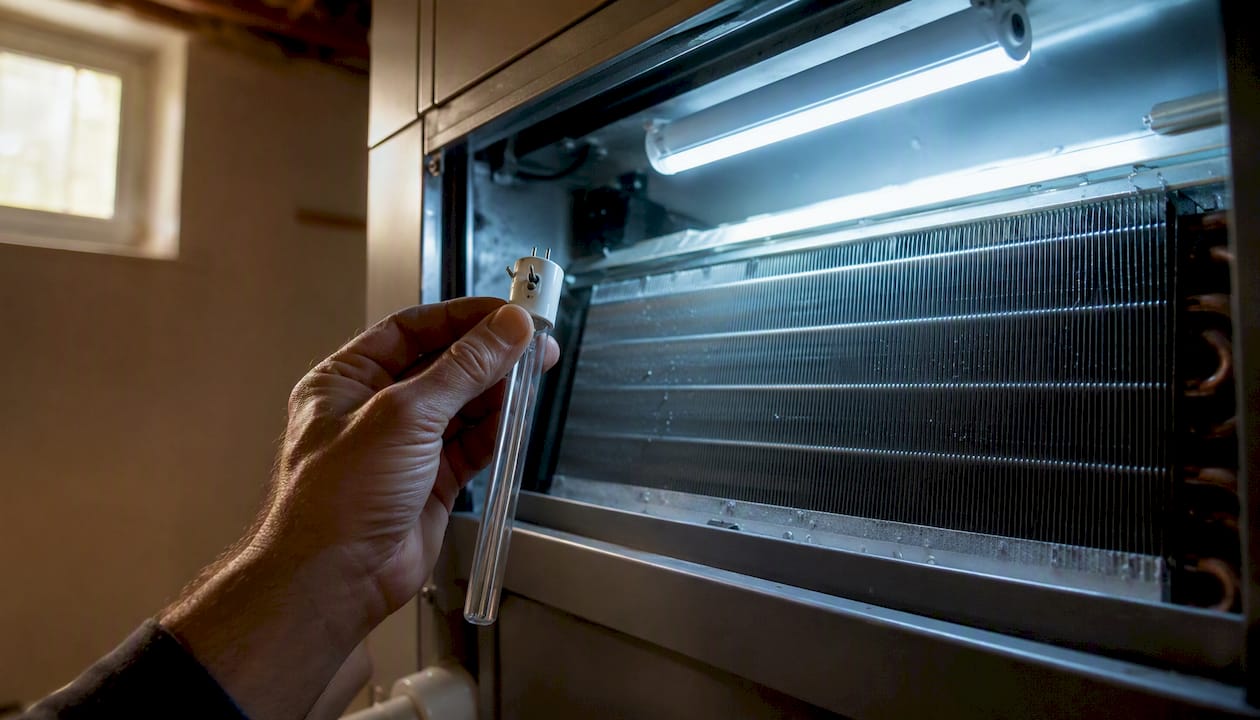
Pro Tip: In Arizona, the shoulder seasons (March and November) are when systems sit idle longest. Run your AC in COOL mode for at least one full cycle per week during those months. It keeps the coil dry, exercises the drain line, and means you won’t start the summer with a musty surprise on the first hot day.
Are musty AC smells dangerous? Health risks and precautions
The smell itself comes from microbial volatile organic compounds (MVOCs) — gases released by mold, mildew, and bacteria as they metabolize organic matter. Breathing MVOCs and airborne spores can irritate the eyes, nose, and throat, and can worsen asthma and allergy symptoms, especially with repeated exposure over days or weeks.
Who is most at risk:
- People with asthma or chronic respiratory conditions
- Anyone with seasonal or mold allergies
- Individuals with compromised immune systems
- Young children and older adults
Immediate precautions if the smell is strong or persistent:
- Stop running the system until you’ve identified and addressed the source
- Open windows to ventilate affected rooms if outdoor conditions allow
- Replace the filter immediately — it’s the fastest way to reduce what the system is circulating
- Do not spray air fresheners or deodorizers into vents. Professionals are clear on this: masking the odor leaves the mold and bacteria in place and can add chemical irritants to the air
Health note: Persistent musty odor after cleaning is a signal that contamination has spread beyond what surface cleaning can reach. At that point, continued system use increases cumulative indoor exposure. Get a professional inspection before running the system regularly again.
Mold inside an HVAC system is particularly concerning because the blower fan distributes spores throughout every room the system serves. A single contaminated coil or duct section can affect indoor air quality across the entire home. That’s why “wait and see” isn’t a great strategy once you’ve confirmed visible mold inside the system.
When to hire an HVAC technician and what it will cost
Some musty AC problems are genuinely DIY-fixable. Others need a professional from the start. Here’s how to tell the difference.
Call a technician when:
- The smell persists more than 24 hours after completing all DIY steps
- You see visible mold inside vents, on the coil, or inside the air handler
- The condensate drain clogs repeatedly within the same season
- There’s standing water in a drain pan you can’t access or empty yourself
- You smell burning, chemical, or rotten-egg odors — those are separate, potentially dangerous issues that require immediate shutdown and a service call
What a technician will inspect and do:
- Visual evaporator coil inspection for biofilm, scale, and physical damage
- Camera inspection of the condensate drain line to locate clogs or cracks
- Moisture measurements inside the air handler and duct system
- Drain pan condition check and float switch test
- Duct inspection, and NADCA-standard cleaning if contamination is found — duct cleaning guidance covers what that process involves
- Professional coil cleaning with non-corrosive foaming cleaner and disinfectant
Ballpark cost ranges (these vary by region, system size, and access difficulty):
- Diagnostic/service call: $75–$150 for the visit and initial assessment
- Condensate drain clearing: $75–$200 depending on clog severity and access
- Professional coil cleaning: $100–$400 for a standard residential system
- Duct cleaning (NADCA-recommended): $300–$700 for a typical home, more for larger systems or heavy contamination
- UV-C light installation: $150–$500 installed, depending on system and bulb type
Most condensate and coil service is completed in a single visit. Duct cleaning typically takes 3–8 hours depending on home size.
Hiring checklist:
- Confirm the technician holds NATE certification — it’s the industry’s primary competency standard for HVAC service
- Ask for a written estimate before work begins
- Verify coil cleaning uses non-corrosive foaming cleaners, not bleach
- For duct cleaning, ask whether the company follows NADCA guidelines and uses negative-pressure equipment
- Get a written summary of findings after the visit
Quick diagnostic checklist: match your symptom to the likely source
Work through this list in order. Stop at the first match and follow the action.
- Musty smell only at startup, fades within an hour → Seasonal idle moisture on coil or in drain pan → Run a full COOL cycle; if it clears, flush the drain line and replace the filter as preventive steps.
- Wet-sock or sour smell at startup, persists through the cycle → Dirty sock syndrome, bacterial coil buildup → Complete the coil-cleaning step (Step 5 above) or call a technician if you’re not comfortable accessing the coil.
- Musty smell only when COOL is running, strongest at vents → Coil biofilm or duct mold → Start with coil cleaning; if smell persists after 24 hours, schedule a duct inspection.
- Smell near the air handler or furnace closet even when the system is off → Standing water in drain pan or nearby moisture source → Check and empty the drain pan; inspect for water stains or active leaks around the unit.
- Musty smell at every vent equally, no change with system on or off → Duct contamination → This one needs a professional camera inspection and likely NADCA-standard duct cleaning.
- Smell returned within a day or two after DIY cleaning → Deeper coil contamination or system short-cycling causing the coil to stay perpetually damp → Call a technician; the system may also need a sizing evaluation.
- Chemical, burning, or rotten-egg odor → Not a mold issue — potential electrical fault, refrigerant leak, or gas issue → Shut the system off immediately and call a pro. Do not run the system.
What local HVAC technicians actually find most often
The calls Trucomfortaz technicians respond to most frequently aren’t the dramatic ones — they’re the quiet, predictable ones. A drain line that hasn’t been flushed in two or three years. A drain pan with an inch of standing water that the homeowner never knew was there. A filter that was last changed sometime before the previous summer.
What’s worth saying plainly: the dirty sock smell is diagnostic information, not just an annoyance. When a coil smells like a wet gym bag at startup, that’s bacteria telling you exactly where moisture is trapped. Treating it as a nuisance to mask delays the fix and extends exposure. NATE-certified technicians approach it the opposite way — the smell is the first clue, and the job is to follow it to the source rather than cover it up.
One thing homeowners often underestimate is how much a short-cycling system contributes to recurring odors. If your AC is oversized for your home, it cools quickly and shuts off before the coil has time to dry. The coil stays damp cycle after cycle, and no amount of cleaning keeps the bacteria from coming back. That’s a sizing conversation, not just a maintenance conversation — and it’s worth having with a technician who isn’t on commission.
Tru Comfort’s diagnostic and maintenance services for musty AC issues
Persistent musty odors are one of the most common reasons homeowners in New River and the surrounding area call Trucomfortaz. The fix is usually faster and less expensive than people expect — but only when the right part of the system gets addressed.

Trucomfortaz’s NATE-certified technicians handle the full sequence: diagnostic visit to confirm the source, condensate drain clearing and pan cleaning, professional coil cleaning with non-corrosive foaming cleaners, and duct inspection with NADCA-aligned recommendations when contamination has spread. For homeowners who want to stay ahead of odor and efficiency problems, the Tru Comfort Advantage maintenance plan includes scheduled seasonal tune-ups, priority service, and the kind of ongoing relationship that catches a clogged drain before it becomes a mold problem.
No commissions, no upsells for work the system doesn’t need. Schedule a diagnostic visit or ask about a maintenance plan by calling Trucomfortaz directly or booking through Trucomfortaz.
Sources
- AC Smelling Musty? Here’s How to Fix Your Air Conditioner | Apartment Therapy
- Does your air conditioner smell? Here’s what it means – Trane
- How to fix a musty-smelling air conditioner – Southern Living