AC Short Cycling: Causes, Fixes, and When to Call a Pro
If your AC turns on and off every few minutes, that’s AC short cycling, and the first thing to do right now is check your air filter. A clogged filter is the most common fixable cause, and swapping it out takes five minutes. If you’re also hearing buzzing, smelling something burnt, or seeing ice on the copper lines, shut the system off and call a licensed technician.
Quick signs you’re dealing with short cycling:
- The house feels clammy even when the AC has been running for hours
- You hear the outdoor unit kick on and off repeatedly throughout the day
- The compressor starts with a hard thump or hum, then stops within minutes
- Your energy bills have climbed without any change in usage habits
Key Takeaways
AC short cycling is a symptom, not a single problem. Start with the filter and thermostat, then call a NATE-certified technician if those checks don’t resolve it, because delays turn inexpensive repairs into compressor-level failures.
| Point | Details |
|---|---|
| Normal cycle length | A healthy AC runs 15–20 minutes per cycle, 2–3 times per hour; under 10 minutes signals a problem. |
| Start with the filter | A clogged filter is the most common fixable cause; replace it every 1–3 months to prevent recurrence. |
| Know when to stop DIY | Ice that won’t thaw, refrigerant odor, or electrical buzzing all require a licensed technician immediately. |
| Repair cost range | Fixes range from under $20 (filter) to $200–$700 (capacitor) to several thousand for compressor or full replacement. |
| Trucomfortaz | NATE-certified technicians in New River, AZ diagnose and repair short cycling with written quotes and maintenance plans. |
Table of Contents
- What does AC short cycling actually mean?
- What causes AC short cycling?
- Why short cycling damages your system faster than you’d expect
- Step-by-step troubleshooting checklist for homeowners
- How common causes are fixed and when you need a pro
- What repairs typically cost and how long they take
- How to prevent short cycling from coming back
- When professional help is the right choice
- The part most homeowners get wrong about short cycling
- Trucomfortaz handles short-cycling diagnostics in New River and Anthem
- Sources
What does AC short cycling actually mean?
A normal cooling cycle runs about 15–20 minutes under moderate conditions, with a healthy system cycling roughly 2–3 times per hour. That runtime gives the evaporator coil enough time to pull moisture out of the air, which is what keeps your home comfortable rather than just cold.
Short cycling is when those runs are notably shorter, or the system starts more than a few times per hour. The AC reaches the thermostat’s set temperature too quickly or trips a safety switch before completing a proper dehumidification pass, then shuts off and starts again almost immediately.
Here’s how to measure it yourself:
- Note the exact time the outdoor compressor kicks on.
- Watch for when it shuts off and record that time.
- Wait and record when it starts again.
- Repeat for 2–3 cycles.
A run of 8 minutes followed by a 4-minute off period, then another 8-minute run is a clear short-cycle pattern. A run of 18 minutes with a 10-minute rest is normal. If you’re consistently seeing runs under 10 minutes, you have a problem worth addressing.
Normal vs. short-cycle timing at a glance: A healthy system runs 15–20 minutes per cycle, 2–3 times per hour. Short cycling is anything under ~10 minutes per run or more than 3–4 starts per hour.
What causes AC short cycling?
Dirty filters and thermostat placement are the two most common causes homeowners can fix themselves, but the full list of causes runs deeper. Here’s what to look for, ordered from easiest to fix to most serious:
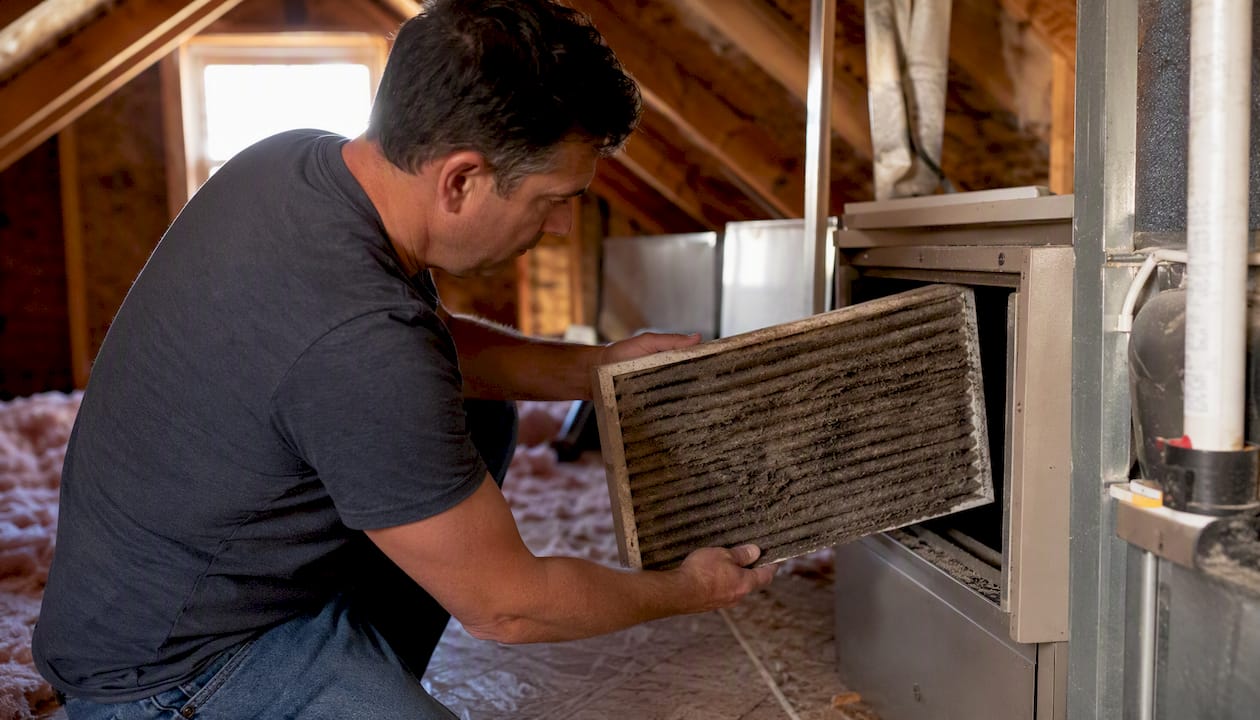
- Dirty or clogged air filter (Easy DIY): Restricted airflow causes the evaporator coil to freeze or the system to overheat and trip the safety shutoff. You’ll notice weak airflow from vents and possibly ice on the indoor unit. Replace the filter first, every time.
- Thermostat placement or calibration (Easy DIY): A thermostat sitting in direct sunlight, near a supply vent, or in a drafty hallway reads false temperatures and triggers short cycles. Best placement is an interior wall, 52–60 inches above the floor, away from vents and windows. Some smart thermostats also have a compressor minimum-off-time setting (typically around 5 minutes) that prevents rapid restarts.
- Frozen evaporator coil (Intermediate): Ice buildup on the indoor coil blocks airflow and forces the system to shut down on safety. You’ll see frost on the larger copper refrigerant line near the air handler. Shut the system off, let it thaw completely (2–4 hours), then replace the filter before restarting.
- Oversized AC unit (Requires replacement or system upgrade): An oversized unit cools the space in 5–8 minutes, hits the setpoint, and shuts off before removing meaningful humidity. The house feels cool but sticky. This is a design problem, not a repair problem. The fix is a correctly sized replacement, confirmed with a Manual J load calculation.
- Low refrigerant from a leak (Requires licensed tech): A refrigerant leak drops suction pressure until the low-pressure safety switch trips the system off. The AC cools briefly, shuts down, restarts, and repeats. You may notice ice on the copper lines or a gradual loss of cooling capacity. Refrigerant work requires EPA Section 608 certification.
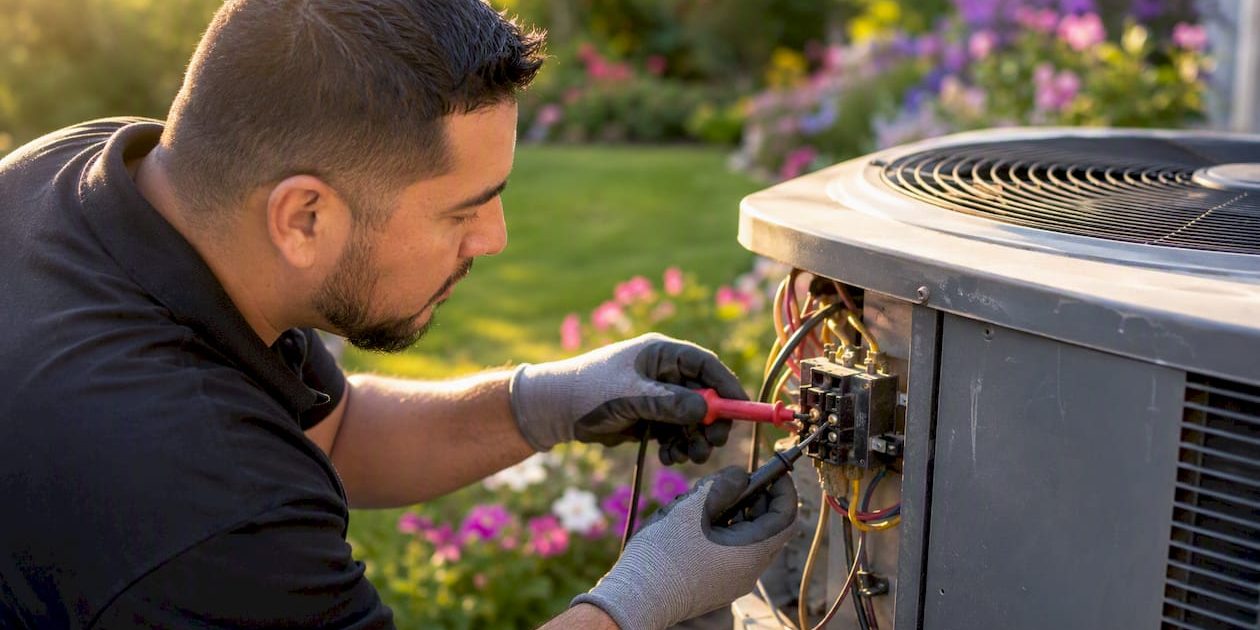
- Failing capacitor or contactor (Requires licensed tech): A weak start capacitor produces a recognizable pattern: the outdoor fan spins up, the compressor hums for 1–3 minutes, then the unit shuts down on thermal overload. That cycle repeats. Capacitor and contactor replacement is a professional repair, though it’s one of the faster and less expensive ones.
- Dirty condenser coil (Intermediate): A condenser caked in dirt, cottonwood, or debris can’t shed heat efficiently, causing the system to overheat and shut off early. You can rinse the outdoor unit gently with a garden hose (fins pointing outward, low pressure), but a full coil cleaning is better left to a tech.
- Blocked supply or return registers (Easy DIY): Closed registers or furniture blocking returns restricts airflow system-wide and can cause the same freeze-and-trip cycle as a dirty filter.
Pro Tip: Before anything else, check every return air grille in the house. A single blocked return in a hallway can starve the system enough to cause short cycling, and it takes 30 seconds to fix.
Why short cycling damages your system faster than you’d expect
Every time an AC compressor starts, it draws a surge of electrical current several times higher than its normal running draw. A system that short cycles can rack up many more starts per day than the normal 8–15, and each of those hard starts stresses the compressor windings, the start capacitor, and the contactor.
The compressor is the most expensive single component in your system, often costing well over a thousand dollars just for the part. Short cycling accelerates wear on it faster than most other operating conditions.
Beyond equipment damage, the comfort impact is immediate:
- Poor dehumidification: The coil never runs long enough to pull adequate moisture from the air, leaving the house feeling clammy even at 72°F.
- Temperature swings: The thermostat overshoots in both directions, so the house cycles between slightly too warm and slightly too cool.
- Higher energy bills: Startup draws more power than steady-state operation, so frequent starts waste electricity without delivering proportional cooling.
Delaying diagnosis compounds all three problems. A capacitor replacement caught early costs a few hundred dollars. A compressor replacement or full system swap because the issue ran for months costs several thousand.
Step-by-step troubleshooting checklist for homeowners
Work through these in order. Stop and call a technician the moment you hit a step that’s beyond safe DIY territory.
- Replace or inspect the air filter. Pull it out and hold it up to light. If you can’t see light through it, replace it. Use the correct MERV rating for your system (typically MERV 8–11 for residential). This single step resolves a significant share of short-cycling complaints.
- Check thermostat placement and settings. Confirm it’s set to COOL and AUTO (not ON, which runs the fan continuously regardless of cooling). Look for direct sunlight, nearby supply vents, or exterior walls that could cause false readings.
- Confirm all supply and return registers are open. Walk every room. Furniture, rugs, and closed dampers all restrict airflow.
- Check outdoor unit clearance. The condenser needs at least 2 feet of clearance on all sides. Remove leaves, cottonwood, or debris from the top and sides. Don’t spray water into the electrical compartment.
- Look for ice on the indoor unit or copper lines. If you see frost or ice, shut the system off immediately and let it thaw fully before restarting. Running a frozen coil causes compressor damage.
- Check your thermostat’s minimum compressor off-time setting. Many programmable and smart thermostats have this buried in advanced settings. Setting it to 5 minutes prevents rapid restarts that stress the compressor.
- Listen for the short-run-with-hum pattern. If the outdoor fan starts, the compressor hums briefly, then the unit trips off within 1–3 minutes, that’s a capacitor signature. Note it and call a tech.
Stop DIY and call a licensed technician if you observe any of the following:
- Ice that won’t thaw after 4+ hours with the system off
- A sweet or chemical odor near the indoor or outdoor unit (refrigerant leak)
- Electrical buzzing, burning smell, or a tripped breaker
- Repeated short cycles that persist after completing all steps above
Pro Tip: Before the technician arrives, write down the pattern you observed: how long the system runs, how long it’s off, and any sounds or smells. That 60-second note cuts diagnostic time significantly and helps you get an accurate quote faster.
Refrigerant work and electrical component replacement are not DIY tasks. Handling refrigerants without EPA Section 608 certification is illegal, and working inside an electrical panel or capacitor circuit carries serious shock risk.
How common causes are fixed and when you need a pro
Some short-cycling causes are genuinely homeowner-fixable. Others require tools, certifications, and diagnostic equipment that aren’t practical for a homeowner to own.
| Cause | Typical Fix | DIY or Pro? |
|---|---|---|
| Dirty/clogged filter | Replace filter ($10–$20) | DIY |
| Blocked registers | Open registers, move furniture | DIY |
| Thermostat placement | Relocate thermostat or add remote sensor | DIY/Pro |
| Frozen evaporator coil | Thaw, replace filter, restart | DIY (thaw only) |
| Dirty condenser coil | Rinse exterior fins with hose | DIY (light cleaning) |
| Failing capacitor/contactor | Component replacement | Licensed tech |
| Low refrigerant/leak | Leak search, repair, recharge | EPA-certified tech |
| Oversized unit | Manual J assessment, system replacement | Licensed tech |
| Control board failure | Board diagnosis and replacement | Licensed tech |
| Compressor failure | Compressor or system replacement | Licensed tech |
Red flags that mean call now, not later:
- Smoke or burning smell from any part of the system
- A breaker that trips every time the AC starts
- A strong sweet or chemical odor (refrigerant)
- Short cycling that started suddenly overnight with no filter or thermostat explanation
When a technician arrives for a short-cycling diagnosis, expect them to check refrigerant pressures with gauges, test capacitor microfarad ratings, measure voltage and amperage at the compressor, and review thermostat wiring. If sizing is suspected, a Manual J load calculation review may follow. You can read more about signs your AC needs attention before the appointment to better describe what you’ve observed.
What repairs typically cost and how long they take
Cost ranges below reflect typical U.S. market pricing. Your actual quote depends on brand, local labor rates, and whether parts are in stock.
- Filter replacement: Under $20, done in minutes by the homeowner.
- Thermostat relocation or new thermostat: $150–$350 installed, typically same-day.
- Capacitor or contactor replacement: $200–$700 depending on component and labor; usually completed in one visit, 30–90 minutes on-site.
- Condenser coil cleaning (professional): $100–$300; same-day service.
- Refrigerant leak search and repair: $300–$1,000 depending on leak location and severity; may require 1–3 days if parts are needed.
- Compressor replacement: $1,500–$2,500+ for the part alone; full replacement may be more cost-effective on older systems.
- Full system replacement: $4,000–$12,000+ depending on system size, efficiency rating, and installation complexity.
When replacement beats repair: If your system is 12–15 years old, has had multiple major component failures, or has a recurring refrigerant leak, replacement is often more cost-effective than continuing to repair it. A new correctly sized system also eliminates the oversizing problem if that’s been a persistent issue.
Diagnostics typically run 30–90 minutes for a straightforward inspection. Simple repairs like a capacitor swap often happen the same day. Refrigerant leak repairs or part orders can push the timeline to 1–3 days. Full system replacements are usually scheduled within a few days to a week depending on equipment availability.
How to prevent short cycling from coming back
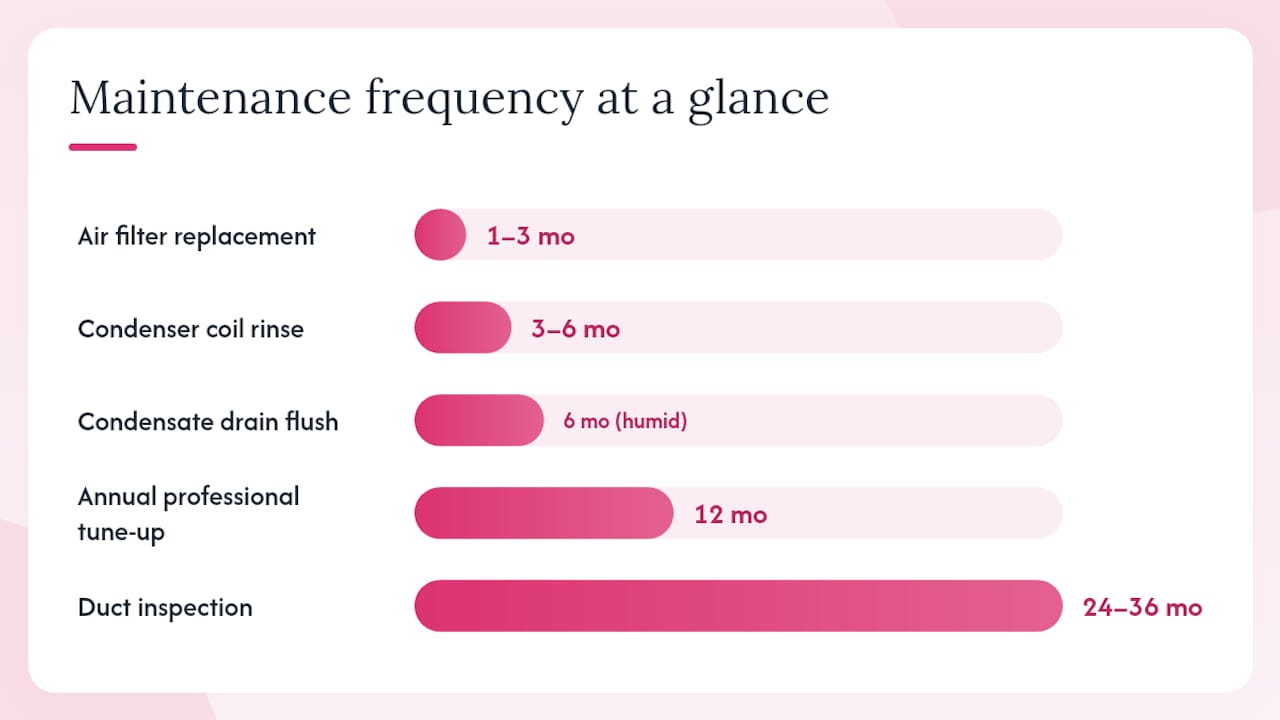
A consistent maintenance routine eliminates most of the common causes before they develop. The schedule below is based on manufacturer guidance for residential AC systems and standard trade practice.
| Maintenance Task | Recommended Interval |
|---|---|
| Air filter inspection/replacement | Every 1–3 months |
| Annual professional tune-up | Once per year (spring before cooling season) |
| Condenser coil exterior rinse | Every 3–6 months or after heavy pollen/debris events |
| Thermostat calibration check | Annually |
| Condensate drain flush | Every 6 months (monthly in humid climates) |
| Duct inspection for leaks or blockages | Every 2–3 years |
Beyond the schedule, a few habits make a real difference:
- Keep 2–3 feet of clearance around the outdoor condenser at all times. Shrubs grow faster than you’d expect.
- If your thermostat has a cycles-per-hour (CPH) or minimum-off-time setting, configure it. A 5-minute minimum off-time protects the compressor from rapid restarts.
- Watch the condensate drain for slow drainage or standing water near the air handler. A clogged drain can trigger a float switch that shuts the system off and mimics short cycling.
- If you’re replacing an oversized unit, insist that the contractor performs a Manual J load calculation before sizing the new system. Skipping this step is how oversizing problems get repeated. Building envelope improvements like new doors and windows also affect your home’s cooling load, so factor those in if you’ve made recent upgrades such as installing new interior doors to improve energy efficiency.
- Variable-speed or two-stage systems are worth considering when replacing an oversized unit. They modulate output to match actual load, which eliminates the short-cycle-from-oversizing problem by design.
For a full AC maintenance schedule tailored to New River and Anthem, the local climate adds some specific considerations around dust, monsoon humidity, and cottonwood season that affect filter and condenser cleaning frequency.
When professional help is the right choice
Most short-cycling causes that survive the DIY checklist require one of three things: refrigerant certification, electrical diagnostic equipment, or a Manual J calculation. That’s where Trucomfortaz comes in.
Trucomfortaz’s diagnostic process for a short-cycling complaint follows a structured sequence: a homeowner interview to triage symptoms, a visual inspection of both the indoor and outdoor units, filter and airflow verification, thermostat configuration review, electrical testing (voltage, amperage, and capacitor ESR measurement), and refrigerant pressure checks when the situation warrants it. That sequence is designed to find the actual cause rather than replace parts speculatively.
Trucomfortaz technicians are NATE-certified, which means they’ve passed independent competency testing specific to HVAC systems, not just a manufacturer’s in-house training. The company is family-owned and based in New River, AZ, and its technicians work on non-commissioned pay, so the recommendation you get reflects what your system actually needs.
Trucomfortaz also offers maintenance plans that include seasonal tune-ups, priority scheduling, and potential diagnostic fee waivers when a repair is approved. For homeowners in New River, Anthem, and surrounding areas, emergency service is available.
Pro Tip: When you call to schedule, mention the specific pattern you observed: “runs 6 minutes, off 3 minutes, repeats” tells the technician far more than “it keeps shutting off.” That detail often lets them arrive with the right parts already on the truck.
The part most homeowners get wrong about short cycling
Short cycling gets treated as a single problem with a single fix, but it’s actually a symptom with a dozen possible causes. The mistake I see most often is homeowners replacing the thermostat because it’s the most visible and accessible component, when the actual cause is a dirty filter, a frozen coil, or a capacitor that’s been weakening for months.
The filter check is genuinely the right first move, not because it’s the easiest, but because it’s the most frequently correct answer. After that, the diagnostic logic branches quickly into territory that requires gauges and meters. Knowing where that line is, and stopping before you cross it, is what keeps a $300 capacitor repair from becoming a $2,500 compressor replacement.
Refrigerant and electrical work carry real safety risk. A capacitor holds a lethal charge even after the system is powered off. Refrigerant released improperly is both illegal and a health hazard. There’s no shame in doing the filter and thermostat checks yourself and then handing the rest to a certified technician. That’s the right call, not the cautious one.
Trucomfortaz handles short-cycling diagnostics in New River and Anthem
When the filter swap and thermostat check don’t stop the short cycling, you need someone with gauges, a capacitor tester, and the certification to handle refrigerant. Trucomfortaz provides exactly that, with NATE-certified technicians who diagnose the actual cause rather than guess at it.

A Trucomfortaz service call for short cycling includes a full onsite inspection, electrical and pressure testing, a written diagnosis, and a clear repair quote before any work begins. Diagnostic fees may be waived when a repair is approved. The Tru Comfort Advantage maintenance plan adds seasonal tune-ups, priority scheduling, and member pricing that reduces the cost of exactly the kind of repairs short cycling tends to require. If diagnosis reveals the system is too old or too oversized to repair economically, the team can walk you through central air replacement options with honest guidance on sizing and timeline. Emergency service is available for homeowners in New River, Anthem, and surrounding areas. Schedule a diagnostic visit at Trucomfortaz.
Sources
- What Is AC Short Cycling? Causes & Troubleshooting | Carrier
- AC Short Cycling: Why It Happens and How to Fix It – Thermostat & HVAC Helpers
- Is Your AC Short Cycling? What It Means and What to Do
- How Often Should My AC Turn On? Normal AC Cycles Explained
Recommended
- Why Does My Air Conditioner Keep Turning On and Off in New River, AZ?
- How Often Should You Perform Routine Maintenance On Your AC in Anthem and New River, AZ?
- Ten Signs Your Home AC Unit May Need Maintenance | Tru Comfort
- How Often Should You Do Regular Maintenance On Your House AC Unit? | Tru Comfort