Restaurant Makeup Air Problems: Causes, Signs and Fixes
Most restaurant makeup air problems come down to one thing: the exhaust hood pulls more air out of the building than the makeup air system puts back. The kitchen goes negative, the hood loses smoke capture, and the dining room, the cooks and the energy bill all pay for it. This guide covers the signs, the usual causes, the checks you can run safely, and the point where you need an HVAC technician with airflow instruments.
TL;DR
- Makeup air is outdoor air supplied to replace what the exhaust hood removes. When the two are out of balance, the building pressure shifts and the hood stops capturing well.
- Common causes are a makeup air fan that is off or running backward, slipping belts, dirty filters, closed dampers, duct restrictions, and supply air aimed at the hood.
- Diagnose with measurements (airflow, pressure, motor amps, fan speed), not guesses from symptoms.
- Current model code requires makeup air whenever commercial kitchen exhaust runs, and the two must start together.
- Call a pro when the fix involves airflow testing, rebalancing, duct changes or a unit that will not run.
Table of Contents
- What makeup air does in a restaurant kitchen
- Signs your kitchen has a makeup air problem
- The most common causes
- Safe checks you can run before calling anyone
- Why measurements beat guessing
- Fixes that work
- Maintenance that prevents most of it
- What the code says
- When to call a professional
- Our perspective
- Get help with your air balance
- FAQ
- Sources
What makeup air does in a restaurant kitchen
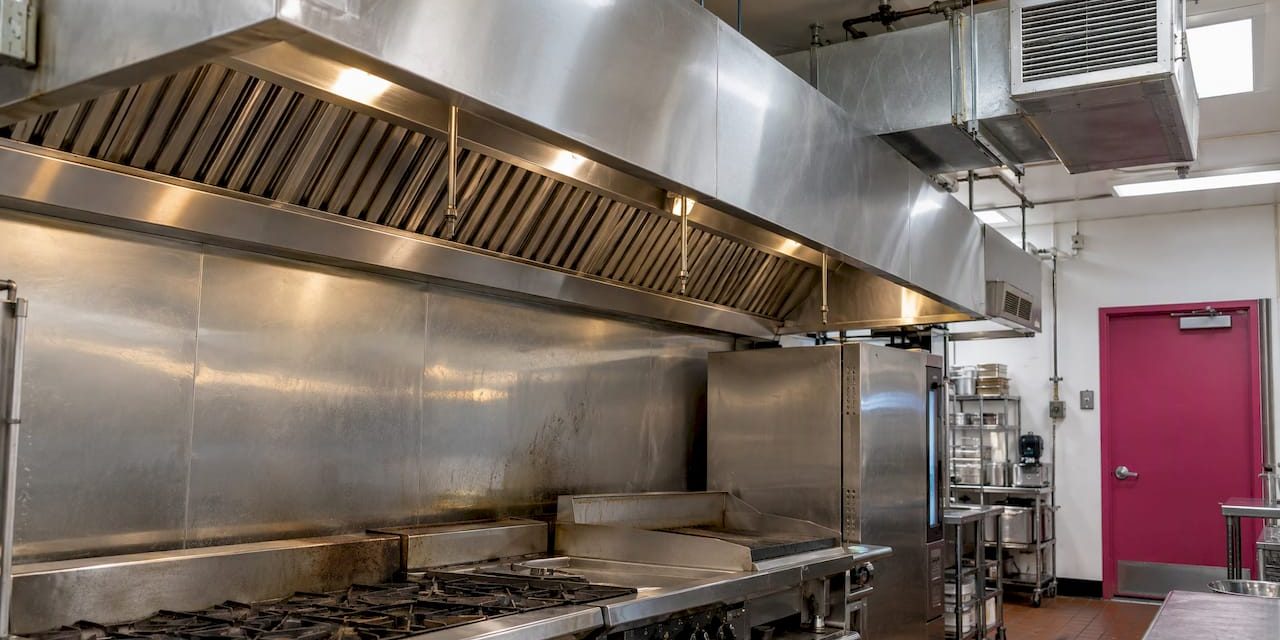
A kitchen hood is an air pump pointed at the ceiling. Every cubic foot per minute (CFM) it removes has to come from somewhere. ASHRAE defines makeup air as outdoor air, or a mix of outdoor and transfer air, intended to replace exhaust air. In a kitchen it is generally filtered and fan-forced, may be heated or cooled, and may be delivered through outlets in or near the hood.
The California Energy Commission’s kitchen ventilation design guide puts the principle simply: air in equals air out. If exhaust exceeds the intentional replacement air, the building turns negative, and uncontrolled infiltration supplies the deficit. That infiltration comes through door gaps, the dock, the roof and any other leak, and you do not control its temperature, cleanliness or location.
So a makeup air system is not an accessory to the hood. It is half of one system, and it needs the same attention as the hood and the exhaust fan.
Signs your kitchen has a makeup air problem
The symptoms below follow directly from the physics of negative pressure and badly placed supply air. None of them proves the cause by itself, but a cluster of them points straight at air balance.
- Smoke and grease vapor escape the hood. Insufficient replacement air can make the building negative and reduce hood capture. Supply air that is too fast near the hood can also blow vapor out.
- Pilot lights go out or flames waver. A hood manual lists smoke blowing away, extinguished pilot lights and cooled cooking equipment as signs that makeup air is aimed or sized wrong.
- Hot or cold spots at the cook line. Locally supplied air that is too hot or too cold causes problems for staff and hood performance.
- Air rushing in through doors and gaps. That is infiltration making up the shortfall.
- Rooftop units that struggle. If the dining room HVAC is fighting outside air being pulled through the building, comfort and energy use both suffer.
- Smells drifting into the dining room. Kitchen air moving toward the front of the house is a sign the pressure relationship is off.
If the main complaint is an uncomfortable dining room or office area, our guide on what to check when an office AC is not cooling covers the cooling side of the picture.
The most common causes
The makeup air unit is not doing its job
A hood manufacturer’s maintenance manual lists the typical culprits: closed makeup air dampers, a fan that is not running or is turning the wrong way, a slipping belt, dirty filters, duct leaks or restrictions, and HVAC units that do not supply enough outdoor air. Most of these are mechanical wear or setup issues, which is good news: they are fixable.
A fan that spins the wrong way is common after a motor swap or electrical work. It still moves some air, so everything looks fine until the hood is measured.
Supply air that fights the hood
A makeup air system can have the right volume and still cause trouble because of where the air lands. Makeup air introduced near the hood can interfere with capture, particularly at high velocity.
The same applies to the dining room system. CaptiveAire warns that an HVAC return grille within approximately 6 feet of a hood can seriously affect capture, and nearby diffusers can push smoke out of the hood. Remodels that move a diffuser or add a return near the line are a frequent hidden cause.
Exhaust that grew without the supply
A new fryer, a bigger hood or a speed increase on the exhaust fan raises the demand for replacement air. If the makeup air unit was sized for the old kitchen, the new equipment starts a pressure problem on day one.
Dirty or restricted airflow paths
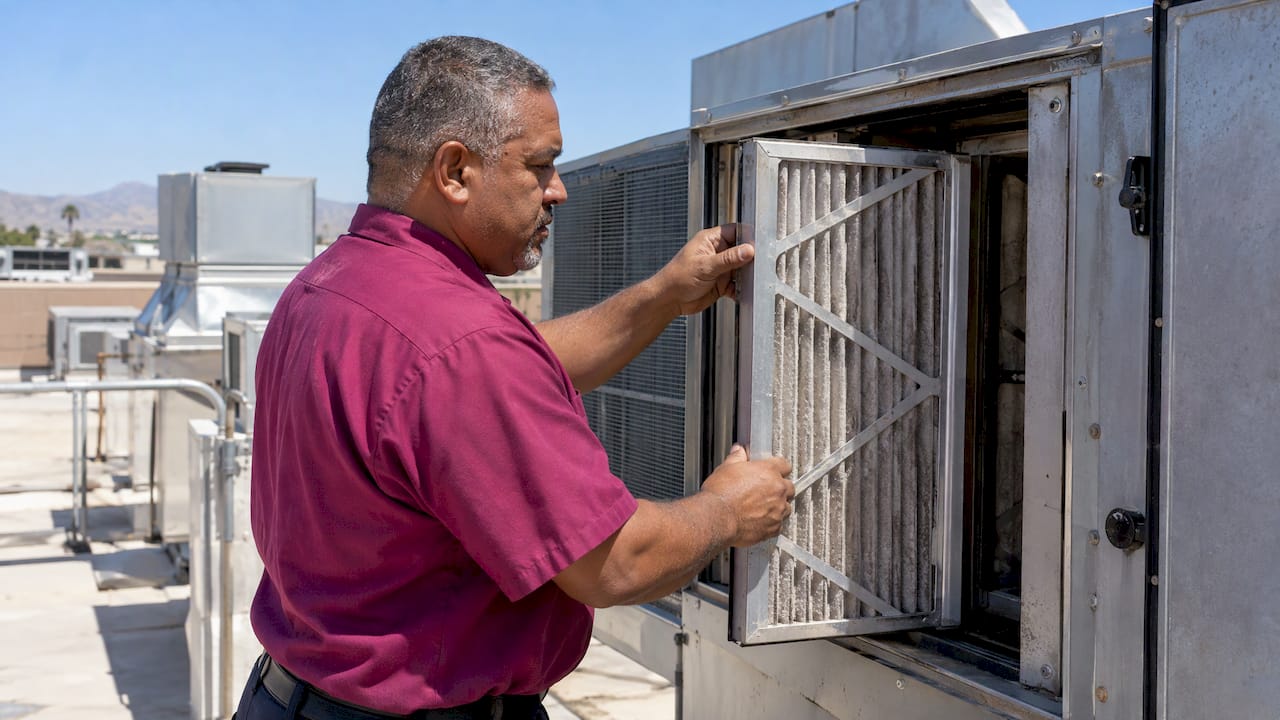
Clogged filters, restricted intake screens and fouled supply registers all reduce the CFM that reaches the kitchen. A low-flow reading with low pressure and low power can point to low fan speed, slipping belts, wrong sheaves, incorrect VFD settings, temperature effects or system losses not included in the rating.
The interlock is not tying the systems together
The makeup air unit and the exhaust fan are supposed to start together. If the interlock fails or is bypassed, the exhaust can run alone and pull the building negative for minutes or hours at a time.
Safe checks you can run before calling anyone
Stick to observation and non-invasive checks. Do not open electrical panels, bypass interlocks or work on rooftop equipment unless you are qualified. Fuel-fired equipment and grease-laden exhaust carry fire and combustion risks, so adjustments to those systems belong with qualified contractors.
- Confirm both fans run when the hood is on. Listen and look at the switches or controls. A hood manual recommends starting the makeup air and exhaust fans before cooking and leaving them on for at least 30 minutes after cooking stops.
- Watch for obvious airflow. Feel for air at the makeup air outlets. Weak or no air suggests a belt, damper, filter or fan problem.
- Check filters and intake screens. If they are visibly loaded, replace or clean them on the schedule in your unit’s manual.
- Look at where supply air is aimed. Remove any obstruction that points air at appliances, and note any diffuser or return grille close to the hood.
- Do a smoke or steam capture look. With the line cooking normally, see whether vapor rolls into the hood or drifts out the front.
- Write down what you find. Note the time of day, which equipment was running, doors open or closed, and the weather. A technician can use this.
One temporary test from a hood manual is useful when smoke blows away or equipment is cooled: reduce or redirect makeup air, and temporarily block portions of the supply with cardboard to see if capture improves. Treat it as a diagnostic clue to hand to your technician, not a permanent fix, because blocking supply can starve the building of replacement air.
Why measurements beat guessing
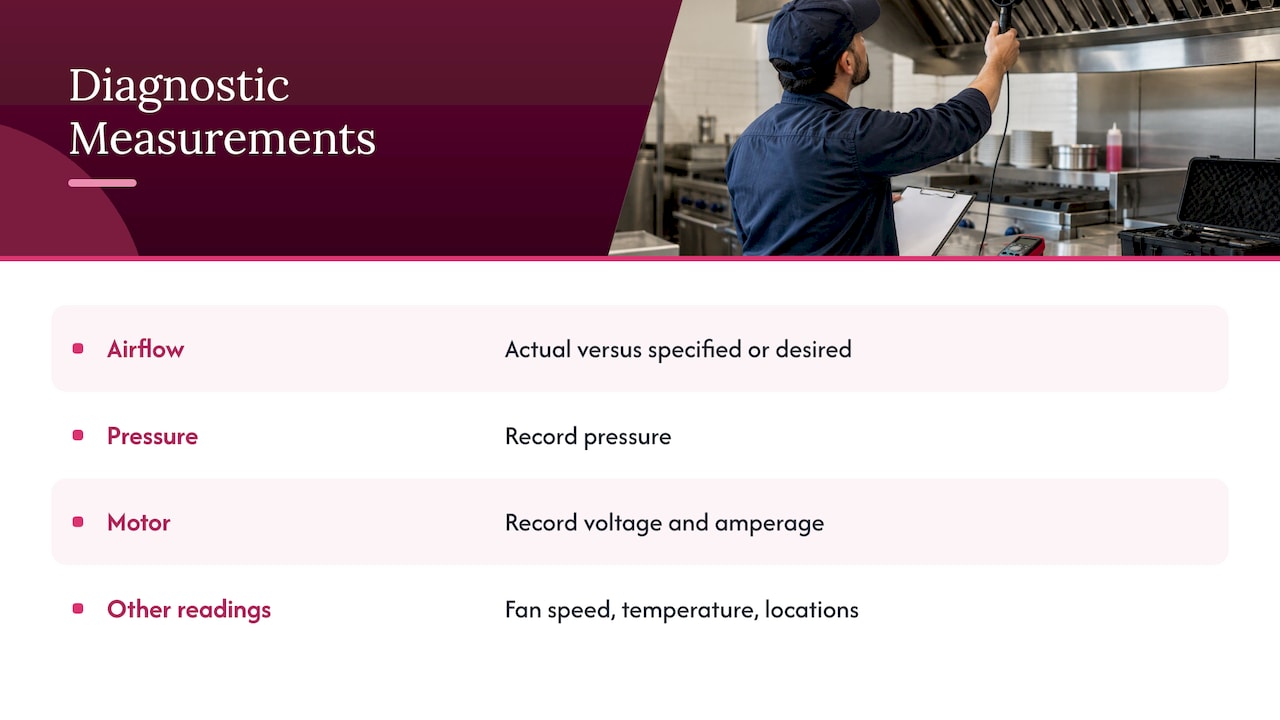
Symptoms overlap. Wavering flames can come from too much supply air or from a negative building. A hot kitchen can come from a weak makeup air unit or from a hood that is spilling heat. Greenheck recommends measuring actual airflow against the specified or desired airflow, and recording pressure, motor voltage and amperage, fan speed, temperature and measurement locations rather than diagnosing from symptoms alone.
That is the same approach we use in any air balance job: measure first, then change one thing at a time and measure again. If you want to see how that works in a home setting, our pages on air balancing and CFM measurement and negative pressure checks show the logic, which scales up to commercial systems.
Fixes that work
The repair depends on the cause. In rough order from simplest to biggest:
| Cause found | Typical fix |
|---|---|
| Fan off, wrong rotation or interlock fault | Correct wiring or controls, restore the interlock |
| Slipping belt, worn motor or fan | Replace the worn parts, then verify speed and amps |
| Dirty filters, blocked intake | Clean or replace, set a regular schedule |
| Closed or stuck damper | Repair the actuator or linkage, confirm travel |
| Duct leak or restriction | Seal or repair the ducts, remove obstructions |
| Supply air too fast near the hood | Spread the air over more grille area or more pathways |
| Diffuser or return too close to the hood | Relocate or redirect it |
| Exhaust grew past the supply | Rebalance, or resize the makeup air |
For air that lands too hard near the hood, the CEC guide recommends reducing the design exhaust rate before adding makeup air volume. It also suggests minimizing supply velocity by reducing the volume through any one pathway, increasing diffuser or grille area, or combining pathways. Remote displacement diffusers, perforated ceiling diffusers and transfer air are other options it names.
That order matters. Adding more makeup air to a kitchen that is exhausting more than it needs raises equipment size and energy use. Lower the demand first, then supply what remains.
Maintenance that prevents most of it
A quarterly routine catches the slow failures. One published checklist covers discharge temperature, filters and intake, freeze protection, belts, the motor and fan, dampers and the exhaust interlock, and calls for the makeup air unit and the kitchen exhaust fan to be checked on the same visit. That last point is the practical one: if the two are serviced by different vendors on different days, nobody checks the balance between them.
For the broader building, our commercial HVAC maintenance checklist lays out what to inspect and when. If a unit’s fan has stopped turning, see what to do when an AC fan is not spinning.
What the code says
Codes vary by state and city, and your local building department decides which edition applies to your restaurant. The model code is a useful reference. The ICC says the 2024 International Mechanical Code requires makeup air whenever commercial kitchen exhaust systems operate. Makeup air from all building sources must be approximately equal to total exhaust and must not reduce exhaust effectiveness. Mechanical makeup air systems must start and operate at the same time as the exhaust. The code also addresses conditioning of makeup air and provides an exception for compensating hoods.
There is also a commissioning angle. An earlier IMC requirement, quoted in a hood manufacturer’s guide, calls for a performance test before final approval to verify exhaust airflow, makeup airflow and proper operation, with capture and containment checked visually while appliances are at operating temperature. If your kitchen never had a documented test, a balance check is a sensible baseline.
When to call a professional
Call for service when:
- Capture is poor and the simple checks above did not change it.
- The makeup air unit does not run, trips breakers or short-cycles.
- You are adding or replacing cooking equipment or a hood.
- Ducts need repair, sealing or rerouting.
- You need measured airflow, pressure and amp readings.
- Smoke, flame or carbon monoxide concerns are present. In that case, stop cooking and treat it as an emergency.
If you manage several properties, a documented maintenance schedule across all of them saves repeated emergency calls.
Our perspective
We see the same pattern again and again: someone replaces a part, the symptom shifts, and the real imbalance stays. A belt gets changed but the damper is still stuck. A diffuser gets moved but the exhaust fan was sped up last year.
Our approach is to measure the system, explain what the numbers say, and recommend only the work the readings support. Our technicians are NATE-certified and non-commissioned, so a recommendation is never tied to what earns a bonus. That matters when the answer might be a cleaning and a belt rather than a new unit.
If you run a restaurant, treat the makeup air unit as part of your regular HVAC maintenance, not an afterthought. A planned visit costs less in disruption than a Friday night with a smoky line and a hot dining room.
Get help with your air balance
Tru Comfort Heating & Cooling serves homeowners, business owners and property managers in New River, AZ and surrounding areas with AC repair, maintenance, ductwork and emergency service. If your restaurant or commercial space has comfort problems, uneven airflow or equipment that will not run, our team can inspect the HVAC side and explain what the findings mean in plain terms.
For ongoing coverage, look at the Tru Comfort Advantage maintenance plans, or book air conditioner repair and maintenance. If a failure cannot wait, our emergency HVAC service is available. Our team can also help with air duct installation when the ductwork is the restriction.
FAQ
What is the most common restaurant makeup air problem?
Exhaust that is stronger than the replacement air. The building goes negative, the hood loses capture, and outside air leaks in through doors and gaps. Often the cause is a simple mechanical fault, such as a slipping belt, a closed damper, a dirty filter or a fan that is off.
Can too much makeup air be a problem?
Yes. Air that arrives at high velocity near the hood can push smoke and grease vapor out instead of letting the hood capture it. It can also blow out pilot lights and cool cooking equipment. The usual remedy is to spread the supply over more grille area or more pathways, not to simply cut the air.
Should the makeup air unit run when the hood is off?
Not necessarily, but the two should start together when the hood is on. The ICC says that under the 2024 IMC, mechanical makeup air systems must start and operate simultaneously with the exhaust. One hood manual also suggests leaving both fans on for at least 30 minutes after cooking stops.
How often should a makeup air unit be serviced?
A quarterly check is a common benchmark. It covers filters, belts, the motor and fan, dampers, discharge temperature and the exhaust interlock, and it should be done together with the kitchen exhaust fan. Follow your unit’s manual and local requirements for the exact schedule.
Who should fix it, an HVAC company or a hood company?
Both can be involved. An HVAC technician handles the makeup air unit, ductwork, airflow measurements and building comfort. Hood and grease exhaust work, including fire protection components, belongs to qualified kitchen exhaust contractors. Sharing readings between them speeds up the fix.
Sources
- ASHRAE Terminology: makeup air
- California Energy Commission CKV Design Guide: Optimizing Makeup Air
- CaptiveAire hood installation, operation and maintenance manual
- Greenheck: Fan and System Troubleshooting
- Commercial hood makeup air installation, operation and maintenance manual
- Makeup air unit quarterly maintenance checklist
- ICC: Exhaust Systems and Makeup Air under the 2024 IMC
- CaptiveAire: Performance Evaluation of the Systems