Home Energy Audit in Arizona: Cost, Steps and What to Fix
A home energy audit in Arizona is a visit, usually 90 minutes or so, in which a trained assessor checks where your house loses cool air, wastes electricity and strains your AC, then gives you a prioritized list of fixes. Through SRP the in-person visit costs $45 (free if you are income-qualified), and the online version is free. In a desert climate where cooling can be 40% to 50% of a summer electric bill, the audit is the cheapest way to learn which upgrade is worth paying for first.
This guide explains what gets tested, what you pay, how to prepare, and how to turn the findings into work on your ducts, windows and HVAC system.
TL;DR
- An audit looks at your equipment, ducts, insulation, windows, lighting and water heating, and often includes a blower door test and thermal imaging.
- SRP lists its in-person Home Energy Assessment at $45, free for income-qualified customers, and its online assessment is free to all SRP customers.
- The federal 25C audit credit applied to purchases through December 31, 2025, so do not count on it for a 2026 audit.
- In Arizona the biggest wins usually come from keeping heat out: sealing leaks, shading west- and south-facing windows, fixing ducts and insulation, then upgrading the AC if it is aging.
- Bring your last 12 months of bills and know where your HVAC equipment and attic access are.
Table of Contents
- What a home energy audit actually is
- What gets tested during an audit
- What an Arizona home energy audit costs
- Rebates, credits and programs that can help
- How to prepare for your audit
- What the audit usually recommends for Arizona homes
- Turning audit findings into HVAC work
- Our perspective
- Get the HVAC side of your audit handled
- FAQ
- Sources
What a home energy audit actually is
An audit (also called a home energy assessment) is a structured inspection of how your house uses and loses energy. The U.S. Department of Energy describes it as the essential first step to lowering energy bills, and says the blower door test and an infrared scan are two of its signature tools.
New York’s energy agency breaks the process into three phases: evaluation, testing and recommendations. Evaluation starts with your past utility bills as a baseline, then a walk through the interior and exterior. Testing measures airtightness. Recommendations tell you what to do and in what order. The same structure applies in Arizona, with the emphasis shifted toward heat.
There are two broad levels:
- A walk-through assessment, where the assessor reviews your bills, equipment and appliances and talks through habits and quick wins.
- A diagnostic audit, which adds equipment such as a blower door fan and an infrared camera to measure leakage and find hidden heat gain.
Neither one replaces a professional look at your cooling system. An audit tells you where the house is weak. A licensed HVAC contractor tells you what the equipment needs.
What gets tested during an audit
The exact checklist depends on the program and the auditor, but most Arizona visits cover these areas.
Utility bill review
The assessor compares your usage across seasons. One Phoenix homeowner reported on Reddit that the auditor went over the APS bill line by line and talked through appliance use and the pool. Pool pumps, second refrigerators and old electronics often show up as steady drains that no thermostat setting will fix.
Heating and cooling equipment
SRP says its in-person assessment takes about 90 minutes and covers heating and cooling equipment, thermostats, lighting, safety monitors, water heating and appliances. The assessor looks at equipment age, condition, filter state and how the system is controlled.
Air leakage (blower door test)
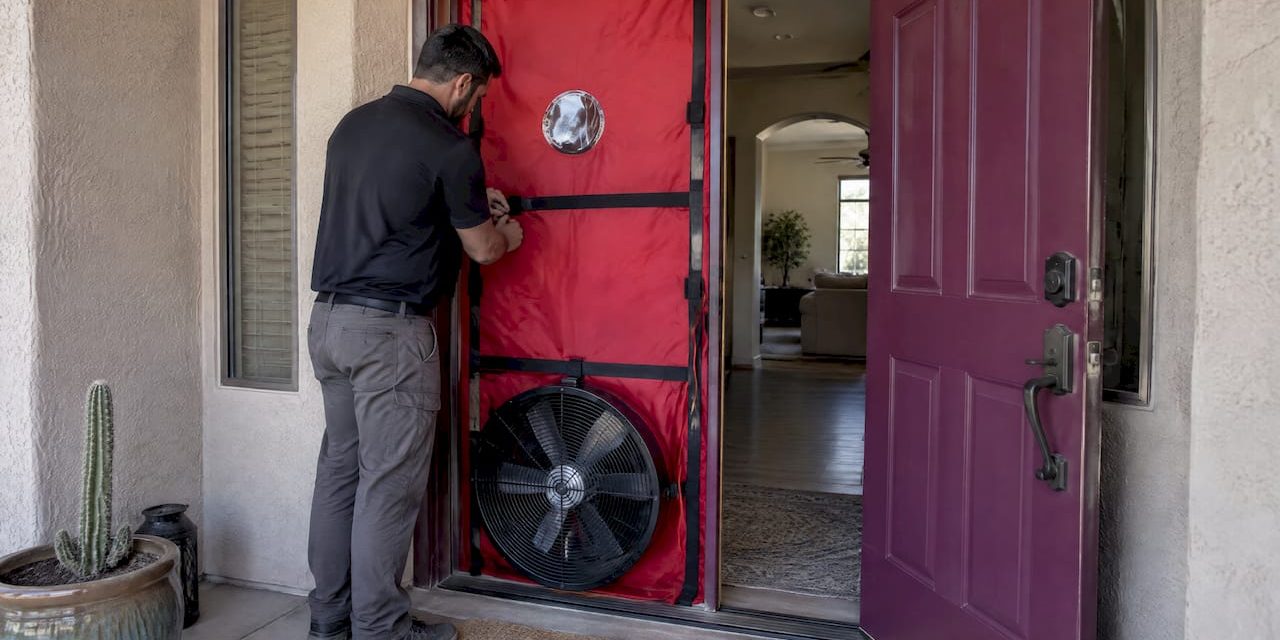
A fan is mounted in an exterior doorway and pulls air out of the house. That lowers the indoor pressure so leaks reveal themselves, as the NYSERDA guide explains. Gaps around windows, doors, recessed lights, plumbing penetrations and attic hatches are the usual culprits.
The U.S. Department of Energy notes that air leaks are a major source of energy loss, and sealing them can trim roughly 10% to 20% off heating and cooling bills, according to EPB’s audit checklist. Your results will depend on how leaky the house is to begin with.
Thermal imaging
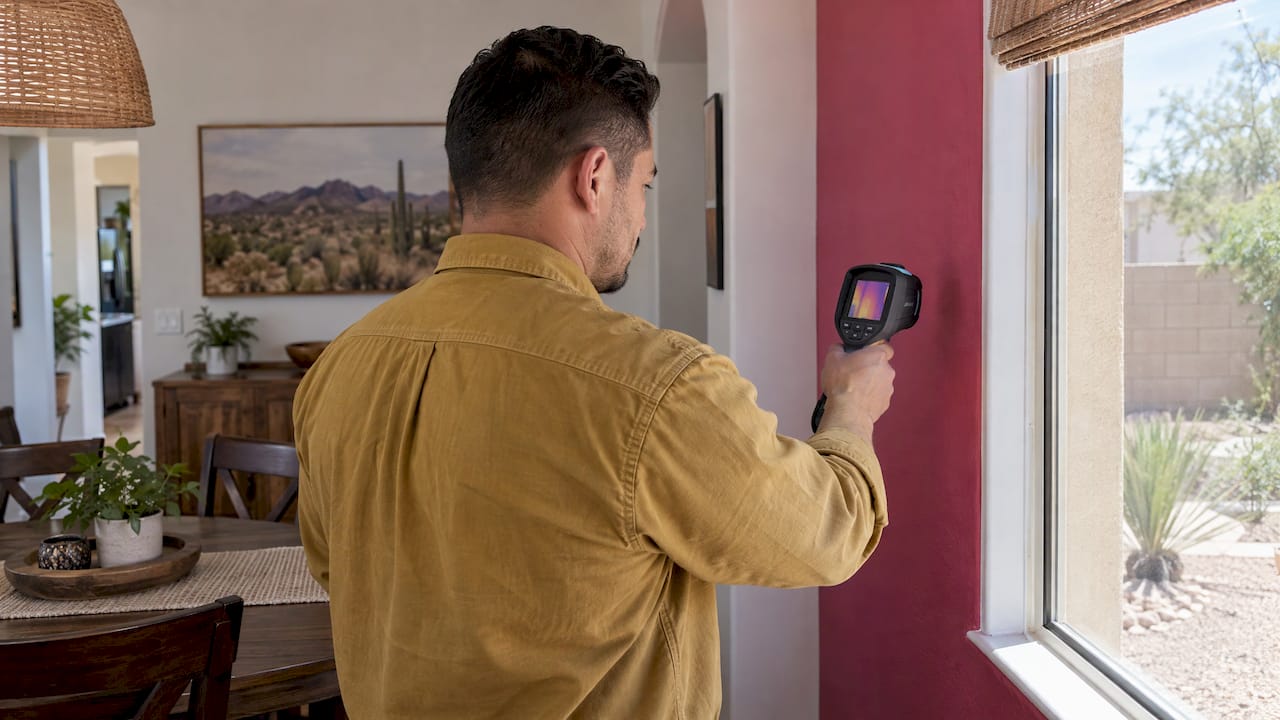
An infrared camera shows temperature differences on walls and ceilings. In summer it can reveal missing or compressed attic insulation, hot spots around poorly sealed windows, and ducts that are dumping cooled air into an attic.
Ducts
Duct leakage matters more in Arizona than almost anywhere, because many homes run ducts through a very hot attic. A leaky or poorly insulated duct system loses cooled air before it reaches a room. If one bedroom is always warmer than the rest, ducts are a prime suspect, and our piece on why some rooms are hotter than others walks through the common causes.
Insulation, windows and doors
The assessor checks attic insulation depth and coverage, window type and exposure, and door seals. West- and south-facing glass gets particular attention.
Safety checks
Safety monitors are part of SRP’s scope. If a gas furnace or water heater is in the home, a combustion safety check is a normal item in more comprehensive audits.
What an Arizona home energy audit costs
Prices depend on which utility you are with and how deep the audit goes. Here is what the utility’s own pages say.
| Option | Cost | What you get |
|---|---|---|
| SRP in-person Home Energy Assessment | $45, free if income-qualified | About 90 minutes, a customized energy report, free energy-saving products worth up to $250 |
| SRP online assessment | Free for all SRP customers | Self-guided review of your home and usage |
| APS-area diagnostic audits | Set by the APS program and its participating auditors | Diagnostic testing such as blower door and duct leakage, depending on the provider |
| Private diagnostic audit | Varies by auditor and home size | Full testing and a written report |
For APS customers, check APS’s own energy-efficiency pages for the current audit price and the list of participating auditors, since program pricing and rules change.
What changes the price
- Home size and age. Bigger or older homes take longer to test.
- Depth of testing. A walk-through costs less than a blower door and duct leakage audit.
- Utility sponsorship. Utility programs subsidize the visit, which is why a $45 SRP visit is far below the cost of a standalone diagnostic.
- Income qualification. SRP waives the in-person fee for qualifying customers.
SRP reports that its assessment program has helped participants save 48.1 million kWh and $6.25 million since it began, per its March 2026 release. That figure covers the whole program, not what any single home will save.
Rebates, credits and programs that can help
SRP
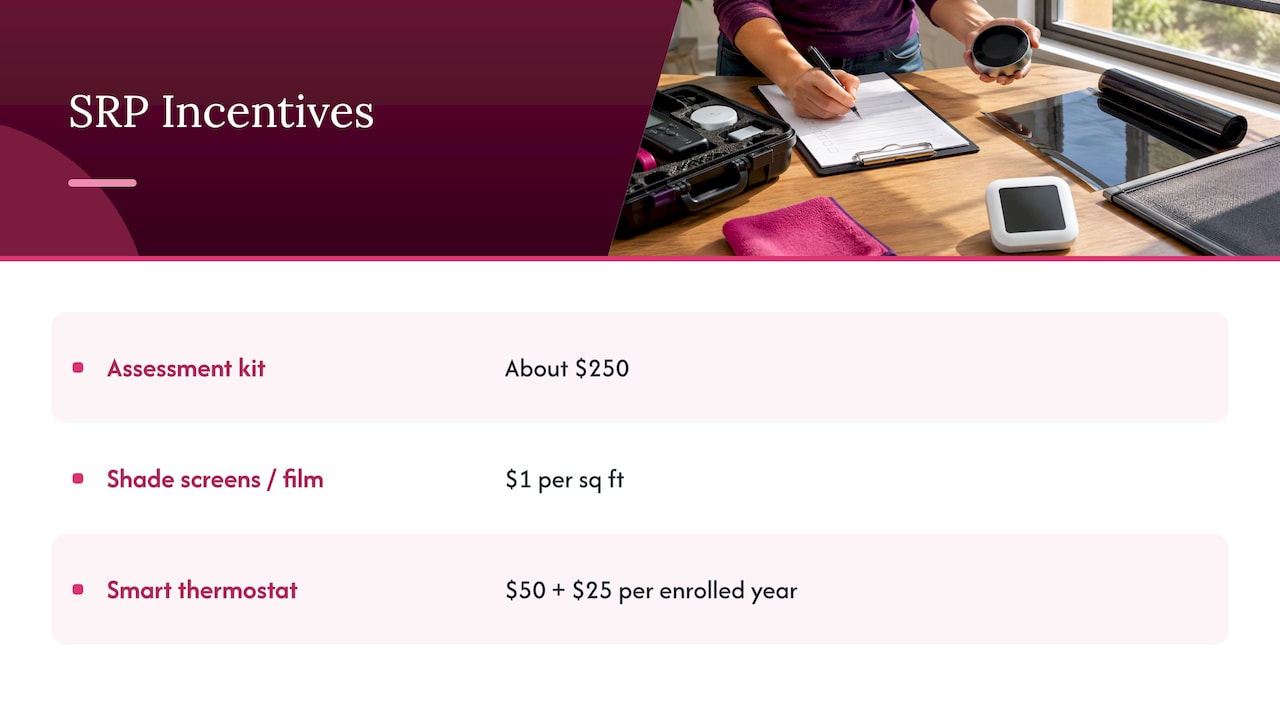
Customers who complete an assessment receive a kit valued at about $250, and SRP also offers a rebate of $1 per square foot on professionally installed shade screens or window film. Its smart thermostat program pays $50 per qualifying thermostat plus $25 for each year you stay enrolled. All of this is listed in SRP’s summer preparation release. If you plan an HVAC upgrade as well, our SRP HVAC rebate paperwork checklist covers what to keep on file.
The federal 25C credit
The 25C Energy Efficient Home Improvement Credit applied to purchases from January 1, 2023 through December 31, 2025, and included up to $150 per year for home energy audits meeting Department of Energy specifications, per the Arizona Governor’s Office of Resiliency. That window has closed, so a 2026 audit should not be budgeted around it. Ask your tax preparer whether any federal credit currently applies to your situation.
Weatherization help
Arizona’s Weatherization Assistance Program, administered through the Arizona Department of Housing, starts with an energy audit and serves eligible homeowners and renters at no cost. If your household is income-limited, ask the state about eligibility before paying for upgrades yourself.
How to prepare for your audit
A little preparation makes the visit more useful and often shorter.
- Gather 12 months of electric bills. Summer peaks and winter lows tell the assessor how much is cooling and how much is baseline.
- Note problem rooms. Write down which rooms run hot, which windows get afternoon sun, and where you hear air whistling.
- Know your equipment. Find the age and model of your AC, furnace or heat pump, and when it was last serviced.
- Clear access. The assessor may need to reach the attic hatch, the air handler, the water heater and the electrical panel.
- List your appliances. Pools, spare refrigerators, space heaters and older electronics all matter.
- Plan to be home. The in-person visit includes a conversation, and the assessor will walk you through the findings.
- Ask for the report in writing. SRP’s Energy Ambassador provides a customized energy report after the visit.
What the audit usually recommends for Arizona homes
In a hot climate the logic is simple: keep heat out first, then cool what is left efficiently. SRP states that blocking direct sun on west- and south-facing windows can reduce heat gain, and notes that windows account for up to half of the heat entering a home.
Typical recommendations, roughly in order of payback:
- Air sealing. Caulk and weatherstrip gaps around windows, doors and ductwork, which SRP lists among its summer tips.
- Window shading. Professionally installed shade screens or window film on west- and south-facing glass.
- Attic insulation. SRP says attic insulation and air sealing can lower cooling costs by roughly 10%.
- Duct repair or replacement. Sealing leaks and insulating ducts, or replacing ducts that have failed.
- Smart thermostat. A qualifying model can enroll in utility programs. We cover realistic savings in our smart thermostat guide.
- LED lighting. Switching from incandescent bulbs reduces both power use and heat inside the house.
- Efficient AC or heat pump. SRP notes that cooling can account for 40% to 50% of a summer electric bill, so a high-efficiency system makes a large difference when the old one is near the end of its life.
- Water heating. Pipe insulation and an efficient water heater trim a quieter share of the bill. These energy-saving plumbing upgrades pair well with an audit’s water-heating findings.
Turning audit findings into HVAC work
The audit report is a to-do list, and the HVAC items on it are where a licensed contractor comes in. Three situations come up most often.
The ducts are leaking
If the audit shows duct leakage, repair or replacement is the fix, and the system should be sized and balanced afterward. Our air duct installation and repair page explains what we do, and our ductwork cost per linear foot article helps you frame a budget.
The AC is old or struggling
When the report flags aging equipment, the question becomes repair or replace. Our guides on when to replace your AC and on high-efficiency HVAC, Manual J and ducts cover how to decide. If you do replace, the sizing calculation matters: see why we say not to approve AC work without Manual J, AHRI matching and a test-out.
The system is fine but dirty or neglected
Often the cheapest result is routine care: filters, coils, airflow and refrigerant checks. Our HVAC maintenance schedule shows how often each task comes up.
Our perspective
An energy audit and an HVAC visit answer different questions, and homeowners get the most from both when they use them in the right order. The audit tells you where the house loses comfort. The HVAC visit tells you what the equipment needs.
Here is what we see around New River and the north Valley: homeowners replace an air conditioner and are disappointed because the leaky ducts and a sun-baked west wall are still there. The new unit is working harder than it should from day one. Fix the envelope and the ducts first, and the system you buy can be sized more honestly.
That is also why our NATE-certified technicians are non-commissioned. When you bring us an audit report, our recommendation is built around what the report and the equipment show, not around a sales target. We would rather earn a long-term customer than sell a bigger system than the house needs.
If your audit points to ducts, an aging AC or a furnace, bring us the report. We will go through it with you and tell you plainly what is repair, what is replacement and what can wait.
Get the HVAC side of your audit handled
Once you have your report, Tru Comfort Heating & Cooling can take care of the equipment items on it. We install, repair and maintain air conditioners and furnaces, install and repair ducts, and offer emergency HVAC service in New River and surrounding areas.

If you want to keep your system running efficiently after the upgrades, look at our Tru Comfort Advantage maintenance plans. For air conditioner work, start on our air conditioner services page, or reach us through trucomfortaz.com.
FAQ
How long does a home energy audit take?
SRP’s in-person Home Energy Assessment takes about 90 minutes. A diagnostic audit with blower door and duct testing can run longer, depending on home size and how much testing is done. Expect to be home for the whole visit.
Is a home energy audit worth it in Arizona?
In a climate where cooling can account for 40% to 50% of a summer electric bill, knowing where the heat gets in is useful. With SRP’s in-person visit listed at $45 and a kit worth up to $250 included, the audit is a low-cost way to rank your upgrades. Savings depend on your home’s condition.
Can I get a free home energy audit in Arizona?
SRP’s online assessment is free to all its customers, and its in-person assessment is free for income-qualified customers. Arizona’s weatherization program also begins with an audit for eligible households. Check your utility’s current program page for qualifications.
Should I do the audit before replacing my air conditioner?
Yes, when timing allows. The findings on leaks, ducts, insulation and shading change how large a system you need. Sizing should follow a proper load calculation, not the size of the old unit.
Does an energy audit include a duct test?
Diagnostic audits commonly include duct leakage testing, while a basic walk-through may only cover visible ductwork. Ask the provider before booking exactly which tests are included. If you have rooms that never cool properly, request the duct test.
Sources
- SRP Offers Free and Low-Cost Tips to Prepare Homes for Summer
- SRP Home Energy Audit
- Saving Energy | SRP
- Energy Efficient Home Improvement Credit 25C | Arizona Governor’s Office of Resiliency
- The Complete Guide to Home Energy Assessments | NYSERDA
- Home Energy Assessments | U.S. Department of Energy
- Home Energy Audit Checklist | EPB