Hot Attic and Your AC in Arizona: Causes and Fixes
If your air conditioner runs all afternoon and the house still feels warm, the attic is a prime suspect. On a 110-degree Phoenix day, the attic can hit 140 degrees, and that heat pushes down through the ceiling into the rooms your system is trying to cool. The fix is rarely one gadget. It is usually a mix of sealed ducts, good insulation, a properly working AC and, in some homes, a change in where the ducts run.
TL;DR
- Arizona attics routinely run far hotter than the air outside, and that heat works against your AC all day.
- If your ducts or air handler sit in the attic, attic temperature directly affects how much cooling actually reaches your rooms.
- Duct sealing, insulation, correct refrigerant charge and airflow, and yearly maintenance do most of the work. Attic fans help less than people expect.
- Before any attic work, repair roof leaks, protect exhaust and flue pathways, and have wiring checked.
- A technician can tell you whether the problem is the attic, the ducts or the AC itself.
Table of Contents
- How hot does an Arizona attic really get?
- What a hot attic does to your air conditioner
- Is it the attic, the ducts or the AC?
- What actually reduces attic heat and its effect on cooling
- Safety before you touch the attic
- Our perspective
- When to call a professional
- Get your system ready for the next summer
- FAQ
- Sources
How hot does an Arizona attic really get?
Hot. Reported figures for Phoenix-area attics land around 140°F or more on a 110-degree day. Techs who work up there describe even higher numbers in peak summer, which is why attic work is usually done early in the morning.
The real number depends on your house. In a Phoenix study of four monitored homes with tile roofs and ventilation above code, peak attic temperatures ran from 4°F to 28°F above the outdoor temperature. That range tells you something useful: two homes on the same street can behave very differently. The same study ties attic temperature to several things:
- Solar heat gain on the roof
- How well the attic is ventilated
- Heat conducted through the ceiling and through the ducts or air-handler cabinet
- Duct leaks
- How the space around the air handler is built
If you live in the foothills north of Phoenix, summers are brutal and your roof takes the full hit. Our guide on how hot Anthem and New River get in summer covers what your system is up against.
What a hot attic does to your air conditioner
There are two separate problems: heat coming through the ceiling, and heat attacking the ductwork.
Heat pushing down through the ceiling
The ceiling becomes a warm surface above your head. That matters for comfort in a way the thermostat does not show. The Arizona Institute for Resilience reports that under-insulated Phoenix homes can have operative temperatures above 90°F even with the thermostat set at 75°F, because hot surfaces radiate heat at you. So a house can read 75°F on the wall and still feel like it is not cooling.
Heat attacking the ducts
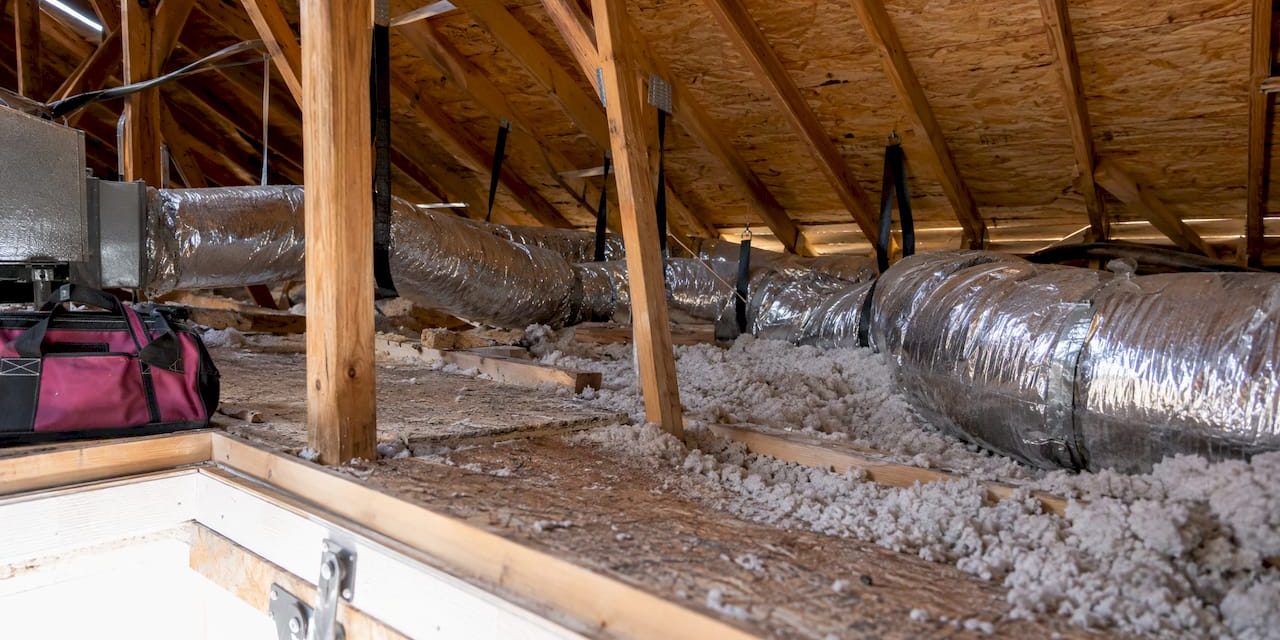
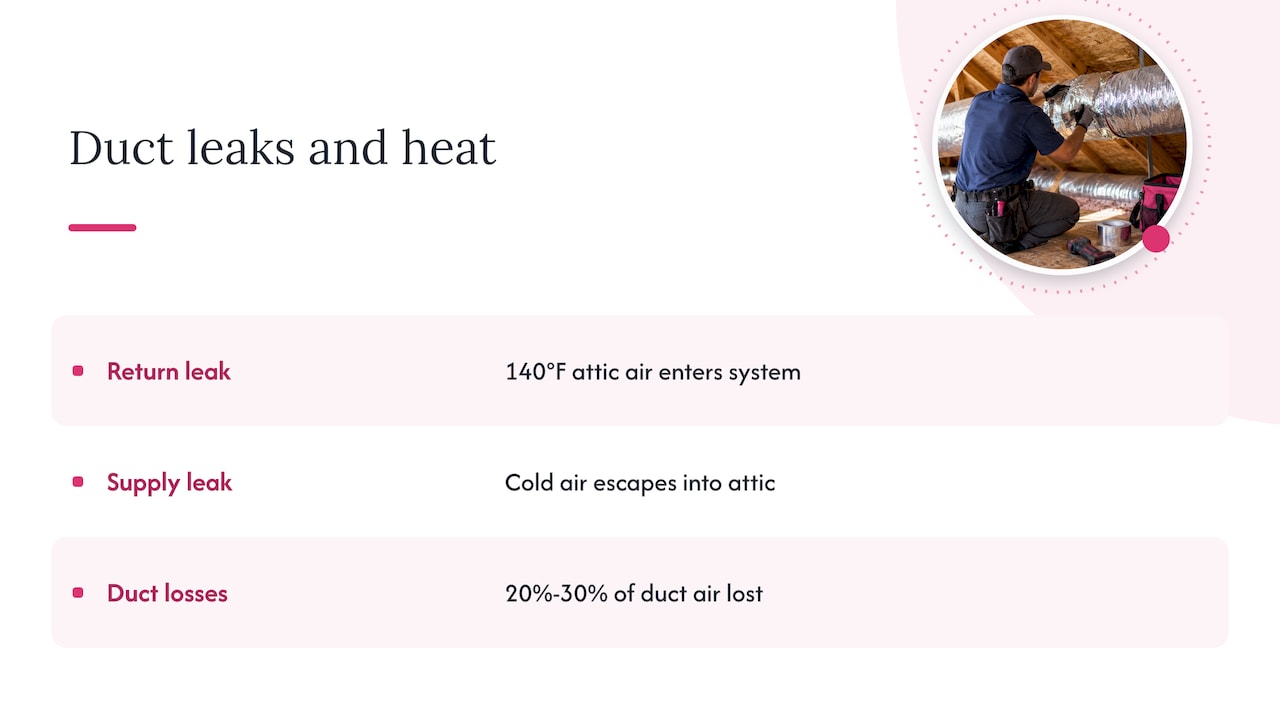
Many Arizona homes, especially older ones and many single-story builds, run ducts through the attic. When that is your setup, attic temperature is critical to how efficiently air is distributed, and hotter attic air makes return leaks worse. A return leak pulls 140°F attic air straight into your system. A supply leak dumps cold air you paid to make into the attic.
Leaks are common. One manufacturer’s guidance says the average home loses 20% to 30% of the air moving through its ducts to leaks and poor connections. Treat that as a rule of thumb rather than a measurement of your house, which is why a duct test is worth having done. Our article on leaky air ducts and when a 25 Pa test makes sense explains what to expect.
Is it the attic, the ducts or the AC?
A hot attic is often blamed for problems that are really equipment or installation issues, and the reverse. Here is how the symptoms usually sort out.
| What you notice | Likely contributor | Next step |
|---|---|---|
| One or two rooms always hotter, especially upstairs or at the end of a duct run | Duct leaks, restricted airflow, or heat from the attic over that room | Duct inspection and airflow check |
| Whole house warm on 105°F+ days, AC runs nonstop | Under-insulated attic, low refrigerant charge, low airflow, or an undersized system | Full system diagnostic |
| Weak airflow at vents | Dirty filter, duct problem, or a blower issue | Check the filter, then call a technician |
| Dust, dirt streaks near duct seams in the attic | Duct leaks | Duct sealing |
| Air is blowing but not cold | Refrigerant or equipment problem | Repair visit |
Two official sources explain why it pays to look at the AC itself and not only the attic. A U.S. Department of Energy guideline notes that field studies have shown more than half of installed air conditioning systems have significant defects. ENERGY STAR says more than half of new systems in U.S. homes do not reach their rated efficiency because of improper installation, and that poor installation can cut performance by as much as 30%.
In the Phoenix study, two of five air conditioners had materially deficient capacity. Both had low airflow and one was seriously undercharged. So a hot attic and a struggling AC often show up together, and fixing only one leaves comfort on the table.
If you are chasing a single hot room, see why some rooms are hotter than others. If the system just is not cooling, start with our AC not blowing cold air fix guide.
What actually reduces attic heat and its effect on cooling
The research is fairly consistent. The order of payoff is roughly: stop the leaks, insulate, then consider ventilation and reflective measures.
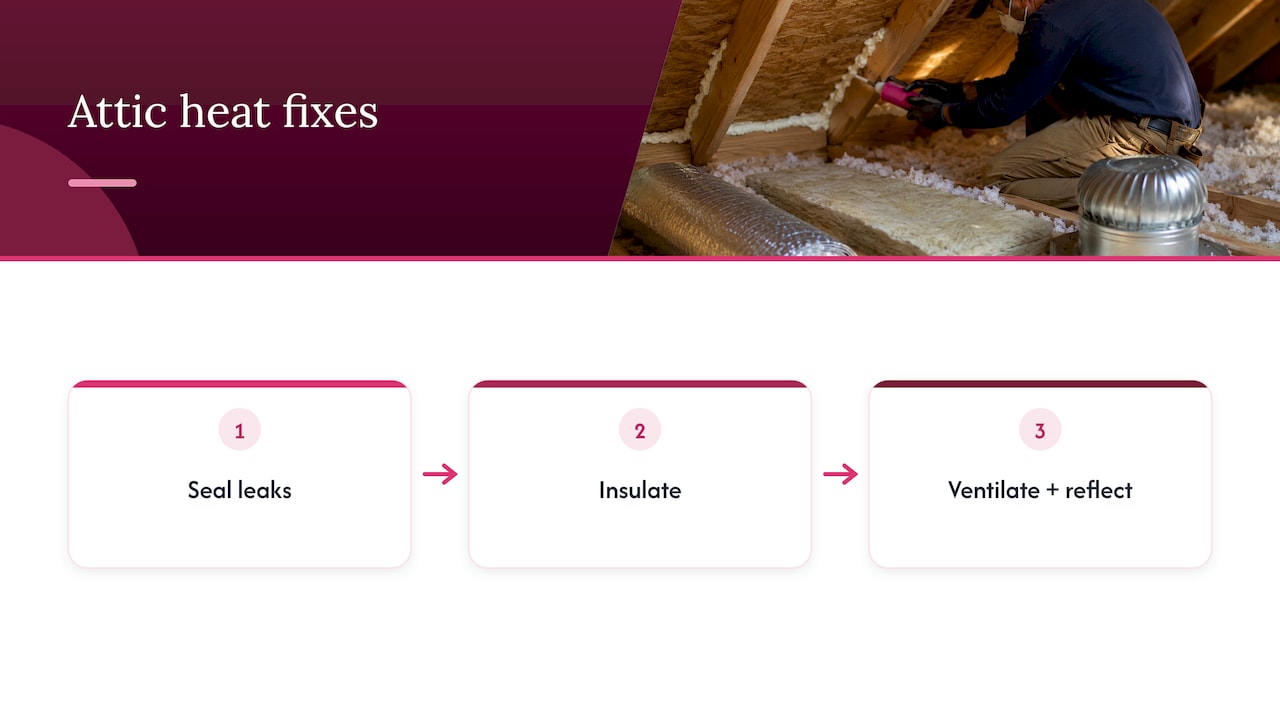
Seal the ducts and the attic floor
The Florida Solar Energy Center recommends attic insulation, reflective roof finishes or radiant barriers, and thorough duct sealing, and ideally placing ductwork in conditioned space. The Department of Energy’s attic guide adds sealing gaps around ducts, wiring, plumbing, lighting and attic entries before insulating.
Add or restore insulation
Insulation is the barrier between the superheated attic and your ceiling. The Arizona Institute for Resilience also recommends roof insulation, low-emissivity double-pane windows and exterior shading to cut radiant heat. Shade helps your equipment too: see our piece on shading your house before shading the AC unit.
Fix the AC itself
A Lawrence Berkeley National Laboratory study found that correcting refrigerant charge, inadequate airflow and duct leakage can improve performance in a conventional attic. It also found that properly sized and installed air conditioners perform as well as or better than oversized, poorly installed ones, which have higher peak energy use. If you are weighing a new system, Manual J, AHRI matching and a final test-out are the checks to insist on.
Consider moving the ducts out of the attic
The same study found that sealing and insulating the attic at the roofline gave dramatically better cooling performance and lower energy use than a conventional attic, with much of the gain from insulation and air sealing. That is a larger project, but it shows how much the duct location matters. If your ductwork is old, damaged or poorly routed, air duct installation is one way to address it, and our ductwork cost per linear foot page helps you plan.
What about attic fans?
Ventilation has a role, but expectations should be realistic. FSEC notes that ventilation can lower attic air temperature but cannot overcome radiant heat transfer to attic surfaces. The Building America Solution Center says attic fans usually deliver less living-space benefit than expected, with small-to-moderate cooling-load reductions, and some fans can use as much energy as they save. A better-balanced setup is soffit intake paired with high exhaust such as a ridge vent, as the DOE durable-attic guide describes. Think of ventilation as one piece, never the whole answer.
How the pieces compare
| Measure | What it does | Best paired with |
|---|---|---|
| Duct sealing | Stops cooled air escaping and hot air entering | Insulation, airflow check |
| Attic insulation and air sealing | Slows heat moving into living space | Duct sealing |
| Refrigerant charge and airflow correction | Restores the AC’s real capacity | Annual maintenance |
| Radiant barrier or reflective roof finish | Cuts radiant heat at the roof | Insulation |
| Soffit and ridge ventilation | Lowers attic air temperature | Sealed ceiling plane |
| Window shading and low-e glass | Reduces radiant load inside | Any of the above |
In a hot-dry-climate field study, a house that combined these kinds of measures used about 40% less energy per day than a control house. Total window shading alone cut use by about 36%, and spectrally selective windows trimmed air-conditioning load by 12%. Those are results from one study house, so read them as a sign of direction, not a promise for yours.
Safety before you touch the attic
Attic work in summer is dangerous on its own: the heat can overwhelm you in minutes. Do inspections early in the morning or hire it out. Beyond heat, several rules from federal building guidance matter:
- Repair roof leaks and moisture problems first. DOE guidance says insulation and air sealing should follow roof and moisture repairs and the handling of hazardous wiring or materials. Bath fans should vent outdoors, not into the attic.
- Do not block or disable exhaust paths. PNNL warns that attic work must not block kitchen and bathroom exhausts, combustion flues, radon pipes or plumbing vents.
- Active knob-and-tube wiring goes to a licensed electrician, and work stops if asbestos is present, per the same checklist. After air sealing, natural-draft appliances need a combustion-safety retest.
Our perspective
We climb into a lot of Arizona attics, and the pattern repeats. Homeowners call because the AC “can’t keep up,” and often both things are true: the attic is brutal and the system has a fixable problem, like leaky ducts, low airflow or a charge that is off.
That is why we start with the whole picture before recommending anything. Our technicians are NATE-certified and non-commissioned, so what we recommend is based on what your home needs, not on a sales incentive. Sometimes the answer is a tune-up. Sometimes it is duct repair or new ductwork. Sometimes it is replacing a system that was never sized right.
Our advice for foothill homes is simple: get the ducts and equipment checked every year, before the heat arrives, and deal with attic issues while the weather lets you. A system that is clean, sealed and properly charged works with the attic instead of fighting it.
When to call a professional
Book a visit if rooms stay hot after the filter is changed, the system runs almost constantly in summer, your energy bills climb with no explanation, or you see dirt streaks around duct seams. NAHB advises having heating and cooling equipment checked and cleaned by a professional every year, and InterNACHI suggests tuning up the cooling system in spring and the heating system in fall. The same guide says to check the filter monthly in heavy-use seasons and change it at least every three months. Our HVAC maintenance schedule and AC maintenance checklist lay out what to do and when.
Maintenance matters for cost too. The DOE guideline above notes that proper maintenance of cooling systems can reduce their energy use by as much as 50%. If your unit is old, our guide on how long AC units last in Arizona can help you decide between repair and replacement.
Get your system ready for the next summer
Tru Comfort Heating & Cooling is a family-owned HVAC company in New River, AZ. We handle air conditioner installation, maintenance and repair, air duct installation, and emergency service, and our NATE-certified technicians are non-commissioned. If you want a yearly check on a schedule, ask about the Tru Comfort Advantage maintenance plans.

If your AC is failing in the heat right now, contact us for emergency HVAC service and we will get a technician moving.
FAQ
Does a hot attic make my AC work harder?
Yes. Heat from the attic moves through the ceiling and into ducts and the air handler if they are up there. Research on Phoenix homes shows attic temperature strongly affects duct efficiency, especially when return leaks pull in hot attic air. Sealed ducts and good insulation reduce that load.
Will an attic fan fix a hot attic?
Not by itself. Federal building guidance says attic fans often give less benefit than expected because most heat reaches the living space as radiant heat. Insulation, air sealing and duct work usually matter more.
Why is one room so much hotter than the others?
Usually airflow is uneven. Ducts that restrict flow, rooms far from the thermostat, leaks and attic heat above that room are common causes. A duct inspection tells you which. Our guide on hotter rooms in Anthem homes walks through it.
How often should an Arizona AC be serviced?
At least once a year, with a professional checkup before summer. Many homeowners also check the filter monthly during heavy use. See our guide to how often to maintain a home AC unit for the details.
Can I fix attic problems myself?
Simple tasks like changing filters are fine. Attic work involves extreme heat, wiring, flues and exhaust paths, so have a qualified professional handle duct repair and any air sealing or insulation changes.
Sources
- Monitored In-Situ Performance of Residential Air-Distribution Systems (ASHRAE Phoenix study)
- Why Is My Attic So Hot? (Bob Vila)
- Why homes often feel warmer than the thermostat suggests (Arizona Institute for Resilience)
- Why Is One Room Always Hotter or Colder Than the Rest of My Home?
- Measure Guideline: Air Conditioner Diagnostics
- ENERGY STAR quality installation checklist
- Attic Insulation and Ventilation (FSEC)
- Guide to Durable Attics (U.S. Department of Energy)
- Attic Ventilation Fans (Building America Solution Center)
- ACEEE Summer Study 2000, Paper 555 (Lawrence Berkeley National Laboratory)
- Systems Interactions and Energy Savings in a Hot Dry Climate (ACEEE)
- Comprehensive Attic Package, Vented to Unvented Attic (Building America Solution Center)
- Sealing and Insulating Existing Vented Attics, Code Compliance Brief
- Assess Your Home’s Efficiency with an Energy Audit (NAHB)
- A Homeowners Guide to Heating and Cooling (InterNACHI)