High Static Pressure in HVAC: Causes, Signs and Fixes
High static pressure means your blower is pushing against more resistance than the system was built for. The air has a hard time getting through the filter, coil, ducts or grilles, so you get less airflow, longer run times, more noise and extra wear on the motor. The fix starts with a measurement, not a guess, and it usually lives in the ductwork, the return air path or the filter, not in the equipment itself.
TL;DR
- Static pressure is the resistance your blower works against, measured in inches of water column. High readings mean weak airflow and a strained blower.
- Compare the measured total external static pressure (TESP) with the maximum printed on the equipment nameplate. A reading 10% to 20% over that rating points to an airflow problem.
- The usual culprits are undersized returns, restrictive filters, pinched or undersized ducts, tight transitions and a coil that is dirty or too small for the airflow.
- Closing vents, stacking filters or swapping in a bigger air conditioner does not solve it. A technician with a manometer can find the exact pressure drop and the cheapest fix.
Table of Contents
- What static pressure actually is
- What counts as “high”
- What happens to airflow when static pressure goes up
- Signs your system has high static pressure
- What causes high static pressure
- Why return air problems can affect your safety
- How a technician diagnoses it
- Fixes, from cheapest to most involved
- Perspective: measure before you replace anything
- Get your static pressure measured
- FAQ
- Sources
What static pressure actually is
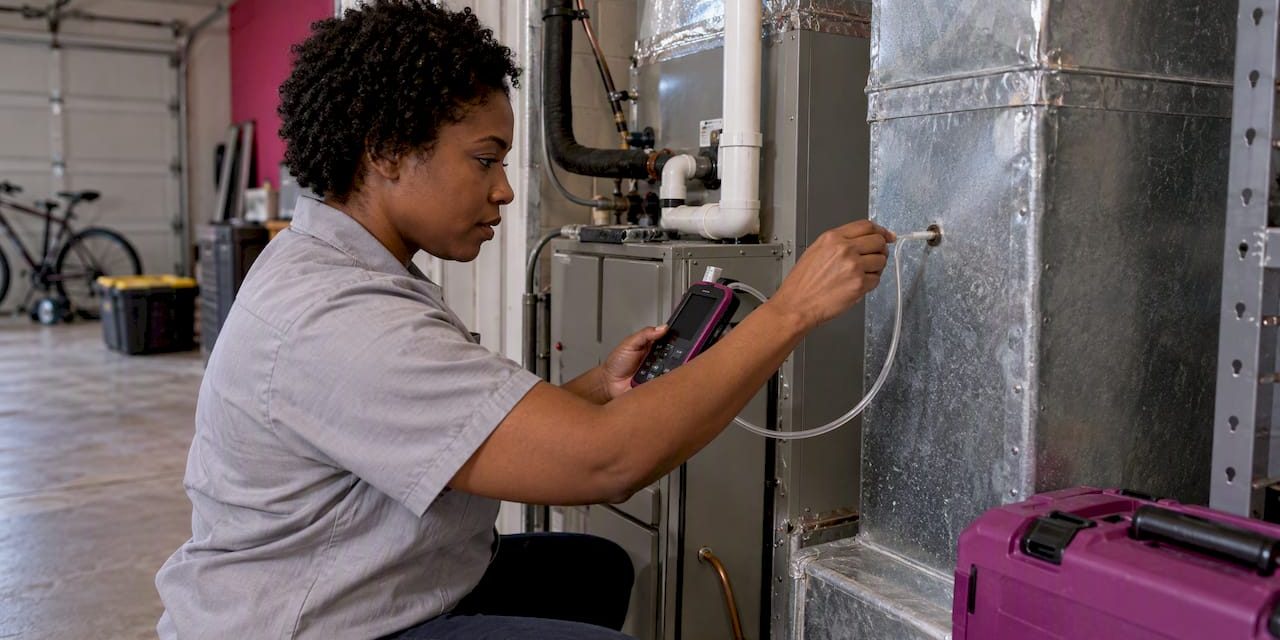
Think of your duct system as a set of straws the blower has to breathe through. Static pressure is the pressure a fan pushes and pulls against to move air, and it presses equally on all sides of the duct. Technicians measure it in inches of water column (in. w.c.) using a manometer with two pressure ports and static pressure tips.
You will not feel static pressure the way you feel a breeze at a vent. You feel its effects: a room that never cools, a system that never seems to shut off, a whistle at the registers.
ESP, TSP and TESP: the terms in plain words
The search results throw a lot of acronyms at you. Here is what each one means in the field:
- Total external static pressure (TESP) is the sum of the absolute values of the pressure on the suction (return) side and the discharge (supply) side of the blower. Unlike a pressure drop across a single coil or filter, it represents the total work the fan does against everything outside the equipment cabinet.
- External static pressure (ESP) is the everyday shorthand for the same idea. Most technicians use it to mean the TESP reading taken at the equipment.
- Component pressure drops are the individual losses across the filter, the evaporator coil, a damper or a run of duct. They explain where the TESP is coming from.
What counts as “high”
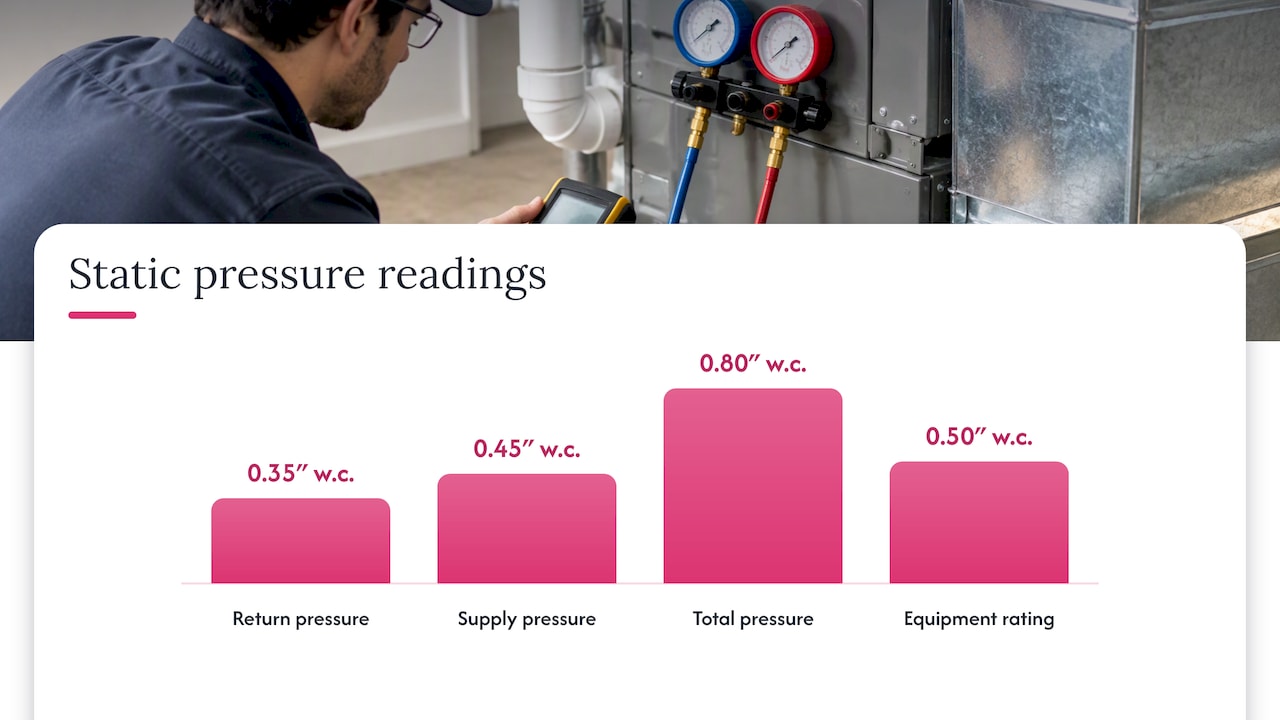
There is no single number that fits every home, because every blower is rated differently. The right comparison is between your measured TESP and the maximum on the equipment’s nameplate. If the measurement is 10% to 20% above the manufacturer’s rated figure, there is probably an airflow problem hurting performance.
A quick worked example makes it concrete. Say the nameplate lists a maximum external static pressure of 0.50 in. w.c. A technician reads 0.35 on the return side and 0.45 on the supply side. Add the absolute values and TESP is 0.80, which is 60% over the rating. That is not a borderline reading. Something in the system is choking the airflow.
What happens to airflow when static pressure goes up
Airflow, measured in cubic feet per minute (CFM), is what actually cools and heats your rooms. As resistance climbs, the blower moves less air. The ASHRAE Handbook says it plainly: if static pressure is too high, the blower cannot deliver the required system airflow.
That matters in Arizona for a simple reason. An air conditioner sized for a summer afternoon in New River depends on its full airflow to move heat off the coil and into your rooms. Starve it of air and a properly sized system behaves like a smaller one. It runs longer, the far bedrooms lag behind, and the coil and compressor work in conditions they were not designed for.
The same logic applies on the heating side. A furnace that cannot move its rated airflow runs hotter inside the cabinet and cycles harder.
Signs your system has high static pressure
No single symptom proves it, but a cluster of these is a strong hint:
- Weak airflow at some or all registers, even though the blower sounds like it is working
- An AC that runs nearly nonstop on hot days yet struggles to hold the thermostat setting
- Rooms far from the equipment that stay warmer than the rest of the house
- Whistling at vents or a rushing, droning noise from the ducts. ASHRAE notes that high flow resistance raises the pressure the fan must produce and increases noise, especially at low frequencies
- A blower that sounds strained, or a motor that has failed more than once
- Doors that slam or pull shut by themselves, or a hiss under closed bedroom doors
If the whistling is your main complaint, our whistling air vents guide walks through how to narrow it down. If your AC runs but the air is warm, start with this homeowner fix guide for an AC not blowing cold air, because low airflow and low refrigerant look similar from the couch.
What causes high static pressure
Most problems come from the air path around the equipment, not the equipment. Here are the common causes, roughly in the order a technician checks them.
Undersized or restricted return air
The return side is the most common offender. Studies cited by ACCA show 80% of homes have undersized return duct systems, which is why a return duct survey belongs in every service and maintenance visit. The same source gives a sizing guide: return ducts at 400 CFM per ton, with no more than 0.08 in. w.c. of drop and 0.05 in. w.c. as the safest target.
A single small return grille serving a 4-ton system is a textbook example. The blower pulls hard on that one opening, the return side shows a strong negative reading, and the supply side suffers. Our guide to three free checks that catch most return air problems shows what you can look at before anyone measures anything.
Filters that are dirty or too restrictive
Every filter adds resistance, and a loaded filter adds a lot more. A dense filter on a system with modest ductwork can eat the whole pressure budget by itself. This is why a high-efficiency filter is not automatically an upgrade. If you are weighing how fine a filter you really need, this comparison of HEPA 13 vs 14 filtration levels explains how much filtration different grades deliver, and the trade-off for your blower is the pressure each one adds. Ask your technician to check the pressure drop across whatever filter you choose.
For how often to swap standard filters, see our HVAC maintenance schedule.
Ducts that are pinched, undersized or poorly built
Field fixes for duct problems are well documented. When ACCA describes using static pressure readings to find duct deficiencies, the list of things to correct includes pinched or blocked ducts, undersized ducts, restrictive transitions and poor duct suspension. A flex duct that sags between hangers or gets kinked behind a joist can be a bigger restriction than anyone expects.
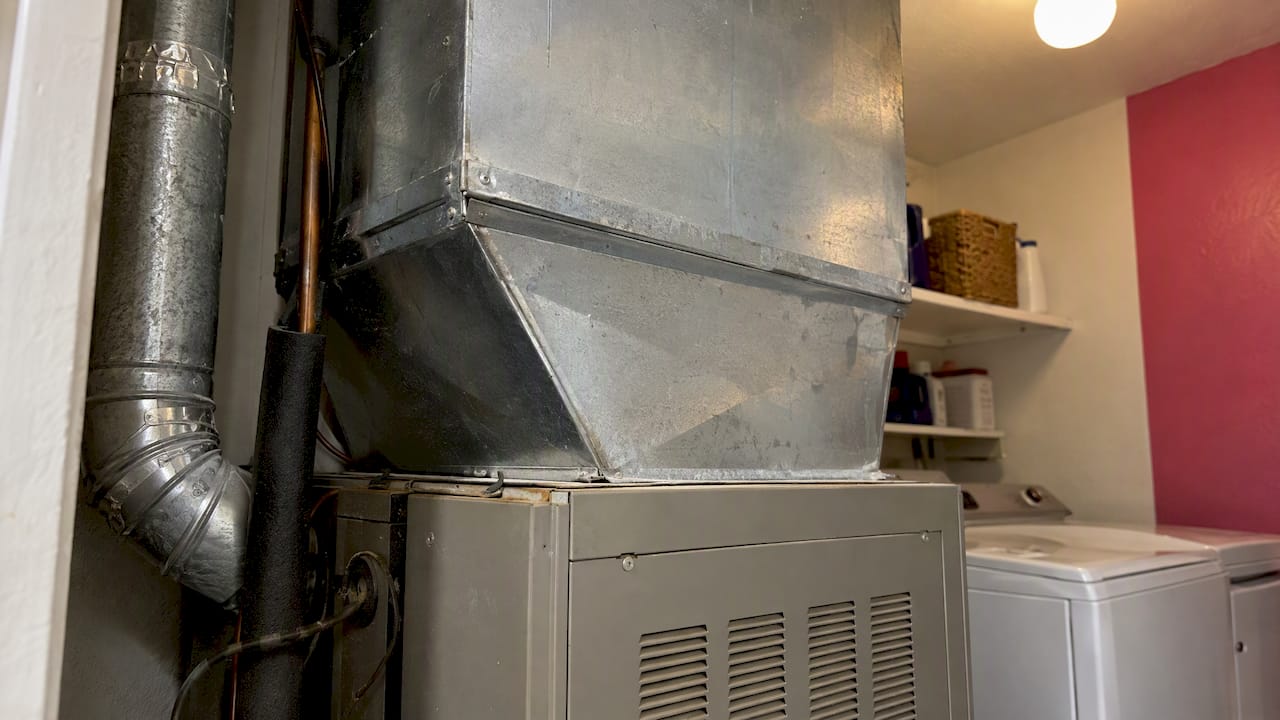
Transitions matter as well. ASHRAE advises that duct transitions should not expand at an angle greater than 15 degrees, or the airflow separates from the wall and creates rumble and resistance. A boxy, abrupt fitting right off the furnace or air handler is a common place to find this.
A coil or component that is too restrictive
A dirty evaporator coil or a coil that is too deep for the blower raises resistance. So can a closed or partly closed damper. This is why technicians profile the system rather than only reading TESP.
Closed vents and sealed-off rooms
Closing registers to push more air to other rooms is a popular home remedy, and it usually backfires. You shrink the open area, the pressure climbs and the airflow you were trying to redirect drops. It is one more reason to leave vents open and have the balance measured.
Zoning that is not set up with a proper bypass
Zoned systems add their own risks, because dampers close off sections of duct. A bypass duct is one way to relieve pressure, and it has to be set correctly. ACCA describes balancing it by measuring static pressure with zones closed and adjusting the manual damper to restore the original supply-trunk pressure. If your zoning is misbehaving, read our five homeowner checks for zoned HVAC that is not working first.
Why return air problems can affect your safety
High static pressure is not only about comfort. When bedroom doors are closed and the room has no return path, the main part of the house can go negative. ACCA notes that in homes with inadequate bedroom return-air pathways, closed doors can create negative pressure and may cause gas-appliance backdrafting. If you have a gas furnace or a gas water heater, that is a reason to take a persistent pressure problem seriously.
If you smell exhaust, notice soot around an appliance, or a carbon monoxide alarm sounds, leave the house and call emergency services. Then have a licensed HVAC technician inspect the combustion appliances. For the non-emergency version, our guide to five negative pressure checks, starting with safety is the place to begin.
How a technician diagnoses it
A good diagnosis takes less time than most homeowners expect, and it should end with numbers on paper.
- Read the nameplate. Note the maximum rated external static pressure and the blower’s rated airflow.
- Take the TESP reading. Drill two small test ports, one in the return plenum before the blower and one in the supply plenum after the coil, then measure each side with a manometer.
- Compare to the rating. Add the absolute values and see how far over the rating you are.
- Profile the system. Pressure profiling means measuring static pressure at multiple points to isolate the drop across the coil, filter and other components, so the resistance can be budgeted across the system.
- Fix the biggest drop first. Often this is a return grille, a filter rack or one bad trunk transition.
- Re-measure. The job is finished when the reading has dropped and the airflow is back where it should be.
The approach also opens a door to bigger improvements. Static pressure testing can reveal opportunities to redesign and upgrade the duct system, which is better than replacing equipment and inheriting the same problem.
Want to see what the measured airflow looks like once a system is corrected? Our pages on restoring lost airflow with a TESP test and air balancing based on measured CFM cover the process in more detail.
Fixes, from cheapest to most involved
| Fix | Typical use | What it addresses |
|---|---|---|
| Replace a loaded filter or switch to a less restrictive one | First check on every call | Filter pressure drop |
| Open blocked registers and clear furniture or rugs from returns | Quick homeowner step | Restricted air path |
| Clean the evaporator coil | Maintenance visit | Coil pressure drop |
| Straighten kinked flex duct, add hangers, fix crushed sections | Attic and crawlspace work | Pinched or sagging ducts |
| Rework abrupt transitions | When profiling shows a big drop at a fitting | Turbulence and noise |
| Add return air capacity or a bedroom return path | Common in older homes | Undersized returns, door pressure |
| Rebalance a zone bypass | Zoned systems | Incorrect damper setting |
| Replace or redesign sections of ductwork | When the duct system is too small overall | Whole-system resistance |
Notice what is not on the list: buying a bigger air conditioner. A larger unit with the same ducts brings more airflow demand to the same restrictions. If you are considering replacement, our guide on what to approve before AC work starts explains why load calculations and a post-install test should be part of any quote. For a deeper look at how ductwork fits into a bigger upgrade, see our high efficiency HVAC guide.
Perspective: measure before you replace anything
We see the same pattern in New River homes again and again. A homeowner calls because the upstairs is hot, the blower has failed or the AC “is too small.” The instinct is to replace a part or the whole unit. When we put a manometer on the system, the equipment is often fine and the air path is the problem: one small return, a crushed section of flex duct, a filter that was changed to something denser without anyone checking the numbers.
That is why our NATE-certified technicians are non-commissioned. Nobody on our team earns more by recommending a bigger job, so the static pressure reading, not a sales target, decides what we propose. If the fix is a filter swap and a return grille, that is what we will tell you. If the ducts really are undersized, we will show you the readings that say so.
Our advice: ask anyone who quotes you a new system or a blower motor whether they measured TESP first, and ask to see the number.
Get your static pressure measured
If you recognize the symptoms above, a measurement will tell you far more than a guess. Our team handles air conditioner repair, maintenance and installation, furnace service and air duct installation in New River and surrounding areas. If your system quits on a hot day, we also offer emergency HVAC service. To catch pressure problems before they become failures, ask about the Tru Comfort Advantage maintenance plans.
FAQ
What should static pressure be in an HVAC system?
It should be at or below the maximum external static pressure printed on your equipment’s nameplate. That figure differs by model, so compare your measured TESP with your own unit’s rating. A reading 10% to 20% above it suggests an airflow problem.
What is the difference between ESP and TSP?
In everyday service work, ESP and TESP refer to the pressure the blower works against outside the equipment cabinet, found by adding the absolute return and supply readings. Individual pressure drops across a filter or coil are component readings, which help explain where the total comes from.
What happens to CFM when external static pressure goes up?
Airflow falls. The blower has a limit to the resistance it can overcome, and once static pressure is too high it cannot deliver the airflow the system needs. You feel it as weak vents, longer run times and uneven rooms.
Can a high-MERV filter cause high static pressure?
Yes. Any filter adds resistance, and a denser one adds more, especially as it loads with dust. Before moving to a finer filter, ask your technician to measure the pressure drop across it so you know your blower can handle it.
Can I fix high static pressure myself?
You can check the easy items: replace a dirty filter, open closed vents and clear returns. Measuring TESP, reworking ducts or adding return capacity is work for a trained technician with the right instruments.
Sources
- Static Pressure, RSES Journal (2014), via InspectApedia
- Use Static Pressure Measurement to Pinpoint Duct Deficiencies, ACCA HVAC Blog
- Properly Sizing Return Duct Systems, ACCA HVAC Blog
- An Easy Retrofit for Return Air, ACCA HVAC Blog
- Balancing a Zone System Bypass Duct, ACCA HVAC Blog
- Chapter 48, Noise and Vibration Control, ASHRAE Handbook
- Profiling an HVAC System, National Comfort Institute