
Measure CFM, Not Guesswork: Air Balancing HVAC for Homeowners
Air balancing (TAB, short for Testing, Adjusting and Balancing) is the process of measuring and adjusting airflow so each room gets the amount of conditioned air it was designed to get. Done right, it fixes hot and cold spots, cuts wasted energy, and takes strain off your blower and compressor. Start with a few free checks yourself; if hot spots persist, book a measurement-based service.
TL;DR:
- Proper air balancing can significantly improve temperature consistency, reduce energy bills, and extend HVAC system lifespan by ensuring balanced airflow across all rooms.
- Signs of imbalance include temperature swings over 2°F between rooms, persistent hotspots, weak airflow at vents, and sudden energy bill increases, especially after renovations.
- DIY checks like replacing filters, clearing vents, and testing airflow with tissue can identify simple issues, but deeper problems require professional measurement and adjustment.
- A professional air balance involves precise measurement of airflow and static pressure, damper adjustments, and verifying total supply and return CFM closely match design targets.
- Costs vary based on system size and complexity but are generally lower than repair or replacement, which should be considered if total repair estimates exceed a certain threshold relative to system age.
Table of Contents
- What Is Air Balancing HVAC and Why Does It Matter?
- How Do You Know If Your Home Needs Air Balancing?
- What DIY Checks Can You Run Before Calling a Pro?
- What Does a Professional Air Balance Actually Involve?
- What Do CFM and Static Pressure Numbers Actually Mean?
- When Should You Call a Professional, and What Drives the Cost?
- What I’ve Learned Watching Homeowners Chase Airflow Problems
- How Trucomfortaz Approaches Air Balancing in New River
- Where to Learn More About TAB Standards
- Sources
- FAQ
What Is Air Balancing HVAC and Why Does It Matter?
Air balancing HVAC work is a measurement discipline, not a matter of nudging a register louver until a room feels better. True TAB means a technician measures actual cubic feet per minute (CFM) at every supply and return, then adjusts dampers, fan speed, and sometimes ductwork until each room hits its intended airflow target. This is a recognized discipline: NEBB certifies technicians in Testing, Adjusting and Balancing, and residential targets typically trace back to ACCA’s Manual D and Manual J, which calculate duct sizing and room-by-room heating and cooling loads. Air balancing is often described as ensuring every zone gets its intended airflow, which is the whole point of TAB as a practice.
When a system is properly balanced, homeowners notice:
- Bedrooms and living rooms hold the same temperature within a couple of degrees
- The upstairs stops running noticeably hotter than the downstairs
- The blower runs quieter because it isn’t fighting closed-off dampers
- Utility bills often drop because the compressor doesn’t have to overwork to compensate for starved rooms
How Do You Know If Your Home Needs Air Balancing?
Some signs are obvious the moment you walk from room to room. Others take a little tracking. Here’s what to log before you decide whether the fix is a five-minute DIY job or something that needs a technician with a manometer.
- Temperature swings of 2°F or more between rooms on the same floor, especially between a room near the air handler and one at the end of a long duct run.
- Persistent hotspots upstairs, in bonus rooms, or in additions tacked onto the original ductwork.
- Whistling or hissing vents, which usually means a damper or register is choked down too far for the air trying to pass through it.
- Weak or barely-there airflow at specific registers while others blow fine.
- Doors changing the airflow in a room when closed, a sign the return path is blocked or undersized.
- A recent remodel, room addition, or new HVAC unit that changed duct layout or system capacity without a re-balance to match.
- A sudden jump in energy bills with no other explanation, which often points to the blower fighting an imbalance it wasn’t designed for.
Any one of these on its own might be nothing. Two or three together, especially after a renovation, are a strong signal your ductwork and dampers need attention.
What DIY Checks Can You Run Before Calling a Pro?
Plenty of comfort complaints get solved without paying anyone, because the cause is something small and fixable. Run through these before assuming you need a full professional balance.
- Check your filter first. A clogged filter chokes airflow system-wide and mimics a balance problem. Most residential systems do well with a MERV 8 to 11 filter changed on a regular maintenance schedule, not left in until it’s gray.
- Clear every return and supply vent. Furniture, rugs, and boxes pushed against a return can starve the whole system. Learn to tell supply vents from return vents so you know which ones need to stay wide open.
- Reopen any dampers you or a previous owner closed. Fully closing a branch damper to “push more air” to another room often backfires by raising static pressure everywhere else.
- Run a simple paper test. Hold a sheet of paper or tissue near a supply register. If it barely moves, note the room. Do the same at return grilles.
- Look at accessible ductwork in the attic or basement for disconnected joints, crushed flex duct, or torn insulation. Fixing an obviously kinked duct is fair game; do not open the air handler cabinet or touch the blower assembly yourself.
Pro Tip: Run the paper test with the system on its highest fan setting and every interior door open. If a register still barely moves air under those conditions, that’s a duct or damper problem, not a thermostat setting.
DIY checks fix a real share of comfort complaints, but they have a ceiling. If you’ve cleared filters and returns and a room is still noticeably off, the cause is likely something a flashlight can’t diagnose, like undersized ductwork or a damper buried inside a wall cavity. That’s the point where guessing starts to hide the actual problem instead of solving it.
What Does a Professional Air Balance Actually Involve?
A real TAB job follows a sequence, and knowing the steps helps you tell a thorough technician from someone eyeballing vents.
Design review. A technician who has the original plans checks target CFM per room against Manual D and Manual J calculations, so the balance targets something specific rather than a guess.
Baseline measurements. This is where the instruments come out:
- A flow hood or balometer captures the exact CFM coming out of each supply register
- A manometer measures total external static pressure (TESP) inside the ductwork
- An anemometer, sometimes with a pitot tube for a full traverse across a duct, measures air velocity where a flow hood can’t seat properly
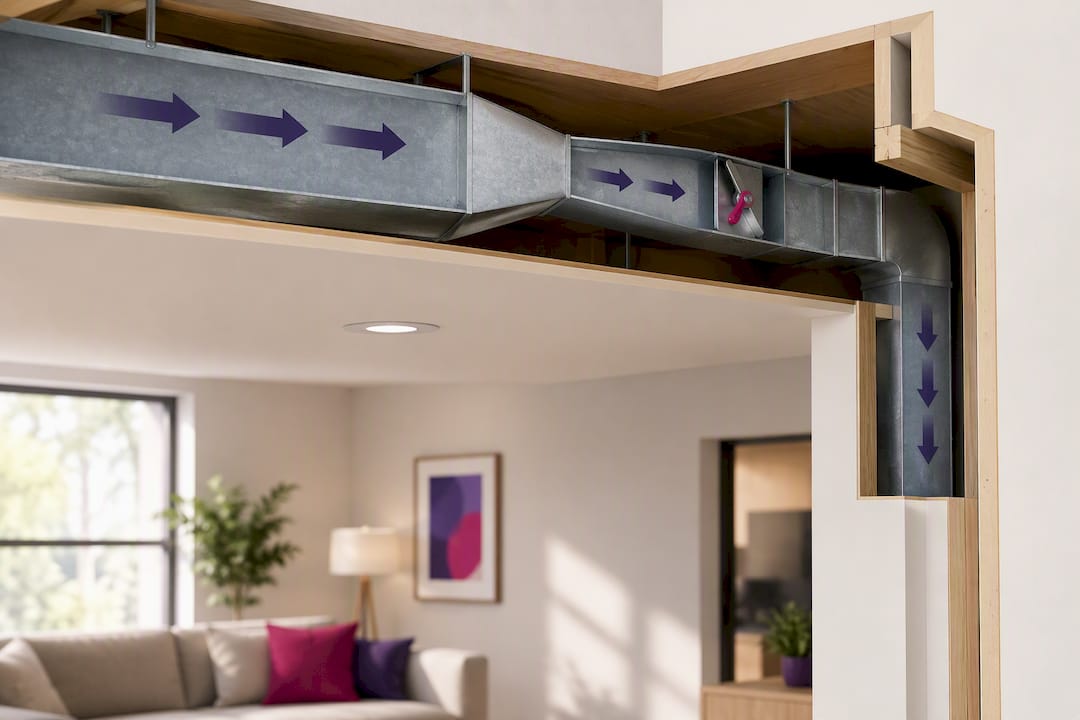
Adjustments. The technician sets dampers proportionally against an index outlet, typically the farthest or hardest-to-reach register, kept fully open while others are throttled to match. This proportional method avoids overclosing dampers, which would spike static pressure and stress the blower. Fan speed gets recalibrated if needed, and any duct leaks or crushed sections found along the way get sealed or repaired.
Final verification and report. Every register gets re-measured, and total supply CFM is checked against total return CFM. In a properly balanced system, these two numbers should match closely. The technician documents measured CFM against design CFM for every terminal.
A full residential balance is not a fifteen-minute visit. Instrumented measurement across a whole house commonly takes several hours, and that time is what separates a documented TAB job from someone turning a screwdriver on a few louvers and calling it done.
What Do CFM and Static Pressure Numbers Actually Mean?
CFM (cubic feet per minute) is simply the volume of air moving through a register or duct in a minute. Every room in your house has a design CFM based on its size, insulation, and sun exposure, and a technician’s job is to get the measured number close to that target.
Two numbers matter most on a finished report:
- Total supply CFM vs. total return CFM. These should be close to equal in a healthy system, and most technicians work within a tolerance of roughly ±10 percent before flagging a problem.
- Total external static pressure (TESP). This is the resistance the blower fights to push air through your filter, coils, and ducts. Static pressure that runs above your system’s design spec is a warning sign, often tracing back to a restrictive filter, undersized return, or blocked coil.
A proper final report lists measured CFM at every register, the percent deviation from design CFM, and whatever adjustments or repairs the technician recommends going forward. If a technician hands you a verbal “it’s fine now” with no numbers, you have no way to check the work later.
When Should You Call a Professional, and What Drives the Cost?
Call a professional when the problem crosses from annoying to structural: a multi-zone system where one zone never keeps up, any imbalance that started right after a renovation or new equipment install, suspected duct damage you can’t reach, or static pressure readings that keep climbing no matter what you fix on your own.
Several factors drive what a job costs:
- Number of registers and zones, since more terminals mean more measurements and adjustments
- Access difficulty, like ductwork buried behind finished ceilings or tight crawlspaces
- Duct repair or sealing needs discovered during the inspection
- Blower or motor recalibration, which takes more time than a simple damper adjustment
- Whether you need a formal written TAB report, which adds documentation time but gives you a paper trail
Cost decisions often intersect with a bigger question: is it worth repairing an aging system at all? A common rule of thumb multiplies the repair estimate by the age of the unit; if that number tops $5,000, replacement usually makes more financial sense than another repair. Balancing work is almost always the cheaper side of that equation, since it’s tuning an existing system rather than swapping parts.
What I’ve Learned Watching Homeowners Chase Airflow Problems
Most people assume airflow issues mean the equipment is failing. In practice, the unit is often fine and the ductwork or dampers are the actual culprit, which is why measurement matters more than instinct. A technician who shows up with a flow hood and a written report is doing something fundamentally different from one who just closes a few registers and leaves. The technicians are focused on providing recommendations based on measured data rather than sales incentives. Expect a real conversation about what was measured, what changed, and why, not a vague “should be better now.”
How Trucomfortaz Approaches Air Balancing in New River
If your home has rooms that never feel right no matter how you set the thermostat, that’s usually a sign the system needs tuning, not replacing. Technicians provide recommendations based on actual measurements in your ductwork rather than sales targets.

A service visit typically starts with the same checks covered above: filters, returns, dampers, and a look at accessible ductwork, before moving into instrumented measurement if the problem calls for it. Depending on what’s found, that can mean air conditioner repair or maintenance, furnace service, or duct installation if the runs themselves are undersized or damaged. Homeowners who want to keep a balanced system from drifting again over time can also ask about the Tru Comfort Advantage maintenance plans, which build in the kind of regular checks that catch small airflow problems before they turn into whole-house discomfort. If a room in your home has never felt right, schedule an evaluation and get a straight answer on what’s actually going on.
Where to Learn More About TAB Standards

For deeper reading, NEBB’s TAB certification page covers the professional standard, while ACCA’s technical manuals explain how Manual D and Manual J set the design targets technicians measure against.
Sources
- Air Balancing: Achieving Harmony in an HVAC System – ACHR News
- Testing, Adjusting and Balancing Certification – NEBB
- Air Balancing 101 – Engineered Air Balance
- HVAC air balancing: This Old House
FAQ
What Is the $5,000 Rule for HVAC?
There is a common decision guide suggesting that if the repair estimate multiplied by the unit’s age exceeds a certain threshold, replacement may be more financially sensible than repair. A full air balance tends to be significantly less costly as it involves tuning existing equipment rather than replacement.
How Do You Fix an Unbalanced HVAC System?
Start with free checks: replace dirty filters, clear blocked returns and supply vents, and reopen any dampers that were closed too far. If hot and cold spots persist after that, a technician needs to measure CFM at each register with a flow hood and check static pressure with a manometer before adjusting dampers and fan speed to match design airflow targets.
How Do You Do Air Balancing in HVAC Step by Step?
A professional balance starts with a design review against Manual D and Manual J targets, then baseline measurements using a flow hood, manometer, and anemometer. From there, a technician adjusts dampers proportionally from an index outlet, recalibrates fan speed if needed, and re-measures everything so total supply CFM matches total return CFM before handing over a written report.
Can I Balance My HVAC System Myself?
You can resolve plenty of comfort complaints yourself by changing filters, clearing vents, and reopening dampers, and many issues stop there. Full instrumented balancing, though, requires specialized tools most homeowners don’t own, and adjusting dampers without measuring airflow first can actually make an imbalance worse.
How Long Does a Professional Air Balance Take?
A whole-house instrumented balance commonly takes several hours, depending on the number of registers, how accessible your ductwork is, and whether any duct repairs turn up along the way. Larger homes or multi-zone systems generally take longer than a single-zone ranch house.