Stop Guessing, Homeowners: Inducer Motor Noise and Costs $200–$500
Most inducer motor noise comes down to two problems: something mechanical, like worn bearings, debris, or a loose mount, or something electrical, like a failing start capacitor. Grinding, metallic scraping, or any smell of burning means shut the furnace off at the switch and call a technician. A steady hum with no wheel movement usually points to a capacitor or seized motor rather than something you should force. Everything else below walks you through the safe checks and the order to run them in.
TL;DR:
- Loose mounts or trapped debris often cause rattling noises, which can typically be fixed by tightening hardware and cleaning without replacing parts.
- Bearing wear or physical damage lead to squealing, grinding, or metallic scraping, usually requiring full motor assembly replacement.
- Persistent humming with no wheel movement indicates electrical issues such as a failing start capacitor, which should be diagnosed by a professional.
- Critical symptoms like burning smells, metallic noises, or water inside the housing demand immediate professional attention and should never be delayed.
- Regular annual maintenance, including vent inspection and filter changes, helps prevent noise issues and extends the lifespan of the inducer motor.
Table of Contents
- Inducer Motor Noise Types and What They’re Telling You
- Safety Checks Before You Touch Anything
- A Step-by-Step DIY Troubleshooting Sequence
- When It’s Time to Call a Licensed Technician
- Preventive Maintenance That Actually Quiets Things Down
- Common Inducer Motor Models and Their Noise Quirks
- Why Some Diagnostics Belong to a Professional
- Ready for a Professional Diagnosis? Here’s What Tru Comfort Offers
- Sources
- FAQ
Inducer Motor Noise Types and What They’re Telling You
The sound coming from your furnace closet is data. Family Handyman notes that tapping, humming, whirring, or grinding are usually the earliest signs something is going wrong with the inducer, and spinning the blower wheel by hand while the power is off often reveals whether you’re dealing with a bearing problem or something as simple as trapped debris.
Here’s how to translate what you’re hearing:
- Rattle or vibration: Usually loose motor mounts, debris caught in the impeller, or a slightly bent fan blade. Stand near the furnace cabinet with the blower door off (power still on) and try to pinpoint whether the noise tracks with the motor housing itself or the surrounding sheet metal.
- Squeal or whine: Almost always bearing wear or something rubbing against the housing. This is often a pre-failure warning, not an emergency, but it won’t fix itself.
- Grinding or metallic scraping: Severe bearing failure or physical damage to the impeller wheel. At this stage, replacement of the assembly is typically the outcome, since most residential inducer motors run on sealed bearings that can’t be serviced.
- Humming with no rotation: An electrical problem, usually the start capacitor or a control board signal issue, not a mechanical one.
- Intermittent or sluggish operation: Could be a weakening motor, voltage irregularities, or a vent restriction that’s preventing the pressure switch from closing properly.
One thing worth knowing: tightening mounts and clearing debris resolves a surprising share of rattling complaints, while grinding or screeching almost never responds to a tightening job. If your noise falls into that second category, skip ahead to the section on calling a pro.
Safety Checks Before You Touch Anything
Run these in order, and don’t skip the power verification step.
- Shut off power at both points. Flip the furnace’s local disconnect switch, then kill the breaker at your panel. If you own a non-contact voltage tester, confirm there’s no current at the unit before opening any panel.
- Note when the noise happens. Does it occur only at startup, or does it run continuously through the heating cycle? Write down any error codes or blinking LED patterns on the control board. This detail alone can save a technician real diagnostic time.
- Look inside the cabinet. With the power confirmed off, check for leaves, insect nests, or debris around the impeller and at the outside vent termination. Look for corrosion or water staining, which can hint at a bigger drainage or condensation issue.
- Spin the wheel by hand. Gently turn the impeller. Smooth rotation with light resistance is normal. Grinding, grittiness, or a wheel that won’t turn at all confirms a bearing or debris problem.
- Get out if you smell burning or hear a CO alarm. That’s not a troubleshooting moment. Ventilate the space and call a professional immediately.
Pro Tip: Keep your phone handy and record a 10-second video of the noise before you shut the furnace down. Technicians can often narrow down the likely cause just from hearing it, which speeds up the visit.
A Step-by-Step DIY Troubleshooting Sequence
Work through these steps in order rather than jumping straight to the motor.
- Confirm the thermostat is actually calling for heat, and check that the furnace switch and breaker are both on.
- Power down the unit and pull the access panel. Inspect the impeller and the outside vent termination for blockage.
- Check the motor mounting bolts and rubber isolation mounts. Tighten anything loose, and replace mounts that have gone stiff or cracked.
- If the motor hums but the wheel won’t spin, stop there. That’s frequently a start capacitor failure, and testing capacitor microfarad readings involves live circuits best left to a technician.
- Reassemble the panel and restore power to see if the noise has changed before deciding on next steps.
A few ground rules while you work:
- Use a screwdriver, flashlight, and a glove for debris removal, nothing more.
- Never probe live terminals or attempt to test voltage yourself unless you’re trained to do it safely.
- Don’t run the furnace with a grinding or screeching noise “to see what happens.” That’s how a $250 capacitor job turns into a full assembly replacement.
- Remember that most modern inducer motors use sealed bearings, so there’s no lubrication port to squirt oil into. If bearing wear is the cause, replacement of the motor assembly is the realistic fix, not a repair.
When It’s Time to Call a Licensed Technician
Some symptoms mean stop troubleshooting and pick up the phone. Grinding or metallic noise, any burning smell, a triggered carbon monoxide alarm, or visible water inside the housing all fall into that category, and none of them should wait for a convenient weekend.
Less urgent but still worth a professional visit: persistent humming that survives your basic checks, intermittent failures that come and go, or a furnace that locks out on a pressure switch fault. That pressure switch is frequently just the messenger. A weak inducer motor often can’t generate enough vacuum to close the switch, which triggers a lockout that looks like a switch problem but isn’t.
Cost expectations vary by region and motor model, but reported ranges commonly land around $200 to $450 in parts and $200 to $500 in labor for inducer-related repairs, with capacitor swaps sitting well below full motor replacement. When you book a visit, ask whether the technician will test static pressure and the pressure switch directly, whether your inducer assembly is sealed or serviceable, and what warranty applies to parts and labor.
Preventive Maintenance That Actually Quiets Things Down
A yearly furnace tune-up catches most of what turns into noisy inducer motors down the road, and swapping filters every one to three months keeps airflow resistance from stressing the motor unnecessarily.
- Check the outside vent termination each season for nests, leaves, or snow buildup, since a blocked vent forces the inducer to work harder than it should.
- Ask your technician to check motor mounts and confirm the blower wheel is properly balanced during routine service.
- Don’t expect to lubricate your way out of bearing noise. Sealed inducer motors don’t have a service point for that, so maintenance is really about keeping the venting path and impeller clean rather than servicing the motor internals.
Pro Tip: Homes in dusty or high-humidity regions see inducer wheels accumulate buildup faster, which throws off balance and creates noise well before the bearings actually fail. A quick visual check each fall catches this early.
Common Inducer Motor Models and Their Noise Quirks
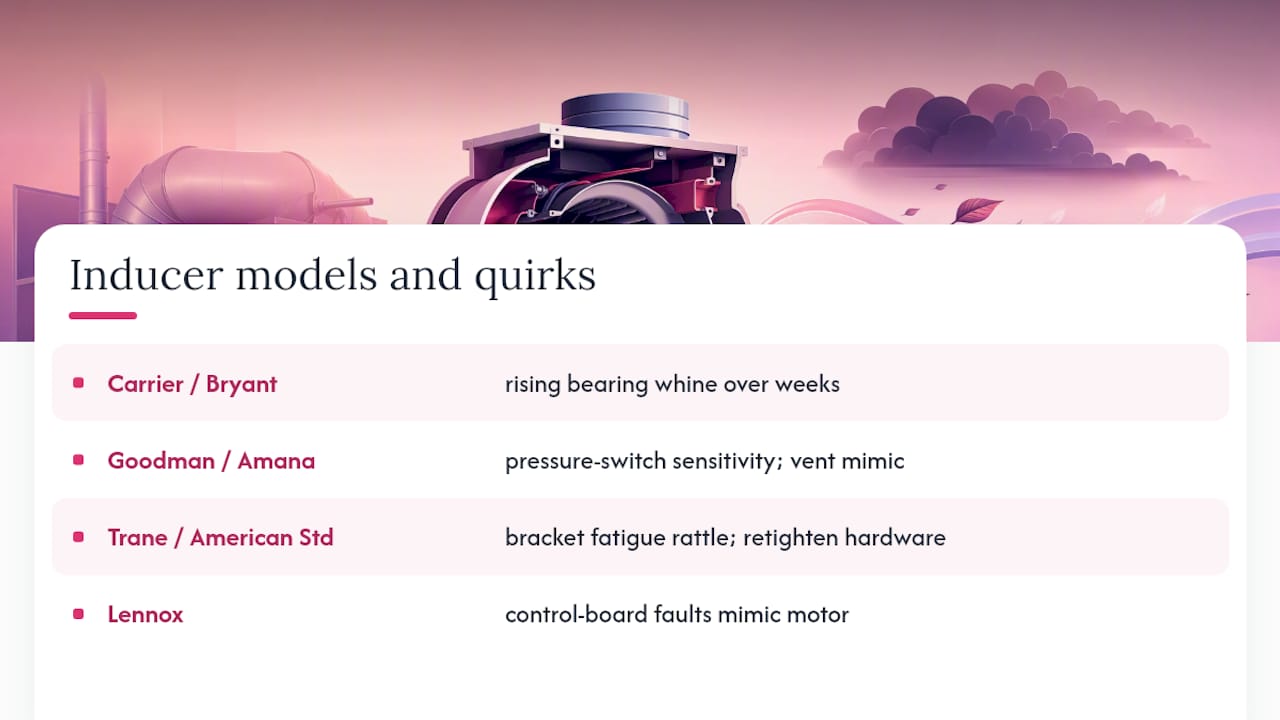
Not every inducer motor fails the same way. Furnaces built by Carrier and Bryant often use direct-drive inducer assemblies where bearing wear shows up as a rising whine that gets louder over weeks, not days. Goodman and Amana units frequently pair the inducer with a pressure switch that’s sensitive to even minor vent restrictions, so a “bad motor” complaint on these systems sometimes turns out to be a partially blocked vent pipe instead.
Trane and American Standard inducer assemblies tend toward mounting bracket fatigue over time, producing a rattle that’s mechanical rather than motor related, and that responds well to simply retightening hardware. Lennox systems have a reputation among technicians for control board communication faults that mimic inducer failure, humming or short-cycling that looks electrical but traces back to a board issue rather than the motor itself.
None of this means you should diagnose your furnace by brand alone. It means that if a repair guide online describes a fix that doesn’t match what you’re hearing, the mismatch might just be your specific model behaving differently than the article assumed.
Why Some Diagnostics Belong to a Professional
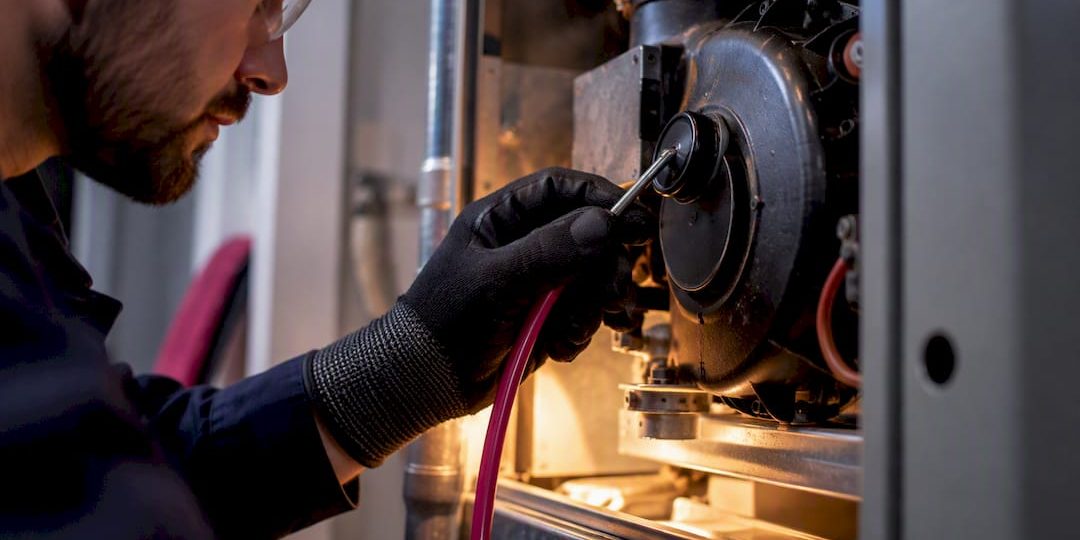
Tru Comfort’s NATE-certified technicians run diagnostics that go beyond what’s safe for a homeowner to attempt: voltage readings at the motor, capacitor microfarad testing, and manometer measurements of static pressure inside the venting system. Those three checks isolate the real cause fast, which is exactly why replacing a $30 capacitor gets confused with a $400 motor assembly more often than it should. A technician trained to read those numbers correctly saves you from guessing, and from paying for parts you didn’t actually need.
Ready for a Professional Diagnosis? Here’s What Tru Comfort Offers
If your inducer motor is grinding, humming without spinning, or you’ve run the safe checks above and the noise hasn’t changed, a technician visit settles the question fast instead of leaving you guessing for another heating season. Tru Comfort’s technicians are NATE-certified and non-commissioned, meaning the recommendation you get is based on what your furnace actually needs, not what pads a bill.

A typical diagnostic visit covers a voltage check at the motor, capacitor testing, and a manometer reading of static pressure, followed by whatever repair the results point to, whether that’s a capacitor swap, an inducer assembly replacement, or clearing a restricted vent. Before your appointment, clear access to the furnace, jot down when the noise happens and what you’ve already checked, and have your furnace’s model and approximate age ready. For ongoing peace of mind, the Tru Comfort Advantage maintenance plan builds in the seasonal checks that catch motor mount wear and vent blockages before they turn into a 2 AM noise complaint. If you’re in New River or the surrounding area and ready to get this looked at, book a furnace repair visit and get a straight answer instead of another guess.
Sources
- What Is a Furnace Inducer Motor and Why Is It Important? – Family Handyman
- Engineerskill
- Furnace Inducer Motor Troubleshooting Guide – North NJ HVAC
- Inducer Motor Bearing Noise Guide | DuPage County (BuildingDuPage)
FAQ
How Do I Know If My Inducer Motor Is Bad?
Listen for grinding, persistent squealing, or a hum with no wheel movement, then confirm with a hand-spin test once the power is safely off. Rough or seized rotation, along with visible bearing wear or a bent impeller, points to a motor that needs professional attention rather than a cleaning.
How Much Does It Cost to Fix an Inducer Motor?
Reported ranges commonly fall around $200 to $450 in parts and $200 to $500 in labor for inducer-related repairs, though your final number depends on motor model and local labor rates. A failing capacitor is a much smaller repair than a full inducer assembly swap, which is why an accurate diagnosis matters before you approve any work.
Is It Worth Replacing the Inducer Motor on a Furnace?
Yes, in most cases, since the inducer is essential for safe venting and the furnace won’t run reliably, or safely, without it. If the rest of the furnace is in good shape and within its typical service life, replacing just the inducer assembly is usually more cost effective than replacing the whole unit.
What Is the Average Lifespan of an Inducer Motor?
Inducer motors generally last as long as the furnace itself under normal conditions, though dust, humidity, and vent restrictions can accelerate bearing wear well before that. Grinding, rising whine, or a wheel that no longer spins smoothly are the clearest signs a motor is reaching the end of its service life.