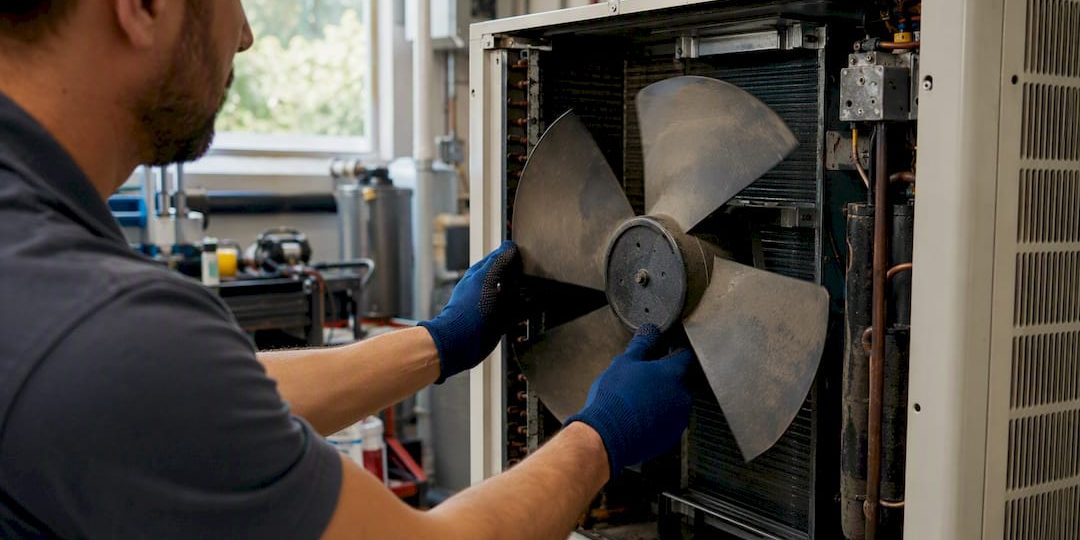
AC Fan Not Spinning? Here’s What’s Wrong and What to Do
If your outdoor AC fan won’t spin, you’re looking at one of four likely culprits: a tripped breaker, a failed start/run capacitor, a seized or burnt-out motor, or something physically jammed in the fan housing. Turn the system off at the thermostat right now, and if you’re comfortable doing so, flip the breaker for the outdoor unit to “off” too.
Here’s why that matters: running the AC without the outdoor fan spinning can push the compressor into overheating and freeze the evaporator coil, which turns a capacitor fix into a compressor replacement job.
- Tripped breaker or lost power to the outdoor unit
- Failed start/run capacitor (the most common electrical culprit)
- Seized or burnt-out fan motor
- Debris, ice, or a bent blade physically blocking the fan
Key Takeaways
A silent or humming AC fan almost always traces back to a tripped breaker, a failed capacitor, a seized motor, or a mechanical jam, and running the system anyway risks compressor damage.
| Point | Details |
|---|---|
| Power off first | Turn off the thermostat and breaker before inspecting or touching the outdoor unit. |
| Spin test tells the story | A blade that spins freely by hand but won’t start under power usually means a bad capacitor. |
| Humming without motion | This points to a failed start/run capacitor, not a dead motor or lost power. |
| Repeated breaker trips mean stop | A second trip after reset signals a deeper fault that needs a licensed technician. |
| Trucomfortaz diagnoses first | NATE-certified, non-commissioned technicians test the actual failing part before recommending a fix. |
Table of Contents
- Quick Checklist Before You Touch Anything Outside
- Why Does My AC Fan Start Then Stop?
- What Do Capacitor and Motor Failures Actually Look Like?
- Could a Mechanical Jam Be Stopping the Fan?
- When Should You Stop and Call an HVAC Pro?
- How Do You Prevent Fan Failure Next Season?
- What Actually Matters Here
- Get a Same-Week Fan Diagnosis From Tru Comfort
- Sources
Quick Checklist Before You Touch Anything Outside
Run through these checks before you assume the worst. Most take under two minutes and several don’t require you to go near the outdoor unit at all.
- Confirm the thermostat is set to “Cool” and the target temperature is at least a few degrees below the current room temperature.
- Walk outside and listen. A humming sound with no blade movement points to power reaching the unit but something stopping the motor. Dead silence usually means no power at all.
- Pull your indoor air filter and hold it up to a light. If you can’t see through it, replace it. A clogged filter can trigger downstream problems, including frozen evaporator coils that create secondary fan issues.
- Check your breaker panel for a tripped breaker labeled AC or condenser. Reset it once. If it trips again immediately, stop and leave it off.
- Look at the fan housing from a safe distance for leaves, sticks, or a bent blade pressed against the cage.
Pro Tip: Snap a photo of the outdoor unit and the breaker panel before you call anyone. A technician who can see what you saw often diagnoses faster over the phone, which can shave time off a service visit.
Why Does My AC Fan Start Then Stop?
A fan that starts, runs a few seconds, then quits is telling you something different than a fan that never moves at all. Following this sequence in order gets you to the right conclusion without opening any electrical panels.
- Cut power first. Switch the thermostat off, then kill power at the breaker. Everything past this point assumes the unit is de-energized.
- Inspect visually. Look at the blades for cracks or bends, check for oil residue around the motor (a sign of a leaking capacitor or worn bearing seal), and scan for rust around the base.
- Restore power briefly and just watch. A motor that hums but never spins usually points to a failed start/run capacitor. Total silence with no hum suggests the fault is upstream, in the breaker, contactor, or wiring. A fan that spins slowly or intermittently often means a struggling capacitor or a motor bearing on its way out.
- Cut power again, then try the manual spin test. With the system fully off, use a long insulated stick or pole (never your hand) to give the fan blade a gentle push. If it spins freely and smoothly, mechanical binding probably isn’t the issue.
If the blade spun freely by hand but wouldn’t start under power, that pattern almost always traces back to a bad capacitor rather than a seized motor. Techs use this exact “won’t move versus moves slowly” distinction because it separates a $100 fix from a $400 one.
Pro Tip: A manual spin that gets things moving again isn’t a repair. It’s a diagnostic clue. Don’t leave the unit running that way; the capacitor will fail again, usually within days.
What Do Capacitor and Motor Failures Actually Look Like?
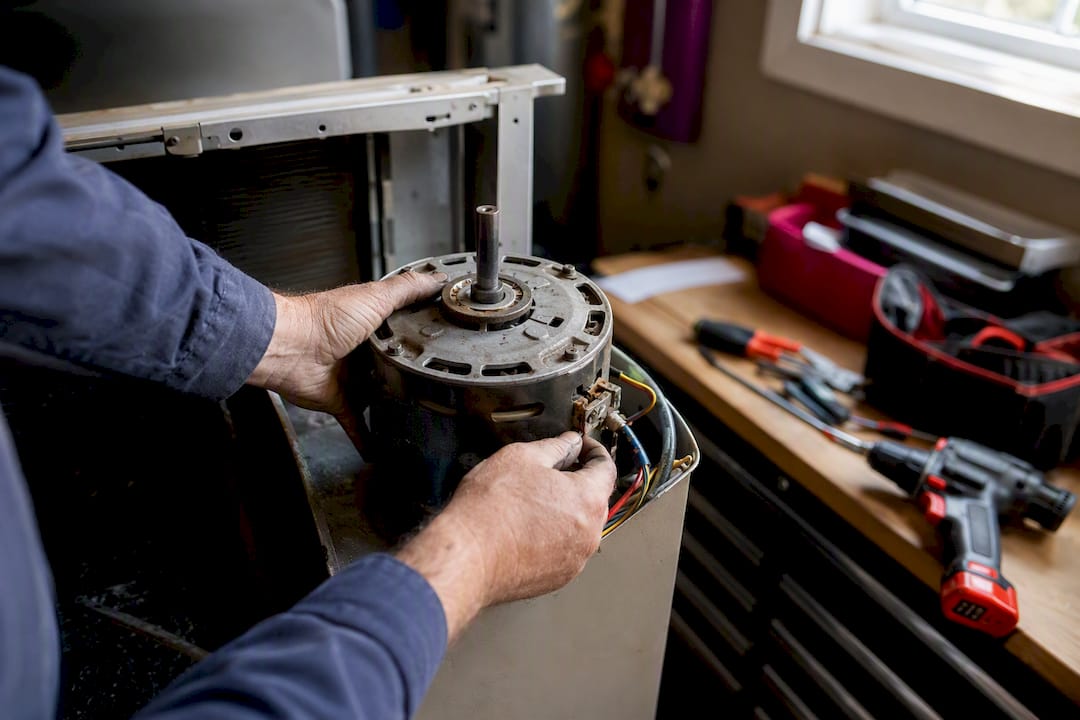
The start/run capacitor is a small cylindrical part, usually about the size of a soup can, mounted near the fan motor inside the unit’s electrical compartment. A healthy one looks flat on top and bottom. A failing one bulges outward, sometimes cracks, and can leak a dark, oily residue.
- A bulging or leaking capacitor is a near-certain point of failure, and it stores an electrical charge even after the unit is powered off, so touching it is a genuine shock hazard.
- A failed contactor, the relay-like switch that sends power from your thermostat call to the compressor and fan, can leave both dead even though the thermostat is calling for cooling correctly.
- A motor casing that’s hot to the touch, a burning odor near the unit, or a grinding sound when power is applied all point to motor failure rather than a simple capacitor swap.
- A motor that stays silent even after a successful manual spin test usually means the windings have burned out internally.
Cost and time expectations differ a lot between these two fixes. Capacitor swaps are typically quick, often same-visit repairs. Motor replacement takes longer and costs more because the part has to be matched to your specific unit’s horsepower and rotation direction, and it’s not something to attempt without training given the amp-draw testing involved.
Could a Mechanical Jam Be Stopping the Fan?
Sometimes the problem has nothing to do with electricity at all. Leaves, small sticks, a dropped toy, or grass clippings can wedge between the blade and the fan cage tightly enough to stall the motor completely. With power fully off, you can usually clear this yourself using gloved hands or a stick.
- Bent or cracked blades from storm debris or a mower strike will throw the fan off balance and can eventually seize the shaft.
- A blade that wobbles, has noticeable side-to-side play, or drags when spun by hand signals worn bearings, a wear pattern distinct from capacitor failure because the fan still moves freely with power off.
- Clearing visible debris is a reasonable homeowner task. Bearing wear or a bent shaft is not; that’s a technician job that usually means a new motor.
When Should You Stop and Call an HVAC Pro?
Some symptoms mean you’re done troubleshooting and it’s time to pick up the phone. Pushing past these signs risks your safety and your system’s compressor.
- The breaker trips a second time after you reset it. Repeated trips point to a deeper electrical fault, like a short or a failing compressor, not a simple overload.
- You smell burning plastic or ozone near the outdoor unit.
- The capacitor is visibly bulging, leaking, or cracked.
- The motor casing is hot to the touch after being off for more than 20 minutes.
- The refrigerant line has visible ice on it, a sign the system has been running without proper airflow.
A licensed technician will safely discharge and test the capacitor, check the motor’s amp draw against its rated specification, inspect the contactor for pitting or burn marks, and verify refrigerant pressures. Our guide on testing a blower motor with a multimeter walks through the kind of meter work a pro performs safely.
Pro Tip: A capacitor failure diagnosed and fixed same-day is common. A burnt motor or a compressor already stressed from running without airflow takes longer to source and schedule, sometimes a few days depending on parts availability.
How Do You Prevent Fan Failure Next Season?
Most of what wrecks a condenser fan is preventable with a handful of habits spread across the year rather than one big fix.
- Replace your air filter on a regular schedule and keep return vents free of furniture or rugs blocking airflow.
- Keep at least two to three feet of clearance around the outdoor unit, and clear leaves, grass clippings, and overgrown shrubs regularly.
- Book an annual tune-up with a NATE-certified technician who can catch a weakening capacitor or a bearing starting to wear before it strands you on a 110-degree afternoon.
- Smart thermostat settings and seasonal upkeep reduce strain on the whole system, which means fewer cycles asking the fan motor to work harder than it should.
Where Tru Comfort Fits Into Your Fan Repair
Tru Comfort Heating & Cooling is a family-owned HVAC company staffed by NATE-certified technicians who work on a non-commissioned basis, meaning the diagnosis you get is the one your system actually needs.
- Emergency service is available for the “stop now” scenarios covered above.
- Annual maintenance plans catch failing capacitors and worn bearings before they leave you without cooling.
- Our maintenance scheduling guide outlines how often your specific system should get checked.
What Actually Matters Here
The conventional advice on a dead AC fan tends to jump straight to “check the capacitor” or “call someone,” and both miss the point. The manual spin test is the single most useful five-second diagnostic a non-electrician can safely run, because it splits the problem in half instantly: mechanical or electrical. Most homeowner guides bury it under a wall of generic troubleshooting steps instead of leading with it.
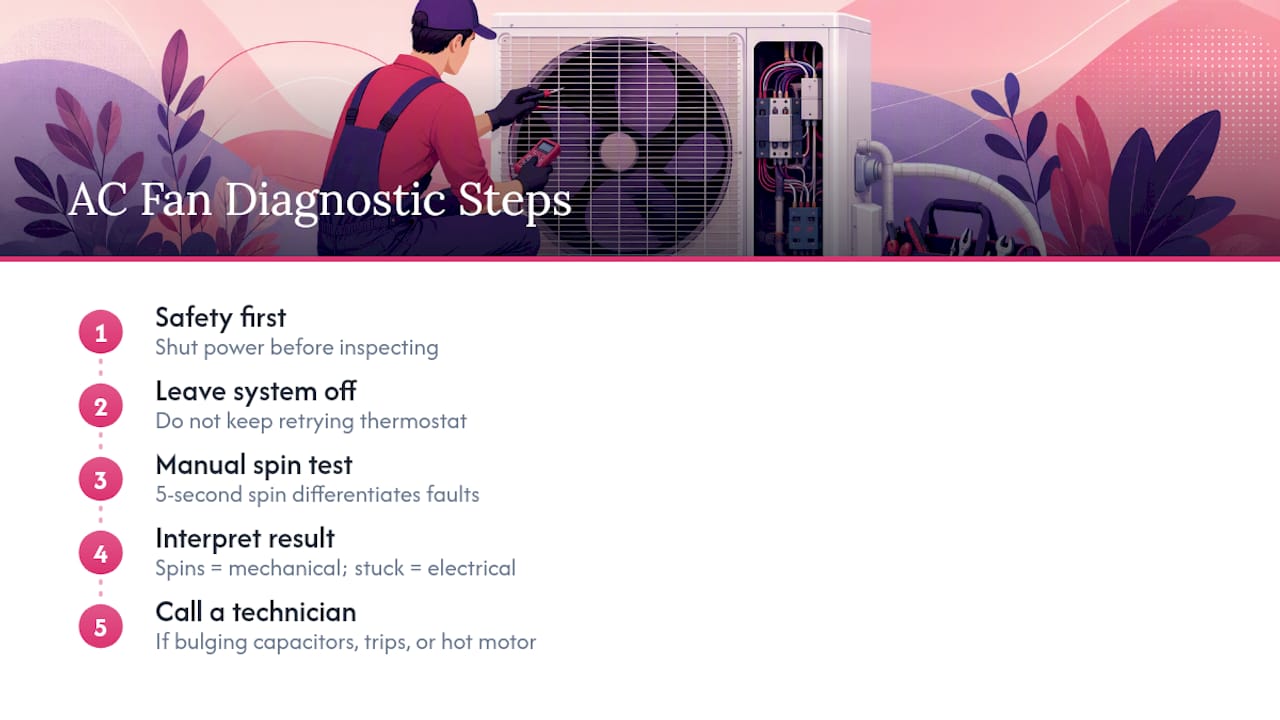
What’s underrated is the discipline of turning the system off and leaving it off. Every homeowner instinct says to keep trying the thermostat, hoping the fan kicks in on the next cycle. That instinct is exactly backward. A compressor running blind, without its fan clearing heat, degrades fast, and the frozen coil that follows makes diagnosis harder for whoever eventually looks at it.
Prioritize safety first, a five-second spin test second, and a real technician the moment you see bulging capacitors, repeated breaker trips, or a hot motor casing. Everything else is secondary.
Get a Same-Week Fan Diagnosis From Tru Comfort
A DIY capacitor swap looks simple online until you’re holding a part that stores a live charge minutes after the power’s off. Trucomfortaz gives New River and Anthem homeowners a faster, safer path: NATE-certified technicians who diagnose the actual failing part, non-commissioned, so you’re not upsold a new motor when a $100 capacitor would’ve done the job.

If your fan is humming but not spinning, or dead silent after a breaker reset, our HVAC repair and maintenance services cover the exact diagnostics this article walks through, capacitor testing, amp-draw checks, contactor inspection, done safely and usually same visit. For homes where the fan motor is already grinding or the unit is aging out, our guide on when to replace your AC helps you weigh repair against replacement before you spend on either. Call to schedule a diagnostic visit this week.
Sources
- Inspectapedia — Condenser fan diagnosis and repair
- AC Fan Not Spinning? 8 Causes & How to Fix Them — Carrier
- AC Fan Not Spinning or Turning On? Causes & Easy Fixes — Bryant
- Hvac