Signs of AC Failure: What to Watch For and When to Call
Most air conditioners give notice before they quit. The usual signs are weak airflow, warm air, new noises, odd smells, water near the unit, a system that turns on and off too often, and energy bills that climb without a reason. Some of these mean you can check a thermostat or a filter and carry on. Others mean you should switch the system off and call a technician the same day. This guide sorts them so you know which is which.
TL;DR
- Weak airflow, warm air, uneven rooms and higher humidity are the most common early signs. Check the thermostat and filter first, then call if nothing changes.
- Burning smells, smoke, grinding, ice, repeated breaker trips or significant water leaks mean you should shut the system off and call for help right away.
- Refrigerant, electrical controls and ductwork are professional jobs, not do-it-yourself repairs.
- A unit over 10 years old that needs frequent repairs while bills rise is a candidate for replacement.
- Symptoms alone cannot confirm a failed compressor. A technician has to test the system.
Table of Contents
- The signs at a glance, sorted by urgency
- Weak airflow, warm air and uneven cooling
- Unusual noises
- Strange smells
- Water, ice and humidity
- Short cycling, hard starts and tripping breakers
- Rising bills, frequent repairs and age
- Our perspective
- Safe checks before you call
- Is it the compressor?
- When to call, and how fast
- Catching problems before they become failures
- Get a straight answer from NATE-certified technicians
- FAQ
- Sources
The signs at a glance, sorted by urgency
Use this table as a quick triage. Details for each sign follow below.
| Sign | What it may point to | What to do |
|---|---|---|
| Warm air from vents | Thermostat setting, dirty filter, low refrigerant, compressor or airflow problem | Check thermostat and filter, then book repair |
| Weak airflow | Clogged filter, duct leaks or restrictions, blower or compressor trouble | Replace filter, then book repair if it persists |
| Rooms too hot or too cold | Duct problems, improper sizing, poor operation | Schedule an inspection |
| Loud rattling or high-pitched sounds | Loose or touching components, failing parts | Book repair soon |
| Grinding or metal-on-metal noise | Serious mechanical damage | Shut off and call right away |
| Burning smell or smoke | Overheating parts or wiring | Shut off and call right away |
| Water pooling indoors | Clogged drain, damaged pan, frozen coil | Shut off and call |
| Ice on coil or refrigerant lines | Airflow or refrigerant problem | Shut off and call |
| Short cycling | Dirty filter, low refrigerant, thermostat fault, oversizing | Change filter, then call if it continues |
| Breaker trips repeatedly | Electrical fault | Stop resetting, call |
| Rising bills and frequent repairs | Declining efficiency | Get an evaluation |
Weak airflow, warm air and uneven cooling
The most common complaint is simple: the system runs, but the house does not cool. The U.S. Department of Energy’s HomeCooling101 guide lists low or leaking refrigerant, worn compressor or fan controls from frequent on and off operation, and leaking, clogged or constricted ducts as common reasons an air conditioner performs poorly.
The cause often hides in plain sight. ENERGY STAR notes that dirty coils reduce the system’s ability to cool, make it run longer, raise energy costs and shorten equipment life. Carrier says a dirty filter shows up as short cycling, reduced airflow at the registers and warmer indoor air.
Pay attention to the pattern:
- Warm air everywhere: points to refrigerant, the compressor, the thermostat or airflow.
- Weak airflow at every vent: points to the filter, the blower or the ducts.
- One room always hot: points more to ductwork or sizing than to the AC itself.
If the air is not cold, our guide on what to do when your AC is not blowing cold air walks through the checks in order. If the thermostat reads a temperature the system never reaches, see thermostat not reaching the set temperature.
Unusual noises
Air conditioners are not silent, and not every sound is a problem. LG says snapping, clicking, gurgling, hissing and humming can be normal operating sounds, while loud rattling, rapid tapping and high-pitched sounds call for inspection because parts may be touching, vibrating or malfunctioning.
A useful rule: a new sound that keeps happening deserves attention, and a harsh one deserves it fast.
- Rattling or tapping: often a loose panel, a fan blade or a part that has shifted. Book a visit before it damages something else.
- High-pitched squealing or screeching: can signal motor or bearing trouble.
- Grinding or metal-on-metal: switch the system off. Parts Town’s cooling-season guide advises shutting down the equipment and contacting an authorized technician for grinding, severe vibration, smoke or burning odor, and overheated or discolored wiring.
- Loud humming before startup, or a struggle to start: can be a hard start, which we cover in the compressor section below.
Strange smells
Smells can tell you where to look, but they should not be used to diagnose refrigerant. Bryant says a musty or moldy odor typically means moisture is supporting mold or mildew growth, and a burning odor can indicate an electrical or mechanical problem. It adds that a chemical odor alone cannot reliably identify a refrigerant leak.
In practice:
- Burning or electrical smell: turn the system off at the thermostat and call. Do not keep running it to see if it clears.
- Musty smell when the system starts: usually a moisture or drainage issue. A technician can inspect the coil, pan and drain line.
- Chemical or faintly sweet smell near the outdoor unit: treat it as a possible refrigerant leak and have a trained technician look. Our article on finding AC refrigerant leaks safely explains what to look for and what to leave to a professional.
Water, ice and humidity
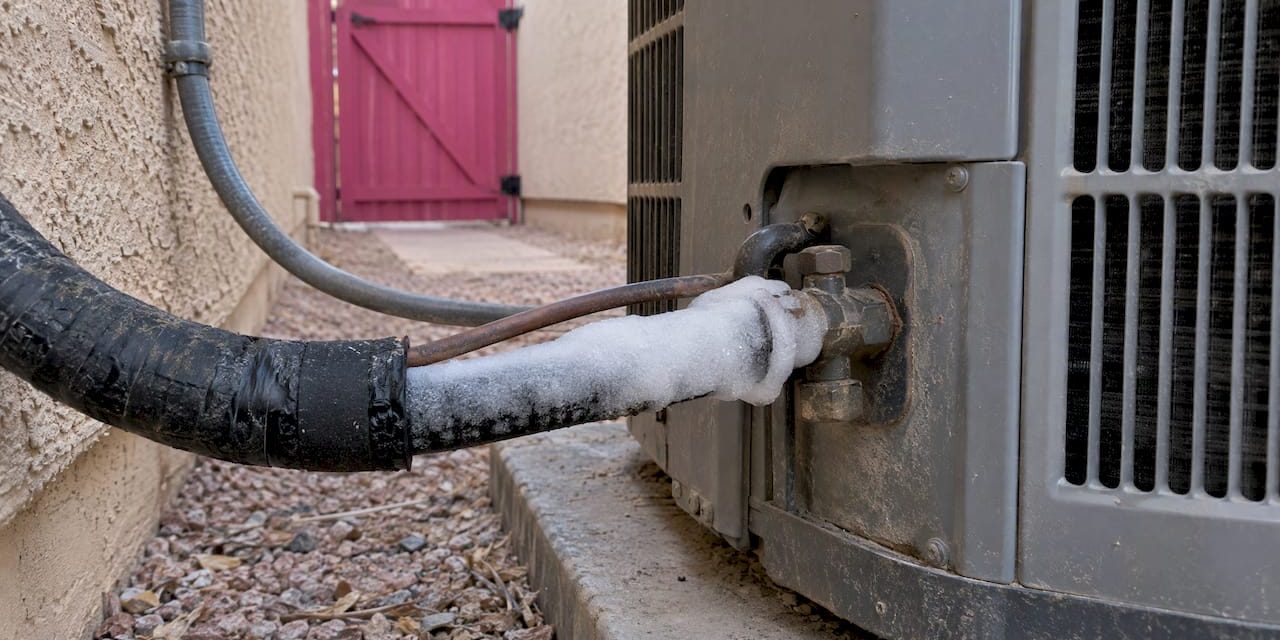
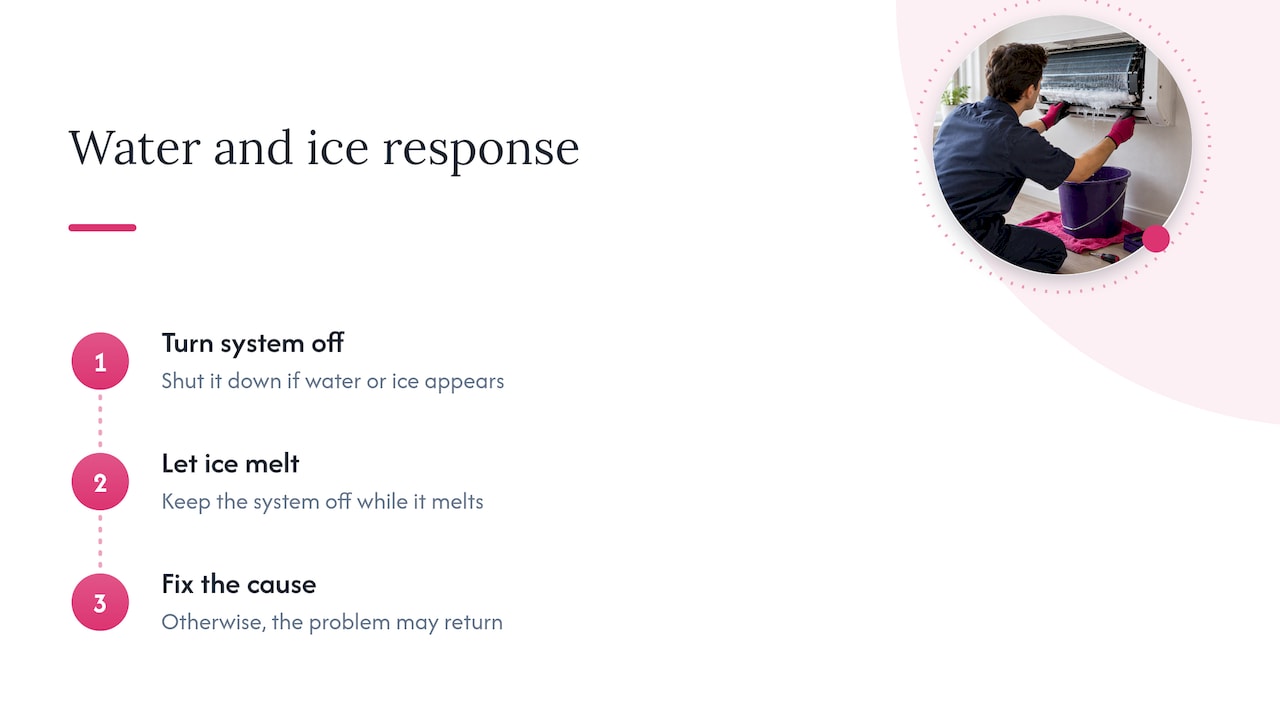
Water near the indoor unit is never a good sign. Trane says pooling water commonly comes from a damaged drain pan, a clogged condensate line, a frozen evaporator coil or a damaged condenser, and recommends turning the AC off and calling for repair rather than running it.
Ice on the coil or the refrigerant lines is a related warning. Parts Town lists ice, significant water leakage and suspected refrigerant leakage among the conditions where you should shut the equipment down first. Let the ice melt with the system off, and expect the problem to return if the cause is not fixed.
Humidity matters too. American Standard associates high indoor humidity with low refrigerant, poor airflow, a dirty evaporator coil or an aging system. If your home feels clammy even though the thermostat says it is cool, the system may be cooling the air without removing moisture properly. An oversized unit can do this as well, and our piece on oversized AC symptoms shows how to log cycles and check humidity.
If you suspect a coil problem, evaporator coil leak symptoms lists what to describe to your technician.
Short cycling, hard starts and tripping breakers
A system that starts, runs a few minutes, shuts off and starts again is short cycling. Carrier says a dirty filter or low refrigerant can cause short cycling, and that low refrigerant can also make a system run unusually long without stopping. American Standard adds a faulty thermostat and oversized equipment to the list, and says that if changing the filter does not fix it, you should contact an HVAC professional.
The cost of ignoring it is wear. The Department of Energy warns that frequent cycling can wear the compressor and fan controls, and it recommends a professional inspection of the unit’s electrical connections.
For the full picture, read AC short cycling: causes and fixes or, for a local angle, why your air conditioner keeps turning on and off in New River.
A breaker that trips repeatedly is a separate warning. Parts Town includes repeated breaker trips among the signs to act on promptly. Resetting it again and again risks overheating wiring, so read why your AC breaker keeps tripping before you touch the panel again.
Rising bills, frequent repairs and age
Sometimes the failure is gradual. The U.S. EPA’s ENERGY STAR guide says replacement may be worth considering when an air conditioner is more than 10 years old, needs frequent repairs while energy bills rise, leaves rooms too hot or cold, causes humidity problems or is noisy. A separate ENERGY STAR guide says frequent repairs combined with rising energy bills can indicate that the equipment has become less efficient.
A simple way to track this: keep your summer electric bills and your repair invoices in one folder. If usage climbs year over year in similar weather, and you have paid for more than one repair, it is time for an honest evaluation instead of another patch.
Goodman notes that replacement rather than repair may be suggested when a costly fault affects an older, inefficient unit, though the recommendation depends on the specific equipment. If you are weighing it, our guides on when to replace heating and air conditioning and the best time to replace an AC can help you plan.
Our perspective
In New River, an air conditioner is not a luxury. It runs hard for much of the year, so small problems grow fast. The warning signs above usually show up weeks before a breakdown, and the homeowners who call early almost always have simpler, cheaper conversations with us.
Our technicians are NATE-certified and non-commissioned. That matters most at the moment of a diagnosis. Nobody on our team earns more for recommending a bigger job, so when we tell you a part can be repaired, or that a system has reached the point where replacement makes more sense, the advice is built around your home and not around a sales target.
We also believe the best repair is the one you never need. A tune-up before the hot season catches dirty coils, weak capacitors, clogged drains and loose connections while they are still small. That is the idea behind our Tru Comfort Advantage maintenance plans: regular attention, a long relationship, and fewer emergencies.
Safe checks before you call
A few checks cost nothing and sometimes solve the problem. Carrier says thermostat settings can mimic AC failure, including no airflow, an unexpectedly high indoor temperature or lukewarm air alternating with cold air. Work through this list:
- Thermostat: confirm it is set to cool, the temperature is below the room temperature, the fan setting is correct and no schedule is overriding you.
- Filter: check it, and clean or replace it according to your owner’s manual. Our HVAC maintenance schedule gives a typical filter rhythm.
- Outdoor unit: make sure nothing blocks it. Debris, plants and stored items choke airflow. See AC condenser clearance for how much space to leave.
- Vents and registers: confirm they are open and not covered by furniture.
- Write down what you see: when it started, what you hear and smell, and whether the problem is constant or comes and goes.
The Department of Energy’s Building America guideline says a clogged filter or fouled condenser coil may be an obvious problem, while more extensive diagnosis belongs with a skilled HVAC technician. The DOE’s homeowner guidance is equally clear that a technician should repair a refrigerant leak and recharge the system, and it treats electrical controls and duct defects as professional work as well.
Two cautions. Do not open the equipment just to read a model number, and do not try to add refrigerant. Goodman advises giving the technician your warranty status, so find your purchase and installation paperwork ahead of the visit.
Is it the compressor?
The compressor is the part homeowners fear most, and the symptoms overlap with cheaper problems. The DOE guideline says compressor trouble becomes more plausible when the outdoor unit repeatedly tries to start, the system has hard starts, there is unusual mechanical noise or severe vibration, or both temperature and humidity stay high despite correct controls and airflow.
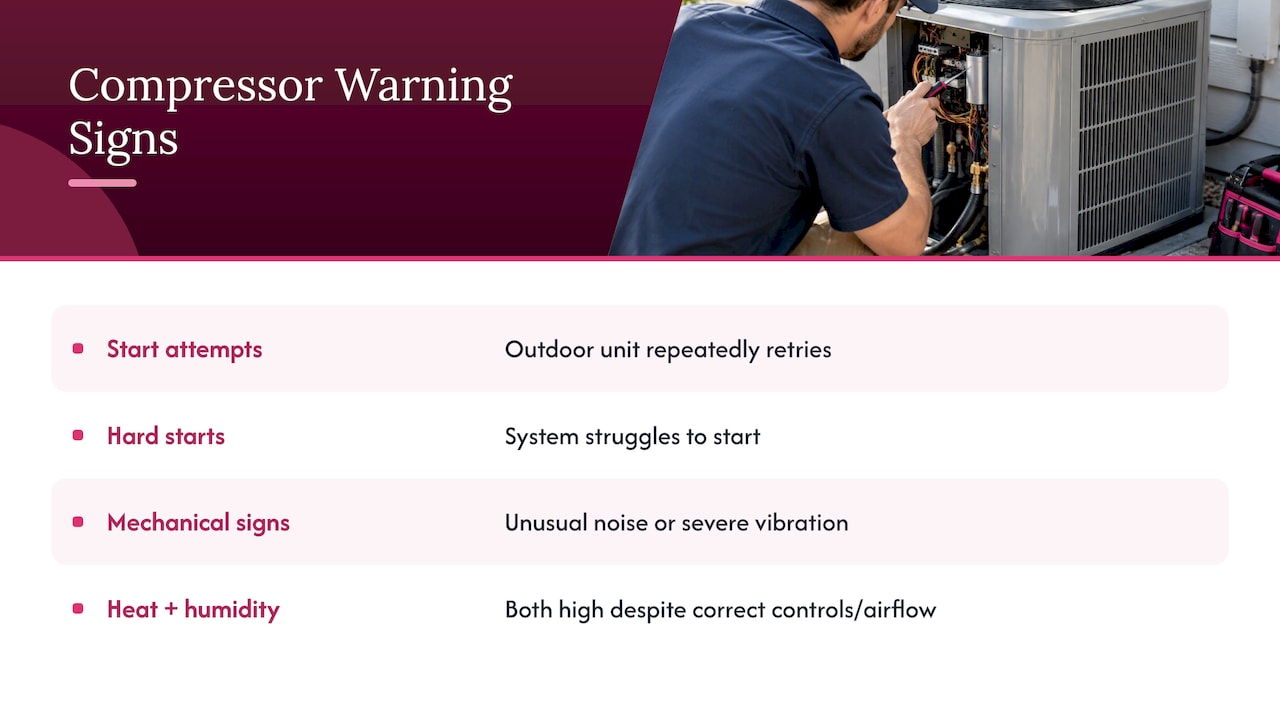
The same guideline warns that warm air, short cycling and poor cooling also come from filters, ducts, refrigerant, coils, capacitors or controls. So compressor failure cannot be confirmed from symptoms alone. A qualified technician has to test the electrical and refrigeration performance. If you want to see the usual pattern, read our AC compressor failure signs.
When to call, and how fast
Call the same day, with the system off:
- Burning smell, smoke or discolored wiring
- Grinding or metal-on-metal sounds, or severe vibration
- Significant water leakage or ice on the coil or lines
- Breaker that trips repeatedly
- Suspected refrigerant leak
Book within a few days:
- Warm or weak airflow that persists after the thermostat and filter check
- Short cycling that continues after a filter change
- New rattling or high-pitched sounds
- Humidity that stays high
- One or more rooms that never reach the set temperature
Plan an evaluation:
- A unit more than 10 years old
- Repairs piling up while bills rise
If you manage a rental or office, the checks are similar. See office AC not cooling and our commercial HVAC maintenance checklist. Tenants can also read how long a landlord has to fix AC.
Catching problems before they become failures
Nearly every sign above traces back to something a seasonal inspection would have caught: dirty coils, a clogged drain, a dirty filter, loose electrical connections or low refrigerant. ENERGY STAR says airflow problems alone can reduce efficiency by up to 15%, and plugged drains can cause water damage and affect humidity.
Use our AC maintenance checklist for what you can do yourself, and ten signs your home AC may need maintenance for the cues to watch. For how often a professional should visit, see how often to do regular maintenance on your house AC unit.
Get a straight answer from NATE-certified technicians
If your AC is showing any of the signs above, we can diagnose it and tell you plainly what it needs. Tru Comfort Heating & Cooling is a family-owned company serving New River, AZ and surrounding areas. Our technicians are NATE-certified and non-commissioned, and we handle air conditioner repair, maintenance and installation.

If you would rather prevent the next breakdown, look at the Tru Comfort Advantage maintenance plans. If the problem cannot wait, our emergency HVAC service is there for it. Prices depend on the system and the job, so we do not list them here. Contact us for an estimate.
FAQ
What is the first sign of AC failure?
For most homes it is a change in cooling: weaker airflow, air that is not as cold, or rooms that take longer to cool. Noises, humidity and a rising electric bill often come next. Check the thermostat and filter first, then book a visit if the change persists.
Can I keep running my AC if it is making a strange noise?
It depends on the sound. Clicking or humming can be normal. Grinding, metal-on-metal noise, severe vibration or a burning smell are reasons to shut the system off and call a technician, because continued running can turn a small repair into a major one.
Does warm air from the vents always mean the compressor has failed?
No. Warm air can come from a thermostat setting, a dirty filter, low refrigerant, duct problems or a compressor fault. Only testing by a qualified technician can confirm which one it is.
How do I know whether to repair or replace my AC?
Look at age, repair history and energy bills together. ENERGY STAR guidance points to units over 10 years old that need frequent repairs while bills rise. A technician should inspect the system and explain the options before you decide.
Sources
- Tips for Lowering Your Cooling Costs (U.S. Department of Energy)
- Maintenance Checklist (ENERGY STAR)
- A Guide to Energy-Efficient Cooling and Heating (U.S. EPA)
- A Guide to Energy-Efficient Heating and Cooling (ENERGY STAR)
- Measure Guideline: Air Conditioner Diagnostics (U.S. Department of Energy)
- AC Troubleshooting (Carrier)
- How to Identify and Fix Noises from Your LG Air Conditioner (LG)
- Common Cooling Season HVAC Failures (Parts Town)
- Why Does My AC Smell? (Bryant)
- AC Leaking Water? (Trane)
- Top 10 Signs You Need Air Conditioning Repair (American Standard)
- The Urgent AC Repair Service Call (Goodman)