Office AC Not Cooling? Checks to Run Before You Call
If your office AC is running but the space stays warm, the cause is usually one of four things: the thermostat or schedule is telling the system the wrong thing, airflow is restricted, the outdoor unit can’t shed heat, or the refrigerant circuit has a fault. The first three you can often rule out in 15 minutes without opening a panel. The fourth needs a certified technician. This guide shows you what to check, what the symptoms point to, and when to stop and make the call.
We’re Tru Comfort Heating & Cooling, a family-owned HVAC company in New River, AZ. In the Arizona desert, an office that can’t hold temperature in summer is not a minor annoyance. It affects staff, equipment and customers by lunchtime. So the advice below is written to get you to the right decision quickly.
TL;DR
- Start with the simple stuff: thermostat mode and setpoint, schedule or building-controls overrides, dirty filters, blocked vents and a debris-choked outdoor unit.
- Warm air from running equipment, ice on lines, a hissing or oily spot, or a tripping breaker means stop troubleshooting and call a professional.
- Never add refrigerant yourself. In the U.S., EPA rules require certified technicians for service that could release refrigerant.
- Most “sudden” failures build slowly. Filter changes and a spring tune-up prevent the majority of no-cool calls.
- Emergency service is available from our New River team when the office can’t wait.
Table of Contents
- First, work out what the system is actually doing
- Safe checks you can do in 15 minutes
- What’s behind it when the checks don’t solve it
- Why a rooftop or commercial unit adds wrinkles
- When to shut it off and call
- Perspective: what we see in office calls
- Keep it from happening again
- Get it fixed without the guesswork
- FAQ
- Sources
First, work out what the system is actually doing
Before you check anything, describe the failure in one sentence. The answer sends you down a different path.
| What you see | What it usually points to |
|---|---|
| Nothing runs at all | Power, tripped breaker, thermostat, schedule or a safety shutoff |
| Fans run, air is room temperature or warm | Compressor or outdoor unit not running, or a refrigerant problem |
| Air is cool but the space never gets there | Airflow, load, closed zones or an undersized system |
| Cooling works in the morning, fails by afternoon | Frozen coil, overheating condenser, or a system at its limit |
| One room or zone is warm | Dampers, ductwork, vents, or zone controls |
Hold a hand or a thermometer to a supply vent. If the air coming out is only a few degrees cooler than the room, you have a capacity or airflow problem. If it’s not cooler at all, you have a cooling-mode problem.
Safe checks you can do in 15 minutes
These need no tools beyond a ladder-free walk around the building and, for filters, a replacement filter of the right size. Don’t open electrical panels, bypass safety switches or climb onto a rooftop unit unless you are trained to.
1. Thermostat, schedule and building controls
Confirm the mode is set to cool (not fan or heat), the setpoint is below the current room temperature, and the fan setting makes sense. Many offices use a programmable thermostat or a building management system with after-hours setbacks. A schedule that changed after a power blip, a holiday setting left on, or someone’s override can leave the system idle at 2 p.m.
If you have a controller with alarms, read them. A fault code tells a technician far more than “it’s warm.” Also check that the thermostat isn’t sitting in direct sun or next to a printer, because it will read warm or cold wrongly and cycle the system badly.
2. Air filters
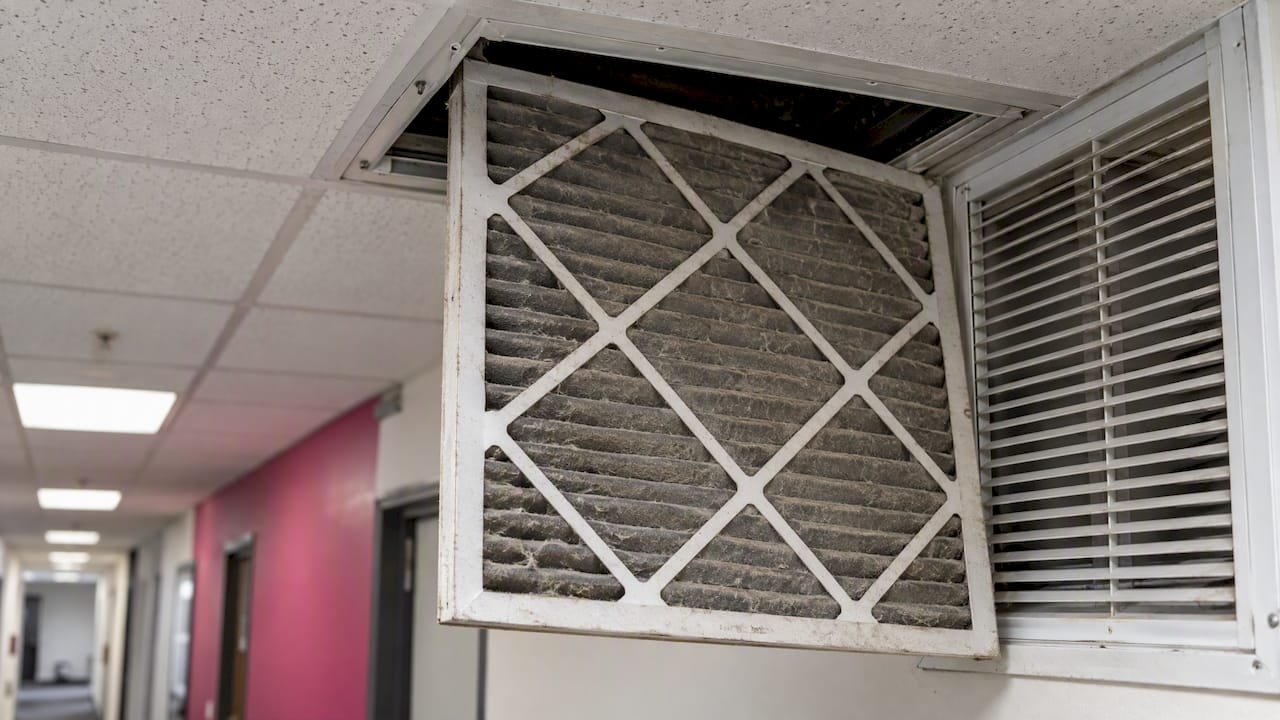
A clogged filter starves the coil of air. The system keeps running but moves less air, cools unevenly and, in the worst case, freezes the evaporator coil. Offices with foot traffic, printers and carpet clog filters faster than homes do. Check them monthly during the cooling season and replace any that look gray or matted. Our HVAC maintenance schedule explains the 1 to 3 month range and what changes it.
3. Supply and return vents
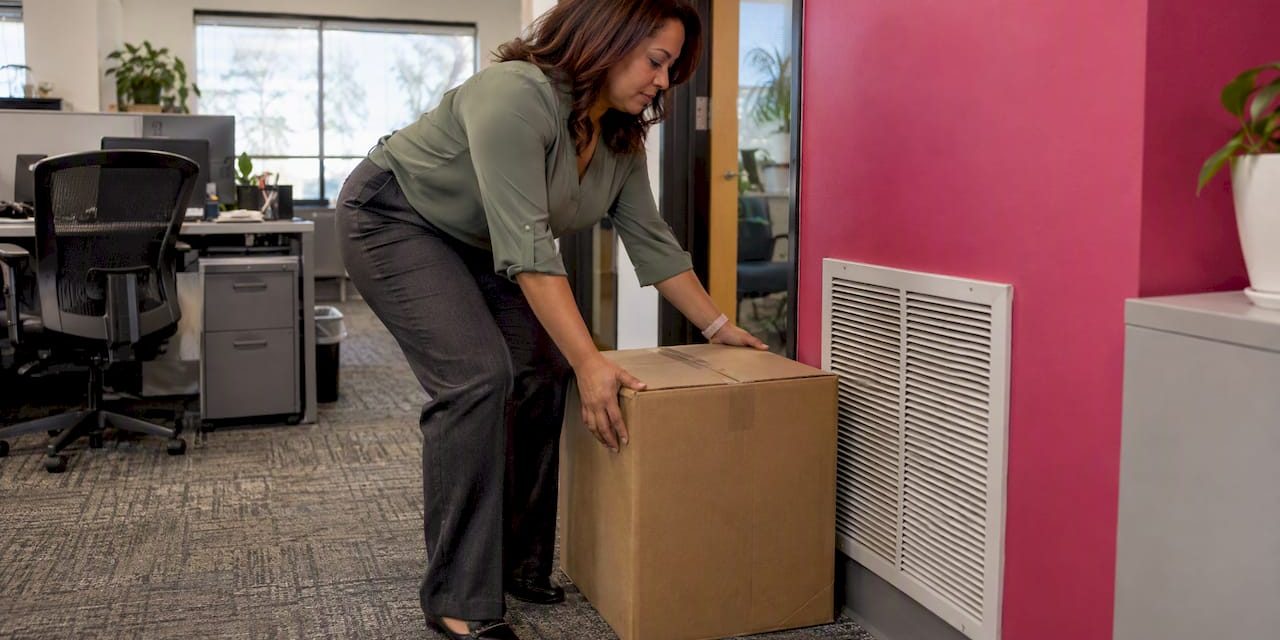
Walk the floor. Furniture pushed against return grilles, boxes stacked under vents and closed registers all choke airflow. A return blocked by a file cabinet can make a whole zone feel dead. Open everything that should be open.
4. The outdoor unit or rooftop unit exterior
Look at the condenser from the ground. Leaves, cottonwood fluff, plastic bags, weeds or a stacked pallet restrict the airflow it needs to reject heat. Make sure the fan spins when the system calls for cooling. If the coil fins are packed with dirt, a technician should clean them correctly, because bent fins and misapplied cleaners cause damage. For residential-scale equipment our guides on condenser clearance and sun exposure around the unit apply to small commercial split systems too.
5. Look for ice
If you can see ice on the refrigerant line or the indoor coil, shut the cooling off and set the fan to run so the ice thaws. Running a frozen coil can push liquid refrigerant back toward the compressor, which is the most expensive part of the system. Thawing is a stopgap, not a fix. Ice means either low airflow or a refrigerant problem, and the next freeze is coming.
6. Breakers and disconnects
If the breaker for the unit has tripped, you can reset it once. If it trips again, stop. A repeat trip points to a failing motor, capacitor, contactor or compressor, and forcing it risks a fire or burned windings.
What’s behind it when the checks don’t solve it
If the basics are fine, the cause is inside the equipment. Here is how technicians think about it.
Airflow versus refrigerant
Professional diagnosis starts with airflow, because a system with bad airflow looks like a system with bad refrigerant. The U.S. Department of Energy’s Building America measure guide on air conditioner diagnostics says diagnosis requires evaluating airflow alongside the temperature split, condensing temperature over ambient, evaporator saturation temperature, superheat and subcooling. It also cautions that a low temperature split can indicate low capacity but should be validated, since normal-looking splits can occur with an incorrect charge or noncondensables in the system.
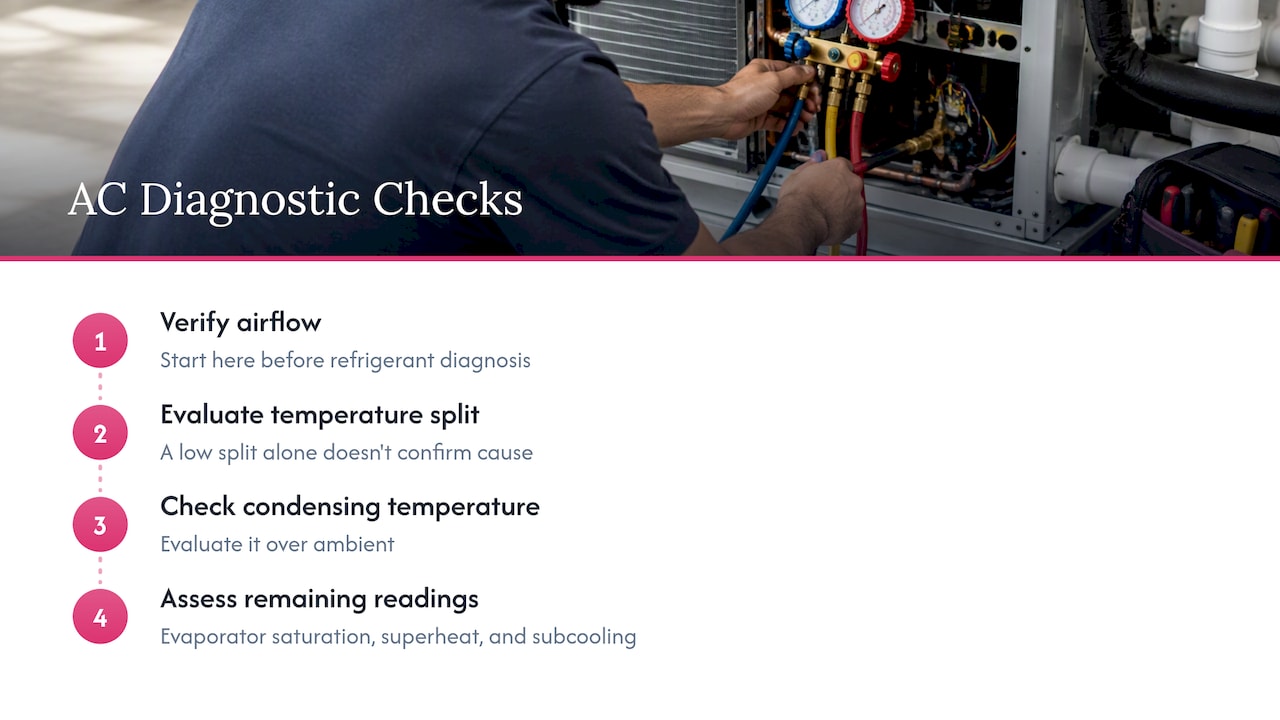
That is why a guess like “it just needs a recharge” is so often wrong. Adding refrigerant to a system with a dirty coil or a weak blower only masks the real problem and can overcharge it.
Low refrigerant and leaks
Refrigerant is not consumed. If the level is low, there is a leak. Trane’s commercial refrigeration troubleshooting guide lists an undercharged system as showing low head pressure, low suction pressure, low compressor amp draw, high superheat and low subcooling. You can’t see those readings from the floor, but a technician reads them with gauges in minutes.
The DOE guide adds that once adequate airflow is verified, an evaporator saturation temperature below 28°F can indicate undercharge, a liquid-line restriction or a fouled evaporator coil. High condensing temperature over ambient can point to overcharge, noncondensables or a restriction. In plain terms: the numbers narrow the cause, and a leak search comes before any top-off. Our guides on finding refrigerant leaks safely and evaporator coil leak symptoms describe what to tell your technician.
Dirty coils
A dirty condenser coil can’t reject heat, so head pressure climbs, the compressor works harder, and capacity falls on the hottest days, exactly when you need it. A dirty evaporator coil does the reverse, blocking airflow and sometimes icing over. In dusty parts of Arizona, this is among the most common reasons a system is “fine” in May and failing in July.
Failed electrical parts
Capacitors, contactors and fan motors are cheap compared with a compressor, and they fail often in sustained heat. Typical signs are a humming outdoor unit that doesn’t start, a condenser fan that doesn’t spin while the compressor runs, or a unit that starts then trips off. These repairs are quick when caught early. They get costly when the unit keeps struggling and takes the compressor with it. See compressor failure signs if you hear grinding, clicking or loud humming.
Ductwork and zoning
If cold air is made but never arrives, look at the duct system. Disconnected or leaking ducts in an attic or ceiling plenum can lose a large share of the air before it reaches a room, and in Arizona attic temperatures make that loss painful. Our guide on leaky air ducts covers the testing method. Zoned systems add dampers and controls that can stick or fail, which we cover in zoned HVAC not working.
Size, load and humidity
Offices change. More people, more computers, a server closet, a new glass partition or a tenant who runs space heaters can raise the load beyond what the original system was sized for. An undersized system runs nonstop and never catches up. An oversized one cools quickly, short-cycles and leaves the room clammy. If the problem is chronic rather than sudden, ask for a load calculation, not just another repair. See oversized AC symptoms for how to log cycles and humidity first.
Why a rooftop or commercial unit adds wrinkles
Many small offices and retail suites run packaged rooftop units rather than a split system with an outdoor condenser. The causes are similar, with a few extras: an economizer damper stuck open or closed, belt-driven blowers with worn belts, multi-stage cooling where only one stage is firing, and control boards that lock out after a safety trip. Rooftop work involves heights, live power and rotating parts, so the safe checks stay on the ground: schedule, thermostat, filters, vents and visible alarms.
If you manage multiple suites, note which tenants lose cooling and when. A pattern (always the east side, always after 3 p.m.) usually points to load or airflow rather than a random failure, and it saves diagnostic time.
When to shut it off and call
Stop troubleshooting and switch the cooling off at the thermostat if you see or notice any of these:
- Ice on the refrigerant lines or indoor coil that returns after thawing.
- A hissing sound, an oily residue on fittings, or a chemical smell.
- A breaker that trips repeatedly.
- A burning smell, smoke or scorched wiring.
- Loud grinding, banging or squealing from the compressor or blower.
- Water pooling around the indoor unit or dripping through ceiling tiles.
- Warm air from the vents after you’ve cleared the filter and vents and the outdoor unit is running.
On refrigerant, the rule is firm. The EPA’s Section 608 requirements under 40 CFR Part 82, Subpart F require technicians who maintain, service, repair or dispose of equipment that could release refrigerants to be certified. That is one reason “topping off” with a store-bought kit is not a workaround, and why our technicians are NATE-certified and work to those rules.
If the office is unusually hot and people are affected, consider moving staff or closing the space while it’s repaired. Heat illness is a real risk in Arizona, and it’s not worth a day of productivity.
Perspective: what we see in office calls
Most office no-cool calls we hear about aren’t mysteries. They’re a filter nobody changed since spring, a condenser caked with dust, a thermostat schedule gone sideways, or a small leak that has been quietly draining the system for a season. The expensive failures come when a struggling system is left to run for weeks because it was “still sort of cooling.”
Our technicians are NATE-certified and non-commissioned, which means nobody on our team earns more by selling you a bigger repair or an early replacement. When we find a failed capacitor, we say it’s a failed capacitor. When the system is near the end of its life and repairs keep stacking up, we’ll tell you that too, with the numbers, so you can decide. Our guides on when to replace an AC and what to approve before installation explain how we think about that call.
If you take one habit from this article: check filters monthly in cooling season and book a tune-up before summer, not during it.
Keep it from happening again
Preventive maintenance is dull and it works. A reasonable routine for a small office looks like this:
- Monthly in the cooling season: inspect filters, replace as needed, and walk the vents for blockages.
- Before summer: have a technician inspect coils, check refrigerant pressure and temperature readings, test capacitors and contactors, check drains and verify controls and schedules.
- After a storm or construction nearby: look at the outdoor unit for debris and dust.
- Whenever something changes: a new tenant, more equipment or a remodel is a reason to recheck the load.
- Keep a log: dates of service, filter sizes, error codes and complaints. It makes the next diagnosis faster.
For a deeper list, see our AC maintenance checklist and the notes on how often to service your AC in Anthem and New River. The same principles apply to light-commercial equipment, though larger systems may need more frequent visits depending on hours of operation and building use.
Get it fixed without the guesswork
If the checks above don’t bring the temperature down, we can diagnose the problem, explain it in plain language and give you options. Our air conditioner repair, installation and maintenance services cover New River, AZ and surrounding areas for homeowners, business owners and property managers. If the office can’t wait, our emergency HVAC service is there for exactly that.
For property managers and owners who want fewer surprises, the Tru Comfort Advantage maintenance plans are built around scheduled visits and cost savings, so problems get caught before the hottest week of the year. We don’t publish plan pricing online, so contact us for details on what fits your building.
If you’re not sure whether this is a quick fix, our homeowner-focused guide on AC not blowing cold air is a good companion for the first round of checks.
FAQ
Why is my office AC running but not cooling?
The most common causes are a wrong thermostat mode or schedule, a clogged filter, a dirty or blocked outdoor unit, a frozen coil, a failed electrical part or a refrigerant leak. Start with the settings, filters and outdoor unit. If air from the vents is still warm, a technician needs to measure airflow and refrigerant readings.
Can I add refrigerant myself?
No. Low refrigerant means a leak, so adding more is a temporary patch at best. In the U.S., EPA rules require certified technicians for work that could release refrigerants, and overcharging can damage the compressor. A technician should find and repair the leak first.
Is a commercial AC not cooling an emergency?
It is if the space is unsafe for people, if equipment such as servers is at risk, or if you see ice, water leaks, burning smells or repeated breaker trips. Shut the cooling off at the thermostat and call for service. For a mild loss of comfort, you can run the basic checks first, but don’t let a struggling system run for days.
How often should an office AC be serviced?
At least once a year, ideally before summer, with filters checked monthly during the cooling season. Heavy-use spaces, dusty environments and rooftop units may need more frequent attention. A maintenance plan makes the schedule automatic.
Sources
- Measure Guideline: Air Conditioner Diagnostics, U.S. Department of Energy Building America
- Refrigeration System Malfunctions Troubleshooting, Trane
- Section 608 Technician Certification Requirements, U.S. EPA