Oversized AC Symptoms? Log Cycles, Check Humidity, Ask for Manual J/S
If your air conditioner cycles off within minutes, your home still feels clammy after cooling, some rooms run cold while others stay warm, and your energy bills keep climbing, those are common signs of an oversized air conditioner. Time a cooling cycle and check indoor humidity with a hygrometer. If these signs match what you are seeing, it’s worth having a professional run a Manual J load calculation and a test-out before you repair or replace anything.
TL;DR:
- Indoor relative humidity above 60% deserves attention; the EPA recommends 30% to 50%, and a hygrometer can reveal moisture problems despite comfortable thermostat readings.
- A system sized at least 50% too large may use roughly 9% more annual cooling electricity, while repeated starts also increase compressor wear.
- Request an ACCA Manual J load calculation and Manual S equipment selection, plus cycle logs, airflow, duct leakage, and refrigerant checks before approving replacement.
- Set the fan to AUTO, maintain clean filters, and use kitchen or bathroom exhaust fans; these steps ease symptoms but cannot correct excess capacity.
- If indoor moisture remains high after basic changes, consider a standalone dehumidifier; confirmed sizing problems may call for correctly sized equipment or variable speed operation.
Table of Contents
- Checklist: common symptoms of an oversized AC and how to spot them
- Why an oversized unit produces these symptoms
- How a professional diagnoses oversizing
- Practical fixes and next steps
- A technician’s perspective on sizing and symptoms
- How we can help diagnose and fix an oversized system
- FAQ
- Sources
Checklist: common symptoms of an oversized AC and how to spot them
Short cycling is the clearest tell. Set a timer when the compressor kicks on and note when it shuts off. A healthy system on a moderate day typically runs longer per cycle; repeated short cycles may point toward excess capacity rather than a thermostat quirk.
High indoor humidity despite steady cooling is the second major clue. A unit that satisfies the thermostat too fast cools the air without pulling enough moisture out of it, so rooms feel sticky even at a comfortable temperature. The EPA recommends keeping indoor relative humidity between 30% and 50%, and certainly below 60%. Any reading above that on a cheap hygrometer, even while the thermostat reads satisfied, is worth noting.
Other signs worth tracking at home:
- Uneven temperatures: cold blasts near registers paired with warm back rooms, a pattern that suggests the system overwhelms nearby spaces before far rooms catch up, rather than a duct blockage alone.
- Rising energy bills: short, frequent starts waste energy because compressors run least efficiently in their first few minutes of operation.
- Frequent compressor starts: the outdoor unit kicking on and off frequently during peak heat.
- Condensation on ducts or windows: a sign that moisture is staying in the air rather than draining off the coil.
- Rapid thermostat swings: the set temperature is reached quickly, then drifts back up again within minutes.
A unit oversized by 50% or more can use roughly 9% more annual cooling electricity than a correctly sized one, according to a study cited in federal building guidance, a direct cost consequence of the short-cycling pattern above.
Why an oversized unit produces these symptoms
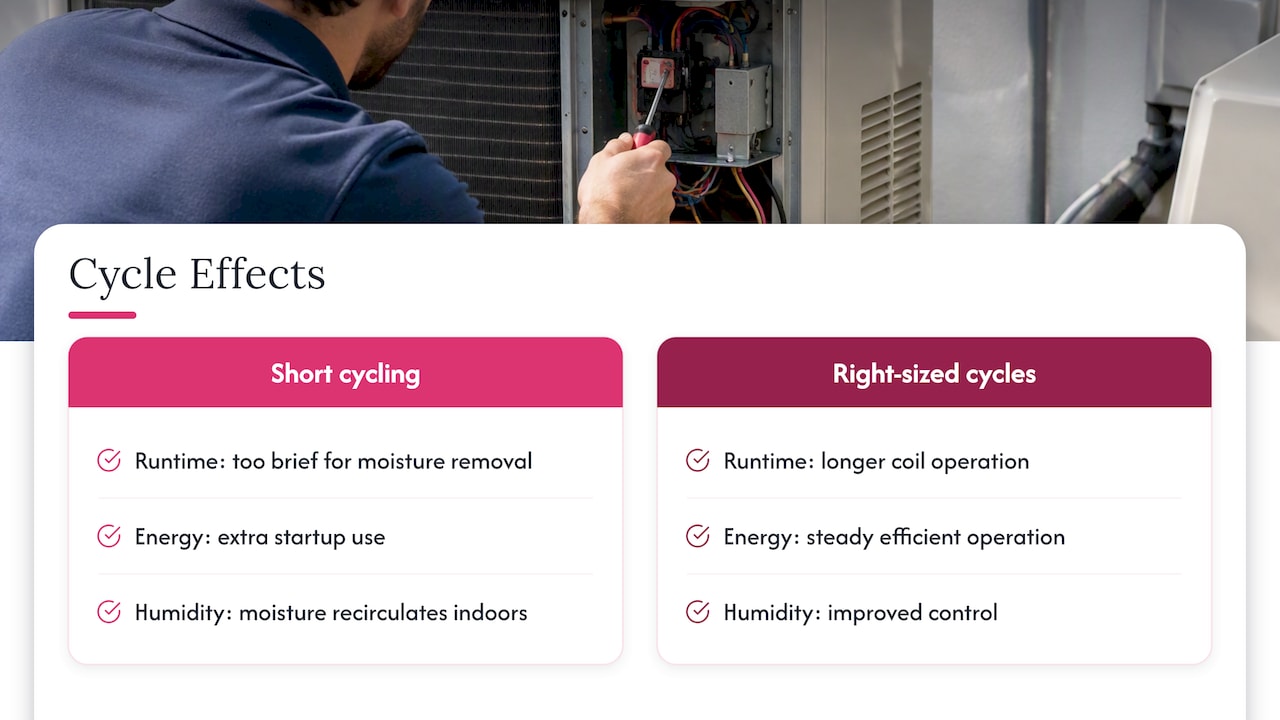
Cooling does two separate jobs: it lowers air temperature, called sensible cooling, and it pulls moisture out of the air, called latent cooling. Removing moisture takes sustained airflow across a cold coil over time. A short burst of cooling can drop the temperature on the thermostat fast, but it rarely runs long enough to condense and drain meaningful moisture, which is exactly why a home can feel cool and damp at the same time.
Short cycling compounds the problem in two ways. Compressors use more energy and run less efficiently in the first several minutes after startup, so a unit that keeps restarting burns extra energy without ever reaching its steady, efficient operating point. It also never dehumidifies the coil long enough to do its job, so moisture keeps recirculating into the house.
Right-sized air conditioners run longer, which improves both efficiency and humidity control. Short cycles reduce condensate removal from the coil and increase wear on the system.
ENERGY STAR guidance on right-sized air conditioners
An oversized system can also mask or worsen other problems. Leaky ducts, a dirty coil, or low airflow reduce the effective capacity reaching your rooms, which sometimes gets misread as a sizing issue, or compounds a real one. That’s why ACCA Manual J load calculations and Manual S equipment selection, backed by ENERGY STAR and Department of Energy guidance, remain the standard way to match a system to a home rather than guessing from square footage alone.
How a professional diagnoses oversizing
A proper diagnosis goes well beyond a visual inspection. Here’s what a thorough visit should include:
- Request a performed ACCA Manual J load calculation and Manual S equipment selection; a quote built only on square footage or a rule of thumb is a warning sign, not a shortcut.
- Ask for timed cycle logs showing runtime per hour over a few cooling cycles, not just a single spot check.
- Have indoor relative humidity measured in more than one room, ideally during peak afternoon heat.
- Request supply and return delta-T readings to confirm the system is extracting the expected temperature drop across the coil.
- Have blower CFM or static pressure tested, since restricted airflow can produce symptoms that mimic oversizing.
- Ask for a duct leakage test, since leaky supply or return ducts waste conditioned air before it reaches your rooms.
- Confirm refrigerant charge and have the coil inspected for dirt or buildup, both of which reduce real-world capacity.
The Forced Air HVAC Guide notes that a contractor unwilling to perform Manual J and Manual S calculations is itself a red flag, since oversizing, poor airflow, and duct leakage together can cut system efficiency substantially.
Pro Tip: Keep your timed cycle log and humidity readings on your phone before the visit; a technician with real numbers can diagnose faster than one starting from scratch.
Variable-speed or multi-stage equipment can mitigate some oversizing concerns by running at lower capacity for most of the season, which is worth asking about if your home’s calculated load falls between standard equipment sizes.
Practical fixes and next steps
A few steps help immediately while you figure out whether replacement is warranted:
- Set your thermostat fan to AUTO rather than ON, since constant fan operation can reintroduce moisture that already condensed on the coil.
- Replace or clean filters on a regular schedule, since restricted airflow worsens both temperature swings and humidity.
- Run bathroom and kitchen exhaust fans during and after showers or cooking to cut the moisture load your AC has to handle.
- Track indoor RH with a hygrometer over a few days to see if the problem is constant or tied to specific conditions.
- Consider a standalone dehumidifier if humidity stays above 60% even after these changes, since no AC adjustment alone solves a load mismatch.
Pro Tip: Shading your home’s exterior, through strategic tree placement or passive cooling landscaping techniques, can reduce the cooling load your system has to meet in the first place.
When multiple symptoms persist after basic maintenance, or diagnostics confirm oversized capacity, poor airflow, or significant duct leakage, maintenance alone will not resolve it. At that point, the realistic long-term options are a properly sized replacement guided by Manual J and S, a variable-speed or multi-stage system to improve run times and humidity control, duct sealing and balancing, and a documented test-out once the work is done.
A technician’s perspective on sizing and symptoms
In our experience, the homeowners who get the fastest, most accurate answers are the ones who show up with a timed cycle log and a few humidity readings already in hand. We always recommend a proper Manual J calculation and a test-out before replacing equipment, not after. Persistent high indoor humidity is not just uncomfortable: the EPA and CDC both link damp indoor conditions to mold growth and respiratory symptoms, so it’s worth addressing sooner rather than later.
How we can help diagnose and fix an oversized system
We run diagnostic visits to help identify what’s driving your symptoms before any repair or replacement decision gets made.
During a visit, ask us for the same things outlined above: timed runtime data, humidity readings, duct leakage results, and a written recommendation, not just a verbal estimate. We offer air conditioner installation, maintenance, and repair, duct sealing through our duct installation services, and ongoing coverage through our Tru Comfort Advantage maintenance plans. If your system is struggling right now, reach out to schedule a diagnostic visit and get a clear answer instead of a guess.
This article is general information, not a substitute for advice from a qualified doctor. Consult a qualified healthcare professional about your own circumstances before acting on anything here.
FAQ
How do you know if your AC is oversized?
A Manual J load calculation compared against your system’s actual capacity can confirm whether the system is oversized.
How do you fix an oversized AC?
Short-term steps like setting the fan to AUTO, replacing filters, and running exhaust fans can ease symptoms, but they don’t correct a true capacity mismatch. A lasting fix usually means a properly sized replacement guided by Manual J and Manual S, sealed ducts, or a variable-speed system that can run at lower capacity.
How can you tell if your AC is affecting your health?
Some asthma cases are attributable to dampness and mold in homes. Watch for musty odors, visible condensation, or worsening allergy and respiratory symptoms at home.
Is it better to oversize or undersize an AC unit?
Neither extreme works well: oversized units short-cycle and leave humidity behind, while undersized units run constantly and still struggle to reach the set temperature. Correct sizing through a Manual J calculation, not a rule of thumb, matches the equipment to your home’s actual sensible and latent loads.
Sources
- Epa
- Right-Size Heating and Cooling Equipment. Office of Building Technology, State and Community Programs (BTS) Technology Fact Sheet