Homeowners: Restore 20–30% Lost Air With a TESP Test
Weak airflow almost always means something is blocking or restricting the path air takes through your system: a dirty filter, leaky or crushed ducts, or a struggling blower. Start by checking the filter and making sure every vent and register in the house is open and unobstructed. If you notice ice on the indoor coil, a burning smell, or a breaker that keeps tripping, stop troubleshooting and call a technician.
TL;DR:
- Sealing leaks in accessible ducts can restore up to 30% of lost airflow without installing new equipment.
- Using a manometer to measure static pressure provides the most accurate diagnosis beyond simple filter or vent checks.
- Replacing filters monthly and sealing duct leaks are cost-effective steps that prevent most low airflow issues from recurring.
- An HVAC technician can diagnose low airflow with specialized testing and fix underlying problems such as duct leaks or faulty blowers.
- Closing vents or dampers may reduce airflow temporarily but can cause pressure issues elsewhere and are not recommended as long-term solutions.
Table of Contents
- How to recognize low airflow in your home
- Common causes and clear fixes, ranked by frequency
- Homeowner-safe steps to try before calling for service
- When to call a professional and what they test
- Preventive steps that stop low airflow from coming back
- Why proper diagnostics beat repeated quick fixes
- How airflow restoration services work
- Sources
- FAQ
How to recognize low airflow in your home
A few simple checks tell you how serious the problem is before you call anyone. Hold a tissue or a strip of ribbon near a supply vent: if it barely moves or hangs limp, airflow at that register is low. Do the same at a return grille to compare how much air is going out versus coming back in, and check several rooms since uneven airflow often points to a specific blocked duct rather than a whole-system failure.
Some signs mean you should stop testing and get help right away.
- Ice buildup on the indoor coil or visible frost on refrigerant lines
- A burning or electrical odor coming from the furnace, air handler, or vents
- A circuit breaker that trips repeatedly when the system starts
- Rooms that used to feel comfortable now feel stuffy or noticeably warmer or colder than the rest of the house
Room-to-room differences matter more than most homeowners realize. A single weak vent usually means a local duct problem, while weak airflow throughout the house points to the filter, the blower, or the main trunk line.
Common causes and clear fixes, ranked by frequency
Most low airflow problems trace back to one of five sources, and they are not equally likely.
- Dirty or wrong-size filters. A clogged filter is the most common cause of restricted airflow because it forces the blower to work against higher resistance, known as static pressure. A filter with too high a MERV rating for your equipment can cause the same problem even when it is brand new, since denser filter material also restricts flow, and homeowners should consult a technician before jumping to a higher MERV filter. Check filters monthly and replace them on a regular maintenance schedule rather than waiting for them to look obviously dirty.
- Duct leaks, disconnections, or kinks. Typical homes lose about 20% to 30% of conditioned air through duct leaks, which means a system can be running fine and still deliver weak airflow to the rooms that need it, according to ENERGY STAR. Small leaks in accessible ducts can be sealed with mastic sealant or metal foil tape, never standard duct tape, which degrades over time. Crushed or kinked flexible ducts in an attic or crawlspace often need a duct specialist to straighten or replace the section.
- Blower motor, fan, or capacitor problems. A failing capacitor or a worn blower motor can slow the fan enough that airflow drops noticeably even with a clean filter and sealed ducts. Repairs to a capacitor are usually quick and inexpensive, while a full blower motor replacement takes longer and costs more, and either job should go to a licensed technician because it involves opening electrical components.
- Evaporator coil icing and refrigerant charge issues. Low airflow across the coil lets moisture freeze on it, and once ice forms, airflow drops even further in a cycle that can damage the compressor. Incorrect refrigerant charge combined with low airflow or the wrong system size is a common cause of coil freeze and premature equipment failure, according to ENERGY STAR’s efficiency guide, and refrigerant work always requires a certified technician.
- Mismatched or incorrectly sized equipment. Installing a new outdoor condenser without checking that the indoor coil, ductwork, and blower are matched to it can quietly choke airflow even though every part is new. This shows up most often after a partial system replacement rather than a full installation.
Statistic Callout: Typical homes lose about 20% to 30% of conditioned air through duct leaks, which means sealing ducts can restore airflow without any new equipment.
Pro Tip: Photograph the filter’s printed size and date before you buy a replacement, since guessing the size at the store is the most common reason homeowners bring home the wrong filter twice.
Cost and timeline vary by cause: a filter swap takes minutes and costs little, duct sealing on accessible runs is typically a same-day job, and blower motor or refrigerant repairs often need a scheduled visit and parts availability.
Homeowner-safe steps to try before calling for service
Work through these in order, and stop if you hit anything beyond a filter, a vent, or a visible duct.
- Turn off power at the thermostat or breaker before touching any panel, filter slot, or accessible ductwork.
- Pull the filter and hold it up to a light. Replace it if you cannot see light through it clearly.
- Walk the visible duct runs in the attic, basement, or crawlspace and look for disconnected joints, crushed sections, or dampers closed by mistake.
- Hold a tissue near each supply and return vent to compare airflow room by room.
- Straighten any pinched flexible ducting you can reach safely, and open any manual dampers you find closed.
Do not open sealed refrigerant lines, remove access panels on the blower compartment, or attempt any repair involving electrical wiring. Those jobs carry both safety risk and the potential to void a warranty.
Pro Tip: Before you call a technician, take a photo of each weak vent and jot down which rooms feel affected and when the problem started. That detail speeds up diagnosis and often saves a second visit.

For a deeper look at return-side problems specifically, these free DIY checks cover the return grille and filter slot in more detail.
When to call a professional and what they test
Call a technician immediately if you see a frozen coil, smell anything electrical, or notice symptoms that suggest a gas appliance is not venting properly, such as soot near the furnace or a persistent headache when the system runs. Repeated breaker trips also warrant a same-day call rather than continued troubleshooting.
A qualified technician diagnoses low airflow with instruments most homeowners have never used:
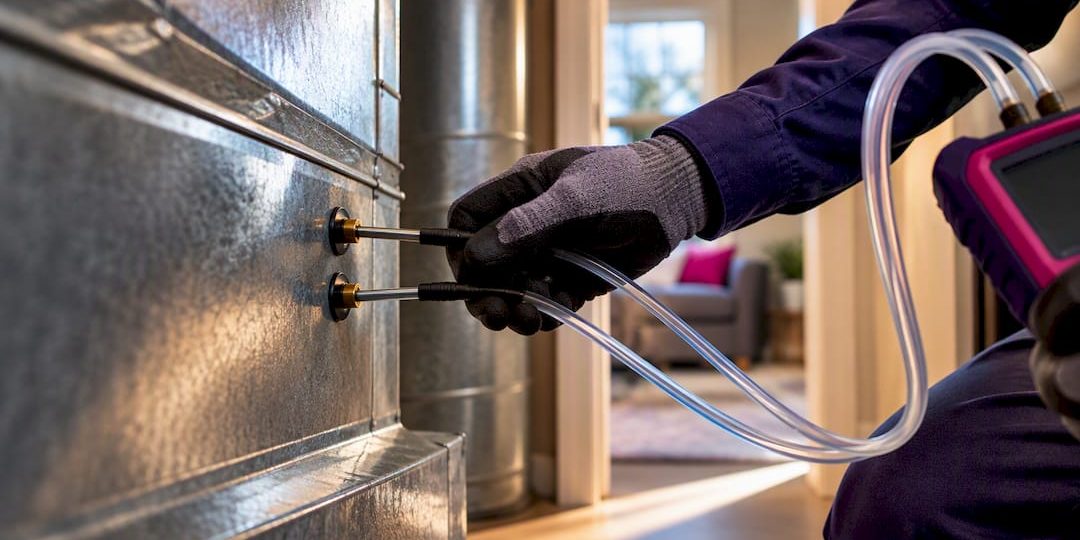
- Total External Static Pressure (TESP) measured with a digital manometer, comparing supply and return plenum readings against the equipment’s rated limits
- Duct leakage testing to find leaks that are not visible from an attic walk-through
- Blower amp and voltage checks to confirm the motor is running at its rated speed
- Refrigerant charge verification when coil icing or poor cooling accompanies the airflow problem
Statistic Callout: TESP measured with a manometer is the most accurate single diagnostic for airflow, which explains why a clean filter alone sometimes fails to fix the problem. A quality visit ends with sealed ducts where needed, a documented airflow reading, and a written scope of work before any repair begins.
Preventive steps that stop low airflow from coming back
A short maintenance routine prevents most of the causes above from recurring.
- Check filters monthly and replace them on the cadence in your HVAC maintenance schedule, choosing the highest MERV rating your system’s fan and filter slot can handle without a technician’s sign-off.
- Schedule a duct inspection if you have never had one, especially in an attic or crawlspace, since sealing and insulating accessible ducts is one of the most reliable ways to recover lost airflow.
- Book a seasonal tune-up that includes a filter change, a blower inspection, and an airflow test, using a checklist like this AC maintenance checklist as a guide for what should be covered.
- Treat a maintenance plan as cheaper insurance against the repairs above, since catching a weak capacitor or a small duct leak early avoids the bigger failure that follows it.
Why proper diagnostics beat repeated quick fixes
A NATE-certified, non-commissioned technician has no financial incentive to skip the static pressure test or talk you into equipment you do not need, which matters because TESP testing and duct sealing are usually cheaper over time than replacing a blower motor that was never actually broken, just starved for air. The homeowners who avoid repeat service calls are the ones who insist on a measured diagnosis instead of a guess.
How airflow restoration services work
A qualified HVAC service provider diagnoses low airflow with TESP testing and duct evaluation as described above, then fixes the actual cause instead of swapping parts until something works. Certified technicians provide recommendations based on system needs rather than upsell incentives.

A diagnostic visit covers filter and duct inspection, blower and capacitor checks, and refrigerant verification when the symptoms call for it, backed by our air conditioner repair and maintenance services. If duct leaks or disconnected runs turn up, our duct installation and sealing services handle the repair the same visit when possible. Schedule a diagnostic today and get a written scope before any work begins.
Sources
- A Guide to Energy-Efficient Heating and Cooling | ENERGY STAR
- Indoor airPLUS technical bulletin: filtration | EPA
- Understanding static pressure in HVAC systems and its impact on performance | Panasonic IAQ
FAQ
What are the symptoms of low airflow in an HVAC system?
Weak or barely-moving air at the vents, rooms that feel warmer or cooler than the rest of the house, and longer run times to reach the set temperature are the main symptoms. Ice on the indoor coil or a burning smell means the problem has become urgent.
How do I fix low airflow in my AC unit?
Start with the filter, since a clogged one is the most frequent cause of restricted airflow, then check that every vent is open and visible ducts are not crushed or disconnected. If airflow stays weak after those checks, a technician needs to measure static pressure with a manometer to find the real cause.
What is the $5,000 rule for HVAC?
This is an informal rule some contractors use to help decide between repairing and replacing a system: multiply the repair cost by the age of the unit in years, and if the result exceeds a certain threshold, replacement may make more financial sense than another repair. It is a rough guideline, not an industry standard, and a written estimate from a technician matters more than the math alone.
How do I get zero airflow in a room?
Closing a supply register fully and shutting any accessible damper on that room’s duct branch stops airflow to it, though doing this on a ducted system can raise static pressure elsewhere and reduce airflow in other rooms. It is rarely a good long-term fix and a technician can recommend a safer way to zone that space.