Arizona Monsoon: EPA and Building America Fixes, Plus NATE AC Service
Yes, monsoon humidity often makes an air conditioner feel like it is losing the fight, because the system has to pull moisture out of the air (latent load) on top of dropping the temperature (sensible load). When outdoor dew points climb, your AC can hit the setpoint on the thermostat and the house still feels damp. Try closing windows, switching to a dry or dehumidify mode if your thermostat has one, and running a portable dehumidifier in the worst rooms.
TL;DR:
- When outdoor dew points stay above 55°F for several days, standard central AC systems often cannot keep indoor humidity below 55-60%, especially in well-sealed homes.
- Using dehumidify mode or setting the fan to auto can improve moisture removal, as continuous fan operation may re-evaporate moisture onto the house.
- Placing portable dehumidifiers in key rooms is effective for localized dampness, but whole-home dehumidifiers are necessary if humidity above 55-60% persists across multiple areas.
- Regular maintenance like filter replacement, coil cleaning, and duct sealing significantly enhances the AC’s ability to dehumidify during monsoon seasons.
- Calling a professional is advised if persistent smells, visible condensation, or constant cycling occur, as these indicate systemic issues beyond thermostat adjustments.
Table of Contents
- Why your AC struggles with moisture during monsoon season
- Immediate fixes to try before calling anyone
- Choosing the right dehumidification setup for your home
- A maintenance checklist that keeps your AC dehumidifying properly
- When it is time to call in a professional
- What years of Arizona monsoon calls have taught me
- How Tru Comfort helps you get ahead of monsoon humidity
- Where these humidity and mold guidelines come from
- Sources
- FAQ
Why your AC struggles with moisture during monsoon season
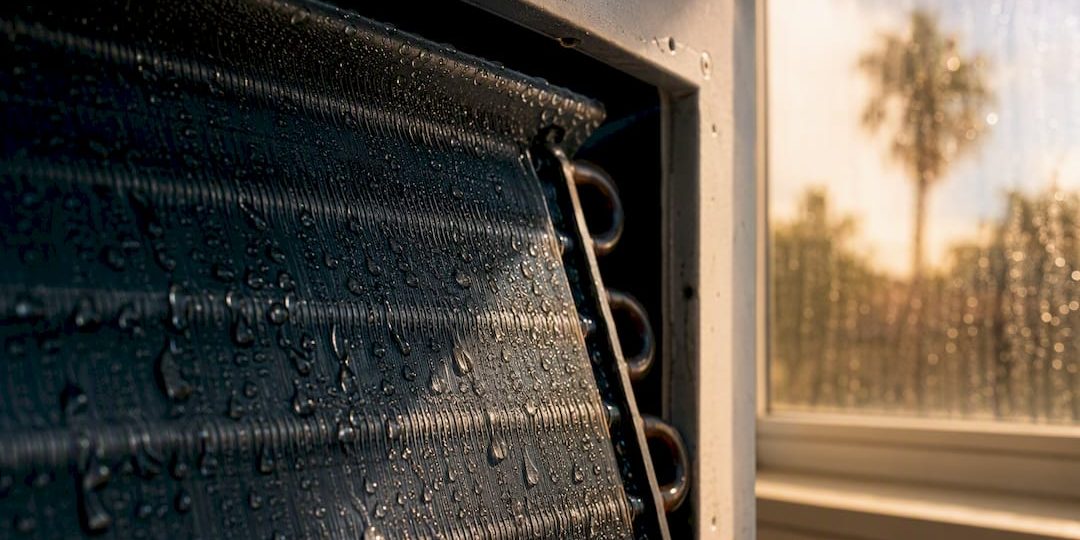
An air conditioner does two jobs at once. It lowers air temperature, which is the sensible load, and it pulls water vapor out of the air, which is the latent load. Moisture removal only happens while the evaporator coil is cold and the system is actually running. A short cooling cycle chills the air fast but shuts off before much condensation has formed on the coil, so the house cools down while the air stays wet.
Monsoon season pushes dew points higher across Arizona, and dew point is the number that actually tells you how humid it feels, not the relative humidity percentage on your thermostat. Once outdoor dew points sit above roughly 55 degrees for a few days in a row, a standard central AC often cannot keep pace with the added moisture, according to Building America and DOE guidance on supplemental dehumidification. That guidance notes the problem shows up most in well-sealed, efficient homes, where the system cools the space so quickly that it never runs long enough to dry the air.
Moisture also gets in through more direct routes during a monsoon surge:
- Open windows and doors during a storm push humid outdoor air straight into the house.
- Exhaust fans left off while showering or cooking let steam linger and raise indoor humidity.
- Gaps around ductwork or the building envelope let humid air infiltrate even when everything is closed.
Watch for short-cycling, condensation on windows or cold water pipes, and musty odors. Those are the early signs that your AC is cooling the air without properly drying it.
Immediate fixes to try before calling anyone
Before you assume something is broken, a handful of quick changes often bring indoor humidity back under control.
- Switch your thermostat to dry or dehumidify mode if it has one. This setting slows the fan and runs the compressor longer, which pulls more moisture off the coil.
- If your system does not have a dry mode, set the fan to auto rather than on. Auto shuts the fan off with the compressor so water sitting on the coil drains away instead of evaporating back into your ductwork.
- Keep windows and doors closed during and after a storm, and skip indoor clothes drying or long steamy showers without running the bathroom fan.
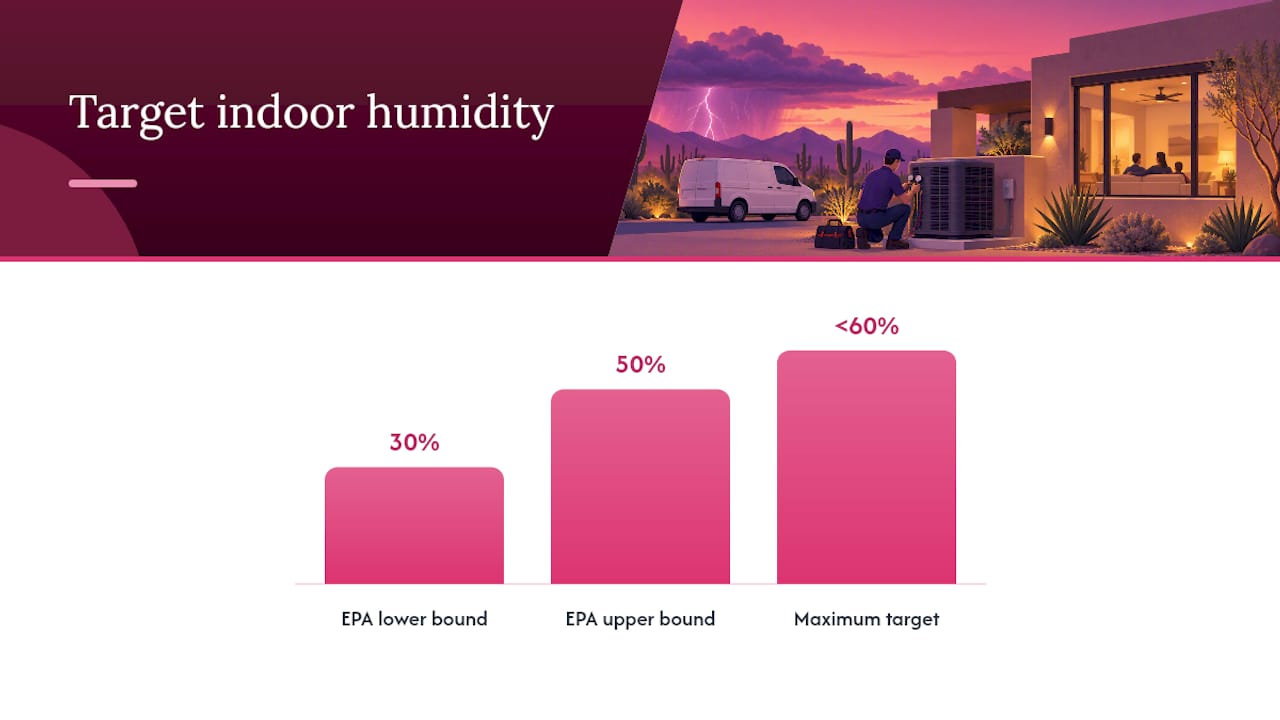
- Place a portable dehumidifier in problem rooms like bathrooms, laundry rooms, or a basement, and set the target below 60% relative humidity, ideally in the 30% to 50% range the EPA recommends.
- If the AC is cycling on and off every few minutes, raise the setpoint by a couple of degrees and watch the run time. A longer, steadier cycle removes more moisture than several short bursts.
Pro Tip: Run the AC for longer stretches during peak monsoon humidity, even if it means setting the thermostat a degree or two higher than usual. Longer run times dry the air more than colder temperatures do.
The fan setting trips up a lot of homeowners. Running the fan continuously feels like it should help circulate cooler air, but with the compressor off, that same fan blows across a wet coil and re-evaporates the moisture it just collected, sending it right back into the house.
Choosing the right dehumidification setup for your home
When thermostat tweaks and a portable unit are not enough, the next step depends on how widespread the problem is and how tightly your home is sealed.
- A portable dehumidifier handles a single damp room well and is the fastest fix for bathrooms, laundry rooms, or basements.
- A ducted or whole-home dehumidifier ties into your existing central AC ductwork and controls humidity across the entire house at once, which suits well-sealed homes where every room runs humid.
- HVAC-integrated options, including humidity-aware thermostats and dedicated dehumidification coils, coordinate with the AC’s own cycles rather than fighting them, and they run quieter than a standalone unit.
**A useful benchmark: if indoor relative humidity consistently sits above 55% to 60%, Building America’s measure guideline treats this as the point where supplemental dehumidification earns its keep, rather than something you can dial away with the thermostat alone. That tradeoff matters when you are choosing how aggressive a system to install: tighter humidity control costs more to run, so it makes sense to match the equipment to how humid your specific home actually gets rather than over-buying capacity you will rarely need.
A maintenance checklist that keeps your AC dehumidifying properly
A system in good repair pulls far more moisture out of the air than one running dirty or low on airflow. Work through this list before monsoon season peaks:
- Check filters monthly during monsoon months and replace them when they look dirty. A clogged filter cuts airflow across the coil and weakens moisture removal even if the compressor runs fine.
- Have someone check the evaporator coil, condensate pan, and drain line for buildup, standing water, or rust, since a clogged drain can back up and cause water damage inside the air handler.
- Ask a technician to verify refrigerant charge and blower performance during a seasonal check. Low airflow or low charge both reduce the system’s ability to dry the air even while it still cools.
- Seal and insulate exposed ductwork, especially in attics, to stop humid air from infiltrating and condensing on cool duct surfaces.
- Book a monsoon-season tune-up before the humidity peaks rather than after symptoms show up, since a coil cleaning and drain check take far less time than repairing water damage.
When it is time to call in a professional
Homeowner fixes solve a lot of monsoon humidity problems, but some symptoms point to something a thermostat setting cannot touch. Persistent musty smells, visible condensation on ducts or walls, or an AC that runs constantly without ever bringing humidity down are signs the system needs a real diagnostic.
A qualified technician typically works through a set sequence:
- Measure indoor relative humidity and dew point, and log how long the system runs per cycle.
- Check for short-cycling and inspect the coil, drain line, and condensate pan for blockages.
- Measure airflow across the coil and check refrigerant pressures against the manufacturer’s specs.
- Recommend fixes such as duct sealing, a whole-home dehumidifier, airflow correction, or a refrigerant adjustment based on what the numbers show.
When you book a visit, ask whether the technician is NATE-certified and whether recommendations are commission-free, since that affects whether you get a diagnosis built around your home or a push toward the priciest fix. Most of these repairs, from a coil cleaning to a duct sealing job, wrap up in a single visit.
What years of Arizona monsoon calls have taught me
Monsoon humidity rarely gets fixed by thermostat settings alone. The homes that stay comfortable through July and August usually needed both an envelope fix, like sealed ducts or better weatherstripping, and some form of supplemental dehumidification. Skipping maintenance during monsoon season is how a damp closet turns into a mold problem and a bigger repair bill later. Catching it early is cheaper and faster than fixing it after the fact.
How Tru Comfort helps you get ahead of monsoon humidity
Chasing thermostat settings only gets you so far when the coil is dirty, the drain line is clogged, or the ductwork is leaking humid air into your attic. 
An HVAC company staffed by NATE-certified technicians provides non-commissioned recommendations, meaning the fix you get is based on what your system actually needs.
- AC diagnostics and repair for systems that are short-cycling or failing to dehumidify
- Coil cleaning, drain clearing, and airflow correction as part of routine maintenance
- Duct sealing to stop humid air infiltration
- Emergency HVAC service when a system fails during a monsoon spike
| Service need | What it addresses |
|---|---|
| AC Maintenance Services | Coil cleaning, drain checks, and airflow correction |
| Air Duct Installation Services | Sealing leaks that let humid air infiltrate |
| Tru Comfort Advantage HVAC Maintenance Plans | Scheduled seasonal checks ahead of monsoon season |
If your home has felt damp no matter where you set the thermostat, request an AC diagnostic visit and get a straight answer on what is actually driving the humidity.
Where these humidity and mold guidelines come from
The recommendations above draw on public guidance rather than opinion.
- The EPA’s mold course sets the 30% to 50% ideal humidity range and the 60% mold-prevention ceiling.
- Building America’s measure guideline explains when supplemental dehumidification pays off and its energy tradeoffs.
- Energy covers airflow and control strategies that improve moisture removal.
- The EPA’s brief guide to mold and moisture outlines homeowner actions after leaks and general humidity control steps.
Sources
- Mold course chapter 2 | US EPA
- Measure Guideline: Supplemental Dehumidification in Warm-Humid Climates
- Energy
- Brief guide to mold, moisture and your home | US EPA
FAQ
What AC mode is best for monsoons?
Use dry or dehumidify mode if your thermostat offers it, since it runs the compressor longer relative to the fan and pulls more moisture off the coil. If that option is not available, keep the fan set to auto so it shuts off with the compressor instead of re-evaporating moisture back into the air.
Does high humidity affect your AC?
Yes, high humidity increases the latent load your AC has to handle alongside cooling the air, which can make the system run longer or cycle more without necessarily lowering the temperature further. The EPA recommends keeping indoor relative humidity below 60% to avoid mold growth tied to that extra moisture.
What is the 3 minute rule for AC?
This refers to giving a compressor a short rest period, generally a few minutes, before restarting it after it shuts off, to avoid strain on the compressor. It is a mechanical safeguard rather than a humidity control setting, though a system that short-cycles constantly will also struggle to dehumidify properly.
Which AC mode is best in humidity?
Dry or dehumidify mode is best when your system has it, since it prioritizes moisture removal over rapid cooling. Where that mode is not available, auto fan with a slightly higher thermostat setpoint often removes more moisture than blasting cold air on a short cycle.
When should I add a whole-home dehumidifier instead of a portable one?
Consider a whole-home unit when indoor relative humidity consistently sits above 55% to 60% across multiple rooms rather than in just one damp space, a threshold Building America’s guideline treats as the point where supplemental dehumidification is worth the investment. A portable unit is better suited to a single problem room like a bathroom or laundry area.