
Why Your AC Breaker Keeps Tripping (And When to Stop Resetting It)
If your AC breaker keeps tripping, reset it once. If it trips again after that single reset, leave it off, run the safe homeowner checks below, and call a licensed HVAC technician or electrician. Repeated resets can push a struggling compressor toward permanent damage, and in worse cases, toward an electrical fire.
TL;DR:
- Resetting a tripped breaker once is safe, but repeating resets risks compressor damage and potential electrical fires, requiring professional diagnosis.
- Breaker trips immediately at startup typically indicate a short circuit, while trips after 10-30 minutes usually stem from heat buildup or airflow restrictions.
- Homeowners should avoid opening capacitors or installing larger breakers, as these actions can cause severe injury or fires and require expert intervention.
- Accurate diagnosis relies on timing of trips, amp-draw tests, and inspecting for mechanical or environmental issues, not guesswork or repeated resets.
- Proper breaker sizing, regular panel inspections, and environmental maintenance prevent chronic trips and extend the lifespan of the AC system.
Table of Contents
- Quick Homeowner Checks You Can Safely Do Yourself
- Common Causes and How Trip Timing Points to the Culprit
- Safety, Red Flags, and What Not to Do
- When to Call a Professional and What Diagnostics They Run
- Trucomfortaz’s Approach and Proof Points
- Circuit Breaker Types and AC Compatibility
- What Happens When the Breaker Size Is Wrong
- Why Panel Inspections Matter Even When Nothing’s Tripping
- Humidity, Rodents, and Other Silent Causes of Shorts
- What the Data Actually Tells You to Do First
- Get a Straight Answer From Trucomfortaz
- Sources
Quick Homeowner Checks You Can Safely Do Yourself
Before you touch anything electrical, switch the thermostat to OFF. This stops the system from trying to restart while you’re working near the panel and removes one variable while you troubleshoot.
Once that’s done, work through these steps in order:
- Reset the breaker correctly. Push it fully to OFF, pause, then push it fully to ON. A half-hearted flip that doesn’t fully click over won’t reset the circuit, and it may feel “on” when it isn’t.
- Wait a sufficient time before restarting the AC to allow internal pressures to equalize, which lowers the odds of an immediate re-trip. This gives internal pressures a chance to equalize, which lowers the odds of an immediate re-trip.
- Check the air filter. A clogged filter restricts airflow across the coil, forcing the compressor to work harder and draw more amperage than the circuit was designed for.
- Inspect the outdoor condenser unit. Clear weeds, leaves, and debris away from it, and look for obvious physical damage. Do not open the electrical panel or touch the capacitor. That part carries a stored charge even when the power is off.
- Confirm which breaker actually trips. Some panels are labeled incorrectly. Make sure it’s genuinely the AC circuit and not a shared circuit with another appliance pulling the load over the edge.
- Write down when the trip happens. Instantly at startup, a few seconds in, or only after the unit has run for a while in the heat. This single detail is often the fastest way to narrow down the cause.
Pro Tip: Keep a simple log on your phone: date, time of day, outdoor temperature, and how long the AC ran before it tripped. That pattern tells a technician more in ten seconds than a vague “it keeps tripping” ever will.
Common Causes and How Trip Timing Points to the Culprit
Timing is the best free diagnostic tool you have. An AC compressor that trips the breaker the instant you flip it on is telling a very different story than one that trips 20 minutes into a hot afternoon.
Instant trip at startup usually points to a dead short, a grounded compressor, or a capacitor that has failed outright. A grounded compressor sends current straight to the metal casing instead of through the motor windings, and the breaker reacts immediately because that’s exactly the kind of fault circuit breakers exist to catch.
A delay of a few seconds often means a weak start or run capacitor, or a compressor that’s struggling to overcome what electricians call Locked Rotor Amps (LRA). LRA is the surge of current a compressor motor needs the instant it starts spinning, before it builds momentum. It’s normally brief and the circuit tolerates it. But a tired capacitor or a compressor with mechanical resistance stretches that surge out, and repeatedly forcing restarts under those conditions pushes destructive heat into the motor windings, which is exactly why the one-reset rule exists.
Trips after 10 to 30 minutes of running shift the suspect list toward heat buildup rather than an electrical fault. Common culprits include:
- Dirty condenser coils that can’t shed heat properly
- Restricted airflow from a clogged filter or blocked outdoor unit
- A failing fan motor that can’t move enough air across the coil
- High head pressure caused by low refrigerant, which forces the compressor to work overtime
Restricted airflow raises the compressor’s operating amps during exactly the conditions when your AC works hardest, which is why these delayed trips cluster on the hottest days of the year rather than happening randomly.
Loose or corroded wiring connections and a breaker that’s simply worn out from age round out the list. Neither is rare, and neither is something you should try to fix yourself.
Safety, Red Flags, and What Not to Do
One reset. That’s the rule. If the breaker trips again right after you reset it, stop. The compressor draws its heaviest current the instant it starts, and forcing it to restart over and over while something is wrong doesn’t give it a fair shot. It just adds heat to windings that may already be stressed.
Certain signs mean you skip the troubleshooting entirely and call for help now:
- A burning smell near the panel, thermostat, or outdoor unit
- Buzzing, crackling, or humming from the electrical panel
- The breaker trips the instant you reset it, with no delay at all
- The breaker itself feels hot to the touch
- Trips that keep recurring across multiple days despite a clean filter and clear condenser
Some things are simply off-limits for homeowners, no matter how confident you feel with a screwdriver. Never open a capacitor panel or attempt to discharge a capacitor. It holds an electrical charge that can injure you even with the system powered down. Never swap in a larger breaker or tape one down to stop it from tripping. That defeats the entire purpose of the circuit protection and is a documented cause of house fires, not a fix. And never keep resetting past that first attempt hoping it’ll “catch.”
Pro Tip: If you smell anything electrical or burning, don’t wait for a scheduled appointment. Shut off power at the main panel if you can do so safely, and call for emergency service the same day.
When to Call a Professional and What Diagnostics They Run
Once you’ve done the safe checks and the breaker still trips, it’s time for a technician, not a second guess. Here’s what a proper diagnostic visit actually involves:
- Clamp-meter amp draw test. A clamp meter measures the actual current pulling through the compressor circuit, comparing it against what the unit is rated for. This is the single most useful measurement in the whole visit.
- Capacitor testing. Capacitors are rated in microfarads, and a weak one shows a reading well outside its rated range even if it looks physically fine.
- Contactor inspection. Pitted or stuck contactors can cause intermittent power delivery that mimics other problems.
- Visual wiring check. Techs look for scorch marks, loose lugs, and corrosion inside the disconnect box and panel.
- Megohmmeter test for a grounded compressor. This measures insulation resistance in the motor windings. A low reading confirms a grounded compressor, and at that point, replacement is usually the only real option.
Repairs range widely in scope. A capacitor swap is quick and inexpensive. A fan motor replacement or a wiring repair takes longer and costs more. A grounded compressor is the most serious outcome, often meaning the outdoor unit needs replacing rather than repairing.
Before you agree to any repair, ask the technician three things: Do you measure amp draw as part of the diagnosis? Are the replacement parts warrantied? Can you give me a written estimate before starting work? A tech who hesitates on any of those three is worth a second opinion.
Trucomfortaz’s Approach and Proof Points
When a Trucomfortaz technician arrives for a breaker-trip call, the process follows a set order: thermostat off, confirm a single reset has already been attempted, run an amp-draw test, check the capacitor, then inspect wiring and connections at the disconnect and panel. Nothing gets replaced on a guess.
That order matters because it protects you from paying for parts you don’t need. Our technicians are NATE-certified, and because they work on a non-commissioned basis, there’s no financial incentive to recommend a compressor replacement when the real problem is a $30 capacitor.
Two calls, two very different outcomes, illustrate why testing before replacing matters:
- One homeowner’s unit tripped every time it tried to restart after a thermostat cycle. Amp-draw testing pointed to a failed run capacitor. Swap it, problem solved, same afternoon.
- Another homeowner’s breaker tripped instantly with zero delay. A megohmmeter test confirmed a grounded compressor, and the outdoor unit needed full replacement.
A tripped breaker is doing exactly what it’s designed to do. The goal isn’t to make it stop tripping. It’s to find out why it’s tripping in the first place, and fix that.
Circuit Breaker Types and AC Compatibility
Not every breaker in your panel is built the same way, and AC units have specific requirements that matter more than most homeowners realize.
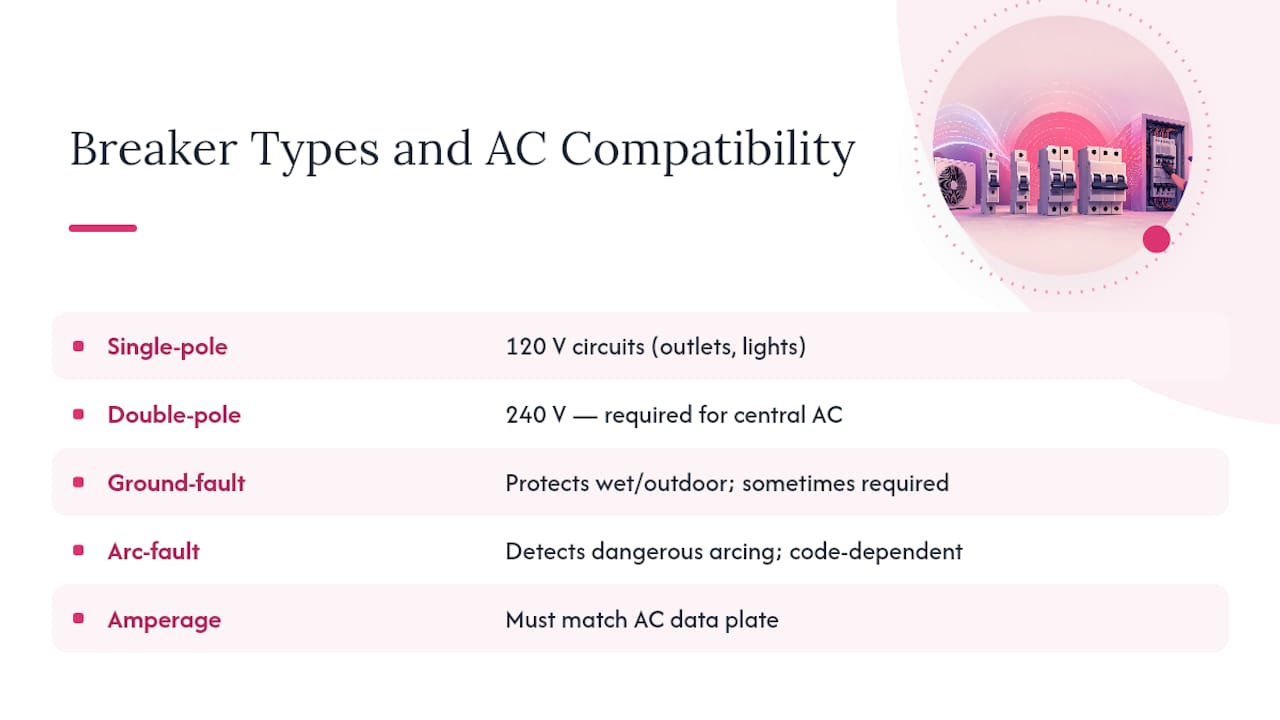
Standard single-pole breakers handle 120-volt circuits, the kind that power outlets and lighting. Central air conditioners, on the other hand, run on 240-volt circuits and require a double-pole breaker, which ties two panel slots together to deliver that higher voltage safely.
Beyond voltage, breakers are rated by amperage, and that rating has to match what the AC’s data plate specifies, not just “whatever fits in the slot.” Many jurisdictions also require the AC circuit to be protected against ground faults in certain outdoor or wet-location contexts, which is a separate consideration from the standard breaker.
Some newer panels use arc-fault or combination breakers designed to catch dangerous arcing conditions that a standard breaker might miss. Whether your AC circuit needs one depends on your local electrical code and the age of your panel.
If your home still has original wiring and breakers from decades ago, mismatched or outdated breaker types are a realistic possibility, especially if the AC system itself has been upgraded since the panel was installed. A breaker rated for a smaller, older unit won’t necessarily handle a newer, more powerful compressor. That mismatch alone can cause chronic nuisance trips that have nothing to do with the AC itself being faulty.
What Happens When the Breaker Size Is Wrong
Breaker sizing isn’t a place to guess. It’s calculated from the AC unit’s Rated Load Amps and Locked Rotor Amps, and getting it wrong in either direction creates real problems.
An undersized breaker trips constantly, even when the AC unit itself is running perfectly fine. It simply can’t handle the normal startup surge, so it interprets ordinary operation as an overload every single time. If you’ve recently had a larger, more powerful AC system installed without an electrician reassessing the panel, an undersized breaker is a real possibility worth ruling out.
An oversized breaker is the more dangerous mistake, even though it causes fewer trips. A breaker that’s rated too high for the wiring and equipment it protects won’t trip when it should. If a compressor starts drawing excessive current from a developing fault, an oversized breaker may let that current flow well past the point where it should have cut power, allowing wiring to overheat.
This is precisely why taping down a breaker or swapping in a larger one to “stop the tripping” is such a bad idea. It doesn’t fix the underlying problem. It just removes the safeguard that was catching it. Breaker sizing should always match the AC manufacturer’s electrical specifications, confirmed by whoever installs or services the unit, not chosen by whatever happens to be sitting in a toolbox.
Why Panel Inspections Matter Even When Nothing’s Tripping
Most homeowners only think about their electrical panel after something goes wrong. That’s backward. Connections loosen gradually from years of thermal cycling, heating up and cooling down every time the AC cycles on and off, and that slow loosening is exactly the kind of problem an inspection catches before it becomes a trip, a burning smell, or worse.
Corroded or loose connections generate resistance, and resistance generates heat. A technician checking your panel periodically can spot warm spots, discoloration, or a lug that’s backed out slightly, and tighten or replace it before it becomes a middle-of-August emergency call. Waiting until it fails means dealing with the problem on the hottest day of the year, at the least convenient possible moment.
Routine panel inspection also catches a breaker that’s aged out. Breakers wear mechanically over thousands of trip-and-reset cycles, and an old breaker can start tripping at loads it used to handle fine, or fail to trip when it should. Neither failure mode announces itself until something forces the issue.
If your panel hasn’t been inspected in several years, and especially if your AC system is more than a decade old, that’s worth putting on the calendar alongside your regular AC maintenance. It’s a short visit that prevents a much longer one later.
Humidity, Rodents, and Other Silent Causes of Shorts
Not every electrical fault starts inside the compressor or the panel. Environmental factors get overlooked constantly, and they’re often the easiest to prevent once you know to look for them.
Humidity speeds up corrosion on electrical connections, contactors, and terminals, particularly in outdoor disconnect boxes that aren’t fully sealed. In hot, humid climates, electrical components wear down faster than they do in drier conditions, which is part of why nuisance trips cluster in certain regions and certain seasons more than others.
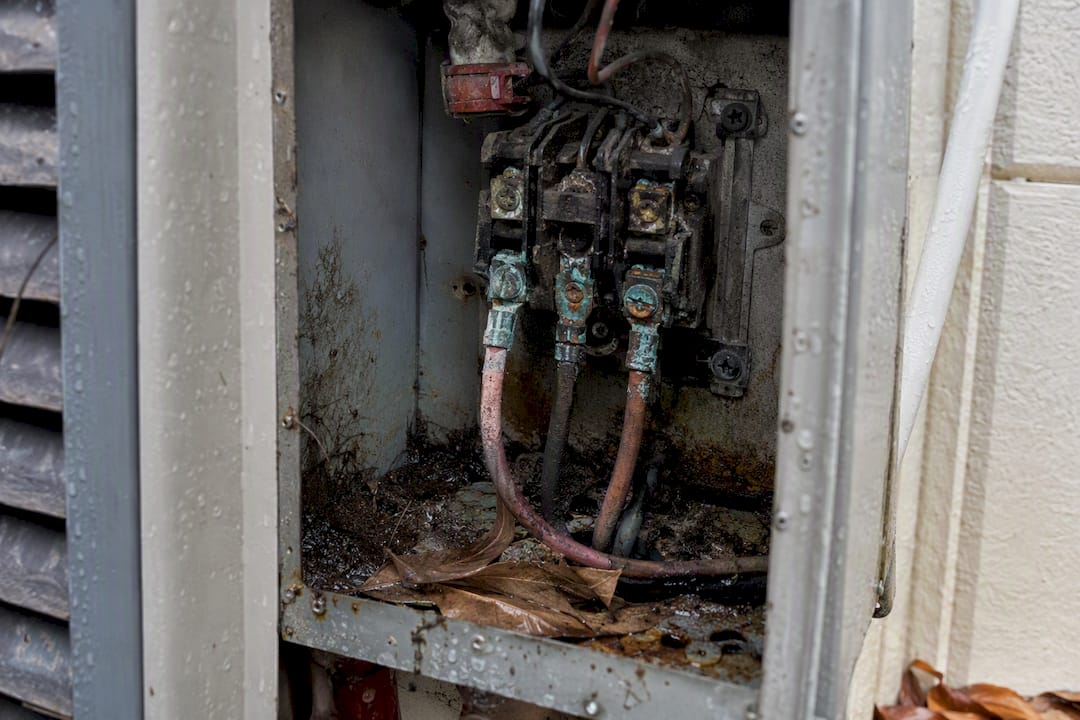
Rodents cause a different kind of damage entirely, and it’s more common than most homeowners assume. Mice and rats chew through wire insulation, particularly around outdoor condenser units and in crawl spaces where wiring runs. Exposed, chewed wiring can create a short circuit that has nothing to do with the AC’s mechanical condition at all. If your unit is tripping and everything mechanically checks out clean, a wiring inspection specifically for rodent damage is worth requesting.
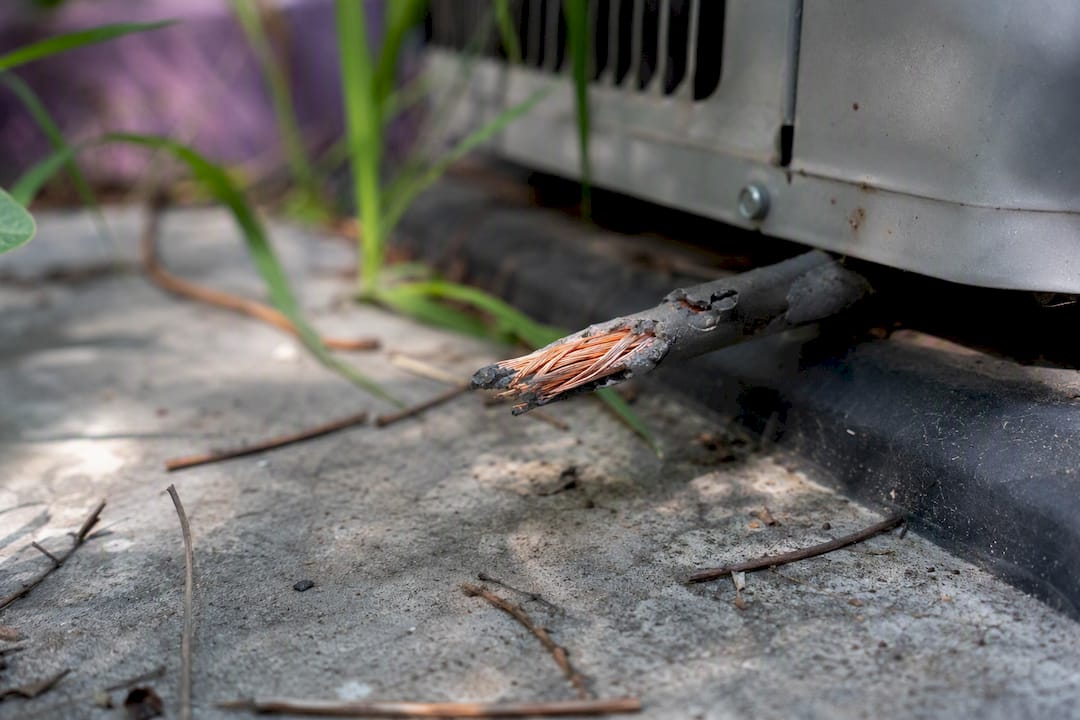
Standing water near the outdoor unit after heavy rain, ant infestations inside the disconnect box, and even dust buildup that combines with humidity to create a conductive film can all contribute to intermittent shorts. None of these show up on a filter check or a visual coil inspection. They show up when a technician actually opens the disconnect and looks.
What the Data Actually Tells You to Do First
The conventional advice online treats every tripped breaker like a mystery that needs a checklist. It doesn’t. Timing solves most of the mystery before you’ve even called anyone. Instant trip means electrical fault. Trips after a long run means heat and airflow. That’s the shortcut most articles bury under ten paragraphs of generic troubleshooting.
Where conventional advice actually falls short is the resetting habit itself. Plenty of homeowners treat the breaker like a stubborn light switch, flipping it two, three, four times hoping it’ll finally hold. That instinct is understandable and it’s also the single most damaging thing you can do to a compressor that’s already struggling with Locked Rotor Amps.
What I’d prioritize first: log the timing, do the airflow checks, and respect the one-reset rule without exception. A breaker that trips twice isn’t asking for persistence. It’s asking for a clamp meter, and that’s a technician’s job, not yours.
Get a Straight Answer From Trucomfortaz
Guessing at capacitors and breaker sizes from a YouTube video is how a $30 part turns into a $3,000 outdoor unit. Trucomfortaz sends NATE-certified technicians who test before they replace, with no commission riding on whichever repair they recommend, so the fix matches what’s actually wrong rather than whatever pays the most.

If your breaker has tripped more than once, don’t keep flipping it. Our emergency AC service covers New River and Anthem for exactly this kind of situation, with amp-draw testing and capacitor checks done on the first visit rather than after a return trip. And if recurring trips have become a pattern rather than a one-time event, our maintenance plans catch the dirty coils and loose connections that cause most of them before they ever reach your panel. Call to schedule a diagnostic visit or ask about same-day emergency availability.
Sources
- AC Compressor Keeps Tripping the Breaker? Stop Resetting It — Cool Wichita
- AC Keeps Tripping the Breaker? It Might Not Be the AC — On Point Service Company
- Circuit breaker tripping when AC turns on: what to do — Affordable Air and Heating
- HVAC Breaker Tripped: Safe Reset and Repair Guide — Covenant Aire Solutions