Homeowners, Prioritized Symptoms and Safe Checks for Bad AC Capacitors
If your outdoor unit hums but the fan won’t spin, the system runs but blows warm air, or the compressor won’t kick on at all, a failing capacitor is the most likely cause. Cut power at the breaker or thermostat right away, then call a licensed technician. Between Carrier’s and Smart Service’s documentation on capacitor failure, these signs consistently point to the same root problem, and Trucomfortaz’s technicians see it constantly during Arizona’s peak cooling months.
TL;DR:
- A failing capacitor causes startup issues, increased electricity use, overheating, and often results in the outdoor unit humming without the fan spinning.
- Symptoms like immediate humming, breaker trips, or burnt smells signal urgent need for professional diagnosis and replacement, which costs between $100 and $400.
- Heat, voltage surges, and age predominantly trigger capacitor failures, with outdoor heat shortening lifespan and power spikes causing rapid damage.
- Visual signs such as bulging tops, oil leaks, or scorch marks confirm capacitor failure, but testing with professional tools is recommended for safety.
- Regular maintenance including annual tune-ups, airflow clearance, and surge protection can prolong capacitor lifespan and prevent costly emergency repairs.
Table of Contents
- What Does an AC Capacitor Actually Do?
- Start, Run, and Dual Capacitors: Which One Is Failing?
- What Causes AC Capacitors to Fail?
- What Are the Warning Signs of a Failing Capacitor?
- How Do You Safely Check for Capacitor Problems at Home?
- When Should You Call a Technician, and What Will It Cost?
- How Can You Prevent Capacitor Failure in the Future?
- What Does Trucomfortaz See in the Field?
- Schedule a Safe Capacitor Inspection
- Sources
What Does an AC Capacitor Actually Do?
An air conditioner capacitor works like a small energy reservoir. It stores an electrical charge and releases it in a quick burst to get the compressor and fan motors spinning, then it keeps feeding a steady charge to help those motors run smoothly once they’re moving. Without that stored energy, an electric motor in your outdoor unit simply doesn’t have enough torque to overcome its own resistance at startup.
There are two jobs happening here, and they matter for understanding symptoms later.
- Startup torque: the capacitor delivers a jolt of energy that spins the motor from a dead stop.
- Running support: once the motor is moving, the capacitor keeps correcting the electrical phase so the motor doesn’t strain or overheat.
When capacitance drops, even slightly, the motor has to work harder to do the same job. That extra strain shows up as heat, noise, or a motor that hesitates before it catches. A weakening capacitor can also raise your electricity use before it fails outright, since the motor draws more current trying to compensate for the shortfall.
Most AC capacitors last many years under normal conditions, though Arizona heat tends to shorten their lifespan. Age alone is rarely a mystery. If your system is past the decade mark and starting to act up, the capacitor should be one of the first things checked.
Start, Run, and Dual Capacitors: Which One Is Failing?
Not every capacitor failure looks the same, and the pattern often tells you which component is the culprit before a technician ever opens the panel.
- Start capacitors deliver the initial jolt to get the compressor or fan moving. When they fail, the unit typically won’t start at all, or it clicks and hums without ever spinning up.
- Run capacitors keep the motor stable during operation. Failure here usually shows up as reduced cooling, overheating, or a motor that starts fine but shuts down or struggles mid-cycle.
- Dual-run capacitors combine both jobs in one canister with separate terminals for the fan and compressor. A partial failure can produce mixed symptoms, like a fan that spins normally while the compressor struggles, or vice versa.
Watch the timing. Trouble the instant you flip the system on points toward a start-side issue. Trouble that appears a few minutes into a cycle, once things have warmed up, points toward the run side.
What Causes AC Capacitors to Fail?
Three factors drive most capacitor failures: heat, voltage instability, and simple age. HomeAdvisor’s cost data identifies all three as the leading causes, and each one degrades the capacitor’s internal dielectric material a little differently.
Chronic heat exposure is the biggest factor in hot climates. Outdoor units already run in high ambient temperatures, and a capacitor mounted inside that housing spends its entire life absorbing that heat. Over years, sustained high temperatures break down the dielectric layer inside the capacitor, gradually reducing its ability to hold a charge.
Voltage spikes act faster and more violently. A power surge, a nearby lightning strike, or unstable grid voltage can push more electrical stress through a capacitor than its rating allows, sometimes causing failure within seconds rather than years. HVAC Project Cost notes that technicians see predictable spikes in capacitor failures after severe storms or extended heat waves, exactly when the grid and the equipment are both under the most strain.
- Heat: cumulative exposure weakens the dielectric material over time.
- Voltage spikes: surges or lightning can cause sudden, immediate failure.
- Age and cumulative cycling: normal wear from years of startup cycles eventually exhausts even a healthy capacitor.
If your system is more than 10 years old and has never had the capacitor replaced, age is probably doing most of the damage, regardless of what triggers the final failure.
What Are the Warning Signs of a Failing Capacitor?
Some symptoms mean “schedule a repair this week.” Others mean “shut it down right now.” Here’s how to tell the difference, ranked roughly by how urgent each one is.
- Humming with no fan movement. The outdoor unit hums or buzzes but the fan blade sits still. This is the textbook sign of a failed run capacitor, described in both Carrier’s and Smart Service’s guidance. The motor is trying to start but has no torque to overcome resistance. Letting it hum for extended periods can overheat the motor windings.
- Outdoor fan not spinning while the indoor blower runs. Your thermostat calls for cooling, the indoor blower comes on, and warm air fills the house because the outdoor half of the system never engaged. This is not safe to leave running. Shut the system off rather than letting it cycle repeatedly with a stalled motor.
- Warm air from the vents despite the system running. The indoor fan works, the display says “cooling,” but nothing changes temperature. The compressor, which does the actual heat removal, never engaged because it lacked the startup boost it needed.
- Delayed or hard starts. The unit takes two or three attempts to fire up, or there’s a noticeable hesitation before the compressor catches. This is often an early warning sign that a capacitor is losing capacitance gradually rather than failing outright, giving you a window to schedule service before a full breakdown.
- Frequent short cycling. The system turns on and off every few minutes instead of running a full cooling cycle. A weak capacitor can cause the compressor to trip its internal overload protection repeatedly, restarting the unit before it’s actually accomplished anything.
- Circuit breaker trips. If the breaker trips at startup or partway through a cycle, the motor is likely drawing excessive current because it’s fighting to start or run without adequate capacitor support. Repeated trips are a strong signal to stop using the system.
- Burning smells or scorch marks. Any electrical burning odor near the outdoor unit, or visible scorch marks on the capacitor housing or nearby wiring, is an immediate stop-and-call situation. This points to overheating that has gone past simple wear and into real fire risk.
- Bulging or leaking capacitor housing. A domed top, cracked casing, or oily residue on or around the capacitor confirms failure on sight. Airtly’s research on capacitor lifespan notes that a visibly bulged or leaking capacitor is essentially a guaranteed replace, no further testing needed.
- Rising electricity bills with no other explanation. A capacitor that’s degrading, but hasn’t failed completely, makes the compressor motor draw more current to compensate. That shows up gradually on your utility bill weeks or months before the unit actually stops working.
Pro Tip: Keep a mental note of when symptoms started. A sudden failure right after a thunderstorm points to a voltage spike; a slow decline over a hot summer points to heat fatigue. Either detail helps your technician diagnose faster.
If you’re seeing any of the first three symptoms on this list, treat it as urgent. Running a system with a locked motor or a stalled compressor doesn’t just waste electricity. It can burn out the compressor itself, and that’s a repair bill in a completely different league.
How Do You Safely Check for Capacitor Problems at Home?
You can gather useful information without ever touching a live electrical component, and that distinction matters, because capacitors hold a charge even after the power is off.
- Cut power completely. Turn the thermostat to off, flip the breaker for the outdoor unit, and if there’s a disconnect box mounted near the condenser, pull that too. Wait a few minutes before approaching.
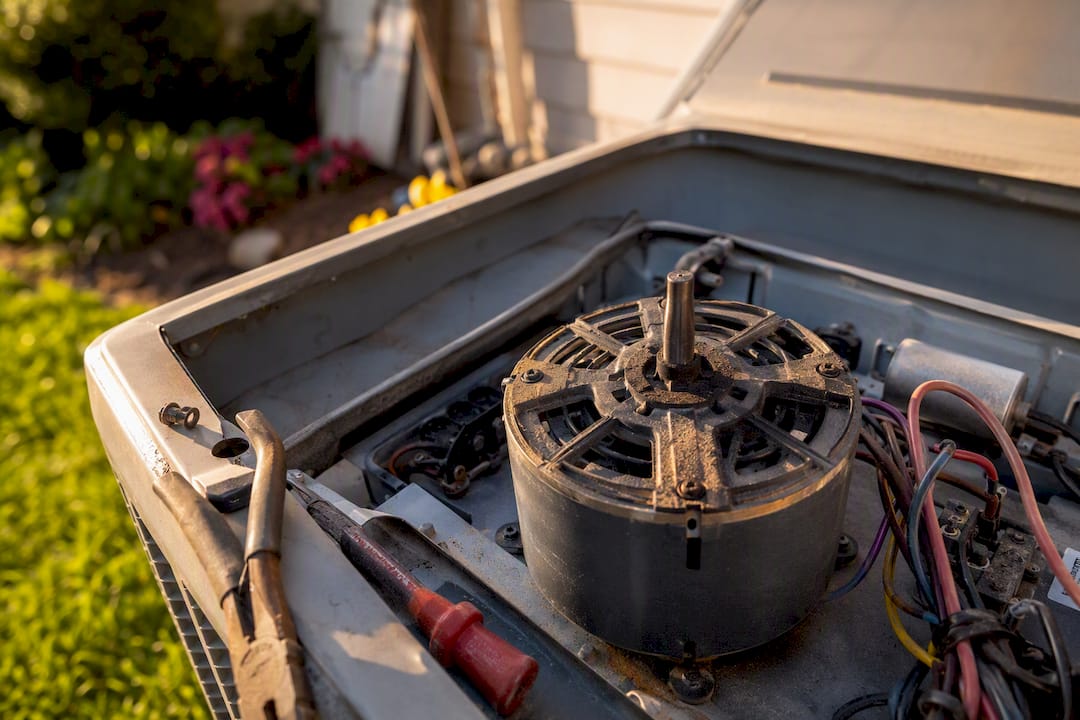
- Look, don’t touch, inside the access panel. With the unit fully powered down, you can visually check for a domed or bulging top, oily residue, rust around the terminals, loose or scorched wiring, and any visible burn marks. These are the same visual cues Smart Service points to as a reliable early indicator of failure.
- Listen and observe from a safe distance before shutting down. Before you cut power, note whether the unit hums without spinning, whether the fan blade moves at all, and whether the breaker trips immediately or only after a few minutes.
- Track patterns over a day or two. Does the breaker trip every time, or only on hot afternoons? Does the thermostat register the call for cooling but nothing outside responds? Patterns help a technician diagnose faster once they arrive.
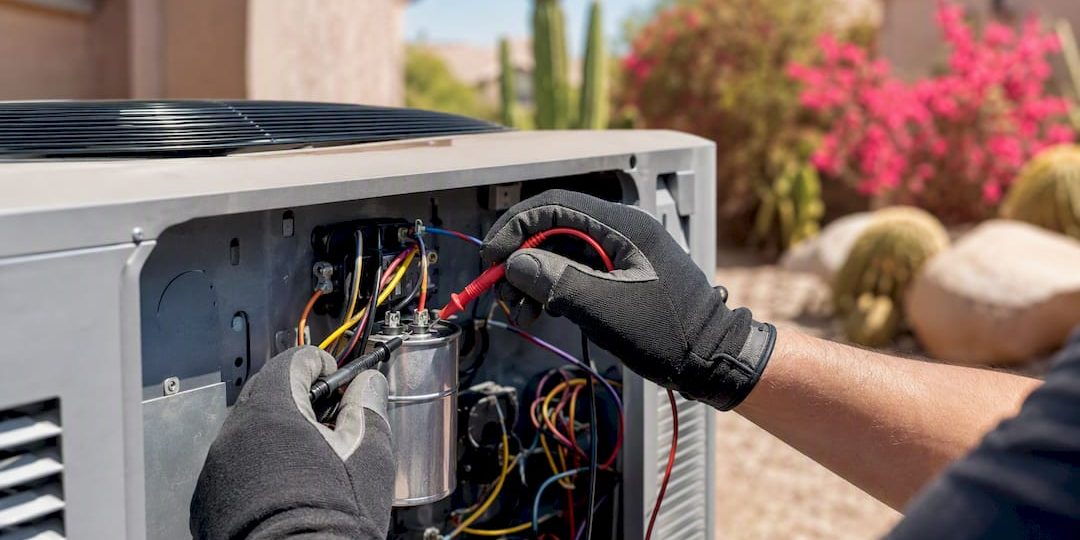
Pro Tip: Never try to discharge or test a capacitor yourself with a multimeter unless you’re trained to do it. A capacitor can hold a dangerous charge long after the unit is unplugged, and professionals use insulated tools and discharge resistors specifically because bare-handed contact can cause serious injury. This isn’t a step to shortcut, even if you’re generally handy.
If any symptom on this list matches what you’re seeing, this emergency AC repair checklist walks through the immediate steps to take before help arrives, particularly if you’re dealing with a humming unit that won’t start.
When Should You Call a Technician, and What Will It Cost?
Certain signs such as humming with a locked fan, burning smells, persistent breaker trips, or visible capacitor damage require immediate professional attention to avoid escalating repairs.
Capacitor replacement itself is one of the more affordable HVAC repairs. Bryant’s guidance puts the typical range at $100 to $400 for parts and labor, and HVAC Project Cost’s figures land in a similar $150 to $400 band. The part itself is cheap. What you’re really paying for is the labor, diagnostic time, and the safety of having someone experienced handle a component that can still shock you after the power is off.
- Standard replacement: $100 to $400, depending on capacitor type and access to the unit.
- Emergency or after-hours service: typically higher due to same-day scheduling.
- Ignored capacitor failure leading to compressor damage: compressor replacement runs into thousands of dollars, far beyond the cost of the capacitor itself.
Running a struggling system, even for a few extra days, puts direct strain on the compressor, and Carrier’s own guidance is blunt about it: a bad capacitor left in service can permanently damage the compressor and motors. That turns a $200 repair into a multi-thousand-dollar one. DIY replacement is technically possible for the mechanically confident, but HVAC Project Cost notes the electrical risk is real enough that most guides recommend hiring a pro, and doing so yourself may also void whatever warranty coverage remains on the unit. If you’re weighing repair against a bigger decision, this guide on when to replace heating and air conditioning can help you figure out where the line is.
How Can You Prevent Capacitor Failure in the Future?
A capacitor’s lifespan isn’t fixed, and a few habits stretch it considerably.
- Get an annual tune-up. A technician can tighten electrical terminals, check capacitance against the part’s rating, and catch a weakening capacitor before it fails outright.
- Keep the condenser area clear. Trim back plants, clear debris, and make sure airflow around the outdoor unit isn’t restricted, since better airflow means lower operating temperatures.
- Consider surge protection. A dedicated surge protector for your HVAC system can absorb voltage spikes from storms before they reach the capacitor.
- Replace proactively once a system nears the 10 to 15 year mark. Swapping an aging capacitor during routine service costs far less than an emergency call.
Regular service also happens to be the easiest way to catch a problem while it’s still just a symptom and not a shutdown. If you’re unsure how often that should happen, this breakdown of AC maintenance frequency lays out a reasonable schedule.
What Does Trucomfortaz See in the Field?
Trucomfortaz’s NATE-certified technicians treat capacitor failure as one of the most common, and most preventable, causes of emergency AC calls in New River summers. The pattern is consistent: heat-stressed capacitors fail hardest during the exact weeks homeowners need cooling most. If your unit is humming or blowing warm air, don’t wait it out. Get it inspected before the compressor pays the price.
Schedule a Safe Capacitor Inspection
A humming unit or warm air blowing from the vents isn’t something to troubleshoot with guesswork. Trucomfortaz sends NATE-certified technicians who safely discharge and test the capacitor, confirm whether it’s the actual cause, and replace it on the spot when it is, all backed by the kind of honest, non-commissioned advice that’s harder to find than it should be in this industry.

A service visit covers full diagnosis, safe capacitor discharge and testing against its rated microfarad value, replacement with a properly matched part, and a follow-up check to confirm the compressor is drawing current normally afterward. Because Trucomfortaz is family-owned and local to New River, you’re not waiting days for a callback during a heat wave, and the company’s maintenance plans catch capacitor wear during routine visits, before it turns into an emergency. If your outdoor unit is humming, tripping the breaker, or just not keeping up anymore, request an inspection through Trucomfortaz’s air conditioner services and get it checked before the next triple-digit stretch.
Sources
- What is an AC Capacitor? | Cost, Signs of Failure & Replacement — Carrier
- AC capacitor replacement cost — HomeAdvisor
- AC capacitor cost and how much to replace — Smart Service
- AC capacitor replacement cost 2026 — HVAC Project Cost