AC Not Blowing Cold Air? A Homeowner’s Fix Guide
Most of the time, an AC running but not blowing cold air comes down to one of three things: the thermostat is set wrong, the air filter is clogged, or the outdoor unit has lost power or is blocked. According to Carrier, a dirty filter, incorrect thermostat settings, or a blocked outdoor condenser coil are the most common homeowner causes. Run through these three checks before anything else:
- Thermostat: Confirm it is set to Cool and the setpoint is at least 3–5°F below the current room temperature. Check that the fan is set to Auto, not On (fan-only mode blows uncooled air).
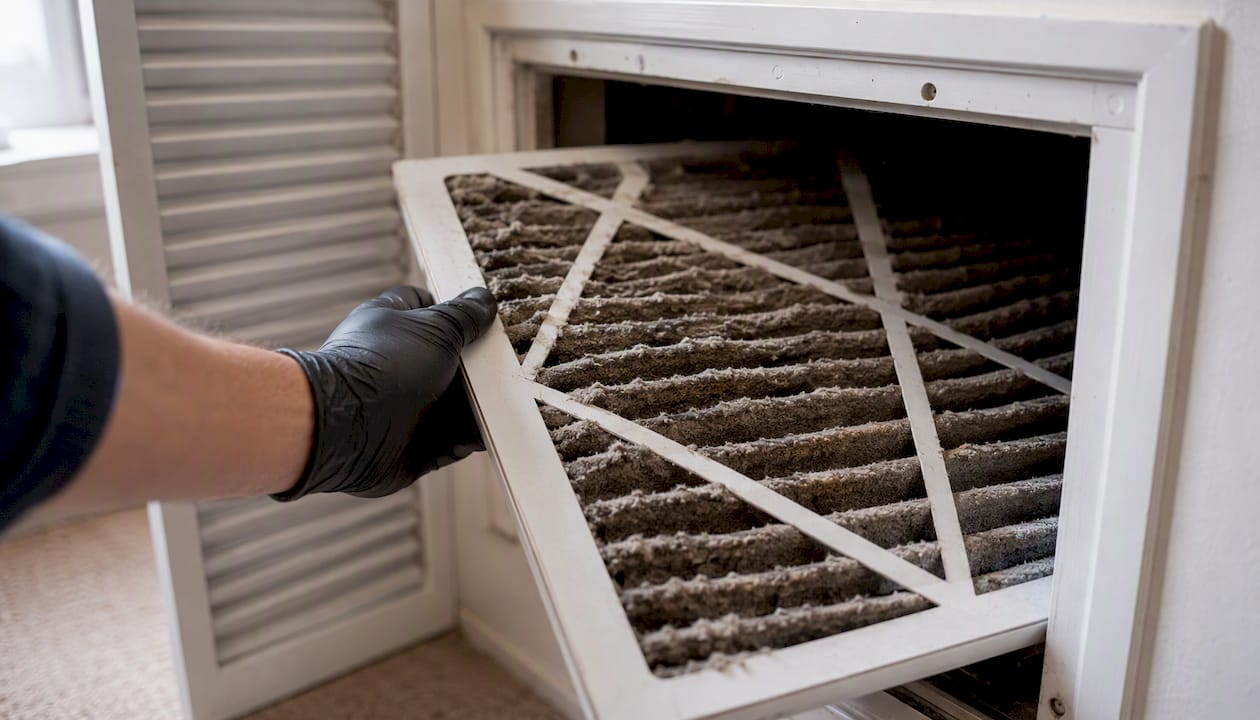
- Air filter: Pull the filter and hold it up to light. If you cannot see light through it, replace it. A choked filter starves the system of airflow and can freeze the evaporator coil within hours.
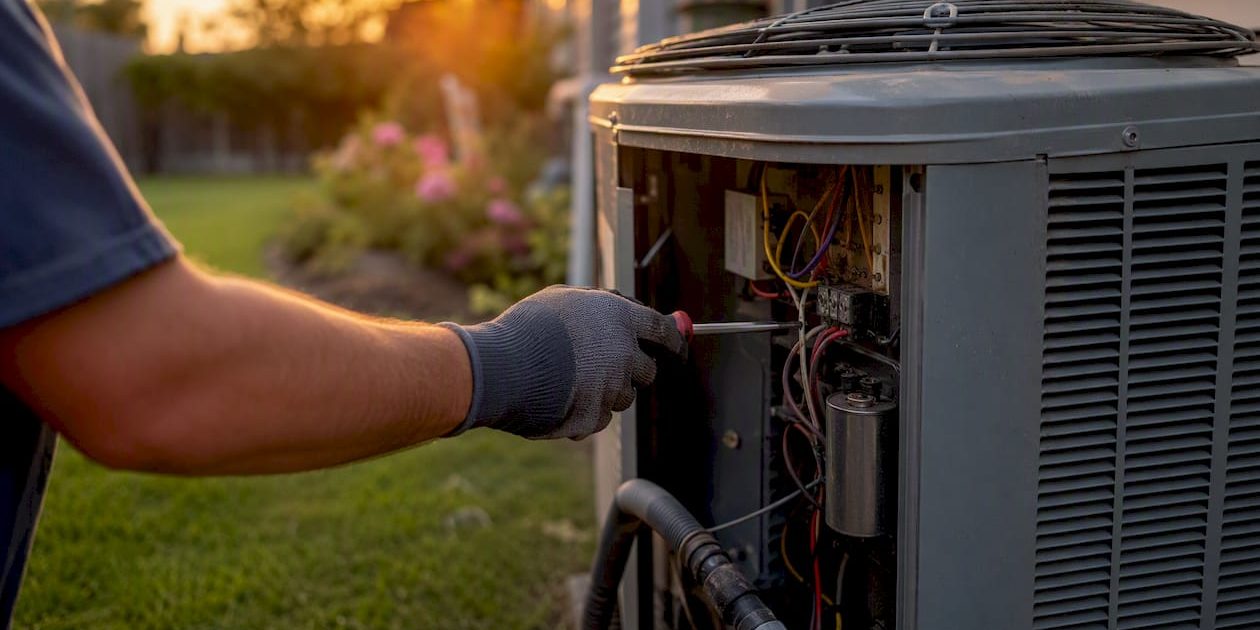
- Outdoor unit: Walk outside and confirm the unit is powered (listen for the fan and compressor). Clear any debris, mulch, or vegetation within 2–3 feet of the cabinet.
Safety warning: Stop running the system immediately if you see ice on the refrigerant lines or indoor coil, smell burning, or notice the breaker tripping repeatedly. Running a frozen system risks compressor damage, and a burning smell points to an electrical fault that needs a technician before the next startup.
If those three checks resolve the problem, you are done. If the unit is still running but blowing warm air, the sections below walk you through the next diagnostic steps and tell you exactly when to call a pro.
Table of Contents
- Why is my AC running but not blowing cold air?
- Step-by-step troubleshooting you can safely do at home
- What your symptoms are telling you
- When should you call an HVAC technician?
- How to prevent your AC from failing to cool in the first place
- Key Takeaways
- The thing most homeowners get wrong about a warm AC
- Trucomfortaz can diagnose and fix it for you
- Useful sources and further reading
Why is my AC running but not blowing cold air?
The causes split cleanly into three groups: airflow problems, heat-rejection problems, and sealed-circuit or electrical failures. Bryant’s troubleshooting guidance covers all of them: thermostat mis-settings, dirty filters, a blocked condenser, refrigerant leaks, frozen evaporator coils, and compressor or electrical faults. Knowing which group your symptoms fall into tells you whether to grab a screwdriver or pick up the phone.
Airflow problems
A dirty or clogged filter is the single most frequent cause. It restricts the air moving across the evaporator coil, which drops coil temperature until moisture freezes on the surface. Once the coil ices over, airflow collapses further and the system blows warm or barely cool air. Closed or blocked supply registers, a dirty evaporator coil, and duct leaks all produce the same effect: the equipment runs, but conditioned air never reaches the living space. Leaky ducts in a hot attic can dump a significant portion of cooled air before it ever reaches a vent.
Heat-rejection problems
The outdoor condenser unit has one job: dump the heat pulled from your home into the outside air. When the condenser coil is coated in dirt, cottonwood, or grass clippings, or when shrubs have grown within a foot of the cabinet, heat transfer stalls. The refrigerant returns to the indoor coil still warm, and cooling capacity drops noticeably. A failed condenser fan motor makes this worse: the coil overheats, high-pressure safeties trip, and the compressor shuts down.
Sealed refrigerant circuit issues
Low refrigerant is almost always the result of a leak, not normal consumption. Trane’s troubleshooting resource is direct on this: if you suspect refrigerant issues, do not attempt to handle it yourself. A licensed technician must locate the leak, repair it, and recharge the system. The two refrigerants you will encounter in U.S. residential systems are R-410A (the current standard in systems manufactured before 2025) and R-22 (phased out of production under EPA regulations; recharging an R-22 system is expensive and increasingly difficult because supply is limited). Compressor failure and a stuck expansion valve also live in this category and require professional diagnosis.
Frozen evaporator coils
Ice on the indoor coil or refrigerant lines is a symptom, not a root cause. Restricted airflow and low refrigerant are the two most common triggers. Either way, the fix starts the same: turn the compressor off and let the coil thaw before doing anything else.
Electrical and mechanical failures
A tripped breaker or a blown fuse at the outdoor disconnect is easy to miss. Beyond that, failed run capacitors are one of the most common field repairs during summer: the outdoor unit hums but the fan does not spin. A failed contactor, a seized compressor, or corroded wiring round out this category. None of these are DIY repairs.
Pro Tip: Map your symptom to a group before you start troubleshooting. Weak airflow everywhere points to the airflow group. Outdoor fan not spinning points to electrical. Ice on the lines points to airflow or refrigerant. That mapping cuts your diagnostic time in half.
Step-by-step troubleshooting you can safely do at home
About 40% of “AC not cooling” service calls are resolved by three homeowner checks: thermostat, breaker or outdoor disconnect, and a dirty air filter. Work through this list in order before calling anyone.
- Verify thermostat settings. Set mode to Cool, fan to Auto, and the setpoint 3–5°F below room temperature. Swap in fresh AA batteries while you are there. A low-battery thermostat can misread temperature or fail to send the cooling signal.
- Check the breaker panel and outdoor disconnect. Look for a tripped breaker (it sits between On and Off). Reset it once. If it trips again immediately, stop and call a technician. Also check the outdoor disconnect box mounted near the condenser; a blown fuse there cuts power to the outdoor unit only.
- Inspect and replace the air filter. Locate the filter at the return air grille or air handler. Hold it to light. Replace it if it is gray and opaque. Use a filter rated for standard residential systems, as filters with too high a rating can restrict airflow on some systems, which causes the same icing problem a dirty filter does.
- Inspect the outdoor condenser unit. Walk outside and look. Is the fan spinning? Do you hear the compressor running (a low hum or vibration)? Clear any leaves, mulch, or debris from the cabinet and the area around it. Do not spray water into the electrical compartment. Do not touch capacitors or wiring.
- Check all supply and return registers. Open every register in the house. A closed register in an unused room does not save energy; it raises system pressure and reduces airflow everywhere else. Make sure furniture, rugs, and curtains are not blocking returns.
- Look for ice. Check the refrigerant lines running into the indoor air handler and the coil itself if accessible. If you see frost or ice, set the thermostat to Off and the fan to On. Let it run in fan-only mode for 1–3 hours to thaw the coil. Running the compressor while the coil is frozen risks compressor damage, which turns a $150 repair into a $1,500 one.
- Controlled restart and temperature-split test. Once the coil is thawed (or if no ice was present), power the system off at the breaker, wait 5 minutes, restore power, and set the thermostat to Cool. After 15–20 minutes of runtime, hold a thermometer at a supply register and another at the nearest return grille. The difference is your temperature split.
Pro Tip: A typical temperature split across the system indicates proper cooling; lower splits can signal underperformance or issues requiring technician diagnosis, whether that is low refrigerant, a dirty coil, or a failing compressor. Write the number down before you call a tech.
What not to attempt: Refrigerant handling of any kind requires EPA Section 608 certification. Capacitor replacement involves stored electrical charge that can cause serious injury. Compressor internals are sealed and require specialized tools. These are not weekend projects.
What your symptoms are telling you
Symptoms map to subsystems fairly reliably. Use this table as a quick reference.
| Symptom | Likely subsystem | Immediate action |
|---|---|---|
| Warm air from all vents | Airflow or refrigerant | Check thermostat, filter, outdoor unit power |
| Weak airflow, all rooms | Airflow | Replace filter, open all registers, check for ice |
| Ice on lines or indoor coil | Airflow or refrigerant | Turn compressor off, run fan-only to thaw |
| Outdoor unit humming, fan not spinning | Electrical (capacitor) | Turn system off, call a technician |
| Outdoor unit completely silent | Electrical (breaker/disconnect/contactor) | Check breaker and outdoor disconnect; call tech if reset fails |
| Water pooling near air handler | Condensate drain clog | Check condensate drain line for blockage |
| High indoor humidity, poor cooling | Refrigerant or oversized system | Call technician for refrigerant pressure test |
| Short-cycling (turns on/off every few minutes) | Electrical, refrigerant, or airflow | Check filter and breaker; call tech if it continues |
A few of these deserve a closer look:
- Water pooling near the air handler usually means the condensate drain line is clogged. Algae and debris build up in the PVC drain over time. A clogged drain triggers a float switch that shuts the system down as a safety measure. You can attempt to clear it with a wet/dry vacuum at the drain outlet, but recurring clogs are a sign the line needs a proper flush.
- High humidity with marginal cooling often points to low refrigerant. The evaporator coil needs to be cold enough to condense moisture out of the air. When refrigerant charge is low, the coil runs warmer and humidity climbs even when the temperature drops slightly.
- Short-cycling has several causes. A system that keeps turning on and off can indicate a refrigerant issue, an oversized system, a dirty filter, or a failing electrical component. It stresses every part of the system and shortens equipment life.
When should you call an HVAC technician?
Some problems are genuinely beyond safe DIY scope. Call a licensed technician if you encounter any of these:
- Ice returns after a full thaw and filter replacement
- The outdoor unit hums but the fan does not spin (likely capacitor)
- The compressor does not start after a controlled restart
- You smell burning from the air handler or outdoor unit
- The breaker trips more than once
- You suspect a refrigerant leak (oily residue near fittings, hissing sound, or a system that has lost charge before)
- Water is pooling heavily near the air handler and drain clearing does not resolve it
What a technician will check
A qualified tech will test capacitors and contactors, measure compressor amperage, perform a refrigerant pressure test, inspect coil condition, and measure airflow. For refrigerant work specifically, the technician must hold an EPA Section 608 certification. Ask for a NATE-certified technician (North American Technician Excellence): NATE certification is the industry’s primary competency standard for residential HVAC and signals the tech has passed independent testing, not just manufacturer training.
Realistic cost ranges
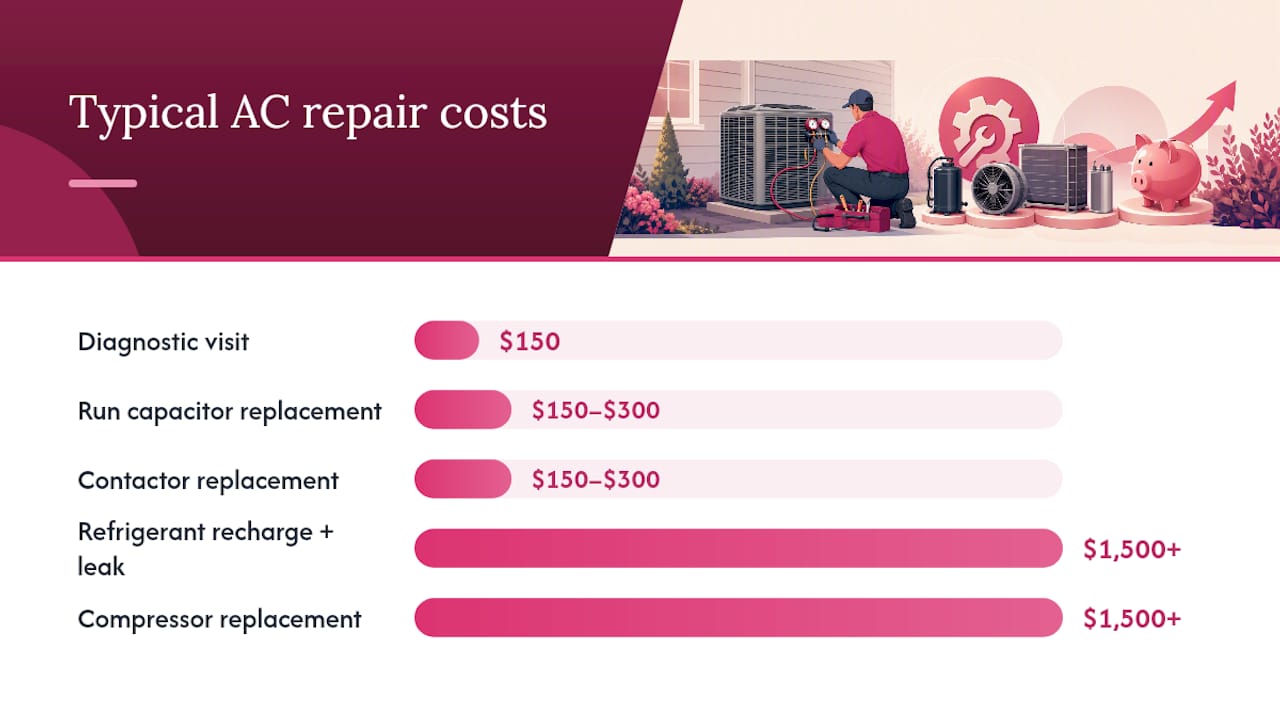
These are ballpark figures based on typical U.S. residential service pricing. Actual costs vary by region, system age, and refrigerant type.
| Repair | Typical cost range | Notes |
|---|---|---|
| Diagnostic visit | $150 | Often applied toward repair cost |
| Run capacitor replacement | $150–$300 | Common same-day repair |
| Refrigerant recharge + leak repair | $1,500+ | Depends on leak location and refrigerant type; R-22 systems cost significantly more |
| Contactor replacement | $150–$300 | Often done alongside capacitor |
| Compressor replacement | $1,500+ | At this cost, weigh repair vs. replacement carefully |
Before the tech arrives, write down the model and serial number from the unit’s data plate, note the symptoms you observed, and list the DIY checks you already ran. That information cuts diagnostic time and helps the tech arrive with the right parts.
How to prevent your AC from failing to cool in the first place
Most cooling failures are preventable. A short, consistent maintenance routine handles the majority of them.
- Replace the filter on schedule. Every 1–3 months for standard 1-inch filters; every 6–12 months for 4–5-inch media filters. Homes with pets or dusty conditions need the shorter interval. Regular filter changes and annual tune-ups prevent many of the failure modes that lead to an AC not cooling.
- Schedule an annual professional tune-up. A full tune-up covers coil cleaning, refrigerant pressure check, electrical inspection, capacitor testing, and condensate drain flush. Spring, before the cooling season, is the right time in most U.S. climates. If you want to know how often to schedule professional maintenance, the short answer is once a year minimum for most residential systems.
- Keep the outdoor unit clear. Maintain 2–3 feet of clearance on all sides. Trim shrubs seasonally. After a monsoon or windstorm, check for debris inside the cabinet (with the power off).
- Check your ducts where accessible. Look in the attic or crawlspace for disconnected duct sections, obvious tears in flex duct, or sections with no insulation. A disconnected run dumps conditioned air directly into unconditioned space.
- Watch for early warning signs like longer-than-usual runtimes, rooms that never reach setpoint, or a sudden spike in your electric bill. These often appear weeks before a full failure.
- Consider a maintenance plan. Priority scheduling, reduced diagnostic fees, and a technician who knows your system’s history add up to lower lifetime costs and fewer emergency calls on the hottest day of the year.
Key Takeaways
Most AC cooling failures trace back to a handful of fixable causes, and catching them early keeps a simple filter swap from becoming a compressor replacement.
| Point | Details |
|---|---|
| Start with three checks: thermostat setting, air filter condition, and outdoor unit power can resolve many no-cooling calls. | |
| Stop the system if you see ice | Turn the compressor off and run fan-only to thaw; running a frozen coil risks compressor damage. |
| Know your temperature split | A 15–20°F supply-to-return split is normal; under 10°F signals a significant problem requiring a technician. |
| Call a pro for refrigerant and electrical | Refrigerant handling requires EPA Section 608 certification; capacitor work carries serious shock risk. |
| Trucomfortaz for local diagnosis | Trucomfortaz’s NATE-certified technicians in New River, AZ handle diagnostics, refrigerant repair, and maintenance plans. |
The thing most homeowners get wrong about a warm AC
Here is what I see consistently: homeowners run a struggling system for days, hoping it will “catch up,” before calling anyone. By the time the tech arrives, a frozen coil has thawed and refrozen twice, the compressor has been working against restricted airflow for 72 hours, and what started as a $200 filter-and-coil-clean job has become a $900 refrigerant recharge with a damaged compressor valve.
The single most protective thing you can do is act on the first sign something is off. A system that runs longer than usual to hit setpoint, a room that used to cool easily but now stays warm, a utility bill that jumps without explanation: these are not quirks to wait out. They are early-stage failure signals.
The other thing worth saying plainly: the DIY checklist in this article is real and genuinely fixes a large share of problems. But there is a category of homeowner who reads a troubleshooting guide, decides the problem is “probably refrigerant,” and buys a refrigerant top-off kit online. Do not do this. Low refrigerant almost always means a leak. Adding refrigerant without finding and fixing the leak means you will be low again in a few months, and you will have introduced refrigerant into the atmosphere without the recovery equipment required by federal law. The fix is a leak repair, not a top-off.
One more thing: if your system is more than 15 years old and the compressor is failing, the math on repair versus replacement usually favors replacement. A new system running R-410A (or the newer R-454B that manufacturers are transitioning to) will be substantially more efficient than a 15-year-old unit limping along. That efficiency difference shows up on your electric bill every month.
Trucomfortaz can diagnose and fix it for you
When the DIY checklist does not solve the problem, or when you would rather have a certified technician handle it from the start, Trucomfortaz is the local option for homeowners in New River, AZ and the surrounding area.

Trucomfortaz’s NATE-certified technicians handle the full range of AC repair work: refrigerant leak detection and recharge, capacitor and contactor replacement, compressor diagnosis, condensate drain service, and full system diagnostics. Every estimate is transparent, and because technicians are not on commission, the recommendation you get is based on what your system actually needs, not what generates the highest ticket. Emergency availability means you are not waiting three days for a callback during a heat wave.
The annual maintenance plan covers filter replacement reminders, coil cleaning, electrical inspection, and priority scheduling, which typically costs less over time than a single emergency diagnostic call. To book a diagnostic visit or ask about maintenance plan pricing, contact Trucomfortaz directly at trucomfortaz.com.
Useful sources and further reading
- Why Is My AC Not Blowing Cold Air? | Carrier
- AC not blowing cold air | Bryant
- Air Conditioner Troubleshooting: Why Your AC Is Not Cooling | Trane
- AC Not Cooling Las Vegas? 8-Step Troubleshooting Guide (2026) | The Cooling Company
- AC Running But Not Cooling? – Paschal Air, Plumbing & Electric
- How Often Should You Do Regular Maintenance On Your House AC Unit? | Tru Comfort
- AC Running but Not Cooling? What to Know First | Budget Heating
Recommended
- Why Is My Furnace Blowing Cold Air? | 6 Reasons Why | Tru Comfort
- Ten Signs Your Home AC Unit May Need Maintenance | Tru Comfort
- Why Does My Air Conditioner Keep Turning On and Off in New River, AZ?
- Why One Room Is Hotter Than the Rest in New River – Tru ComfortWhy One Room Is Hotter Than the Rest in New River