

HVAC Warranties Explained: Coverage, Terms and Claims

An HVAC warranty is a written promise to fix or replace specific parts if they fail within a set period. Most systems carry two separate promises: a manufacturer’s warranty on parts, and a contractor’s warranty on installation labor. The manufacturer’s coverage usually looks generous on the brochure, but it often depends on registering the equipment on time, and it rarely pays for the technician’s hours. Read both documents before you need them.
TL;DR
- The manufacturer’s warranty covers defective parts. Labor to diagnose and swap the part is usually a separate matter.
- Some brands give a longer parts term only if you register within a window. Trane, for example, defaults to five years on parts and typically 10 if you register within 60 days of installation.
- Warranty terms differ by brand, model and install date, so the paperwork for your own unit is the final word.
- Keep your registration confirmation, installation invoice and service records in one folder. They make any claim faster.
- An extended warranty or a maintenance plan can fill the gaps. Compare what each one covers, excludes and requires.
Table of Contents
- The two warranties on every HVAC system
- What an HVAC warranty covers
- How long an HVAC system stays under warranty
- Registration: the step that decides your coverage length
- Parts warranty vs. labor warranty
- What can void or reduce an HVAC warranty
- How to check your coverage and file a claim
- Extended warranties: what they add and what to compare
- Perspective
- Keeping your warranty in good standing with maintenance
- Questions to ask before you sign for a new system
- Warranty help from Tru Comfort
- FAQ
- Sources
The two warranties on every HVAC system
When a new air conditioner or furnace goes in, two different parties are making promises.
The manufacturer promises that the equipment is free from defects in materials or workmanship. ConsumerAffairs describes manufacturer warranties as focused on those defects, which is different from a home warranty plan that covers repair or replacement of home systems because of normal wear and tear.
The installing contractor promises that the work was done correctly: the refrigerant lines, the electrical connections, the drain, the ductwork connections, the thermostat wiring. This is the labor or workmanship warranty. Its length is set by the contractor, not the brand, and it can be shorter or longer than you expect, so get it in writing.
The distinction matters because most failures show up as a bill with two lines on it: the part and the time to install it. A manufacturer’s warranty can wipe out the first line and leave the second one with you.
What an HVAC warranty covers
Coverage is spelled out component by component in the warranty document. In general, expect the following.
| Item | Usually covered by the manufacturer? | Notes |
|---|---|---|
| Compressor | Yes, often the longest term | Check whether the term differs from other parts |
| Heat exchanger (furnace) | Yes, often a long term | Terms are model-specific |
| Coils, motors, control boards | Yes, for the parts term | Replacement part only |
| Labor to diagnose and install the part | Usually no | Often a contractor warranty or plan item |
| Refrigerant | Varies by document | Read the exact wording |
| Filters, belts, routine upkeep | No | Normal maintenance items |
| Ductwork | Typically not part of the equipment warranty | Duct work has its own workmanship terms |
The table is a general pattern, not a promise about your unit. The warranty booklet for the model number on your data plate is the only version that counts.
Liability limits and what is excluded
Manufacturer warranties also cap what the company owes you. Trane’s base limited warranty, for products made on or after March 1, 2024, limits liability to the original purchase price of the product and typically excludes consequential or indirect damages, subject to state law. In plain terms: if a covered part fails and causes a mess, the warranty is about the equipment, not the carpet, the food in the freezer or the hotel room you rent during a heat wave.
That is also where homeowners insurance comes in for some events. If you are wondering what falls outside a warranty and might fall under your policy, our guides on whether homeowners insurance covers AC and whether home insurance covers a heating system walk through the typical situations.
How long an HVAC system stays under warranty
There is no single answer, because every manufacturer sets its own terms. What you will see most often:
- A base parts term that applies automatically. For Trane, parts warranties generally last five years by default.
- An extended parts term that applies if you register on time. The same Trane page says that is typically 10 years when you register within 60 days of installation.
- A labor term from the installer, which is separate and set by the contractor.
Other brands run on similar logic with different numbers. Look up the exact terms for your brand and model rather than assuming the 10-year figure in an ad applies to you.
Registration: the step that decides your coverage length
Registration is the most common way homeowners lose coverage without knowing it. If the longer term depends on registering, missing the window can mean you get the shorter default.
What you generally need on hand, based on Trane’s registration instructions:
- Your name, address and phone number
- The dealer’s name
- The serial number of each product (indoor and outdoor units have their own)
- The installation date
Take photos of the data plates right after installation, while the technician is there and the units are accessible. Many people only look for serial numbers years later, after the sticker has faded behind a bush or a coil.
Other manufacturers work the same way. Carrier, for instance, provides online tools to register equipment and to look up coverage by serial number. After registering, save the confirmation email or a PDF of the page.
A practical habit: ask your installer who is registering the equipment, and when. Some contractors do it for you, and some leave it to the homeowner. Either way, confirm that it was done and keep the proof.
Parts warranty vs. labor warranty
This is the part that surprises people during a repair visit.
Parts warranty. If a covered component fails, the manufacturer supplies the replacement part at no charge. The contractor typically orders it through a parts supplier and the claim is submitted through that channel.
Labor warranty. This covers the time and skill to diagnose, remove the failed part and install the new one. Without a labor warranty, a service plan or an extended labor option, that portion of the bill is yours.
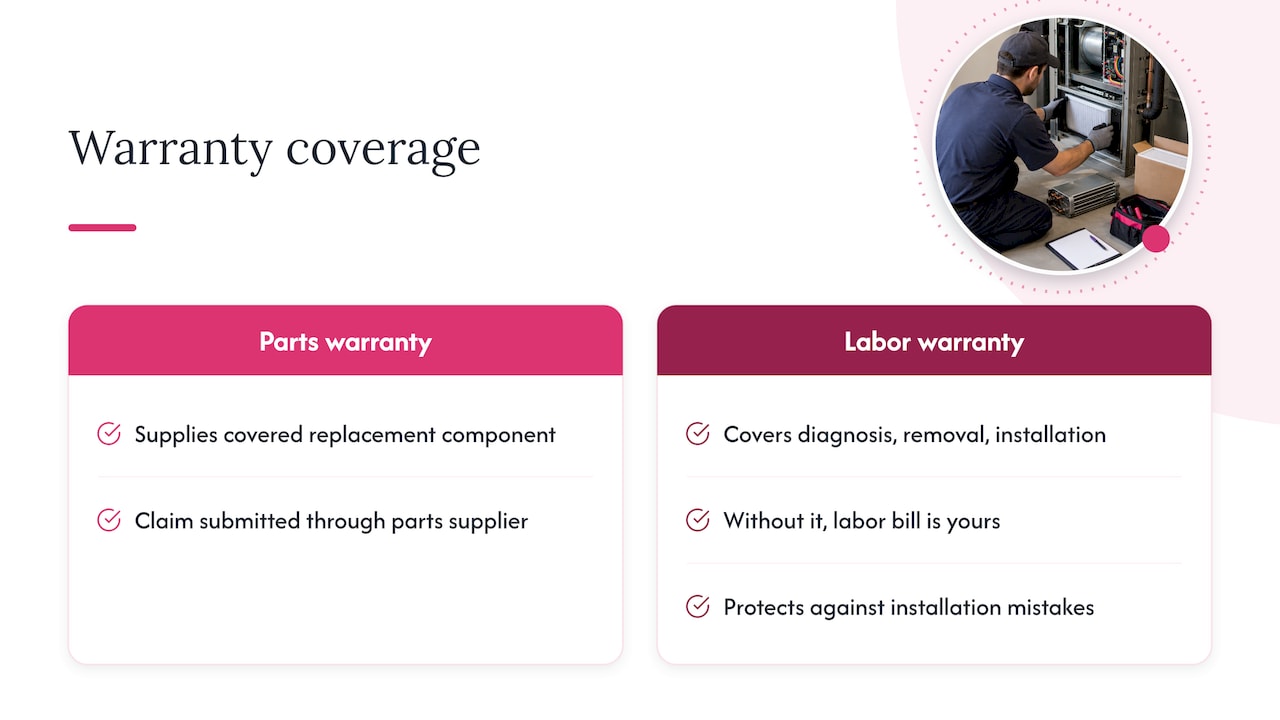
The labor side also protects you against installation mistakes, which are a different category from defective parts. A system that was sized incorrectly or set up poorly can have problems that no part warranty touches. That is why we push homeowners to ask what the workmanship warranty covers and for how long before approving a job. The same principle applies to any home project where a contractor does the work; this homeowner’s guide to remodel warranties shows the questions worth asking about labor coverage.
A longer labor warranty also signals something about the contractor’s confidence in its own work. One warranty-industry blog for contractors notes that a 10-year labor warranty signals confidence in installation quality.
For a deeper look at what a proper installation includes, see our page on what to approve before AC work begins, covering load calculation, equipment matching and the final test-out.
What can void or reduce an HVAC warranty
Warranty documents commonly list conditions that can limit or cancel coverage. The wording varies, so use this as a checklist of what to look for in your own paperwork:
- Missed registration. The longer term may not apply.
- Installation by an unqualified installer. Many documents require installation by a licensed professional according to the manufacturer’s instructions.
- Non-approved replacement parts. Some documents require genuine or approved parts.
- Neglected maintenance. Some warranties require documented upkeep. Dirty coils, clogged drains and filters ignored for months are the kinds of conditions that can lead to a denied claim.
- Moving the unit or using it outside its intended application. For example, relocating a system or using residential equipment in a commercial setting.
- Missing or altered serial numbers. If the data plate cannot be read, proving coverage gets harder.
- Missing the filing deadline. Trane’s base warranty, for example, requires actions to be brought within one year after the cause of action arises.
None of these is complicated to avoid. Most come down to registering, using a licensed installer and keeping records.
In Arizona, the maintenance question is practical, not theoretical. Air conditioners here run hard for much of the year, so filters, coils and drains collect dust fast. Our HVAC maintenance schedule and AC maintenance checklist outline what a homeowner can do between professional visits.
How to check your coverage and file a claim
When something fails, work through these steps in order.
- Find your paperwork. You need the model and serial numbers, the installation date and your registration confirmation.
- Look up the terms. Manufacturers like Carrier let you look up coverage by serial number. Otherwise, use the warranty booklet.
- Call a qualified HVAC company. With Trane, the process is that you contact your local dealer, who diagnoses the issue, contacts a parts supplier if a replacement part is needed and submits the claim through the supplier.
- Ask what is covered and what is not before work starts. Get the part status and the labor charge explained in writing.
- Act quickly. Filing deadlines exist, and a small problem left running can become a bigger one that is harder to tie to a covered defect.
If your system is down in summer heat or winter cold, do not wait on paperwork to get a diagnosis. The diagnosis itself tells you what is covered.
Extended warranties: what they add and what to compare
An extended warranty is optional. According to ConsumerAffairs, it can add five to 10 years of coverage, usually after the manufacturer warranty ends, covering major components and sometimes labor. These plans can be bought from manufacturers or third parties and start once the base warranty expires.
Before you buy one, compare:
- Coverage limits: which components, and is there a cap per claim or in total?
- Exclusions: what is not included?
- Maintenance requirements: do you need to document annual service?
- Fees: is there a service-call fee or deductible for each visit?
- Claim process: who do you call, and can you choose your own technician?
- Labor: is it included, partly included or excluded?
The Federal Trade Commission’s guidance on federal warranty law says warranty terms should be clear, easy to read and available to consumers before purchase. That is a useful standard for yourself as well: if you cannot understand what a plan covers from its written terms, ask for a plain explanation before signing.
Perspective
Most warranty confusion comes from one assumption: that “10-year warranty” means a 10-year free repair. In practice, it usually means a 10-year promise on certain parts, with conditions. The labor, the registration and the upkeep are where homeowners get surprised.
Our technicians are NATE-certified and non-commissioned, so what we recommend is based on what your system needs and not on a sales target. When a part fails, we want you to know up front what the manufacturer will cover and what the visit will cost.
Our view is simple: the best warranty is a system that is installed properly and maintained on a schedule. That is why we built the Tru Comfort Advantage maintenance plans, which are designed to bring annual service, cost savings and some peace of mind together for homeowners and property managers.
Brett
Keeping your warranty in good standing with maintenance
Maintenance is the habit that helps you stay on the right side of the warranty fine print and catch issues early. A sensible routine includes:
- Changing filters on a regular schedule
- Keeping the outdoor unit clear of debris and plants. Our condenser clearance guide explains how much space to leave
- Having a professional inspect the system at least once a year, and keeping the invoice
- Saving every service record in the same folder as your registration
If you are weighing whether a plan is worth it, our honest look at HVAC maintenance plans for Arizona homeowners covers what to consider. Our Tru Comfort Advantage plan is the option we offer.
When a system is old enough that the warranty is long gone and repairs are stacking up, the question changes from coverage to timing. Our guide on when to replace heating and air conditioning helps you decide.
Questions to ask before you sign for a new system
A warranty is easiest to understand at the point of sale. Ask for these items in writing:
- How long is the manufacturer’s parts warranty, and what is the registration window?
- Who registers the equipment, and will I get the confirmation?
- How long is the installation labor warranty, and what does it include?
- Which parts does the labor warranty cover, and are there service fees?
- What maintenance do I need to document?
- If the installer is unavailable later, who can handle a warranty repair?
If the answers are clear and in writing, you have the foundation for an easy claim later.
Warranty help from Tru Comfort
If you are in New River or the surrounding area and want a second set of eyes on a system, an installation quote or a repair, we can help. We handle air conditioner installation, repair and maintenance and furnace installation and maintenance, and we offer emergency HVAC service when a system fails at the worst time.

Our Tru Comfort Advantage maintenance plans keep your system serviced on a schedule, which supports both performance and your records. To talk to a family-owned team of NATE-certified technicians, start at trucomfortaz.com.
FAQ
Does an HVAC warranty cover labor?
Usually the manufacturer’s warranty covers parts only. Labor is generally covered by a contractor’s workmanship warranty, a service plan or an extended warranty that includes labor. Read the documents for your unit to see which applies.
How long is an HVAC system under warranty?
It depends on the brand and model. For Trane, parts are covered five years by default and typically 10 years if registered within 60 days of installation. Labor coverage is set by the installer.
What can void an HVAC warranty?
Common triggers in warranty documents include missed registration, installation by an unqualified person, unapproved parts, missing maintenance records and unreadable serial numbers. Check the exact conditions in your own warranty booklet.
Is an extended HVAC warranty worth it?
It can be, depending on your system’s age, the cost of major components and what the plan includes. Compare coverage limits, exclusions, fees, maintenance requirements and the claim process before you decide.
Sources
- Trane: HVAC Warranty Types, Terms, and What’s Covered
- Trane: Base Limited Warranty
- Carrier: Home HVAC Warranty Registration and Coverage
- ConsumerAffairs: HVAC Warranties, Coverage and Cost
- FTC: Businessperson’s Guide to Federal Warranty Law
- Decoding HVAC and Plumbing Warranties for Contractors