Keep 5–10 ft Clearance: Shade Your House Before Shading the AC Unit
Yes, direct sun raises the air the condenser breathes, which lowers capacity on peak days. The fix is not wrapping the unit in a box. Prioritize shading building surfaces first, then confirm the condenser keeps its manufacturer-specified clearance before adding any local shade. If cooling gets weaker or run-times climb after you shade it, call a technician.
TL;DR:
- Shading the condenser from direct sun helps improve performance but must not obstruct manufacturer-specified clearances or airflow to prevent efficiency loss.
- Proper building shading, especially shading windows and walls, delivers larger energy savings than only shading the condenser, emphasizing the importance of overall home efficiency.
- The effectiveness of shading depends on correct installation, equipment condition, and maintenance; shading a neglected or undersized system provides limited benefits.
- Seasonal adjustments to shading strategies are necessary, focusing on west and south-facing surfaces in summer and liberal use of deciduous trees for multi-season benefits.
- Reflective coatings should be applied to nearby surfaces rather than directly on condenser cabinets to avoid trapping heat and restricting airflow.
Table of Contents
- How outdoor temperature and solar radiation change condenser performance
- Practical shading options: trees, trellises, sails, and reflective treatments
- Placement and clearance: manufacturer guidelines and airflow safety
- Energy impact and evidence: what research shows about savings
- DIY do’s and don’ts when shading a condenser
- Maintenance and monitoring to keep shading benefits
- Effects of UV radiation on AC unit materials and protective coatings
- Guidance on using reflective coatings or films on AC units to reduce heat absorption
- Considerations for integrating AC unit sun exposure mitigation with overall home energy efficiency strategies
- Seasonal variations in sun exposure impact and corresponding adjustment recommendations
- Technician perspective: how pros evaluate sun-related problems on site
- Tru Comfort services: safe shading assessments, maintenance plans, and booking a diagnostic
- FAQ
- Sources
How outdoor temperature and solar radiation change condenser performance
Your condenser is designed to dump heat from inside the house into the outdoor air. When that outdoor air is hotter, because the unit sits in direct sun or next to a sun-baked wall, the condenser has to work harder to move the same amount of heat, and its usable capacity drops. Manufacturer performance data used in Manual S equipment sizing shows this clearly: as outdoor air temperature at the condenser rises, both total and sensible cooling capacity fall. That is why designers use the same outdoor design temperature for load calculations and equipment selection, since a unit sized for a mild climate day will underperform once the mercury climbs.
Sensible capacity (the part that actually lowers the temperature you feel) tends to decline faster than latent capacity (the part that removes humidity) as outdoor temperatures climb. On a hot, dry day, that means your house may struggle to reach its set temperature even though the air feels dry. On a hot, humid day, the system may hold temperature but leave the air feeling damp because it is spending more of its reduced capacity pulling out moisture.
Shading the condenser helps keep intake air a bit cooler, but it is not a substitute for correct sizing, adequate airflow, or a full refrigerant charge. A fault-detection protocol for residential air conditioners found that efficiency depends on outdoor temperature alongside airflow, refrigerant charge, and coil cleanliness, and that problems in those areas can erase any gain from shade. If your system was undersized or already has a dirty coil, shading will not fix the underlying issue.
Practical shading options: trees, trellises, sails, and reflective treatments
Several shading approaches work, and they are not interchangeable. Each fits a different timeline, budget, and yard.
- Deciduous shade trees cast the most cooling shade in summer and drop their leaves to let winter sun through, but they take years to mature and need planning around root growth.
- Trellises with climbing vines give you flexible, removable coverage that can be adjusted or taken down for service access.
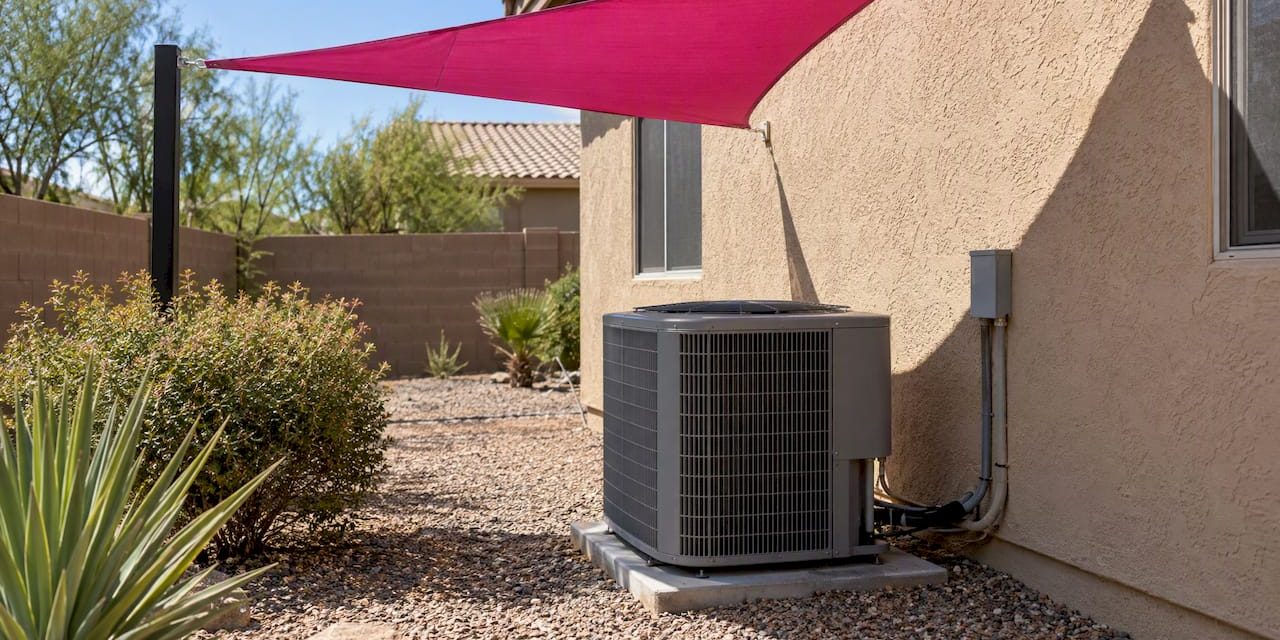
- Freestanding shade sails or lattice panels install quickly and work well for homes that cannot wait years for a tree canopy to fill in.
- Reflective screens and light-colored paving or siding nearby cut the radiant heat bouncing onto the unit, even without blocking direct sun.
Placement matters as much as the method. EPA guidance on trees and vegetation recommends planting trees at least 5 to 10 feet from the building and keeping canopies high enough that they do not crowd service clearances or choke airflow around equipment. Shade transmission varies by species and canopy density, so a loosely spaced lattice or young tree will pass more heat through than a mature, dense canopy.
The bigger payoff, though, usually is not the condenser itself. The same EPA guidance notes that shading windows, walls, and roofs typically delivers larger whole-system energy savings than shading a single outdoor unit, because it cuts the cooling load the whole house has to fight rather than just tweaking the air the condenser inhales.
Pro Tip: Start your shading plan with the west-facing wall and windows that take the worst afternoon sun. Shade the condenser last, and only after you have confirmed it still has full clearance.
Placement and clearance: manufacturer guidelines and airflow safety
Condensers need open space on every side to pull in air, and open space above to exhaust it. Clearances exist so the unit is not recirculating its own hot exhaust back into the intake, which happens fast once shrubs, fences, or a shade box crowd the sides. Exact minimums vary by model, so check the nameplate or owner’s manual for your unit rather than guessing. Our guide to AC condenser clearance covers the typical side, top, and service-access distances manufacturers specify.
Restricted airflow is a worse problem than sun exposure on its own. When intake or exhaust is blocked, head pressure climbs, capacity drops further than heat alone would cause, and the compressor runs under more stress than it was built for. Over time that stress shortens compressor life and can void a warranty.
Before finalizing any shade project, confirm:
- The shade structure sits outside the manufacturer’s minimum side and top clearances.
- Nothing touches or leans against the unit’s cabinet.
- A technician can still access all service panels without moving the shade structure.
- Exhaust air from the top of the unit has a clear, unobstructed path upward.
Energy impact and evidence: what research shows about savings
Building-scale shading, not condenser shading alone, drives the largest cooling-energy reductions, according to EPA research on trees and vegetation. Shading windows and walls, and raising roof albedo, tends to cut whole-house cooling energy by more than shading the outdoor unit by itself.
That does not mean condenser shading is worthless. It just has a smaller ceiling, and the actual savings you see depend heavily on your climate, the condition of your equipment, and how well the shading is installed. A unit with a dirty coil or low refrigerant charge will not show much improvement from shade, because the bigger losses are happening elsewhere in the system. DOE’s Home Cooling 101 frames shading as one piece of a broader cooling strategy that also includes window treatments, ventilation, and routine maintenance, not a standalone fix.
The practical takeaway: pair any shading project with proper maintenance and correct equipment sizing. Shade an undersized or neglected system and you will still run it hard all summer.
DIY do’s and don’ts when shading a condenser
A shading project can help or hurt, depending on how it is built.
- Do keep full manufacturer clearances on all sides and above the unit.
- Do use breathable trellis designs or spaced lattice rather than solid panels.
- Do choose deciduous plantings where you want summer shade but still want winter sun reaching nearby windows.
- Don’t build a solid-sided box around the unit or press shrubs against the cabinet.
- Don’t attach anything to the unit itself, and never block the panels a technician needs to open for service.
After installing any shade, run a few quick checks: note whether run times get noticeably longer, feel whether the supply air temperature drop across the system seems weaker than before, and confirm exhaust air is still moving freely off the top of the unit. If cooling gets worse instead of better, call a technician before the problem compounds.
Maintenance and monitoring to keep shading benefits
Shade only pays off if the system behind it is healthy. Routine coil and fin cleaning, regular filter changes, periodic refrigerant checks, and an annual tune-up keep the unit running at the capacity it was built for. Our AC maintenance checklist walks through these tasks in order.
Watch for warning signs that something is off: longer run times, indoor temperatures that will not hold, unusual noises from the condenser, or electric bills that creep up without an obvious cause. Any of these after a shading project is a signal to have someone look at airflow and clearance, not just the shade structure.
Seasonal upkeep matters too. Prune trees before they crowd the unit, clear fallen leaves and debris from around the base, and remove any temporary cover structures before the heaviest cooling months so nothing restricts airflow when the system needs it most.
Effects of UV radiation on AC unit materials and protective coatings
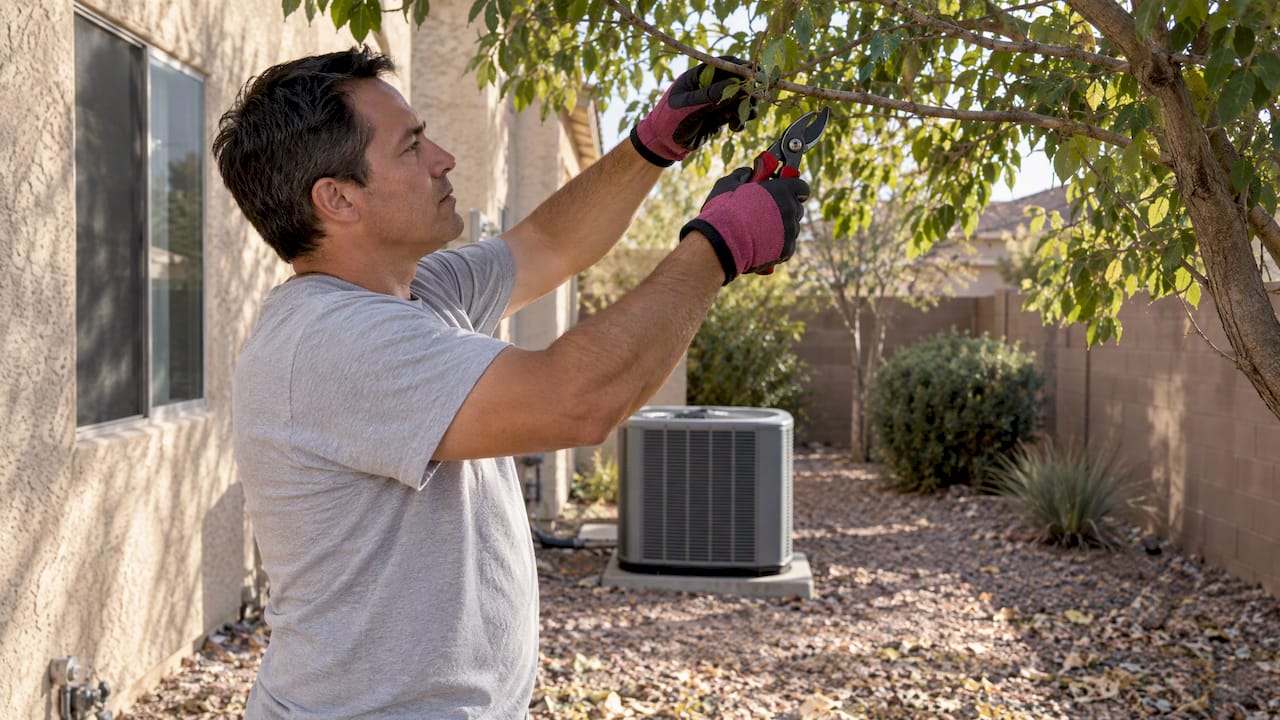
Years of direct sun exposure take a toll on the materials in an outdoor condenser, even though the core mechanical parts sit inside a metal cabinet. UV exposure tends to degrade plastics, rubber gaskets, and wire insulation over time, making them brittle and more prone to cracking. Painted or powder-coated cabinet surfaces can fade or chalk, which is mostly cosmetic, but a compromised gasket or seal around electrical connections is not.
Manufacturers generally build outdoor units to handle years of weather exposure, so UV damage is usually a slow, cumulative process rather than a sudden failure. Still, a unit that bakes in full sun all day, every day, for years tends to show wear on exposed seals and wiring insulation sooner than a shaded one. That is one more reason building-scale shading, which lowers ambient temperature around the unit generally, can extend the working life of the smaller components even if it does not dramatically change cooling capacity.
Routine maintenance visits are the practical way to catch this kind of wear before it causes a failure. A technician checking coil condition and electrical connections during a tune-up will typically spot a cracked gasket or brittle wire insulation well before it causes a service call.
Guidance on using reflective coatings or films on AC units to reduce heat absorption
Reflective coatings and films are sometimes marketed as a way to cut heat absorption on outdoor equipment, but they need to be approached carefully. Any coating applied directly to a condenser cabinet should never block the fins, vents, or airflow paths the unit depends on to breathe. A coating applied over intake louvers or exhaust grilles can trap heat rather than reduce it, undoing any benefit and potentially restricting airflow enough to stress the compressor.
If you are considering a reflective treatment, it belongs on the surfaces around the unit, such as a reflective privacy screen a few feet away or a light-colored fence panel, rather than directly on the cabinet itself. This gets you some of the radiant-heat reduction without touching ventilation surfaces or voiding any coating warranties the manufacturer may have on the cabinet finish.
Before applying anything to the unit itself, check with a professional. A technician can tell you whether a specific product is compatible with your equipment or whether that effort is better spent on building-scale shading, which the EPA’s research on vegetation and shading consistently shows delivers the bigger energy return anyway.
Considerations for integrating AC unit sun exposure mitigation with overall home energy efficiency strategies
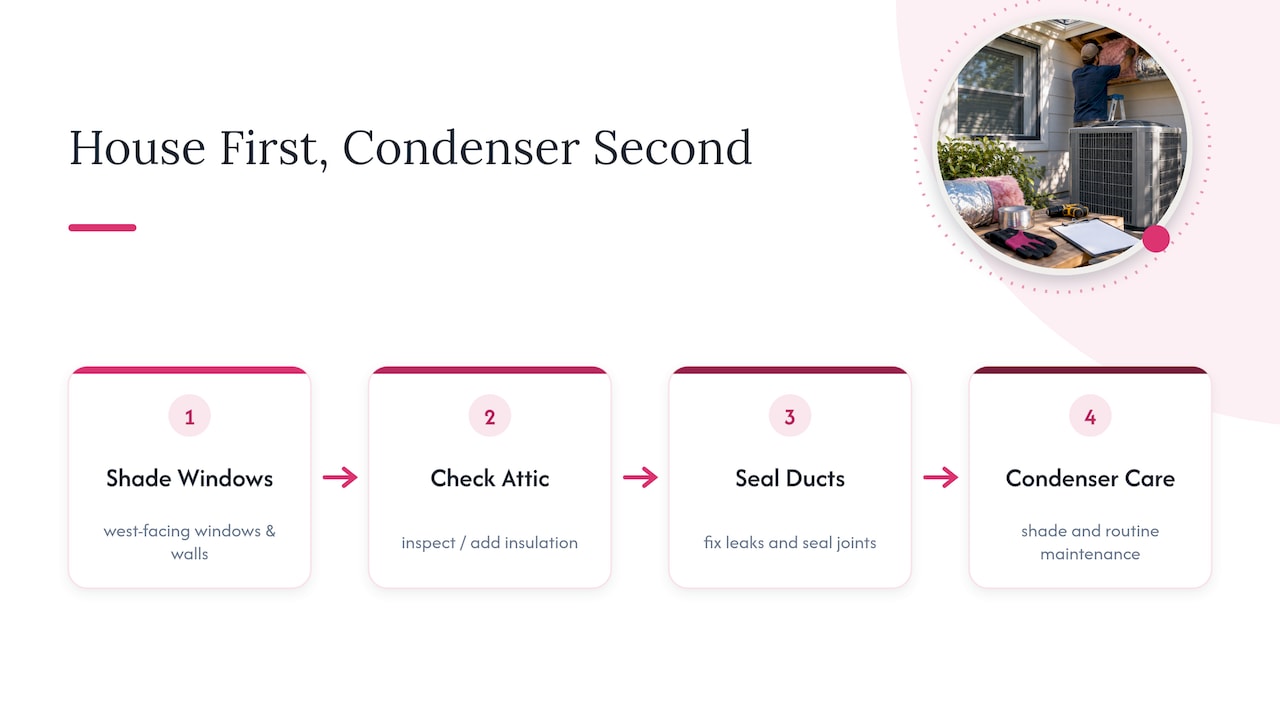
Shading the condenser is a small piece of a larger efficiency picture. The biggest cooling-load reductions typically come from the building envelope: shaded windows, insulated walls, a reflective or well-ventilated roof, and sealed ductwork. If you are planning any of these improvements, sequence condenser shading alongside them rather than treating it as a separate project.
A useful way to think about it: tackle the load your house generates before fine-tuning the equipment that handles it. Shade the west-facing windows and walls, check attic insulation, and seal duct leaks first. Once the house itself is asking less of the system, condenser shading and routine maintenance squeeze out the remaining gains.
This also matters for rooftop units, which many homes in hot climates use for reasons our guide on rooftop AC placement explains. A rooftop unit cannot be shaded by a tree or trellis the way a ground-level condenser can, so for those systems, reducing the roof’s own heat gain through reflective roofing or added insulation does more good than any shade structure could.
Seasonal variations in sun exposure impact and corresponding adjustment recommendations
Sun exposure is not a fixed problem. It shifts with the seasons, and your shading strategy should shift with it. In summer, when the sun angle is high and afternoon heat peaks, maximum shade coverage on west and south-facing surfaces matters most, and that is when a dense canopy or shade sail earns its keep.
In spring and fall, lower sun angles change which surfaces take the worst exposure, often shifting more heat onto east and west walls earlier or later in the day than in midsummer. This is a good time to prune trees and inspect shade structures before the next heavy-use season arrives.
Winter brings the opposite consideration: too much shade can block welcome solar heat gain on south-facing walls and windows in colder climates. That is exactly why deciduous trees are often recommended over evergreens near a home’s sunny side. They shade the condenser and walls in summer, then drop their leaves and let the sun back in once heating season starts.
Technician perspective: how pros evaluate sun-related problems on site
When technicians receive a call about weak cooling on a hot day, shading is not typically the first thing checked. Design sizing, airflow, refrigerant charge, and coil condition are verified before suggesting shade. A common mistake is a DIY shade box that chokes clearance and worsens the problem. Ruling out sizing and airflow faults first helps protect the warranty and the system’s working life.
Tru Comfort services: safe shading assessments, maintenance plans, and booking a diagnostic
If you are not sure whether your shading idea will help or hurt, on-site evaluations can measure it instead of guessing. These check clearances, real performance against manufacturer specs, and recommend shading or relocation only when warranted.

For homeowners who turn up a bigger issue during that check, our air conditioner installation, maintenance, and repair services cover the fix, and our Tru Comfort Advantage maintenance plans keep small problems from becoming expensive ones. Scheduling a diagnostic appointment can provide an exact assessment of what the system needs, nothing more.
FAQ
What is the $5,000 rule for AC units?
This is a homeowner rule of thumb, not a manufacturer standard: multiply the age of your unit by the estimated repair cost, and if the result exceeds a high cost threshold, replacement is often considered the better value than another repair. It is a decision guide, not a hard formula, and a technician’s assessment of your specific system matters more than the shortcut.
Should I leave my window AC on all day in the summer?
Running a window unit continuously on very hot days can keep indoor temperatures stable and may use less energy overall than repeatedly cooling down a hot room from scratch. The better approach depends on your schedule and the unit’s efficiency, so a programmable setting that reduces runtime while you are away is usually a reasonable middle ground.
How do I shade my AC unit from the sun?
Use a breathable trellis, shade sail, or strategically placed tree that keeps full manufacturer clearance on every side and above the unit. Avoid solid enclosures or anything touching the cabinet, since blocked airflow causes more performance loss than the sun exposure itself, as outlined in EPA shading guidance.
How cool should my house be if it’s 100 degrees outside?
There is no single correct indoor target, but many households set their thermostat around a common comfort temperature when it is extremely hot outside to balance comfort with reasonable energy use. Setting it much lower than that on a very hot day asks your system to fight a bigger temperature difference, which increases run time and energy use without necessarily cooling the house faster.
Sources
- Benefits of Trees and Vegetation (EPA)
- Strategy Guideline: HVAC Equipment Sizing (Building America / DOE)
- Home Cooling 101 (U.S. Department of Energy)