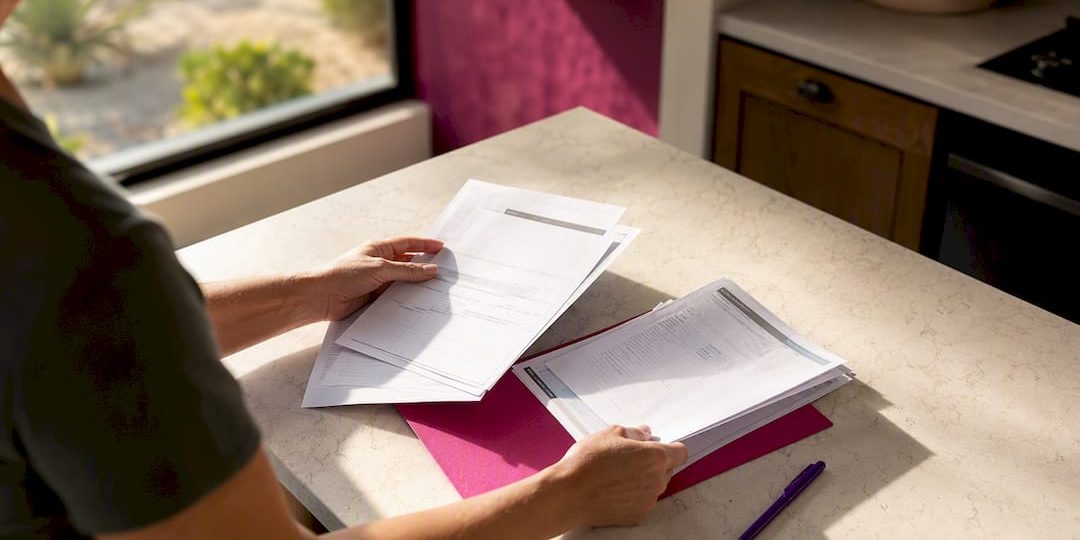
Stop Losing SRP HVAC Rebates: Arizona Homeowners’ Paperwork Checklist
Arizona homeowners can claim SRP Cool Cash rebates on qualifying air conditioners and heat pumps and get incentives through SRP’s BYOT smart thermostat program right now. The urgent part is paperwork: gather your contractor-signed invoice, the AHRI reference number, and a Manual J calculation if you installed a single-stage system, then submit through the SRP Rebate Center within the required submission window after installation.
TL;DR:
- Most SRP rebates depend on proper documentation, including a complete AHRI reference number, signed contractor form, and Manual J calculation when needed.
- Applying early with correct paperwork and verifying AHRI details on-site helps prevent application rejections and ensures timely payment.
- The rebate amount correlates with system efficiency, with variable-capacity units earning significantly higher payouts than single-stage systems.
- For a smooth process, homeowners should work only with licensed contractors experienced in SRP programs who prepare all required forms upfront.
- SRP rebates can reduce federal tax credits, so homeowners should consult a tax professional to account for rebates as purchase-price adjustments.
Table of Contents
- What SRP HVAC rebates are available and how much do they pay?
- Who qualifies for SRP AC rebates and what paperwork do you need?
- How do you apply for an SRP HVAC rebate step by step?
- Do SRP rebates reduce your federal tax credit?
- What mistakes cause SRP rebate denials?
- How does Tru Comfort help with SRP-compliant HVAC installs?
- What actually matters most with SRP rebates
- Get help with your SRP rebate paperwork
- Sources
What SRP HVAC rebates are available and how much do they pay?
SRP Cool Cash rewards you for installing higher-efficiency cooling equipment, and the payout scales with how efficient your compressor is. A basic single-stage system earns a smaller per-ton rebate, while variable-capacity and inverter-driven mini-split systems earn considerably more because they use less electricity to deliver the same cooling.
Rough example: a 3-ton single-stage system pays out at the lower band, while a 3-ton variable-capacity system multiplies that per-ton rate several times over. SRP caps the program at multiple qualifying cooling-system rebates per customer account, so multi-unit properties still have room to claim more than one upgrade.
Beyond Cool Cash, a few other incentives matter for Arizona hvac rebates planning:
- SRP Cool Cash: per-ton rebate bands ranging roughly from $75/ton for single-stage compressors up to $225/ton for variable-capacity or inverter-driven mini-split systems.
- SRP BYOT (Bring Your Own Thermostat): a $50 enrollment bonus per eligible smart thermostat, up to two thermostats per home, plus an annual bill credit for staying enrolled.
- SRP Marketplace: instant point-of-sale rebates on select smart thermostats, no separate rebate application needed.
- Duct testing and sealing incentives: available periodically; check current SRP program pages since these rotate on and off.
Who qualifies for SRP AC rebates and what paperwork do you need?
You need to be a permanent SRP residential electric customer, and the equipment has to go into an eligible dwelling on your SRP account, whether that’s a single-family home, a manufactured home, or certain multifamily units. Rental property owners and property managers can qualify too, as long as the unit is on an active SRP account.
The documentation is where most homeowners trip up, so treat this like a checklist your contractor has to complete before they leave your driveway:
- A paid, itemized invoice showing the installation date, equipment model numbers, and a zero balance or “paid in full” notation.
- The AHRI reference number for the combined system, not just the individual indoor or outdoor unit numbers.
- A signed Contractor Terms and Conditions form, confirming your installer is licensed in Arizona and agrees to SRP’s program requirements.
- A Manual J load calculation, required specifically for single-stage system installations to confirm the equipment is properly sized for your home.
- Submission within six months of the installation date; SRP does not make exceptions for late applications.
Your contractor needs an active Arizona ROC license, and SRP reserves the right to inspect the installation before or after paying the rebate. Keep copies of everything for at least a couple of years in case SRP follows up.
Pro Tip: Ask your contractor for the downloadable Cool Cash checklist and Contractor Terms form before installation day, not after. Handing it to them in advance means they know exactly what SRP expects and won’t leave the job site without signing it.
How do you apply for an SRP HVAC rebate step by step?
Most homeowners apply online, and it’s the faster route if your paperwork is already in order.
- Create an account in the SRP Rebate Center and enter your SRP account number.
- Enter the equipment model numbers and the AHRI reference number for the installed system.
- Upload the installation date, the signed Contractor Terms form, and your paid, itemized invoice.
- Upload the Manual J calculation if you installed a single-stage system.
- Double check that your AHRI listing matches the actual installed equipment before you hit submit.
If you’d rather mail it in, send the same documents (paid invoice, signed contractor form, Manual J if applicable) to SRP’s rebate processing address, which is listed on the current Cool Cash program page. Either way, SRP checks the application against equipment eligibility, contractor credentials, and your paperwork, and there’s no fixed turnaround time. Some applications get flagged for inspection.
If SRP asks for something you don’t have, go back to your contractor immediately. Most missing details, like an AHRI number that only covers one component instead of the full system, are easy fixes if you catch them fast. Waiting too long risks blowing past the six-month window.
If you bought a smart thermostat through SRP Marketplace, install and connect it within 60 days of shipping to keep your BYOT enrollment bonus intact. Miss that window and SRP can claw the bonus back.
Do SRP rebates reduce your federal tax credit?
Yes, and this trips people up every filing season. When you calculate the federal Section 25C energy-efficient home improvement credit, which covers a portion of costs up to program caps (the caps differ for heat pumps versus central air systems), you generally subtract your SRP rebate from the equipment cost first.
IRS guidance treats many utility rebates as a purchase-price adjustment rather than taxable income, which is good news, but the exact treatment can depend on your situation. Talk to a tax professional before you file. If you’re hunting for other Arizona incentives beyond SRP and the federal credit, ResilientAZ’s incentive hub and the DSIRE database both aggregate state and local programs worth checking.
What mistakes cause SRP rebate denials?
Most denials trace back to paperwork gaps that were completely avoidable on installation day.
- An AHRI number that covers only the outdoor unit instead of the full matched system.
- A Contractor Terms form that never got signed before the crew left.
- An invoice missing the “paid in full” notation or showing an outstanding balance.
- No Manual J on file for a single-stage system, or sizing that falls outside the 15% tolerance SRP allows.
- Refrigerant charge or static pressure readings the installer never documented or certified.
Pro Tip: Before your installer packs up, walk through the paperwork with them on-site. Confirm the AHRI number in the official AHRI directory yourself rather than trusting a printed model sheet. It takes five minutes and it’s the single best way to avoid a rejected application.
How does Tru Comfort help with SRP-compliant HVAC installs?
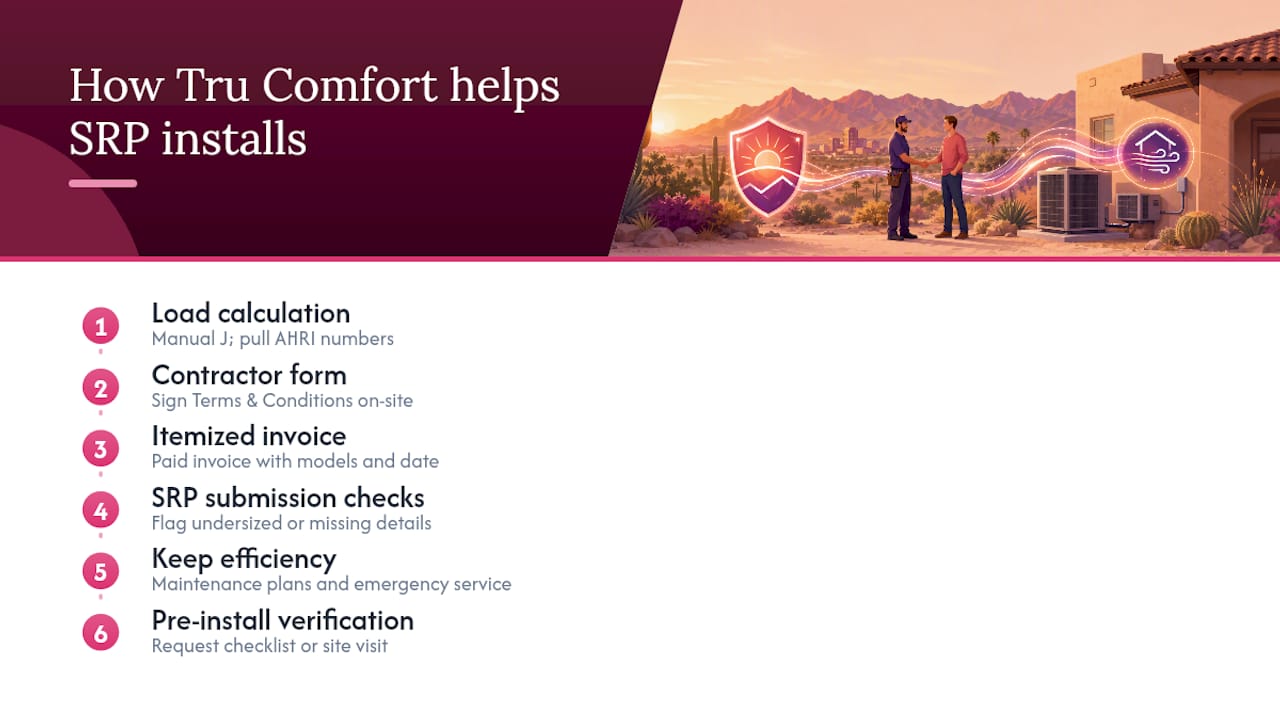
Trucomfortaz’s NATE-certified technicians handle the Manual J load calculation on every single-stage installation and pull the correct AHRI reference numbers before the job is even finished, so you’re not scrambling for documentation after the fact. The team signs the Contractor Terms and Conditions form on-site and hands you a paid, itemized invoice with every detail SRP requires, including model numbers and installation date.
Because Trucomfortaz works in New River and the surrounding Arizona communities regularly, the crew knows the SRP submission timeline and flags issues, like an undersized system or a missing detail, before they become a denied application. Ongoing maintenance plans and emergency service availability also help keep your new system running at the efficiency level that earned the rebate in the first place.
If you’re planning an upgrade, ask for a pre-install paperwork checklist or schedule a site visit through Tru Comfort’s air conditioner services page to confirm your rebate eligibility before work begins.
What actually matters most with SRP rebates
The rebate amount gets all the attention, but it’s rarely what determines whether a homeowner actually gets paid. The bigger risk is a paperwork gap that surfaces three months after installation, when the contractor who did the job is hard to reach and the six-month clock is ticking.
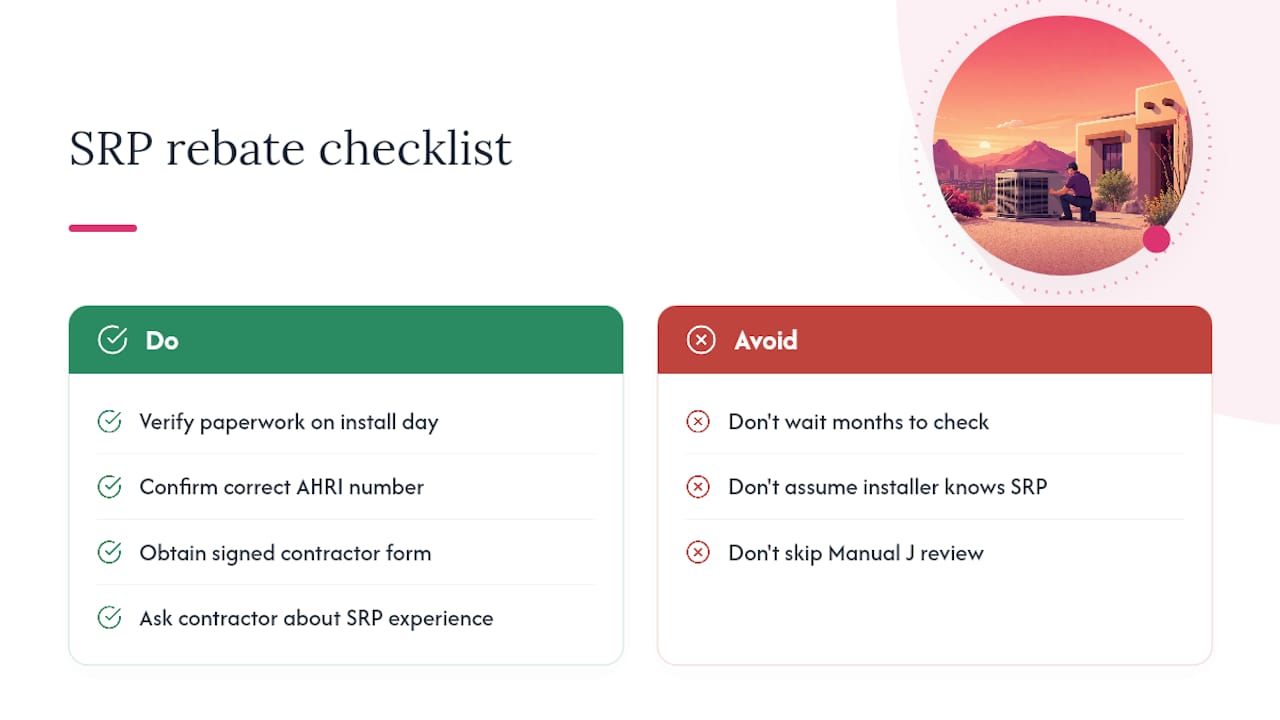
Conventional advice treats SRP rebates like a simple discount you apply for after the fact. That undersells how much the outcome depends on choices made before a single wire gets connected, starting with which contractor you hire and whether they treat the AHRI number and Manual J as routine paperwork or an afterthought. Homeowners who ask contractors upfront about SRP experience, rather than assuming any licensed installer can handle it, tend to avoid the denial letters entirely.
If you take one thing from this: verify the paperwork on installation day, not after. A signed contractor form and a correct AHRI number cost nothing to check on the spot. They cost real money to fix later, or worse, they cost you the rebate entirely.
Get help with your SRP rebate paperwork
Trucomfortaz handles the part of the SRP rebate process that trips up most homeowners: the paperwork. Every installation comes with a Manual J calculation when required, a correctly matched AHRI reference number, and a signed Contractor Terms form ready to submit, so you’re not chasing your installer for missing documents after the six-month clock starts.
Alt text: Tru Comfort technician reviewing rebate paperwork with homeowner
If your current system is aging out or you’re planning a replacement before summer, find out what a compliant installation looks like and how long it takes with existing ductwork already in place. Ask for a pre-install checklist when you schedule your estimate, and you’ll walk into the SRP application with everything you need already in hand.
Sources
- Air conditioner (AC) rebates | SRP
- EnergyStar: heating and cooling savings and federal tax credit info
- Home energy upgrade incentives | ResilientAZ
Recommended
- How Often Should Home AC Systems Be Maintained In New River and Anthem, AZ?
- How Often Should You Perform Routine Maintenance On Your AC in Anthem and New River, AZ?
- Ten Signs Your Home AC Unit May Need Maintenance | Tru Comfort
- Why Winter Is a Great Time for Regular AC Maintenance in New River and Phoenix