Beat 100°F with Garage Cooling: Seal First, Then Mini Split in Arizona
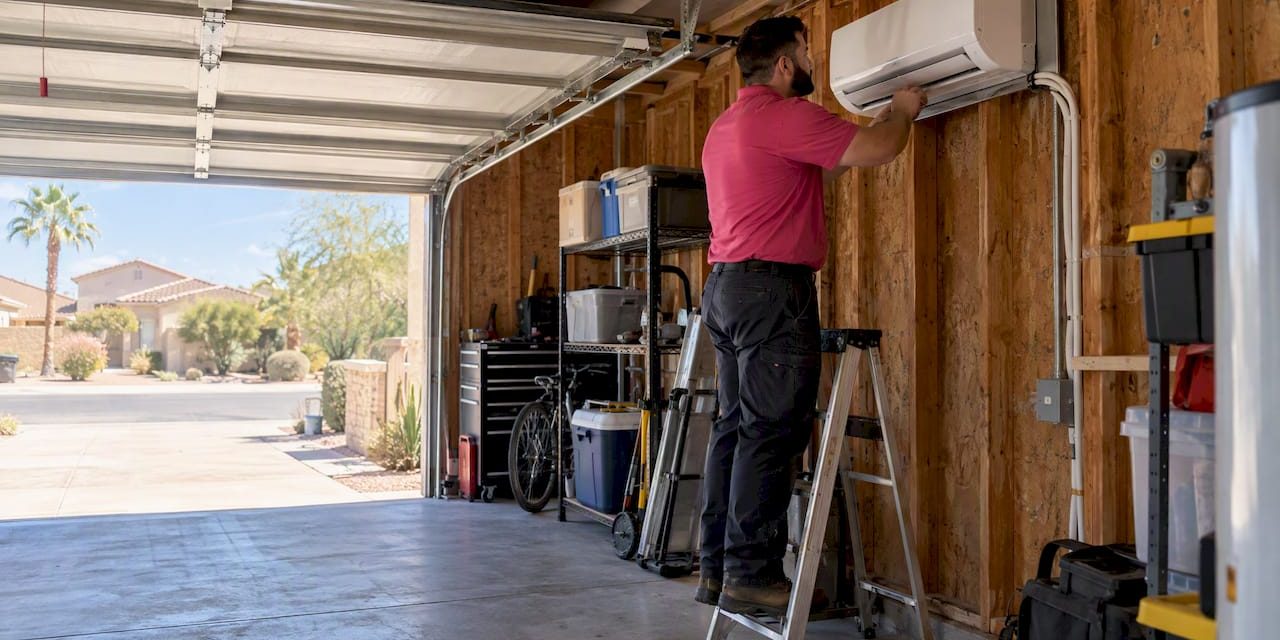
Seal and insulate your garage first, then add refrigerant-based zone cooling such as a properly sized mini-split for the heat that remains. This order matters because the National Weather Service shows Phoenix routinely experiences temperatures reaching 100°F by early May, and an unsealed, uninsulated garage can climb to temperatures well above outdoor levels before any cooling equipment even turns on.
TL;DR:
- Sealing and insulating the garage are crucial first steps, as unsealed spaces can reach much higher temperatures before cooling systems activate.
- A correctly sized ductless mini-split offers the most reliable humidity and temperature control for enclosed garages, especially in hot Arizona climates.
- Ventilation and radiant barriers can reduce peak garage temperatures but do not replace the need for proper sealing, insulation, and mechanical cooling.
- Avoid using evaporative coolers in enclosed garages because added moisture can cause rust, corrosion, and damage to stored items during humid or monsoon seasons.
- Proper load calculation and electrical assessment are essential before installing a mini-split, preventing oversizing and ensuring optimal performance.
Table of Contents
- Garage cooling options at a glance
- How to improve insulation, air sealing, and garage door performance
- Ventilation and passive cooling steps that lower peak heat
- Mini-splits, portable AC, and extending your home system
- Why swamp coolers usually struggle in an enclosed garage
- Low-cost steps you can take today
- How to choose and size the right cooling solution
- What garage cooling costs and how long it takes in Arizona
- What a local HVAC provider recommends for garage heat
- How we can help with garage cooling in New River and Anthem
- FAQ
- Sources
Garage cooling options at a glance
Not every garage needs the same fix. A storage space, a workshop, and a converted home office all have different tolerances for heat, humidity, and dust, so matching the option to the use case saves money and frustration.
- Envelope improvements (air sealing, insulation, door upgrades): the highest long-term payoff and the step every other option depends on.
- Ventilation and exhaust fans: cut peak temperatures and refresh stale air, best paired with sealing rather than used alone.
- Ductless mini-split: the most reliable choice for an enclosed garage that needs steady temperature and humidity control.
- Portable or window AC: a reasonable short-term or occasional-use fix, though less efficient once the space gets large or poorly sealed.
- Evaporative (swamp) cooler: usually a poor match for an enclosed garage because it adds moisture rather than removing it.
- Fans and shading: cheap, immediate relief while you plan bigger upgrades.
Garages used mainly for storage can often get by with sealing, insulation, and a vent fan. A workshop where you spend hours sanding, soldering, or working on a vehicle benefits from a mini-split. A garage being converted into a home office or casita needs the full envelope treatment plus a correctly sized mechanical system, since comfort and humidity control both matter there.
How to improve insulation, air sealing, and garage door performance
Sealing comes before insulating. ENERGY STAR’s efficiency guidance is clear that air sealing should happen first, because insulation only slows heat transfer through solid surfaces. It does nothing to stop air leaking through gaps, and a garage has plenty of them.
- Find and seal the leaks. Common culprits are band joists, top plates where walls meet the ceiling, and penetrations for wiring, plumbing, or vents. Caulk handles small gaps, spray foam fills irregular openings, and rigid foam blocking works well in joist cavities.
- Insulate the ceiling and walls. Batts are the easiest DIY option, blown-in cellulose fills odd spaces well, and spray foam offers the best air-seal-plus-insulation combination for a garage ceiling under a hot attic. For Arizona’s climate, more insulation in the ceiling pays off faster than in the walls, since radiant heat from the roof is usually the biggest driver of garage temperature.
- Upgrade the garage door. An insulated door, a new threshold seal, fresh weatherstripping around the perimeter, and a reflective film on the door’s interior face all reduce heat gain from the biggest uninsulated surface in most garages. The guidance on winterizing doors from door and entry specialists applies just as well to blocking summer heat as winter cold, since the same seals and weatherstripping do both jobs.
- Call in a pro for diagnostics when the gains are unclear. A contractor can run a blower-door test to find leaks you cannot see or feel, and this is especially useful for an attached garage where air leakage into the living space is a safety concern, not just a comfort one.
Pro Tip: Seal the garage-to-house door and its threshold with the same care you’d give an exterior door. It’s often the single leakiest point in an attached garage.
Ventilation and passive cooling steps that lower peak heat
An exhaust fan vents hot air out and pulls cooler outside air in, which can knock several degrees off a garage’s peak temperature during the day. The catch is placement: a fan that’s too close to the garage-to-house door can pull air from inside your home instead of from outside, undoing your sealing work in the process.
- Attic ventilation matters for attached garages because a hot, poorly vented attic radiates heat straight into the garage ceiling below it.
- Seal the attic access panel and any shared framing before adding ventilation, since ventilation without sealing just moves hot air around instead of removing it.
- Radiant barriers installed on the underside of the roof deck or the inside of the garage door reflect a meaningful share of solar heat before it ever becomes warm air inside the space.
- Size exhaust fans to the room, not to whatever unit is on sale, and position intake and exhaust points on opposite sides of the garage to create real airflow rather than a dead spot.
Done right, ventilation and radiant barriers are a low-cost complement to sealing and insulation, not a replacement for either. They shave peaks off the hottest hours but won’t hold a garage at a comfortable temperature all afternoon on their own.
Mini-splits, portable AC, and extending your home system
Once the envelope is tightened up, mechanical cooling is what actually makes a garage usable during an Arizona summer. The three realistic options are a ductless mini-split, a portable or window unit, or extending your home’s central air into the garage, and they are not interchangeable.
Ductless mini-splits are the preferred option for most enclosed Arizona garages. They cool and dehumidify in one pass, they let you control the garage as its own zone without touching your home’s thermostat, and they avoid the duct losses that come with extending central air. A Building America case study on supplemental ductless heat pumps found that a correctly sized, correctly installed mini-split can cool an isolated zone efficiently, but that sizing and installation quality drive the results more than the equipment itself.
- Zone control: the garage runs on its own schedule, independent of the house.
- Dehumidification: important for tools, electronics, and anything stored long-term.
- Efficiency: no ductwork means no duct losses, which matters in a space that isn’t part of the home’s existing duct run.
Portable and window units make sense for occasional use, a small storage garage, or a tight budget. They’re cheaper to buy and need no permanent installation, but they struggle in larger garages, leak conditioned air around their mounting points, and run less efficiently than a properly matched mini-split over a full summer.
Extending your home’s central AC into the garage sounds convenient but usually creates problems: duct losses over the extra run, humidity imbalances between the garage and the house, and a thermostat that now has to satisfy two very different spaces at once. For most attached garages, this ends up less effective and more expensive to fix later than installing a dedicated zone system.
Whichever route you choose, sizing is the detail that makes or breaks performance. A load calculation, often called a Manual J calculation in the trade, accounts for your garage’s square footage, insulation level, door type, and sun exposure to recommend the right capacity. Oversizing is a common mistake homeowners push for, since bigger sounds safer, but an oversized mini-split short-cycles, cools unevenly, and does a worse job controlling humidity than a correctly sized one.
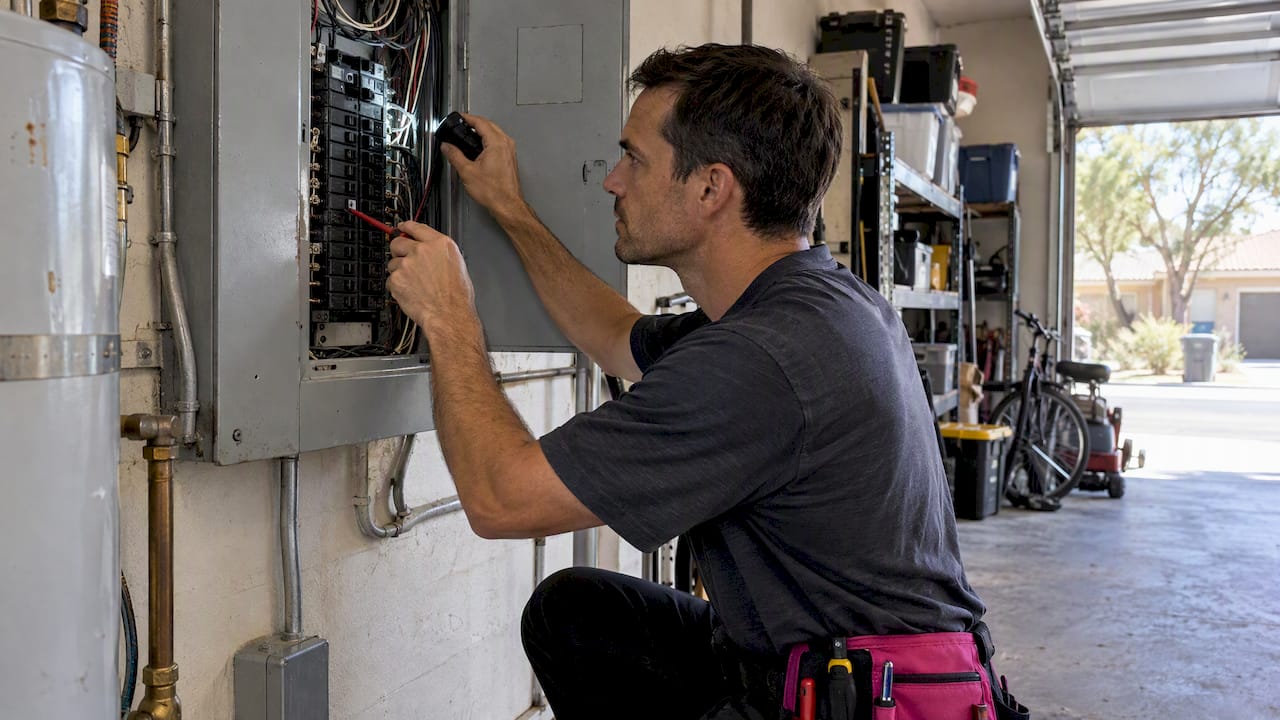
Pro Tip: Ask any installer to show you their load calculation, not just a quoted tonnage. A number pulled from square footage alone usually misses your insulation and door type. Electrical capacity is the other detail to check before you commit: a mini-split needs a dedicated circuit, and older garages often need a panel evaluation before installation day.
Why swamp coolers usually struggle in an enclosed garage
Evaporative cooling works by pulling air through water-soaked pads, and that process adds humidity as it cools. In an open workshop or a covered outdoor space, that trade-off is fine. In an enclosed garage, the added moisture has nowhere to go, and the University of Arizona Cooperative Extension notes that evaporative cooling can be unsuitable for enclosed spaces where that extra humidity damages tools and stored items.
- Monsoon season undercuts performance further, since evaporative cooling depends on dry air and loses effectiveness as outdoor humidity climbs.
- Metal tools rust faster, electronics are more prone to corrosion, and vehicles parked for long stretches can develop moisture-related issues in a humid, enclosed garage.
- Refrigerant-based cooling avoids this trade-off entirely, since it removes humidity as part of the cooling process rather than adding to it.
Evaporative cooling can work well outdoors or in a large, well-ventilated workshop with airflow to the outside. For a sealed, enclosed garage, a mini-split’s humidity control protects stored materials in a way an evaporative system simply cannot.
Low-cost steps you can take today
Before any contractor shows up, a handful of cheap changes make a real difference while you plan bigger work.
- Position fans correctly. An exhaust fan near the ceiling pulls hot air out, while a circulating fan at working height keeps air moving across your body, and you often want both rather than one fan trying to do both jobs.
- Add shade outside. A roll-up shade, awning, or even a shade sail over south- and west-facing doors and windows blocks direct sun before it ever hits the building.
- Seal the garage door. A new threshold seal, fresh weatherstripping, and a reflective film on the door’s interior face cost little and cut radiant heat gain noticeably.
- Protect what you store. Move anything heat-sensitive, like paint, electronics, or certain tools, off the garage floor and away from the door, since that’s where temperature swings are most extreme.
These steps buy you comfort and protect your belongings while bigger projects like sealing, insulation, or a mini-split installation get scheduled.
How to choose and size the right cooling solution
Start with how you actually use the garage. Pure storage rarely needs more than sealing, insulation, and a vent fan. A workshop or a living conversion justifies a dedicated mini-split. From there, a short checklist keeps any contractor proposal honest.
- Ask for a load calculation, not a tonnage estimate based on square footage alone.
- Confirm the electrical plan, including whether a dedicated circuit or panel upgrade is needed.
- Check for a condensation and drainage plan, since mini-splits produce condensate that needs somewhere to go.
- Ask how the install will separate the garage from the house, especially around shared walls or the connecting door.
- Get the efficiency rating and warranty in writing, along with what’s included in ongoing maintenance.
Watch for red flags: a contractor who skips the load calculation, pushes you toward oversizing “just to be safe,” or never mentions air sealing is leaving out work that determines whether the system you’re paying for will actually perform.
What garage cooling costs and how long it takes in Arizona
Costs vary by garage size, condition, and how much electrical work is involved, so get a few quotes before committing to any single path.
- Sealing and insulation are typically the most affordable upgrades and the fastest to schedule, often completed in a day or two.
- Exhaust fan installation adds modest cost on top of sealing work and can usually be done in the same visit.
- Mini-split installation costs more upfront but delivers the most dependable long-term comfort and humidity control, and scheduling depends on permitting and any electrical panel work needed first.
- Portable AC units have the lowest upfront cost since there’s no installation, but they carry higher ongoing operating costs during long stretches of extreme heat.
Permit requirements and electrical panel capacity are the two factors most likely to extend a project timeline in Arizona, so ask about both before you set expectations on scheduling.
What a local HVAC provider recommends for garage heat
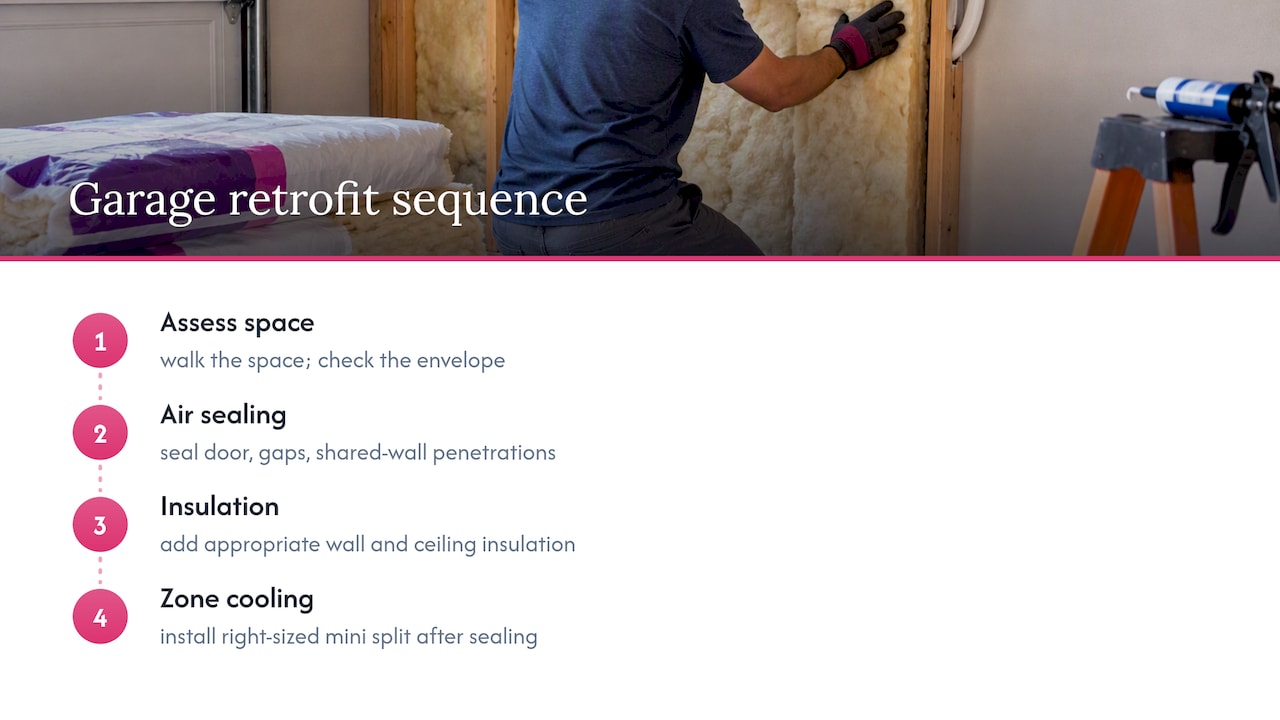
Our order of operations never changes: air sealing first, insulation second, zone cooling third. Skipping straight to equipment is the most common mistake we see, and it almost always means paying for a bigger, more expensive system than the garage actually needs once it’s sealed properly.
We also pay close attention to how a garage connects to the house. An attached garage with an unsealed door or shared wall can pull dust, exhaust fumes, or excess heat into living spaces, and that’s a safety issue as much as a comfort one. Before recommending equipment, we walk the space, check the envelope, and talk through how the garage is actually used day to day.
How we can help with garage cooling in New River and Anthem
We handle the parts of this process that need a licensed hand: diagnosing why a garage runs hot, sizing a mini-split correctly, and installing it so it performs well for years. A diagnostic visit includes a load check for the space, a quick air-seal review of obvious problem spots, and an electrical assessment to help ensure a smooth installation.

If sealing and insulation are already done and you’re ready for dependable, humidity-controlled cooling, our team can size and install a mini-split built for your garage’s actual conditions, and our Tru Comfort Advantage maintenance plans keep it running efficiently through every Arizona summer after that. Request an estimate through our air conditioner installation and service page to get started.
FAQ
What is the best way to cool a garage in the summer?
Seal air leaks and add insulation first, since this reduces the heat load before any equipment has to work against it. For an enclosed garage, a properly sized ductless mini-split is the most reliable follow-up because it controls both temperature and humidity.
Does cracking the garage door help with heat in Arizona?
Cracking the door lets some hot air escape, but it also lets in more hot outside air during peak afternoon heat, so the net benefit is small. A sealed door paired with proper ventilation or mechanical cooling works far better than leaving it partly open.
How hot does a garage get in 100 degree weather?
An unsealed, uninsulated garage can run well above the outdoor temperature on a 100°F day, since the National Weather Service notes Phoenix regularly experiences afternoon highs between 105°F and 112°F during extreme heat, and a garage with poor insulation traps that heat further. Sealing, insulation, and shading all reduce how far above outdoor temperatures a garage climbs.
Where to live in Arizona that is not too hot?
Higher-elevation areas like Flagstaff or Prescott run noticeably cooler than the Phoenix valley, while valley communities including Phoenix, New River, and Anthem see the longest stretch of 100°F-plus days each year. Wherever you live in the valley, a well-sealed and properly cooled garage matters more given that extended heat season.
How much does it cost to install a mini-split in a garage?
Mini-split installation costs depend on garage size, electrical work needed, and labor, so getting a quote based on a proper load calculation is the only way to get an accurate number for your space. Our team can provide a personalized estimate through our air conditioner services page.
Sources
- Historical Extreme Temperatures in Phoenix, Yuma, and El Centro
- A Guide to Energy-Efficient Heating and Cooling (ENERGY STAR)
- Evaporative cooling in semi-arid climates (University of Arizona Cooperative Extension)
- Garage-to-house air leakage and mitigation (Building America / DOE)