Zoned HVAC Not Working? 5 Homeowner Checks Before Pros Measure ESP/CFM
A zone that will not heat or cool usually traces back to one of three things: a stuck or failed damper, a thermostat or control fault, or an airflow restriction like a dirty filter or blocked duct; understanding these issues starts with knowing what an HVAC zoning system is. Start by checking the thermostat’s mode and batteries, swapping the filter, and making sure the registers in that zone are open. If the zone still will not respond, shut the system down and call a professional for electrical or refrigerant diagnostics.
TL;DR:
- Most zone failures are caused by stuck dampers, control faults, or restricted airflow from dirty filters or blocked ducts.
- Checking thermostat settings, replacing filters, and ensuring registers are open can often resolve issues without professional help.
- Duct problems like undersized bypass ducts or leaks are a common cause of poor airflow in specific zones.
- Diagnosis should involve measuring static pressure, airflow, and temperature split before considering refrigerant or electrical faults.
- Regular maintenance, including filter changes and duct sealing, helps prevent zone failures and prolongs system lifespan.
Table of Contents
- Fast checklist to run before calling a technician
- Step-by-step troubleshooting for thermostats, dampers, and airflow
- Why airflow and duct problems cause single zones to fail
- Seasonal maintenance that prevents zoning failures
- When the problem needs a professional
- What a honest diagnosis actually looks like
- Get your zones checked before the problem spreads
- FAQ
- Sources
Fast checklist to run before calling a technician
Before you assume the worst, work through a few simple checks. Most single-zone failures come down to something you can see or hear within a few minutes.
- Confirm the thermostat for that zone is set to the right mode (heat, cool, or auto) and the correct setpoint.
- Pull the filter and check it; replace it if it is gray, clogged, or overdue, and open every supply register in the affected zone.
- Swap the thermostat batteries and reboot or reset the control if the display is frozen or blank.
- Listen and look at the air handler when the zone calls for conditioning: a working damper should click or hum as it opens.
- For cooling complaints, check that the outdoor condensing unit is actually running when the system calls for cool.
If none of these change anything, you are likely dealing with a mechanical or electrical fault rather than a setting.
Step-by-step troubleshooting for thermostats, dampers, and airflow
Work through these checks in order. Each one rules out a cause before you move to something more involved.
- Thermostat and controls. Confirm the zone thermostat has power and is wired correctly, swap batteries if it runs on them, and check that the zone panel recognizes that thermostat in its configuration. Do not open the main control board housing unless you know exactly what you are looking at.
- Zone dampers and actuators. A damper that never moves and makes no sound when the zone calls for air usually has a failed actuator. You can sometimes check a damper manually by locating it on the duct near the air handler and confirming it rotates when power is applied, but actuator replacement is typically a job for a technician.
- Blower, filters, and registers. A clogged filter, blocked return, or crimped flex duct will starve a zone of air even when everything electrical is working. Check the filter, verify the blower is running at the expected fan speed, and look for kinks in flexible ductwork near the affected zone.
- Bypass damper behavior. If other zones seem to over-deliver air while the active zone runs weak, the bypass duct may be short-circuiting supply air back to the return before it reaches the room. ACCA’s guidance on zoned airflow notes that a bypass duct needs a manually adjustable hand damper to create the right pressure drop; without one, it can siphon away the air your active zone needs.
- Refrigerant and coil symptoms. If the unit runs constantly but the zone never cools, or you notice frost on the indoor coil, the problem may be a refrigerant issue or reduced airflow across the coil rather than a zoning fault at all. These require gauges and training to diagnose safely.
- Electrical and control board issues. Check for a blown fuse or tripped breaker feeding the air handler or zone panel, and look for obviously loose wiring at accessible connections. Stop there. Live electrical diagnosis inside a control board is not a DIY job.
Pro Tip: If a single zone runs weak while every other zone feels fine, test it with all other zone dampers closed. If airflow suddenly improves, the bypass duct is very likely stealing air from that zone.
Distinguishing an airflow problem from a refrigerant problem matters because treating the wrong one wastes money. Building America’s diagnostic guidance points out that technicians measure temperature split and airflow before touching refrigerant charge, because low airflow alone can mimic a charge problem. A homeowner can narrow the possibilities, but confirming refrigerant charge requires manifold gauges and training you likely do not have at home.
Why airflow and duct problems cause single zones to fail
A zone that starves for air is often a duct problem, not a damper problem. When a bypass duct is undersized, too short, or missing its own hand damper, it becomes the path of least resistance. Air that should push through the active zone’s branch instead slides back through the bypass and returns to the blower, leaving the room short on supply.
- Feel along accessible duct runs for crimped or crushed flex duct near the affected zone.
- Check return grilles for furniture, rugs, or debris blocking airflow back to the system.
- Look at the bypass duct itself, if visible, for a hand damper that is wide open or missing entirely.
A technician confirms these suspicions with instruments: external static pressure (ESP), airflow in cubic feet per minute (CFM), and temperature split across the coil. Building America’s measure guide notes that field technicians check static pressure and register airflow first, and that airflow below roughly a moderate threshold per ton means the system needs duct repair or balancing before any refrigerant adjustment can be trusted. If you suspect leaky ducts are part of the problem, a duct leakage test will quantify how much conditioned air you are losing before it reaches the room.
Seasonal maintenance that prevents zoning failures
Most zone failures are preventable with a few habits. Dirty filters raise static pressure throughout the system, which quietly reduces airflow to every zone, not just the one that eventually fails loudest.
- Check filters monthly and replace them on the schedule your system calls for, typically every 1 to 3 months.
- Have a technician test thermostat batteries, actuator function, and bypass damper settings each spring and fall, alongside coil cleaning.
- Reserve manual bypass adjustments for minor balancing; a full professional balance is the better call when multiple zones feel off.
- Ask any contractor quoting new zoning whether the design followed Manual J and Manual D load and duct calculations, since skipping that step is a common root cause of recurring problems.
ENERGY STAR’s maintenance checklist backs this up directly: filter changes, seasonal checkups, and duct sealing reduce failures and keep airflow where it belongs. A simple seasonal schedule makes it easier to stay ahead of these issues instead of reacting to a dead zone.
When the problem needs a professional
Some symptoms are not worth troubleshooting further on your own. Call a technician when you notice any of these.
- A damper that shows no movement or sound at all when the zone calls for air.
- Any burning smell, scorch marks, or visible wire damage near the control board or air handler.
- A frozen indoor coil, a fan motor that hums but will not spin, or a zone that runs nonstop without ever reaching setpoint.
A technician’s visit typically includes ESP and CFM measurement, a temperature split check, refrigerant pressure readings, and a bench test of the suspect damper actuator. Before the appointment, note your thermostat model, snap photos of the zone control panel and damper assembly if accessible, and write down when the problem started and what maintenance the system has had. That groundwork helps the technician get to an answer faster, and gives you a clearer sense of whether you are looking at a repair or a bigger line-item fix.
What a honest diagnosis actually looks like
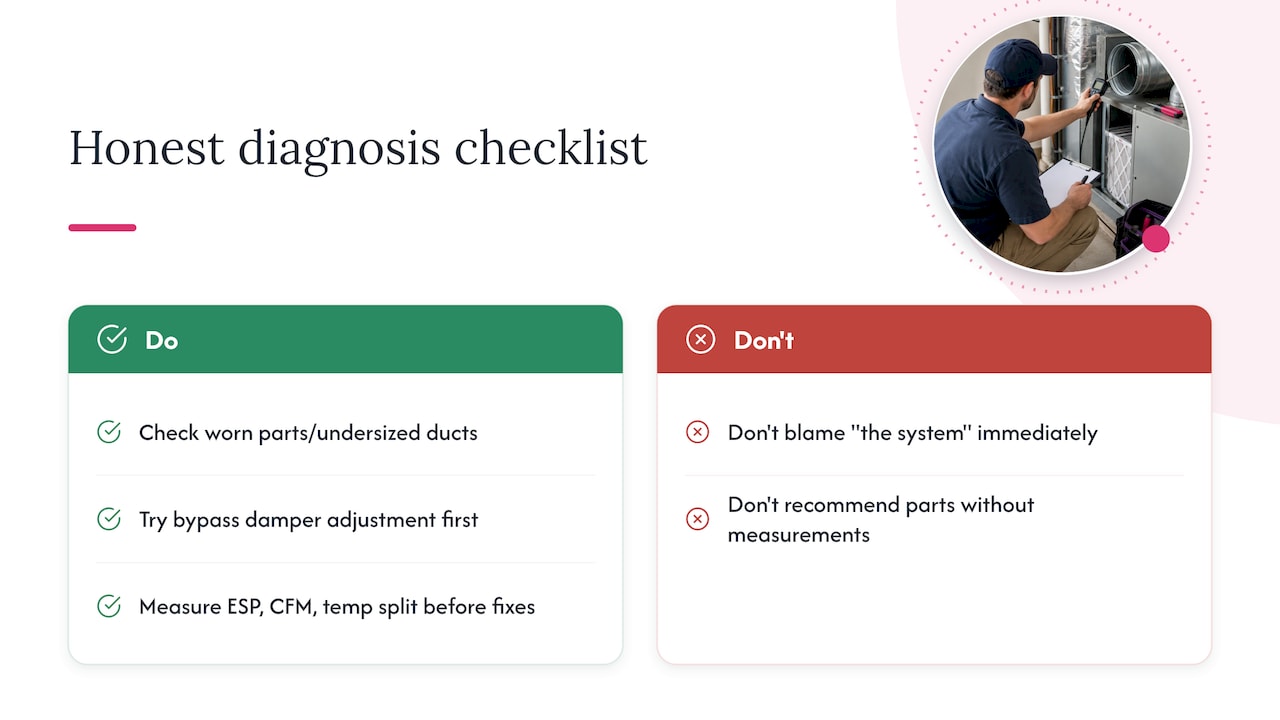
Most zoning complaints get blamed on “the system” when the real cause is one worn part or one undersized duct. Homeowners underestimate how often a $30 bypass damper adjustment solves a problem that looks like it needs a new control board. The gap between what zoning promises (even comfort, zone by zone) and what it delivers almost always comes down to installation details that nobody checked at commissioning.
This HVAC provider employs technicians who perform diagnoses based on system measurements rather than sales incentives. That means running the same ESP, CFM, and temperature split checks described above before recommending any part replacement.
Get your zones checked before the problem spreads
A single dead zone rarely stays isolated. The strain it puts on the rest of the system, through a stuck bypass damper or rising static pressure, tends to show up elsewhere within a season or two. Booking a diagnostic visit now costs less than letting a bad actuator or leaky duct run until something bigger fails.

Technicians measure airflow and temperature split on every call rather than guessing at replacement parts, applying this careful approach whether the fix is a repair or new ductwork. If your zone problem is on the cooling side, start with AC repair and maintenance services. For heating zones, see furnace repair in New River, Arizona. Homeowners who want to stop chasing zone failures season after season can also look into the Tru Comfort Advantage maintenance plan to catch small faults before they become dead zones.
FAQ
Why is one zone of my air conditioning not working?
The most common causes are a stuck or failed zone damper, a thermostat or control fault for that zone, or restricted airflow from a dirty filter or blocked duct. A bypass duct without its own balancing damper can also pull air away from that zone, a problem ACCA’s zoning guidance addresses directly.
What is the $5,000 rule for HVAC?
This is not a standard figure used in professional HVAC diagnostics or industry guidance, and definitions of it vary widely online. Rather than relying on an informal rule, ask your technician to compare the actual repair estimate against the cost and expected lifespan of a replacement system.
How long do zone dampers last?
Published lifespan figures for zone dampers are not listed in manufacturer or industry guidance referenced here, so the honest answer is that it depends on usage, duct conditions, and actuator quality. A damper that stops responding, whether from age or a failed actuator, is a sign it needs inspection rather than a scheduled replacement.
What are some common problems with a zone HVAC system?
The most frequent issues are failed dampers or actuators, thermostat or control board faults, dirty filters raising static pressure, and bypass ducts that short-circuit airflow away from active zones. Building America’s diagnostic guide notes that airflow and refrigerant faults can produce similar symptoms, which is why proper diagnosis measures both rather than guessing.
Sources
- Managing Airflow In Zoned Applications – ACCA HVAC Blog
- Measure Guideline: Air Conditioner Diagnostics, Maintenance, and Replacement
- ENERGY STAR: Heating and cooling maintenance checklist