Homeowners: 5 HVAC UV Safety Checks to Require at Installation
Properly engineered UV-C systems, enclosed, interlocked, and sized by a professional, are safe and genuinely useful as a backup to good filtration. They are not a fix on their own. The real risks show up when homeowners skip professional design: direct eye and skin exposure, ozone from the wrong lamp type, and degraded duct components from unshielded UV.
TL;DR:
- Proper UV-C system design, including sealed and interlocked chambers, is essential to ensure safety and effectiveness; DIY or unprofessional installations pose serious risks.
- UV lights significantly improve coil hygiene and reduce mold or bacteria buildup, but they do not replace filtration for dust, pollen, or pet hair removal.
- Ozone generation can be prevented by choosing lamps filtered to block 185 nm wavelengths and verified with UL 1995 certification before installation.
- Maintenance costs mainly involve replacing lamps every 12 to 18 months, with professional radiometer testing recommended for high-priority systems; DIY replacement risks malfunction or safety issues.
- UV systems are most beneficial for homes with recurring coil mold problems, immunocompromised occupants, or low fresh-air exchange, rather than general dust or allergen concerns.
Table of Contents
- What Does UV Lights HVAC Safety Actually Depend On?
- What Benefits Do UV Lights Actually Deliver in Real Homes?
- What Are the Real Risks of Installing UV Lights?
- What Safety Standards Should Homeowners Demand at Installation?
- How Much Do Lamp Replacement and Upkeep Actually Cost?
- Is a UV Light Worth Installing in Your Home?
- How Tru Comfort Approaches UV Installations
- Ready for a Professional Assessment of Your System?
- Sources
What Does UV Lights HVAC Safety Actually Depend On?
Safety comes down to design, not the technology itself. UV-C light at 254 nanometers damages the DNA and RNA of bacteria, mold spores, and viruses, stopping them from reproducing. That mechanism is well established, but how a system is built around it determines whether it helps your air or just sits there burning electricity.
There are three common approaches, and they are not interchangeable:
- Coil-sanitizing lights mount near the evaporator coil and target surface growth, the slimy biofilm that builds up on cold, wet coils and drip pans.
- In-duct systems sit inside the ductwork and irradiate air as it passes through, aiming at airborne microbes rather than surfaces.
- Upper-room UVGI installs high on walls in occupied rooms, using louvered fixtures to treat air above head height while shielding people below.
- Far-UVC (222 nm) is a newer variant marketed as safer for direct exposure, but the EPA notes the evidence base is still thinner than for established 254 nm systems.
Dose matters as much as wavelength. Airflow speed, duct reflectivity, humidity, and how long air actually lingers in the irradiation zone all change how much UV exposure microbes get. A system rated for a slow-moving 12-inch duct won’t deliver the same dose in a fast 20 inch main trunk, which is exactly why generic, one-size kits underperform.
What Benefits Do UV Lights Actually Deliver in Real Homes?
The clearest, best-documented benefit is coil hygiene. UV-C light suppresses the mold and bacterial film that builds on evaporator coils, which cuts down on the moldy smell many AC systems develop and reduces the buildup that forces coils to work harder.
ETV verification testing on an in-duct system found single-pass inactivation efficiencies of 98% to 99.5% for the specific organisms tested under controlled lab conditions. That is a strong result, but it’s a single pass through a test duct, not a guarantee for how your whole house performs, since real homes rely on repeated recirculation rather than one clean pass.
Realistic benefits break down like this:
- Less microbial buildup on coils and drip pans, which can mean fewer service calls for coil cleaning.
- A modest, incremental reduction in airborne pathogens when UV works alongside solid filtration and adequate air exchange.
- Possible savings over time from avoiding the repairs that come with a neglected, biofouled coil.
What UV won’t do is remove dust, pet hair, or pollen. Those need a filter. If dust is your main complaint, a MERV upgrade paired with a maintenance plan solves that more directly than any UV lamp will.
What Are the Real Risks of Installing UV Lights?
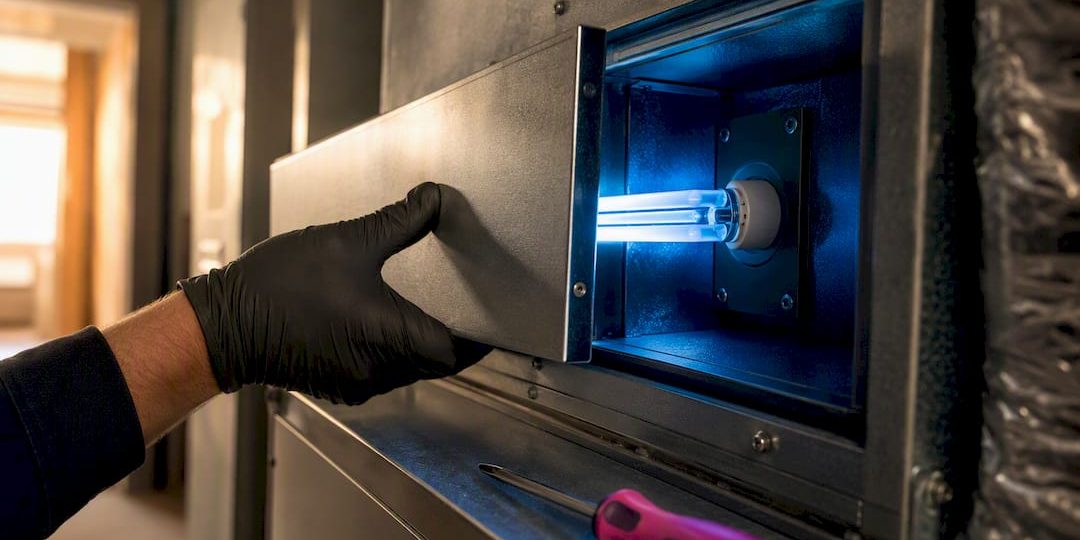
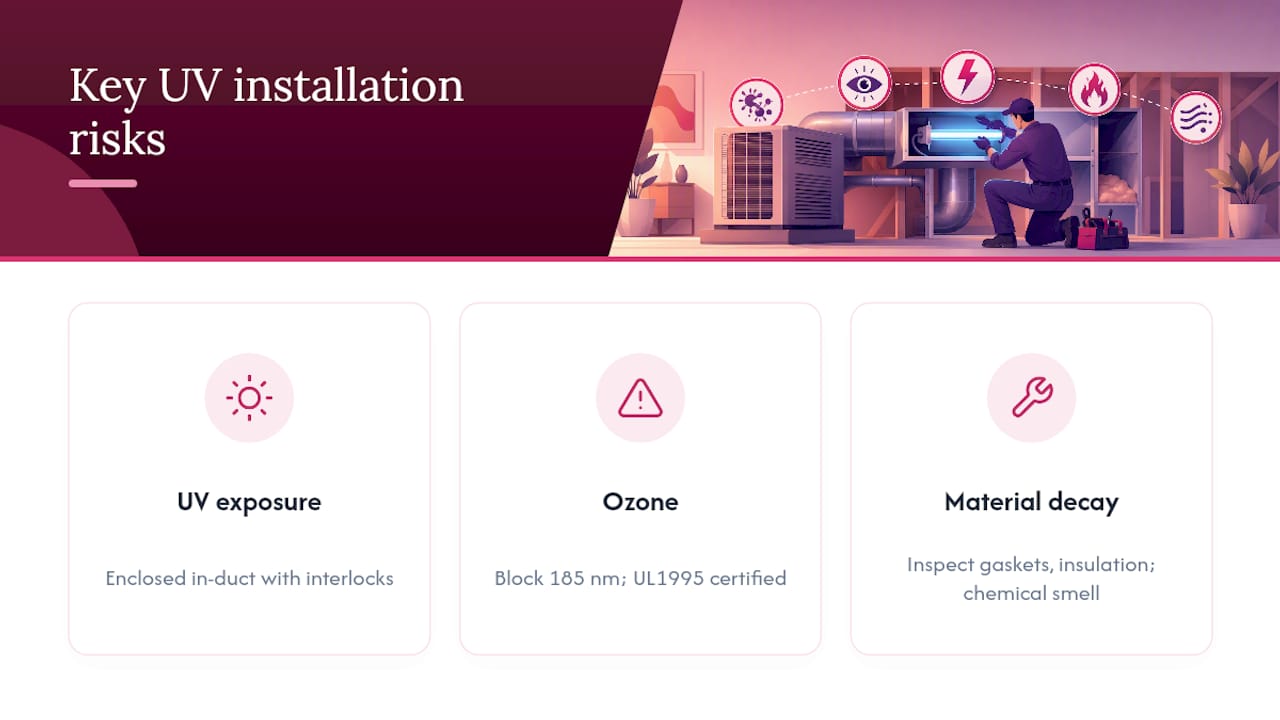
Direct exposure is the biggest hazard, and it’s not trivial. UV-C at 254 nm can cause photokeratitis (a painful, sunburn-like injury to the cornea) and skin erythema with even brief unshielded contact. Because UV-C causes no immediate stinging or blink reflex, people can be exposed without realizing it until hours later. Enclosed in-duct chambers with interlocked access panels solve this by keeping the lamp sealed away from anyone opening the unit.
Ozone is the second concern, and it’s avoidable if you buy the right lamp. Some UV lamps also emit at 185 nm, a wavelength that generates ozone, a lung irritant you do not want circulating through your supply registers. Look for lamps filtered to block 185 nm output or products carrying UL 1995 certification confirming ozone-free operation.
Third, UV-C degrades organic materials over time: rubber gaskets, wiring insulation, and synthetic filter media can crack or discolor when they sit too close to an unshielded lamp for years. Watch for brittle gaskets or a chemical smell near the unit during inspections.
Marketing claims deserve skepticism too.
Pro Tip: Ask any installer to show you the manufacturer’s data sheet for irradiance output and ozone certification before they mount anything inside your ductwork. If they can’t produce it, that’s your answer.
What Safety Standards Should Homeowners Demand at Installation?
A safe install isn’t guesswork, and you shouldn’t accept one that looks like it. ASHRAE guidance is blunt on this point: there is no universal UVGI design; every system needs calculations based on your specific airflow, velocity, temperature, humidity, and duct reflectivity to hit the correct dose.
Here’s what a professional installation should include:
- Sizing calculations matched to your actual duct dimensions and CFM, not a generic chart.
- A sealed lamp chamber with interlocks that cut power the instant an access panel opens.
- Locked or key-controlled switches, kept separate from ordinary room lighting, so no one flips a UV lamp on by accident.
- UL-certified equipment with documented manufacturer output specs.
- Radiometer readings at commissioning to confirm actual irradiance matches the design, a step ASHRAE’s handbook guidance treats as standard practice.
| Placement | Targets | Key trade-off |
|---|---|---|
| Coil-mounted | Surface biofilm on coil/drip pan | Doesn’t touch airborne particles passing through |
| In-duct, downstream of coil | Airborne microbes in moving air | Needs longer duct run for adequate dose |
| In-duct, upstream of coil | Pre-treats air before it hits the coil | Less common; depends on duct layout |
| Upper-room | Airborne pathogens in occupied space | Requires careful shielding and radiometer testing |
UV should never replace filtration. Insist it’s paired with a filter rated to catch what the lamp can’t touch.
How Much Do Lamp Replacement and Upkeep Actually Cost?
UV-C bulbs lose output well before they burn out. Most residential lamps see meaningful irradiance decay by 9,000 to 12,000 hours of runtime, even though the bulb might still glow. That’s usually somewhere between 12 and 18 months of continuous coil-light operation, depending on your system’s runtime.
A realistic maintenance routine includes:
- Annual (at minimum) visual inspection of interlocks, wiring, and lamp housing.
- Checking for a faint ozone smell or discoloration near the fixture, both early warning signs.
- Lamp and, when needed, ballast replacement on schedule rather than waiting for total failure.
- Periodic radiometer testing if the system serves a high-priority space or occupant.
This isn’t a DIY swap-the-bulb job. A NATE-certified technician knows how to verify irradiance, check interlocks safely, and catch material degradation before it becomes a bigger repair.
Is a UV Light Worth Installing in Your Home?
UV tends to pay off in specific situations, not universally. If your coil grows mold repeatedly despite regular cleaning, if someone in the household is immunocompromised, or if your home runs on low fresh-air exchange, a properly sized UV system adds real value.
It’s a lower priority if you already run high-MERV or HEPA-level filtration and your main complaint is dust or pollen. Filtration handles particulates; UV doesn’t.
Before signing anything, run through this checklist with your installer:
- What filtration level am I already running, and does UV actually add something here?
- What’s the expected maintenance schedule and lamp replacement cost over five years?
- Can you show me commissioning evidence, radiometer readings, dose calculations, not just a sales sheet?
- What warranty covers the lamp, ballast, and housing separately?
How Tru Comfort Approaches UV Installations
Trucomfortaz technicians walk every job the same way: inspect the coil, check actual airflow, assess the existing filter, then run the dosing math before recommending anything. Our NATE-certified techs work on non-commissioned pay, so the recommendation is based on your ducts, not a sales quota, and every install gets documented commissioning data.
Ready for a Professional Assessment of Your System?
If you’re weighing UV against a filter upgrade, or wondering whether your ductwork can even support an in-duct system, that’s exactly the kind of question a proper on-site assessment answers instead of guessing from a product box.
Trucomfortaz brings the same coil inspection, airflow check, and dose calculation described above to every New River area home, whether you’re adding UV to an existing system or planning it into a new install. When you request a quote, ask for the same things this guide covers: documented commissioning measurements, sealed and interlocked lamp housing, and a clear maintenance schedule, not just a lamp and a price. Our team also handles the surrounding work that makes UV worthwhile in the first place, from furnace installation to ongoing HVAC service plans that keep coils, filters, and lamps all performing together. Schedule an inspection through Tru Comfort’s HVAC services page and get a straight answer on whether UV makes sense for your ductwork.
Sources
- What upper-room ultraviolet germicidal irradiation (UVGI) is | EPA
- EPA ETV verification statement — American Ultraviolet DC24-6-120
- ASHRAE handbook excerpts on UV-C HVAC applications